There is a specific moment a lot of architecture graduates experience — usually about two years into their first job. The initial excitement of being in a real office, working on real projects, starts settling into something more practical. The question changes from "what do I want to design" to "where exactly is this career going?"
And for a growing number of architects in India right now, the answer to that second question involves BIM.
Not just using Revit. Not just modelling. The full coordination role — managing how a project's different systems talk to each other, catching clashes before they become construction problems, and sitting at the centre of a multi-disciplinary team as the person who holds the model together.
BIM Coordinator is the role that describes this. And for architects who want a career that is technically demanding, well-compensated, and increasingly essential at firms of every size — it is one of the clearest paths available in the Indian AEC market right now.
This guide covers everything: what the role actually involves day to day, how the salary compares, what skills you need to get there, how long it realistically takes, and what the path beyond coordinator looks like.
What Is a BIM Coordinator — Actually?
The job title exists on most AEC firm hiring portals but the description is often vague. Let's be specific.
A BIM coordinator is the professional responsible for managing the integrated model on a project — taking the separate discipline models (architectural, structural, MEP) and ensuring they work together without conflicts. They run clash detection, manage coordination meetings, maintain BIM standards across the team, and serve as the technical point of contact between architects, structural engineers, MEP consultants, and contractors.
If something goes wrong in a BIM workflow — a duct running through a structural beam, an architectural wall conflicting with a plumbing riser, a model that does not comply with the project's LOD requirements — the coordinator is the person who catches it, flags it, resolves it, and makes sure it does not happen again.
It is a role that sits between design and construction. Between technical and managerial. Between the screen and the site.
The distinction between a coordinator and a BIM manager is worth understanding early. A BIM coordinator manages the models and coordination process on a specific project. A BIM manager operates at a firm or department level — setting standards, managing multiple coordinators, defining the firm's BIM strategy. Coordinator is the mid-level role. Manager is the senior one. Most people reach manager after significant time as a coordinator.
What Does a BIM Coordinator Actually Do Day to Day?
On paper the role sounds like it involves a lot of meetings and model reviews. In practice, that is accurate — but it undersells the technical depth involved.
A typical week for a BIM coordinator on a medium-sized commercial project might look something like:
Model management. Maintaining the federated model, the combined architectural, structural, and MEP model, updated to the latest discipline inputs. Checking that each consultant is working to the correct LOD for the current project phase.
Clash detection. Running interference checks using Navisworks or a similar tool. Identifying clashes, categorising them by severity, and producing clash reports that discipline teams can actually act on. Following up to ensure clashes are resolved and not just acknowledged.
Coordination meetings. Running weekly or fortnightly BIM coordination meetings with all discipline leads. Reviewing outstanding clash reports, tracking resolutions, and flagging anything that needs a design decision rather than just model correction.
Standards maintenance. Ensuring every discipline team follows the BIM Execution Plan — the project's agreed standards for file naming, model structure, layer naming, coordinate systems, and deliverable formats. When someone deviates, catching it early before it creates downstream problems.
Client and contractor communication. At milestone stages, prepare model outputs, 3D views, and clash summary reports for client review or contractor use. Making sure what gets shared externally is accurate and formatted correctly.
It is not glamorous work in the way early design is glamorous. But it is genuinely important work — and the professionals who do it well are the reason complex projects get delivered without the chaos that defined pre-BIM construction in India.
Also Read : Can a civil engineer become a BIM Coordinator?
The Career Path — Where You Start and Where You Go
The realistic path to BIM coordinator is well-defined. It does not happen overnight, but it is not mysterious either.
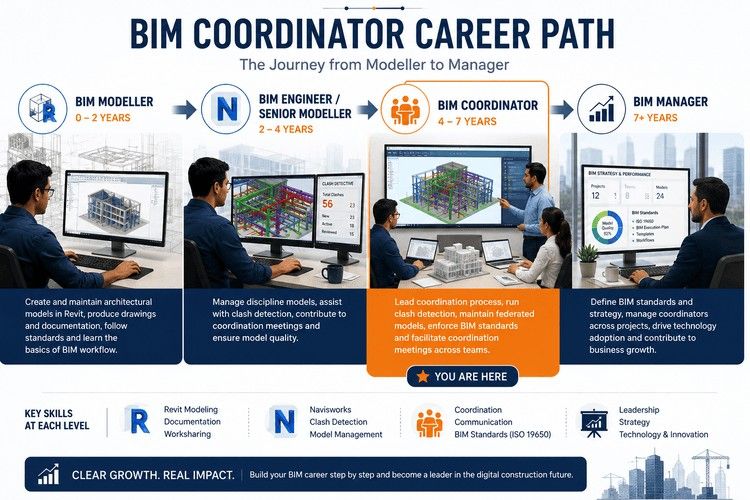
BIM Modeller (0–2 years)
This is where most people start. Creating and maintaining architectural models in Revit, working to specifications set by a coordinator or manager, handling basic documentation and drawing production. At this stage you are learning the software deeply and starting to understand how a BIM project is structured.
The learning curve here is technical. You are getting fast at Revit, understanding family structure, learning how annotation and views work, getting comfortable with worksharing and central files. Most importantly, you are understanding what makes a model coordination-ready versus one that creates problems for everyone downstream.
BIM Engineer / Senior Modeller (2–4 years)
With experience, you start taking on more responsibility within the model — managing specific discipline packages, assisting with clash detection, contributing to coordination meetings. You are not yet running the coordination process but you understand it well enough to contribute meaningfully.
This is also when certifications start to matter. Autodesk Revit certification, Navisworks proficiency, understanding of ISO 19650 standards — these validate your skills and make you a more competitive candidate for coordinator roles.
BIM Coordinator (4–7 years)
Here. This is the role this guide is about. You are now managing the coordination process on projects — running clash detection, maintaining federated models, facilitating coordination meetings, enforcing BIM standards across discipline teams.
In India, coordinator-level roles are increasingly common at large architectural firms, engineering consultancies, international delivery centres in Bengaluru and Hyderabad, and infrastructure project offices. The salary jump from senior modeller to coordinator is meaningful.
BIM Manager (7+ years)
Beyond coordinator, the natural next step is BIM Manager — operating at firm or department level, defining standards, managing coordinators across multiple projects, contributing to the firm's BIM strategy and technology decisions. Some professionals also move into BIM consulting, training, or technology roles from here.
Looking to transition into BIM coordination? Enroll in Kaarwan's Professional Revit and BIM Certification Program and gain the skills needed for today's collaborative project environments.
BIM Coordinator Salary in India — 2026 Reality
Salary is where this career path gets genuinely interesting.
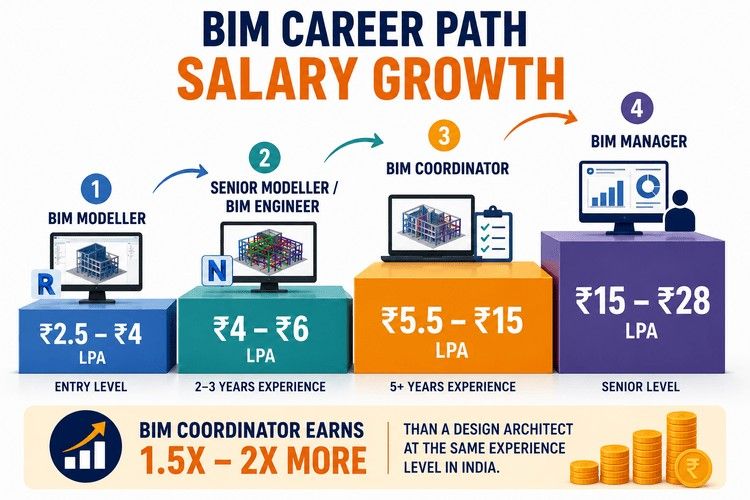
Entry-level BIM Modeller: ₹2.5 LPA to ₹4 LPA in metro cities. Standard starting point for fresh graduates or architecture professionals making the shift to BIM.
Senior Modeller / BIM Engineer: ₹4 LPA to ₹6 LPA with two to three years of BIM-specific experience and relevant certification.
BIM Coordinator: ₹5.5 LPA to ₹15 LPA. The range is wide because it reflects significant variation — project scale, firm type, city, and whether you are working at a domestic Indian firm or an international delivery centre.
Large infrastructure projects, global AEC firms with Indian offices, and international delivery centres in Bengaluru and Hyderabad tend to pay at the higher end of this range. BIM coordinator roles at these firms for professionals with five or more years of experience and international project exposure can exceed ₹12–15 LPA.
BIM Manager: ₹15 LPA to ₹28 LPA at senior level, with the highest packages at international firms or for professionals managing multi-project BIM delivery operations.
The comparison that matters most for architects considering this path: a BIM coordinator with five years of experience typically earns 1.5x to 2x more than a design architect at the same experience level in the Indian market. That gap widens at senior levels.
Skills You Actually Need
Two categories. Both matter. Neither alone is enough.
Technical Skills
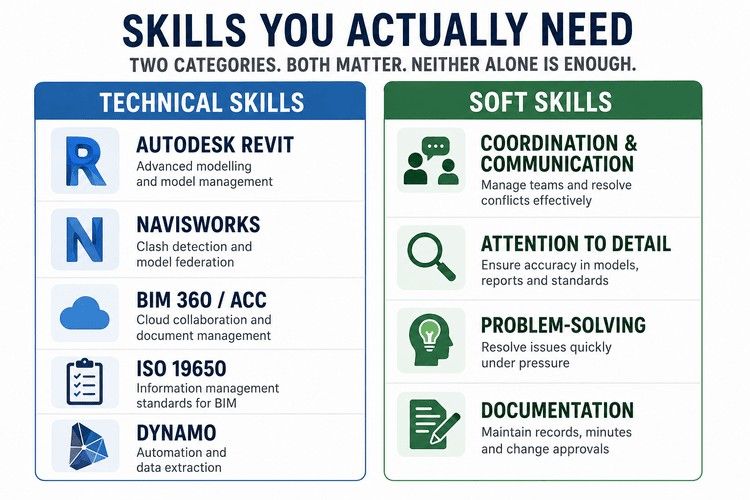
Autodesk Revit — at an advanced level, not just basic modelling. You need to understand model structure, family types, worksharing, linked files, and how to keep a model performant as it grows.
Navisworks — for clash detection and model federation. This is the primary tool for coordination work. Knowing how to set up clash tests, interpret results, and produce actionable reports is core to the coordinator role.
BIM 360 / Autodesk Construction Cloud — cloud-based collaboration is now standard on most projects. Understanding how files are managed, shared, and versioned in a cloud BIM environment is increasingly expected.
ISO 19650 — the international standard for information management in BIM. Knowing the framework — how BIM Execution Plans are structured, what LOD means at each project stage, how information containers and naming conventions work — is what separates a technically credible coordinator from someone who just knows the software.
Dynamo — not essential at coordinator level but increasingly useful. The ability to automate repetitive tasks, run model health checks, or extract data from large models saves significant time.
Soft Skills
Coordination and communication. The job title has "coordinator" in it for a reason. You are managing communication between discipline teams who have different priorities and sometimes different interpretations of the same drawing. Getting those teams to resolve conflicts efficiently — and diplomatically — is as important as any technical skill.
Attention to detail. Clash reports need to be precise. BIM standards need to be consistently applied. A model that has been carefully maintained for six months can be compromised by one discipline team who decided to work outside the agreed coordinate system. Catching and correcting these things before they cascade is a detail-oriented job.
Problem-solving under pressure. Construction schedules do not pause for BIM coordination problems. When a major clash is discovered two weeks before a contractor needs to mobilise, the coordinator needs to facilitate a resolution quickly. The combination of technical knowledge and calm under pressure is what senior coordinators are genuinely valued for.
Documentation. Every coordination meeting needs minutes. Every clash resolution needs to be recorded. Every change to the model that affects design intent needs to be flagged and approved. BIM coordination produces a documentation trail that becomes legally relevant in disputes. Taking this seriously from day one is part of what defines a professional coordinator.
BIM Coordinator vs BIM Manager — When to Make the Move
This question comes up a lot. The honest answer is: experience plus demonstrated capability, not just years.
A BIM Manager is expected to define how BIM works across a firm or project — not just implement it on one project. They set the BIM Execution Plan rather than just following it. They evaluate and procure software. They train and mentor coordinators. They respond to client BIM requirements during bid stages.
Most professionals who make this move successfully have at least seven years of BIM experience, have coordinated multiple projects of varying complexity, and have started taking on aspects of firm-level BIM work — contributing to template development, mentoring junior staff, and representing the BIM team in client meetings.
The move from coordinator to manager is not automatic with time. It requires demonstrating that you can think about BIM at a systems level — not just "how do I manage this clash" but "how do we prevent this category of clash from occurring on any project."
Getting There From Where You Are
If you are an architecture student or graduate reading this and thinking about this path, the starting point is clear.
Learn Revit properly. Not YouTube tutorials for two weeks — genuinely deeply. Work in Revit on real projects or project simulations where you produce construction-ready documentation, manage linked files, and work in a workshared environment. The ability to produce a clean, coordination-ready The Revit model is the foundation everything else is built on.
Get certified. Autodesk Revit certification (Associate and Professional) is the minimum. Adding Navisworks proficiency and ISO 19650 familiarity significantly improves your candidacy for coordinator roles.
Build a portfolio that includes BIM work specifically. Not just design renders — model documentation, clash reports, coordination drawings, LOD schedules. Show that you understand the coordination side of BIM, not just the visualisation side.
And if you are already working as a modeller and looking to make the jump to coordinator, start doing coordination work before you have the title. Ask to sit in on coordination meetings. Offer to assist with clash detection. Volunteer to maintain the BIM standards document. The title follows demonstrated capability far more reliably than it follows time.
Ready to step into BIM coordination? Build industry-ready Revit and BIM skills with Kaarwan's Professional Certification Program and accelerate your architecture career.
Conclusion
The BIM coordinator path is not the only direction an architecture career can go. But for architects who want clear career progression, work that has a measurable impact on how complex projects are delivered, competitive salaries in a market where design-only roles are increasingly commoditised, and skills that transfer globally — it is one of the strongest options available right now. The work is demanding and detail-oriented. The learning curve is real. But the professionals who do it well are rarely looking for work.
Frequently Asked Questions
Q1: How long does it take to become a BIM coordinator in India?
Realistically, four to six years of consistent BIM-focused work from starting as a modeller. The timeline compresses with formal BIM certification, structured learning, and active involvement in coordination work before reaching the coordinator level. Some professionals make the move in three to four years if they have been working on large, complex projects with experienced BIM teams and have taken on coordination responsibilities progressively.
Q2: What is the BIM coordinator salary in India?
BIM coordinator salary in India ranges from approximately ₹5.5 LPA at entry coordinator level to ₹15 LPA for experienced coordinators at international firms or large infrastructure projects. The range reflects variation in city, firm type, project scale, and experience. Metro cities — Bengaluru, Mumbai, Hyderabad, Delhi NCR — consistently pay above the national average for BIM roles.
Q3: Do architects need a separate BIM certification to become coordinators?
Formal certification is not legally required but is practically important. Autodesk Revit certification and Navisworks proficiency are most commonly expected. ISO 19650 familiarity is increasingly valued at firms working on international projects or government mandated BIM projects. A structured BIM certification course that covers both software and BIM process standards — not just software tutorials — provides the strongest foundation for coordinator-level roles.
Q4: What is the difference between a BIM coordinator and a BIM manager?
A BIM coordinator manages the coordination process on a specific project — federated model maintenance, clash detection, coordination meetings, standards compliance. A BIM manager operates at a firm or department level — defining BIM strategy, setting standards across projects, managing coordinators, responding to client BIM requirements during bid processes. The coordinator role is project-specific. The manager role is organisational. Most BIM managers spent several years as coordinators before the transition.
Q5: Can a fresh architecture graduate start directly as a BIM coordinator?
Not typically — the coordinator role requires project experience and technical depth that fresh graduates have not had time to develop. The standard entry point is BIM modeller, which builds the foundation. That said, fresh graduates who have completed rigorous BIM certification, worked on substantial BIM projects during their degree, and can demonstrate genuine coordination understanding occasionally move into coordinator roles faster than average. The portfolio and demonstrated skill level matter significantly.