So you've got a BIM Coordinator interview coming up. Maybe it's tomorrow. Maybe it's next week and you're already refreshing your Navisworks shortcuts at 11 PM. Either way — here's what actually gets asked, in the order it usually comes up, with answers you can adapt instead of memorize.
Most BIM Coordinator interviews cover three things: whether you know the software cold (Revit, Navisworks, BIM 360/ACC), whether you understand the process behind coordination (clash cycles, CDE workflows, issue tracking), and whether you can think on your feet when two disciplines are fighting over the same duct space. Some interviews throw in a live clash-detection exercise too, just to see how you actually work, not just how you talk about working.
Also Read : BIM Engineer Interview Questions and Answers 2026
How Are BIM Coordinator Interviews Structured?
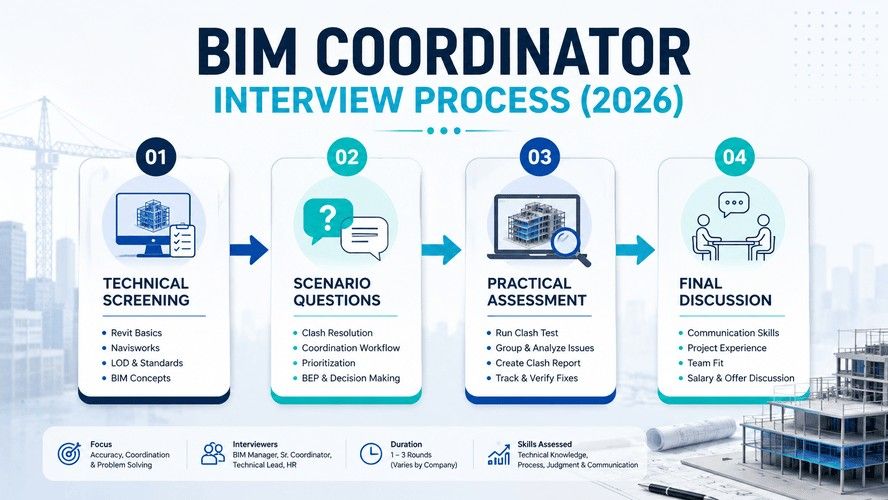
There's no single script every company follows, but a pattern shows up again and again. First round is usually a technical screen — someone checks whether your Revit and Navisworks basics are solid, whether you know your LOD levels, and whether you can explain a clash workflow without stumbling. Second round tends to get into scenarios: "a duct clashes with a beam three days before the coordination deadline, what do you do?" type questions. And for mid-to-senior roles, or firms that take coordination seriously, there's often a practical round — open Navisworks, run a clash test, group the results, maybe write up a mini report on the spot.
If you're a fresher, you might skip the practical round entirely and get more conceptual questions instead. If you're experienced, expect them to push on judgment calls — priority disputes, late submissions, how you'd handle a discipline that keeps ignoring the BEP. Worth reading up on what the role actually expects day to day before you walk in — get the full picture of the BIM Coordinator career path and responsibilities if you haven't already.
Also Read: BIM Jobs in India 2026 — Which Companies Are Hiring?
Clash Detection and Coordination Questions
This is where most interviews spend the bulk of their time. Fair warning — some of these questions sound simple but interviewers are really listening for whether you understand why, not just what.
1. What is clash detection, and why does it matter more than people think?
Clash detection is the process of finding conflicts between elements from different disciplines — a duct running through a beam, a pipe clipping a wall — before construction starts. It matters because catching it in the model costs you a few minutes. Catching it on site costs you rework, delays, and an angry site engineer calling your PM.
2. What's the difference between a hard clash and a soft clash?
A hard clash is a physical overlap — two things occupying the same space. A soft clash (sometimes called a clearance clash) is when elements are technically not touching but violate a required clearance, like an AHU with no service access space around it. Both matter, but hard clashes usually get fixed first because they're non-negotiable.
3. How do you decide what tolerance to set for a clash test?
Depends on the system. Big ductwork or structural elements need more clearance than something like a small conduit. Good practice is tying tolerances to what's already documented in the BEP rather than guessing on the spot — and being consistent about it across every cycle so your results stay comparable.
4. What is clash grouping and why bother with it?
Instead of treating twenty individual clashes along the same corridor as twenty separate issues, you group them into one actionable item. Nobody wants to sit through a meeting discussing the same duct-versus-beam problem eight times because it repeats down a hallway.
5. How do you prioritize which clashes to fix first?
Structural and life-safety issues first, always. Then major MEP routes — the stuff that's expensive or slow to reroute. Then smaller services and finishes. Corridors, risers, and plant rooms tend to jump the queue too, since they cause the most disruption if they go wrong on site.
6. A duct clashes with a beam. Walk me through your first move.
Confirm it's real first — not a tolerance issue, not a duplicate. Note exactly where it is, grid and level. Then look at options: shift the duct elevation, reroute it, resize it, or — worst case — flag it for a structural opening review. Assign it to someone, set a deadline, and check it's actually resolved in the next cycle. That last part trips people up — a lot of "fixed" issues aren't actually re-verified.
7. What's a clash matrix, and have you built one?
It's basically a checklist of which disciplines get tested against which — MEP vs Structure, Plumbing vs Electrical, and so on — so coordination doesn't turn into a random guessing game. If you've built one, mention it. If you haven't, describe how you'd structure one based on project priorities.
8. Two disciplines both blame each other for the same clash — how do you settle it?
Lean on whatever priorities are already agreed in the BEP. Structure usually has the least flexibility, so MEP tends to reroute first — but if that's genuinely not possible, you look at whether a structural opening makes sense. The real skill here isn't picking a side, it's laying out the options with their impact clearly enough that someone can make a fast decision.
Also Read: What Is MEP BIM Modelling? Beginner Guide, Workflow & Career Scope
Software Questions (Navisworks, Revit, BIM 360/ACC)
If Navisworks feels shaky, it's worth get comfortable with Navisworks clash detection before your interview — this is genuinely the section where candidates lose the most points.
1. What's the difference between an NWC and an NWD file?
NWC is the cache file, usually exported straight from Revit, that Navisworks reads quickly. NWD is the published version — the one you share with the wider team, often with viewpoints and clash results already baked in.
2. Explain Selection Sets versus Search Sets.
A Selection Set is a manual, one-time pick of elements. A Search Set is rule-based — built on categories or parameters — and it automatically updates as the model changes. Professionals default to Search Sets because they don't break every time someone tweaks the model.
3. What is worksharing in Revit, and why does it matter for coordination?
It lets multiple people work on one central model at once, syncing changes through local files instead of stepping on each other's work. For coordination specifically, it keeps everyone working off the same live data instead of five different versions floating around on laptops.
4. How do you keep a Revit model from turning into a slow, bloated mess?
Purge what's unused, keep detail levels sensible, avoid heavy imports, manage worksets properly, and don't model tiny details that don't actually help with coordination or quantities. A lighter model just behaves better — syncs faster, crashes less.
5. What's your process for exporting a clean IFC file?
Get the category and property mapping right, agree on the IFC version beforehand, and check coordinates are consistent. Then — and people skip this — actually open it in an independent viewer afterward to confirm it looks right. Exporting isn't the finish line; verifying is.
6. How do you use BIM 360 or ACC in day-to-day coordination?
Mainly for managing issues, RFIs, and checklists, plus controlling folder permissions so the right people see the right files at the right stage. It's also where a lot of the "who approved what, when" traceability lives.
Also Read: BIM Course in India 2026: Complete Guide for Architects & Engineers
Want to answer interview questions with confidence instead of theory? Kaarwan's BIM Certification Program builds hands-on expertise in Revit, Navisworks, BIM coordination, and real project workflows employers value.
CDE and Standards Questions (ISO 19650, Common Data Environment)
1. In plain terms, what is a Common Data Environment?
It's the controlled system — cloud-based, usually — where all project information gets stored, shared, reviewed, and approved. Nobody's supposed to build from a random file someone emailed; everything routes through the CDE so there's a clear, traceable version of the truth.
2. What does WIP, Shared, Published, and Archived actually mean?
WIP is internal, still being worked on. Shared means it's ready for other disciplines to review and coordinate against. Published is the approved version people can build from. Archived is just historical record-keeping. Get this sequence wrong in an interview and it's a red flag — it shows you don't get why status control exists.
3. What is ISO 19650, and do you need to have it memorized?
It's the international standard for managing BIM information — naming, approvals, roles, how files move through a project. You don't need to recite clauses. What interviewers actually want is proof you understand why controlled information flow matters, especially on multi-company or multi-location projects.
4. Why does file naming convention actually matter this much?
Because a bad naming system means people open the wrong file, or can't find the right one, or worse — build off an outdated one without realizing. Good naming makes files traceable and searchable across the whole CDE, and it keeps federation from silently breaking.
5. How would you handle a discipline that keeps ignoring BEP standards?
Start soft — flag the specific non-compliance, give them templates or examples to fix it. If it keeps happening, you enforce a quality gate: models that break critical BEP rules just don't get into federation. Standards only work if someone's willing to hold the line, and eventually that might mean looping in the PM.
Scenario-Based Questions (Managing Multi-Discipline Conflicts)
This is the section a lot of candidates aren't ready for, because it's less about facts and more about how you think under pressure.
1. You've got a tight deadline and half the models still have unresolved clashes. What now?
Break the work down by zone or level, matching whatever the construction sequence actually needs first. Freeze areas progressively as they get coordinated instead of waiting for the whole thing to be perfect. And be upfront with the PM about what's genuinely resolved versus what's still pending — hiding risk never ends well.
2. A discipline submits their model two days late. How do you handle it?
Apply whatever cutoff is in the BEP, but communicate the risk clearly rather than just quietly working around it. If the coordination cycle has to proceed without that model, flag it as an open risk so nobody assumes everything's been checked when it hasn't.
3. How would you run a coordination meeting so it's actually useful?
Come in with the top clashes already sorted by impact — don't waste the room's time scrolling through a raw list. Cover submission status, decisions that need to be made, who owns what, and deadlines. End with clear actions, not just a discussion that trails off. And send minutes afterward so accountability doesn't evaporate the moment the call ends.
4. How do you explain a serious clash to a non-technical project manager?
Skip the jargon entirely. Say what it actually means — "this will cause rework and push the timeline if we don't fix it now" — and show a simple screenshot with the recommended fix. PMs care about cost, time, and risk, so frame it in those terms and they'll act on it fast.
5. Tell me about a time you resolved a coordination conflict.
Even without site experience, freshers can use a college or training project here — structure it as problem, options you considered, the decision made, and how you verified it actually got fixed. Experienced candidates should have a real example ready with rough numbers, even estimated ones: "we had 40 open clashes in a plant room, grouped and prioritized them, got it down to 5 before site mobilization."
Questions for Freshers vs Experienced Coordinators
If you're a fresher, expect more conceptual questions — LOD levels, what clash detection actually is, basic Revit family types, maybe a simple walkthrough of the coordination cycle. They're not expecting site war stories from you. What they are checking for is discipline: can you model cleanly, follow a template, explain a workflow without freezing up. If you don't have real project experience, lean on a college project or even a self-built sample model — just have something concrete to point to.
If you're experienced, the bar shifts toward ownership. They want to know you can drive a clash cycle to closure, not just identify problems and hand them off. Expect harder scenario questions — priority disputes between disciplines, handling a team that ignores standards, managing coordination across time zones if it's a global firm. Bring proof: a clash report, an issue log, a before/after number if you've got one.
Preparing for BIM Coordinator interviews is easier when you've practised real coordination workflows. Kaarwan's BIM Certification Program helps you master Revit, Navisworks, clash detection, and project-ready coordination skills.
Frequently Asked Questions
What software skills are non-negotiable for a BIM Coordinator interview?
Revit and Navisworks, full stop — those two come up in nearly every interview. BIM 360/ACC familiarity is expected at most mid-to-large firms now too, since that's where issue tracking and approvals actually happen day to day.
How technical do these interviews get for freshers?
Fairly technical on fundamentals — LOD, clash types, basic Revit concepts — but light on real-world scenario pressure. Interviewers know freshers haven't run live coordination cycles yet, so they're testing understanding, not experience.
Is a live clash-detection exercise common in BIM Coordinator interviews?
Increasingly, yes — especially at firms that take coordination seriously. You might be asked to open Navisworks, run a test, group results, and talk through your reasoning in real time. It's worth practicing this exact flow beforehand rather than just reading about it.
Build the Navisworks and CDE skills these interviews actually test for with BIM Coordinator certification program — it's built around exactly this kind of real-project scenario.
What certifications help you clear a BIM Coordinator interview?
A structured Revit and Navisworks certification helps more than people expect, mainly because it forces you to work through real coordination scenarios rather than just watching tutorials. It also gives you something concrete to reference when an interviewer asks for proof, not just claims.