
So your team's on a losing streak and someone in the group chat says "bro, check the Vastu of your ground." Sounds a bit much, right? But it happens more than you'd think — cricket coaches, football captains, even a few IPL franchises quietly rope in Vastu consultants before a season starts. So the question deserves a real answer, not a shrug.
Can Vastu really help my team win? Short version — no, Vastu can't guarantee a trophy. It won't fix a shaky bowling attack or a defence that keeps switching off in the 80th minute. What it claims to do is subtler: shape the energy of the spaces your team trains, rests, and gears up in, so that focus and confidence show up a little more consistently. Think of it less as a strategy and more as a mood-setter. Worth knowing about, not worth betting the season on.
Also Read : How can Vastu principles contribute to a productive workplace?
What Vastu Shastra Actually Says About Sports and Competition
Vastu Shastra is old — like, thousands-of-years-old — and it was never built with cricket pitches or football turf in mind. It's a system of directional planning, rooted in the idea that how a space is oriented affects the people using it. Sunlight, airflow, where the "heavy" corners sit versus the "open" ones — all of that, according to Vastu, quietly nudges how people feel and function inside a building.
When Kaarwan looked at how this plays out in offices, the pattern was pretty consistent: desks facing north or east for clarity, leadership zones anchored in the southwest, cluttered northeast corners linked to blocked energy and foggy decision-making. Sports spaces get talked about in almost identical language — just swap "employee" for "player" and "boardroom" for "dressing room." Same logic, different scoreboard.
Worth saying upfront: none of this is peer-reviewed science. It's a belief system with a long cultural history in India, and a lot of athletes and coaches find it genuinely reassuring. That's reason enough to understand it, even if you never rearrange a single bench because of it.
Curious how directional design actually shapes real spaces? Kaarwan's Advance Vastu Design & Compliance Course breaks it down with practical, industry-relevant training.
Vastu Direction Tips for Cricket and Football Teams
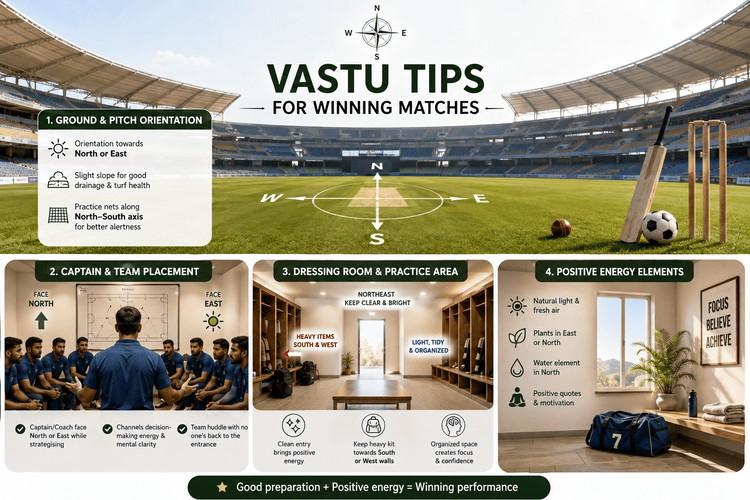
Ground and Pitch Orientation
Vastu tips for winning a match usually start with the playing surface itself. For vastu for stadium/playing ground, the commonly cited guidance is a slight slope or orientation toward the north or east — tied to the idea that morning sun and that direction bring clarity and "positive" energy onto the field. Practically, most grounds are built around drainage, sunlight for turf health, and pitch geometry — which, funnily enough, land in similar directions anyway. So there's a decent overlap between "what Vastu recommends" and "what a groundskeeper would tell you regardless."
For a cricket pitch specifically, some Vastu consultants suggest aligning practice nets along a north-south axis, the thinking being that batters and bowlers stay more alert facing that way. Is there a way to prove this actually sharpens reflexes? No. Does it hurt to set nets up that way if you've got the choice? Also no.
Captain and Team Placement
This is where it gets interesting for vastu for cricket captain searches. The guidance mirrors what's already used for leadership cabins in offices — face north or east while strategising, whether that's at a desk reviewing match footage or standing in a huddle before the toss. The idea is that this direction channels "decision-making energy," similar to how a captain reading the game clearly under pressure needs a calm, focused headspace.
Team huddles get the same treatment. Some consultants recommend the captain or coach positions themselves facing east or north during team talks, with the group loosely arranged so nobody's got their back to the entrance of the dressing room or dugout. It's a small, almost ritualistic habit — but a lot of sports have those anyway (ask any batsman about their crease routine).
Dressing Room and Practice Area
For vastu for dressing room setups, the northeast-clutter-free rule from office Vastu carries over almost word for word. Keep the entry to the locker area bright, tidy, and unobstructed. Kit bags, spare equipment, anything heavy — push it toward the south or west walls rather than letting it pile up near the door. The claim is that a cluttered entrance to a space where players are gearing up mentally creates "blocked" energy, translating to sluggish focus once the whistle blows.
Honestly, even without the Vastu angle, a clean, organised dressing room just feels better to walk into before a big match. That part isn't really up for debate.
Also explore: Vastu direction and colour principles — Kaarwan's deep dive into how these same ideas play out in office spaces.
Thinking beyond match-day superstition? Learn how professionals apply Vastu to real projects with Kaarwan's Advance Vastu Design & Compliance Course — practical, expert-led, and career-focused.
Vastu Colours for Team Spaces and Jerseys
Colour shows up a lot in vastu colors for sports team searches, and the logic borrows heavily from what's already applied to offices and homes.
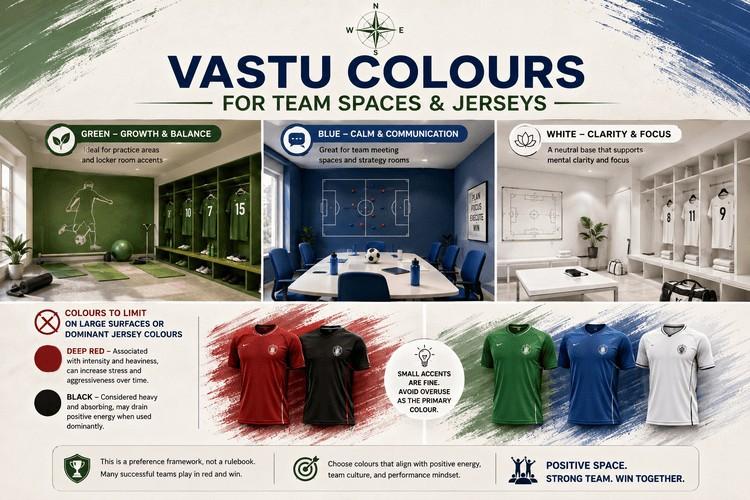
- Green — associated with growth and balance, often suggested for practice areas or locker room accents.
- Blue — linked to calm and clear communication, a common pick for team meeting spaces or strategy rooms.
- White — tied to mental clarity and focus, considered a safe, neutral base for most sports interiors.
On the flip side, deep red and black are usually advised against for large wall surfaces or dominant jersey colours in team spaces — the reasoning being that these shades carry a "heaviness" that can weigh on morale over a long season. Small accents are generally considered fine; it's blanket use across a whole room (or a whole kit) that Vastu consultants tend to flag.
Worth noting — this doesn't mean teams playing in red are somehow cursed. Some of the most successful clubs and franchises globally play in red. Vastu colour guidance is a preference framework, not a rulebook with consequences.
Does Vastu Actually Affect Match Outcomes? A Balanced View
Here's the honest bit. There's no scientific evidence that directional alignment or wall colour changes a scoreline.
Matches are decided by fitness, skill, tactics, form on the day, sometimes a dodgy umpiring call, and a fair bit of luck. Does vastu really work for sports? — nobody can back that up with data, and any source claiming otherwise is stretching the truth.
What Vastu can plausibly influence is the feel of a space — a calmer dressing room, a less chaotic entrance, a team meeting area that doesn't feel like a storage closet. And feel matters more than we like to admit in performance. Athletes talk constantly about visualisation, routine, and mental steadiness before big games. If tidying up a corner of the locker room or picking a calmer colour palette gives a player one less thing to feel unsettled about, that's a real (if modest) psychological nudge — not a magic win-button.
Treat Vastu here the way you'd treat a pre-match ritual or a lucky pair of socks: harmless, occasionally comforting, definitely not a substitute for actual training.
Also read: Vastu-compliant colour schemes for every room — useful if you're picking palettes for a team room or training facility.
Somewhere between blind belief and total dismissal, there's a middle ground where Vastu becomes one more small tool in a team's mental-prep kit — never the main one, never a replacement for actual coaching, but not entirely without value either. If you're setting up a home training corner, a coaching facility, or just curious about the design logic behind it, understanding the core Vastu principles driving these recommendations helps separate the genuinely useful spatial habits (declutter, natural light, clean entrances) from the purely symbolic ones.
For anyone studying design or interiors more broadly, it's worth browsing Kaarwan's wider interior design blogs — there's a lot of overlap between Vastu logic and plain good spatial planning.
Thinking About Vastu Professionally, Not Just Casually?
If sports facility design or Vastu consulting sounds like a career direction, not just match-day trivia, Kaarwan's Vastu course walks you through the same directional and elemental logic used across homes, offices, and now sports spaces — hands-on and practical.
Conclusion
At the end of the day, Vastu isn't going to turn a struggling side into champions, and nobody serious is claiming it will. What it offers is a framework for keeping training spaces calm, organised, and a little more intentional — and for athletes, that mental steadiness genuinely counts for something, even if the science stops there. Skill, training, and strategy are still what wins matches. Vastu, at best, just clears some of the clutter — literally and otherwise — out of the way.
If Vastu design and its real-world applications interest you beyond sports, Kaarwan's Advance Vastu Design & Compliance Course is worth a look.
Frequently Asked Questions
1. Can Vastu really help my team win a match?
Not directly. Vastu Shastra doesn't influence skill, fitness, or tactics — the things that actually decide a match. What it claims to do is shape the energy of training and rest spaces, which some believe supports focus and morale. Treat it as a mindset tool, not a performance guarantee.
2. What direction should a cricket team face before a match, according to Vastu?
Most consultants suggest the captain or team face north or east during team talks and strategy discussions, as these directions are linked in Vastu to clarity and confident decision-making.
3. Which colours are considered lucky for sports teams in Vastu?
Green, blue, and white are the commonly recommended colours for team spaces, associated with growth, calm communication, and mental clarity respectively. Deep red and black are generally suggested in moderation only.
4. Is there any scientific proof Vastu affects sports performance?
No. There's no scientific research linking directional alignment or colour choices to match outcomes. Any performance benefit is more likely tied to the psychological comfort of a well-organised, calming space rather than the Vastu principles themselves.
5. What is the best Vastu direction for a stadium or playing ground?
Vastu guidance often points to a north or east orientation for pitches and playing surfaces, tied to morning sunlight and directional energy. Practically, this also tends to align with good drainage and turf health considerations.