
If you're a B.Arch student staring down your final year, or you've just graduated and someone mentioned GATE like it's the next obvious step - this one's for you. GATE AR 2027 is coming up fast, and honestly, the amount of scattered information out there (half of it outdated, half of it written for engineers who couldn't care less about your paper) makes this more confusing than it needs to be.
So let's just sit down and go through it properly. Dates, eligibility, what's actually new this year, the syllabus, all of it - specific to Architecture and Planning, not buried inside some generic "GATE for all 30 papers" article.
Also Read: Preparation for GATE Architecture: Study Tips and Strategies
What Is GATE AR and Who Should Take It?
GATE - the Graduate Aptitude Test in Engineering - isn't only for engineers, despite the name. Architecture and Planning (AR) has been a standalone paper in it for years now, and it opens up doors that a lot of architecture students don't realize exist until way too late.
Clear GATE AR and you're looking at M.Arch or M.Plan admissions at IITs, NITs, and SPAs - plus PSU recruitment (think NBCC, HUDCO, and similar government bodies that hire architects). It's organized jointly by IISc and the IITs, and for 2027, IIT Madras is running the show.
Who should actually sit for it? Final-year B.Arch students (third year onwards, per the relaxed eligibility rule - more on that below) and anyone who's already graduated. If you're weighing whether to just start your career or push for a PG seat first, GATE AR is often the fork in the road.
GATE AR 2027: Key Dates at a Glance
Here's the full, current schedule - pulled from the official notification, not some third-party guess:
| Event | Date |
| Information Brochure released | July 20, 2026 |
| Registration opens (GOAPS) | August 27, 2026 |
| Regular registration closes (no late fee) | September 27, 2026 |
| Extended registration closes (with late fee) | October 5, 2026 |
| City allotment notification | January 4, 2027 |
| GATE AR 2027 exam dates | Feb 6, 7, 13, 14, 20, 21, 2027 |
| Result declaration | March 19, 2027 |
A couple of things worth flagging. First, the exam is spread across three weekends in February - six possible days total, morning and afternoon sessions - which is more spread out than earlier years used to be. Second, and I can't stress this enough: these dates are labeled "tentative" by IIT Madras itself, and they've already moved once this cycle. Bookmark the official site and check it every couple of weeks instead of relying on memory.
If you've read last year's guide and you're wondering what's actually different this time — fair instinct, always check. On two fronts, though, GATE 2027 just carries forward what GATE 2026 already introduced: the eligibility window is still relaxed to let third-year B.Arch students sit the exam (it used to require final-year standing), and the fee slabs haven't moved either, as of this writing. So if you landed here off a "GATE 2026 vs 2027 eligibility" or "GATE 2026 vs 2027 fees" search — that's your answer, both carried over unchanged. Full breakdown of each is further down the page.
From syllabus coverage to mock tests and rank-focused strategies, Kaarwan helps architecture aspirants prepare smarter for GATE AR with expert guidance and exam-oriented practice. Start Your GATE AR Preparation with Kaarwan
Am I Eligible for GATE AR 2027?
Good news here - eligibility got a bit more generous this year. You qualify if:
- You're currently in your third year or higher of a B.Arch program (this is the relaxed bit - it used to require final-year standing, now third-year students can appear too)
- You've already completed your B.Arch degree
- You hold an equivalent qualification recognized by the relevant professional body
There's no upper age limit, and no cap on how many times you can attempt it. So if you don't crack the score you wanted the first time, that's not the end of the road - plenty of toppers have more than one attempt behind them.
And if you're not a current student at all — already working and eyeing this as a career pivot — the eligibility rules above still apply to you as a graduate, and how working professionals can prepare for GATE AR is worth a separate read.
How to Register for GATE AR 2027
Registration happens entirely on GOAPS - the GATE Online Application Processing System - and this year there are two extra steps that didn't exist before, so don't skip past them assuming it's the same process as last time.
Step 1 - Get your DigiLocker sorted first. This is now mandatory for every Indian applicant. Not optional, not a "nice to have." Go create or verify your DigiLocker account before registration even opens, because doing it under time pressure on the last day is how mistakes happen.
Step 2 - Register on GOAPS. Head to the official portal, sign up with your email and phone number, and generate your enrolment ID.
Step 3 - Complete facial verification. Live facial recognition is part of the process now, layered on top of the usual document checks. It's meant to tighten up identity verification, and from what's been reported, it adds a few extra minutes but isn't complicated.
Step 4 - Fill in your academic and personal details. Degree, college, expected passing year, category if applicable.
Step 5 - Select your paper. AR is your primary choice; a second paper is allowed only if it's on the officially approved combination list (CE and GE are the ones paired with AR).
Step 6 - Upload your photograph and signature. Follow the pixel and file-size specs exactly - this is where a surprising number of applications get flagged as defective.
Step 7 - Pick your exam cities, pay the fee, and download your confirmation page. Keep that PDF somewhere safe. You'll need it later, and IIT Madras doesn't ask you to mail a printed copy anywhere.
GATE AR 2027 Application Fees
Registration fees are one area where 2027 figures cannot yet be stated with certainty, as the official GATE 2027 notification has not confirmed whether the fee structure will change. For reference, the following are the registration fees applicable for GATE 2026:
| Category | Timely Application | Extended Application (Late Fee) |
| Female / SC / ST / PwD candidates (per paper) | ₹1,000 | ₹1,500 |
| General category + Foreign Nationals (per paper) | ₹2,000 | ₹2,500 |
GATE 2026 fees shown above — 2027 fees to be confirmed once the official notification is out. Fee is per test paper; opting for two papers means paying twice over. PwD = Persons with Benchmark Disability.
Worth checking the official GATE 2027 site again closer to registration — fee structures don't move often, but "don't often" isn't "never."
What's New in GATE 2027: Robotics & Automation Paper and Syllabus Revision
A fair bit has shifted this year, and if you skimmed an older GATE guide, some of it will genuinely be new to you.
The biggest structural change is the introduction of Robotics and Automation (RA) as a standalone paper - bringing the total paper count up. It doesn't touch AR directly, but it tells you something about where GATE as an exam is heading: more interdisciplinary, more responsive to what industry actually needs.
More relevant to you: the syllabus itself got revised for the first time in five years. That's not a minor tweak - five years is a long gap, and it means some of the reference material floating around from older batches may not map cleanly onto what's actually being tested now. If you're building your study plan off an old syllabus PDF a senior handed down, stop and cross-check it against the current one before you go further.
There's also live facial verification and mandatory DigiLocker integration for registration, which we already covered above.
Genuinely, the smartest thing you can do right now is avoid the common prep mistakes other GATE AR aspirants make - a lot of them come down to exactly this: studying from outdated material and not realizing the syllabus moved under their feet.
GATE AR 2027 Syllabus Breakdown
The AR paper is split into two parts, and this structure hasn't changed for 2027:
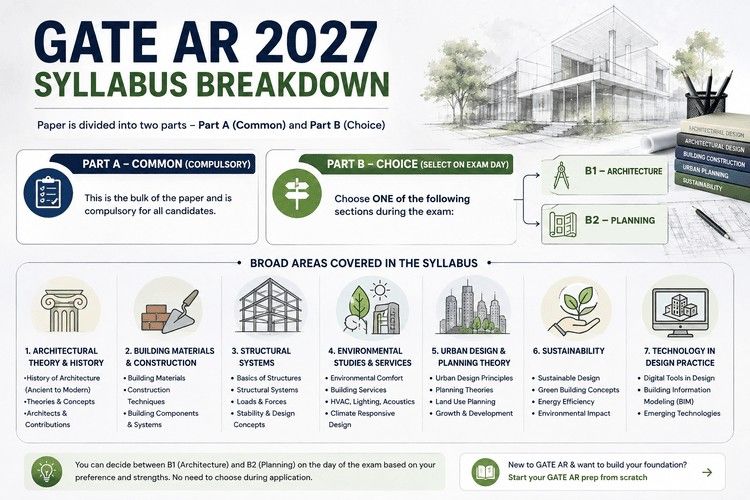
Part A is common and compulsory for everyone - this is the bulk of the paper. It covers architecture and planning fundamentals broadly.
Part B is where you choose: B1 (Architecture) or B2 (Planning), selected during the exam itself, not at the time of application. So you don't have to commit early - you can decide on exam day based on which section you feel stronger in.
Broad areas the syllabus covers include architectural theory and history, building materials and construction, structural systems, environmental studies and services, urban design and planning theory, and - increasingly - sustainability and technology-driven design practices. If you're just getting oriented and don't know where to even begin sorting through all this, starting your GATE AR prep from scratch is a decent place to build your footing before diving into subject-wise depth.
GATE AR Exam Pattern: Marking Scheme and Question Types
This is where AR quietly differs from most other GATE papers, and it trips people up if they're not paying attention.
| Section | Marks |
| General Aptitude | 15 |
| Part A (Compulsory) | 60 |
| Part B (B1 or B2, your choice) | 25 |
| Total | 100 |
Duration is 180 minutes, same as every other GATE paper. Unlike most engineering papers, AR doesn't carry a separate Engineering Mathematics section worth 13 marks - the compulsory Part A absorbs a much bigger chunk of the paper instead. That's a meaningfully different weight distribution, so if you're studying alongside friends prepping for CE or ME, don't assume your prep balance should mirror theirs. It shouldn't.
Question types are the usual three: MCQs (negative marking applies - 1/3 mark off for 1-mark questions, 2/3 off for 2-mark ones), MSQs (no negative marking, no partial credit either), and NAT questions where you type in a numerical answer with no options given.
Honestly, the fastest way to internalize how these get framed is to just practice with previous years' question papers. Reading about question types only gets you so far - solving them is where the pattern actually clicks.
Planning to crack GATE Architecture 2027? Build your preparation with Kaarwan’s structured GATE Architecture course, covering key topics, PYQs, mock tests, exam strategies, and expert mentoring. Explore Kaarwan’s GATE Architecture Course
Prep Tips From GATE AR Toppers and Mentors
Cracking this exam isn't really about who puts in the most hours — it's about who studies smart. Here's what actual GATE AR toppers and our mentors keep coming back to.
- Know why you're doing this before you open a single book. Sounds soft, but it's not — the people who last through months of prep are the ones who reconnect with their "why" when motivation dips, not the ones relying on willpower alone.
- Study the pattern before you study the syllabus. Go through previous years' papers early, not at the end — you'll spot which topics repeat and which ones are just noise.
- Don't skip the hard stuff. Numericals and the subjects everyone avoids tend to carry real weight. Avoiding them doesn't make them disappear from the paper.
- Show up even on the days you don't feel like it. An hour of focused attendance beats a missed session you meant to "make up later."
- Stop chasing the perfect timetable. It doesn't exist. Shorter, daily sessions beat an ambitious schedule you abandon in week two.
- Revise the previous day's material every single day. Five minutes of review now saves you a frantic re-read three months from now.
- Start mock tests earlier than feels comfortable. Waiting to "feel ready" just means you start too late — the discomfort is the point.
- Accept that you won't know everything, and keep moving anyway. Every topper has gaps. What separates them is that they didn't let the gaps stop the momentum.
- For the topics that genuinely aren't clicking, change the format — a video, a study group, a different explanation — rather than re-reading the same notes hoping it lands differently this time.
- Watch the self-doubt talk, and push through it in small steps. Not a pep talk — just, don't let one bad mock convince you the whole plan is broken.
- Build an actual roadmap with weekly goals, and if you want a ready-made structure instead of building one from scratch, a 100-day GATE AR study timetable is a solid place to start — along with previous years' GATE AR question papers if you haven't started those yet.
If there's one formula worth pinning above your desk: mock tests + previous papers + daily revision + regular attendance = the outcome you're after.
What Can You Do With a GATE AR Score?
A good score keeps a genuinely wide set of doors open. M.Arch and M.Plan admissions at IITs, NITs, and SPAs are the obvious one. Beyond that, PSUs that recruit architects and planners - NBCC, HUDCO, DDA, and similar organizations - often use GATE scores as part of their hiring filter. Some candidates use it for financial assistance during their postgraduate years too, since a qualifying score can come attached to a stipend.
Your score stays valid for three years from the result date, so even if postgrad admission isn't your immediate plan, it's not wasted effort - you've got a window to decide. Curious what that actually looks like in practice? The career doors a good GATE AR score can open goes into more detail than we have room for here.
Need proof this actually pans out? How one AIR 1 scorer cracked GATE AR is worth a read — less theory, more "here's exactly what I did differently.
PSUs That Recruit Through GATE AR
A GATE AR score doesn't just open PG admissions — a fair number of India's Public Sector Undertakings use it directly in their recruitment process too. This list isn't exhaustive (PSUs update their hiring routes fairly often), but here's who's actively used GATE scores in recent hiring cycles:
- Airports Authority of India (AAI)
- Bharat Heavy Electricals Limited (BHEL)
- Bharat Sanchar Nigam Limited (BSNL)
- Coal India Limited (CIL)
- Centre for Railway Information Systems (CRIS)
- Chenab Valley Power Projects Limited (CVPPL)
- Damodar Valley Corporation (DVC)
- Electronics Corporation of India Limited (ECIL)
- Engineers India Limited (EIL)
- Gas Authority of India Limited (GAIL)
- Hindustan Aeronautics Limited (HAL)
- Indian Oil Corporation Limited (IOCL)
- Mazagon Dock Shipbuilders Limited (MDL)
- National Aluminium Company Limited (NALCO)
- National Highways Authority of India (NHAI)
- NLC India Limited (NLCIL)
- National Mineral Development Corporation (NMDC)
- Nuclear Power Corporation of India Limited (NPCIL)
- National Thermal Power Corporation (NTPC)
- Odisha Power Generation Corporation Limited (OPGC)
- Oil and Natural Gas Corporation (ONGC)
- Power Grid Corporation of India Limited (POWERGRID)
- Grid Controller of India Limited (GRID-INDIA, formerly POSOCO)
- Rashtriya Ispat Nigam Limited (RINL)
- Steel Authority of India Limited (SAIL)
- And several other PSUs
Worth remembering: PSUs run their own separate recruitment notifications even after GATE results are out — a good score gets your foot in the door, it doesn't auto-enroll you anywhere.
Previous Year GATE AR Cut-offs
| Year | General | OBC-NCL / EWS | SC / ST / PwD |
| 2025 | 40 | 36 | 26.6 |
| 2024 | 41.5 | 37.3 | 27.6 |
| 2026 | to be confirmed | to be confirmed | to be confirmed |
Cut-offs move around a bit year to year depending on paper difficulty and the number of seats up for grabs — treat these as a reference point, not a target to just barely clear.
FAQs
Is GATE AR 2027 registration open now?
Registration opens August 27, 2026 through the GOAPS portal. It was originally scheduled for August 14 but got rescheduled - so if you registered that date somewhere earlier, double-check you're not planning around the wrong one.
What is the last date to apply for GATE 2027 without late fee?
September 27, 2026. After that, you can still apply through October 5, 2026, but with a late fee added on.
Has the GATE AR syllabus changed for 2027?
Yes - this is the first syllabus revision in five years. If you're using older prep material, it's worth cross-checking it against the current official syllabus before you build your study plan around it.
Is DigiLocker mandatory for GATE 2027 registration?
Yes, for all Indian nationals. It's now a required part of the registration process, alongside live facial verification - so get your DigiLocker account created and verified before registration opens rather than scrambling on the day.