

.jpg)
Five years ago, if you opened a sheet from a fifth-year B.Arch portfolio at any Indian architecture school and saw a Grasshopper definition driving a tower facade, you would have assumed the student had probably interned abroad. In 2026, that same definition is what jury panels at CEPT, SPA Delhi, and RVCA expect by default. The shift has been quick and quieter than you would think.
The reason is mostly economic. Indian firms are no longer competing for jobs against the studio next door. They are pitching against Singapore, Dubai, and Rotterdam for the same Tier-1 commercial work, and computational tools are how you bring a 60-person Stuttgart studio's output down to a 20-person Gurgaon team. The Navi Mumbai International Airport, with its lotus-shaped roof by Zaha Hadid Architects, was the most visible reminder of this. Underneath the symbolism, the geometry was solved using algorithms, optimised for daylight performance, and coordinated through BIM. Indian executive architects worked alongside ZHA on it. None of that was possible without a computational backbone.
If you are a B.Arch student, an M.Des aspirant, or a young architect three years into practice and quietly wondering whether you should pick up Grasshopper, this is the moment. The roadmap that follows is built around how Indian studios hire today, what an average student in India can afford to spend on tools, and the kind of projects you will plausibly get staffed on after graduating.
Getting the Vocabulary Right
A lot of confusion around this field comes from people using three terms interchangeably when they shouldn't.
Parametric design is the easiest one. You set parameters, you wiggle them, and geometry updates. A column spacing slider is parametric. Generative design takes that one step further. You feed a system goals and constraints, the computer produces hundreds of viable options, and you pick the one that fits. Algorithmic design is the wider umbrella. You write or assemble logic that tells the geometry how to behave, and parametric and generative both sit inside it. Computational design is the umbrella above all of these. It includes the data analysis, simulation, fabrication-ready output, and now the AI layer that has crept into the workflow over the last eighteen months.
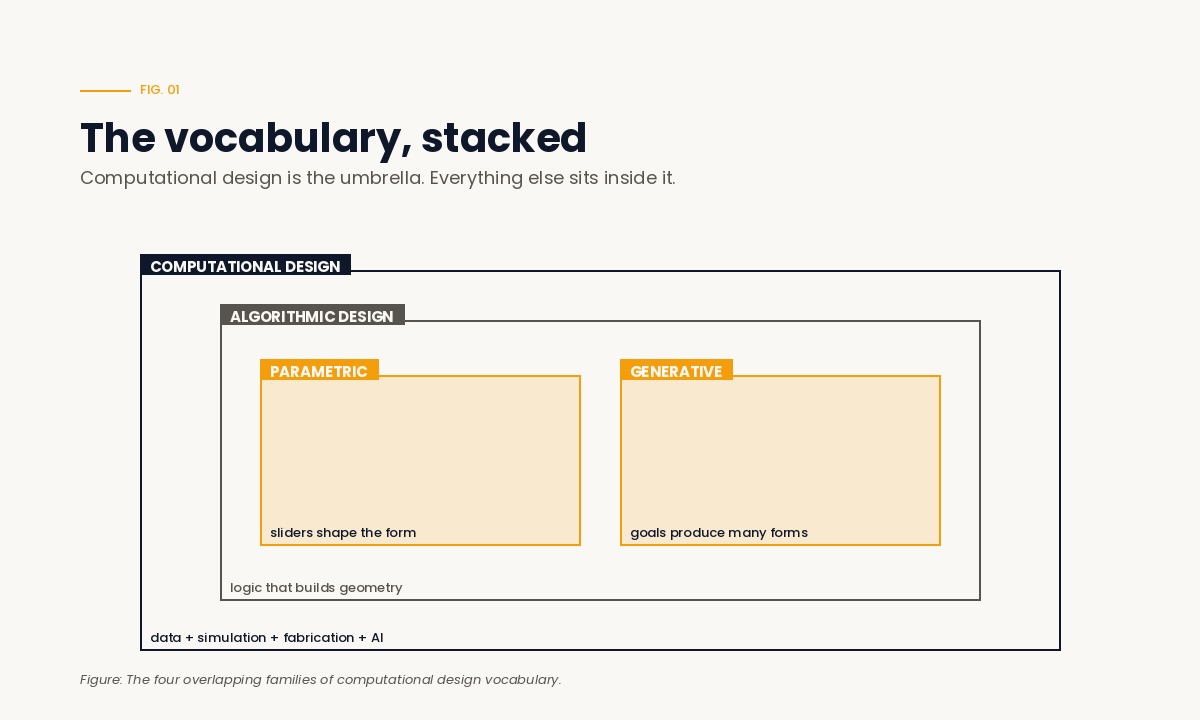
Why does this matter? Because firm directors in Delhi and Bangalore use these terms loosely during interviews, you are expected to determine what they actually need. If a hiring partner says they want a “parametric architect,” they probably mean a Grasshopper specialist who can ship facades. If they say “computational designer,” they likely want someone who can also script in Python or C#, run a Ladybug analysis, and hand-clean geometry off to a fabricator. The difference between those two job descriptions is almost ten lakhs at the senior level. Worth knowing.
Why India, and why right now
There is a specific reason 2026 is the year this field has hit critical mass in the Indian market.
A peer-reviewed study by Purohit and Roy in 2025 surveyed architecture education stakeholders across India and found that 40% of them named lack of technological integration as the single biggest gap in the curriculum, ahead of every other concern raised. That is a damning number, and the firms have noticed. Morphogenesis, with offices in Delhi, Mumbai, Bangalore, and Pune, has been openly moving its entire pipeline to BIM. Studio Symbiosis, run by Amit Gupta and Britta Knobel Gupta out of Stuttgart and Delhi, builds almost everything on a computational performance basis. rat[LAB], Sushant Verma's studio with offices spread between Delhi, Gurgaon, Mumbai, Bangalore, and London, runs an in-house computational research wing. Nudes in Mumbai, founded by Nuru Karim, treats computational design as a social tool, with disaster-relief and low-cost housing work sitting in the same portfolio as high-end mosques and museums. These firms are not waiting for fresh graduates to catch up. They are training mid-career hires from scratch when they have to. If you can land in their inboxes already fluent, you will be paid for it.
The salary band reflects this. Entry-level computational design roles in India in 2026 sit between ₹5 lakh and ₹10 lakh per annum, with senior positions stretching from ₹20 lakh to ₹30 lakh. Glassdoor data across India and the wider region shows a steady premium of 30 to 50 per cent above standard B.Arch graduate salaries for designers who can ship parametric work. That premium has held even as the broader architecture salary market has stayed stagnant.
The 2026 toolkit, decoded
The tools you need to know have not changed as much as the internet wants to convince you. There is a clear hierarchy, and it looks like this.
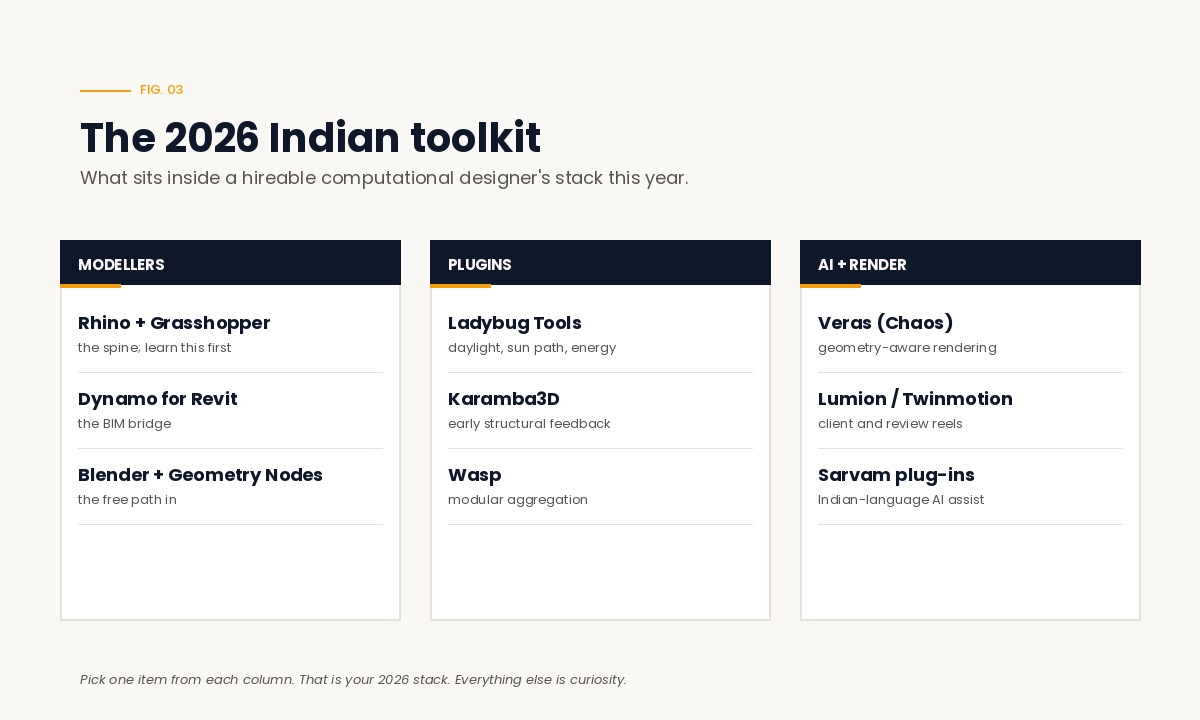
Rhino with Grasshopper remains the spine of the field. It has the largest plugin ecosystem of any computational platform, and almost every Indian firm doing facade or pavilion work is on it. If you only learn one thing this year, learn this. Rhino 8 has stable Python support and the SubD modelling features that most façade designers now use daily.
Dynamo for Revit is the tool you reach for the moment your project enters BIM. If you want to be hired by a firm doing infrastructure, residential towers, or anything where Revit is the source of truth, you cannot skip Dynamo. The 2026 update of Civil 3D added Dynamo automation for drainage systems, which has quietly become a hiring filter at firms doing transit work.
Blender with Geometry Nodes is the surprise of the past two years. It is free, open source, and has matured to the point where small studios are using it for early concept exploration. For a student in India who cannot afford a Rhino license, Blender is now a legitimate path in.
The plugin layer is where you start being useful to anybody who pays you. Inside Grasshopper, you should know Ladybug Tools for environmental analysis (daylight, sun path, energy), Karamba3D for early-stage structural feedback, and Wasp if you are interested in modular or aggregation-based design. None of these is optional any more for a serious portfolio. They are the difference between a project that looks pretty and a project that defends itself in a jury.
The AI layer is the new entrant. Veras by Chaos has become the rendering tool of choice in firms that work across SketchUp, Revit, and Rhino, mostly because it follows your actual geometry rather than hallucinating new buildings. Lumion and Twinmotion have ended up in a two-horse race for real-time visualisation, with Enscape parked between them. Indian studios skew towards Lumion for client presentations and Enscape for internal review.
You do not need to learn every tool. You need to pick a stack. A safe 2026 stack for an Indian student looks like Rhino plus Grasshopper plus Ladybug plus Karamba plus Lumion, with Dynamo added the moment you join a firm doing BIM work.
A roadmap that fits an Indian academic year
Most learning roadmaps online assume you have eight unbroken hours a day. You do not. You have studio submissions, design viva panels, an internship somewhere, and the occasional family wedding that eats a week. Here is a phasing that works around all of that.
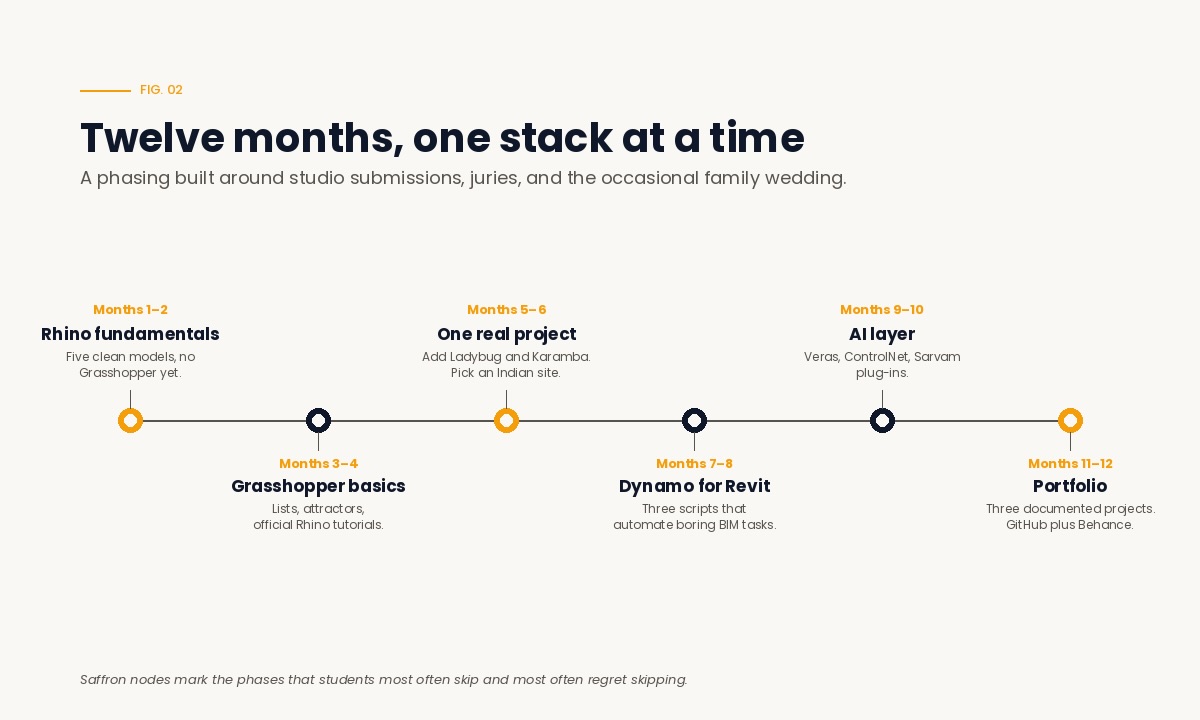
Month 1-2
Get Rhino under your fingers. Build five small models from scratch. Furniture, a small pavilion, a stair, a screen wall, a low-rise residence. Resist the urge to open Grasshopper. The strongest computational designers are the ones who can model cleanly without it.
Month 3-4
Move into Grasshopper. Start with linear definitions, walk into list management, and finish with attractor logic and basic morphologies. The free official tutorials at rhino3d.education are still the most reliable starting point. Pair them with the Kaarwan Rhino and Grasshopper masterclass if you want structured pacing and an Indian instructor base.
Month 5-6
Start a real project. This is where most students stall. Pick one of the commercial typologies Indian firms are putting up right now. A bus terminal canopy in Surat. A facade for a Bengaluru office tower. A community pavilion for a Tier-2 city. Use Ladybug to test daylight, Karamba to check the structure, and document everything. This single project, executed well, is worth more in your portfolio than ten elegant abstract studies.
Month 7-8
Layer in Dynamo. Pick a small Revit project, even a personal one, and write three Dynamo scripts that automate something you actually find boring. Sheet setup, view generation, and schedule cleaning. Boring is the point. Boring is what firms pay for.
Month 9-10
This is where the AI layer comes in. Spend one week each on Veras, on Stable Diffusion ControlNet workflows, and on at least one Indian-language LLM-driven design tool (Sarvam's design plug-ins are the obvious candidates after the AI Impact Summit launched its broader developer suite in February 2026). The point is not to use AI to generate buildings. The point is to use AI to compress the parts of your workflow that do not deserve your attention.
Month 11-12
Build the portfolio. Three projects, deeply documented. One residential, one institutional, one experimental. Show your code, your iterations, your failed attempts. Indian hiring partners are now used to seeing GitHub links beside Behance pages. If you can show a clean Grasshopper definition with comments, you have already cleared a bar that most graduates do not.
What students get wrong
There is a pattern that I have seen enough times now to flag it openly.
Students learn Grasshopper, build one stunning facade study, and stop. The portfolio looks great in screenshots. The interview goes nowhere. The reason is that nobody is hiring you to build a stunning facade study. They are hiring you to take a director's vague idea and turn it into something a contractor in Bharatpur sandstone or aluminium composite can actually build, on budget and within code.
That gap is closed by two habits. First, learning to read drawings. Plans, sections, details, fabrication shop drawings. Second, building one project end-to-end, including the boring bits. Setting out grids. Coordinating with a structural model. Producing 1:5 details. The students who can do this start at ₹8 lakh in their first year. The students who only have facade studies start at ₹4 lakh, sometimes less.
The second mistake is assuming computational design is only for facades and pavilions. It is not. The most interesting work in India right now is in infrastructure. Civil 3D Dynamo handling drainage on highway packages. Site grading scripted out for new housing layouts in Pune and Hyderabad. Form-finding for the next batch of railway station roofs, where the older shell-design methods cannot deliver within the same time budget. The Bagmane Memphis office complex in Bengaluru, which finished its first tower in 2025, used parametric facade logic to handle solar gain in ways that conventional documentation could not have produced inside the budget. None of this is glamorous. All of it pays well.
Where do you take this
For students serious enough to want a postgraduate route, CEPT University's Master's in Computational Design and Fabrication is the strongest formal programme in the country. Two years, full-time, with a curriculum that ranges from form generation to robotic fabrication. The 2026 intake closed applications in March, and seats are limited. SPA Delhi has been adding computational electives steadily, and IIT Roorkee's architecture department has slowly moved in the same direction.
For everyone else, the answer is simpler. Pick a small project. Open Rhino. Spend ninety minutes on it tomorrow. Then do it the next day, and the day after that. Computational design is not a field you study and then enter. You enter it the moment you start building things, and the field meets you partway.
The work is here. The firms are hiring. The salaries are real. What is missing is graduates who treat this as a craft rather than a software certification. Be one of the few who do, and you will not have to compete on the same terms as anybody else.
FAQs
1. What is computational design vs parametric design?
Computational = full workflow; parametric = one method within it.
2. Is it a good career in India (2026)?
Yes, with 30–50% higher salaries than typical architecture roles.
3. Which software should I start with?
Rhino + Grasshopper.
4. How long to become hireable?
About 12 months with a focused roadmap.
5. Do I need coding?
Not initially; useful later for advanced roles.
6. Salary range in India?
₹5–10 LPA entry; ₹20–30 LPA senior.
7. Is a Master’s like CEPT worth it?
Yes for research; not required for jobs.
8. Can I learn it for free?
Yes, using Blender and free tutorials.
9. Which firms hire in India?
Morphogenesis, Studio Symbiosis, rat[LAB], Nudes.
10. Is AI replacing computational designers?
No, it automates tasks but doesn’t replace designers.


.png)