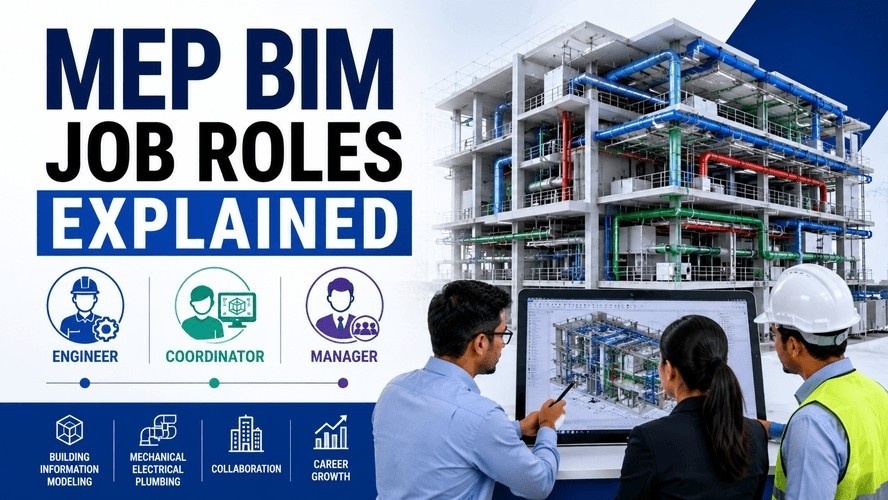
If you're an MEP engineer , or a mechanical, electrical, plumbing professional trying to figure out how BIM fits into your career , you've probably seen titles like "MEP BIM Coordinator" or "BIM Manager" on job listings and wondered: what's the actual difference between these? And more importantly, which one should I be targeting?
Here's the thing , these aren't just different names for the same job. Each MEP BIM role sits at a different level of responsibility, uses different tools, and requires a different kind of thinking. Confuse them and you'll either apply for the wrong role or, worse, hit a career ceiling because you don't know what you're working toward.
Let's break it down properly.
Also Read : MEP Engineer Career Path Roles & Responsibilities.
The MEP BIM Career Ladder at a Glance
Before going deep on each role, here's the three-tier picture:
| Role | Experience Level | Core Tool | Reports To | One-Line Scope |
| MEP BIM Engineer | 2–5 years | Revit MEP + engineering add-ins | MEP BIM Coordinator | System design integrity, technical modelling |
| MEP BIM Coordinator | 4–7 years | Navisworks + ACC | MEP BIM Manager | Clash detection, cross-discipline coordination |
| MEP BIM Manager | 7+ years | Full Autodesk ecosystem + Solibri | VDC/Project Director | BIM strategy, standards, BEP, team oversight |
And below all three sits the MEP BIM Modeler (0–3 years), who's converting 2D MEP drawings into basic 3D models , the entry point for most people coming into the field.
The progression isn't just about years in the seat. Each jump involves a genuine shift in what you're responsible for. An engineer focuses on the technical correctness of a system. A coordinator focuses on how that system fits with everything else. A manager focuses on whether the whole project is running by the right rules.
Also Read: What MEP BIM Modelling Actually Involves , Kaarwan
From MEP system modeling to clash detection and BIM execution, Kaarwan's MEP BIM certification prepares you for every tier of the MEP BIM career ladder. Apply today.
MEP BIM Engineer , Role & Responsibilities
What an MEP BIM Engineer Actually Does Day-to-Day
This is where the engineering knowledge really matters. An MEP BIM Engineer isn't just clicking through Revit , they're responsible for making sure the digital model actually reflects how a building's mechanical, electrical, or plumbing system would work in real life.
On a given day, an HVAC BIM Engineer might be modeling ductwork for a high-rise floor plate, running space analysis to confirm headroom clearances above a suspended ceiling, checking that AHU placements match the thermal load calculations, and flagging routes where the duct size doesn't match the designed airflow. It's engineering work done through software. The difference from traditional CAD is that every element in the model carries data , airflow rates, material specs, system connections , and that data has to be right.
A Plumbing BIM Engineer is working on drainage and water supply systems, making sure pipe slopes meet code requirements (drainage lines can't be modeled flat , gravity still applies inside Revit), coordinating shaft layouts with the structural and architectural teams, and generating plumbing schematics directly from the model.
An Electrical BIM Engineer is modeling cable trays, conduit routes, lighting layouts, switchboard positions, and coordinating with HVAC teams where ducts and cable trays compete for the same ceiling space. They're also producing circuit schedules and load layouts from model data.
The LOD (Level of Development) typically ranges from LOD 300 to LOD 350 at this stage , detailed enough for coordination, not yet fabrication-ready.
Read This : Career Growth Roadmap for MEP Engineers
Tools and Skills Required
Primary tool is Revit MEP , and you need to go beyond basic modeling. Family creation, system logic (especially for duct/pipe connections), parameter management, and the ability to interpret 2D engineering drawings are all expected.
Engineering add-ins like Autodesk Insight (for energy analysis) and Hevacomp integration for HVAC load calculations are increasingly used on larger projects. An MEP BIM Engineer who understands both the software and the engineering behind it is genuinely more valuable than someone who can only model.
Navisworks basics are worth knowing , you'll be exporting models for coordination and need to understand what a clash report is asking of you.
Who They Report To
An MEP BIM Engineer reports to the MEP BIM Coordinator. Their work feeds directly into the coordination process , they're responsible for keeping their discipline model accurate and up to date through design changes.
Also Explore: MEP BIM Coordination Tools and Workflows , Kaarwan
MEP BIM Coordinator , Role & Responsibilities
Core Scope
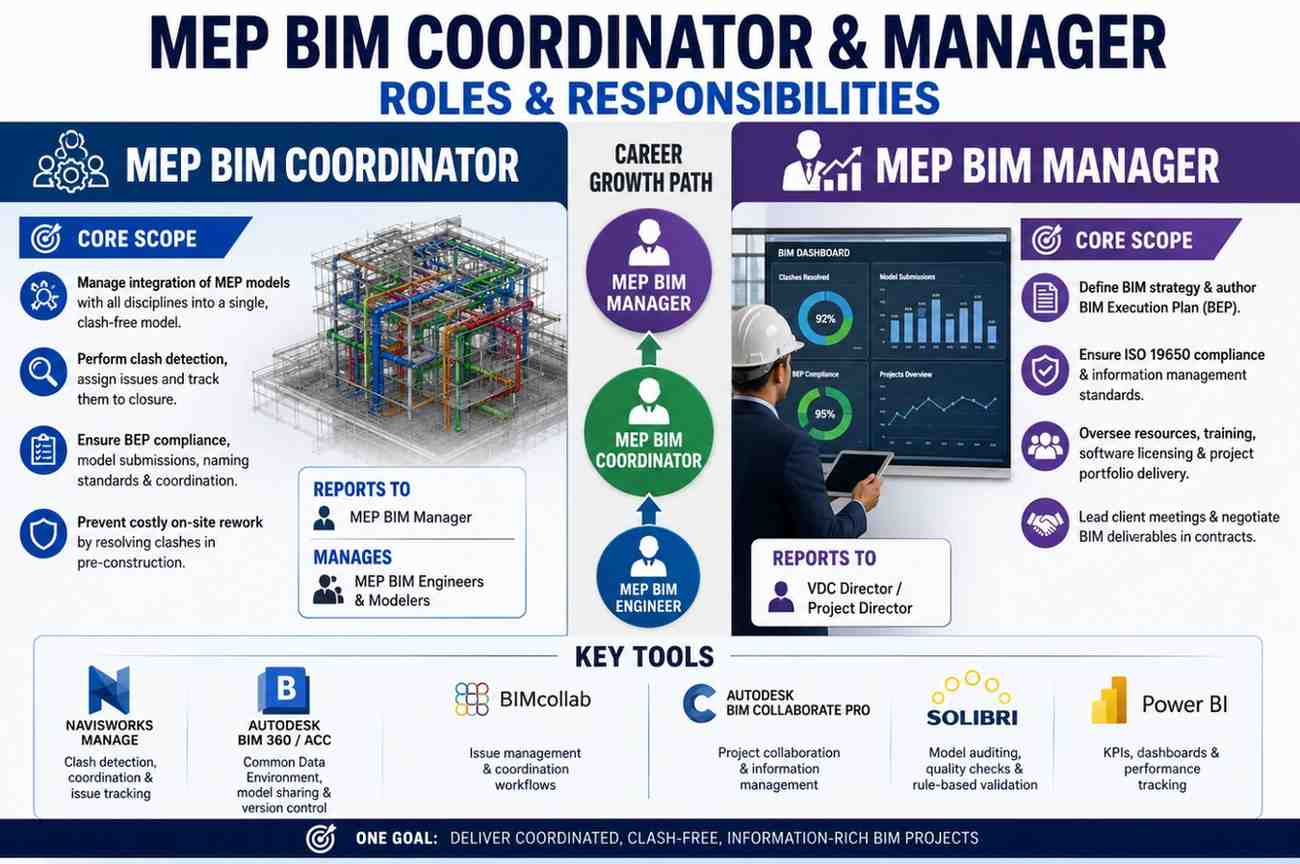
Here's where the job fundamentally shifts. The MEP BIM Coordinator isn't modeling systems , they're managing the integration of all systems, across all disciplines, into one coherent federated model. And then making sure nothing is crashing into anything else.
Their core job is clash detection. On a real project, the structural model, the architectural model, and the MEP models (HVAC, plumbing, electrical, firefighting , each often modeled by a different engineer or subcontractor) all get aggregated into a single environment. Navisworks is where this happens. The coordinator sets up clash tests, categorizes the results by severity, assigns resolution responsibilities to the relevant discipline teams, and tracks those issues through to closure.
Real clashes on commercial projects aren't rare edge cases. They're constant. A 600mm main supply duct conflicting with a primary structural beam. An electrical cable tray positioned where an HVAC maintenance panel needs to open. A plumbing riser that wasn't updated after the structural team revised a core wall position. The coordinator is the person who finds these before they show up on site , and site rework on services clashes can run into crores on larger projects.
BEP (BIM Execution Plan) compliance is also in the coordinator's domain at the project level. They're checking that models are being submitted on schedule, that naming conventions match what was agreed, and that the federated model is clean enough for contractor use.
A real-world example of the scale here: on major infrastructure projects in India (metro rail, airport terminals), MEP BIM Coordinators have been responsible for resolving hundreds of critical clashes in the pre-construction phase , clashes that would otherwise have required on-site rework costing multiples of what a coordination process costs.
Also Read : MEP Engineer vs MEP BIM Engineer
Tools
Navisworks Manage is the primary coordination environment. Setting up clash rules, running tests, generating reports, and tracking issues through BIMcollab or BIM 360 Issues , this is where most of the coordinator's technical time goes.
Autodesk Construction Cloud (ACC) / BIM 360 is the Common Data Environment where models get uploaded, versioned, and shared. Coordinators need to know how to manage the CDE , model drops, revision tracking, access control.
Clash matrices (which discipline's model gets checked against which, and at what tolerance) are something a coordinator develops and maintains. It's not a one-size-fits-all setup.
Who They Report To, Who Reports to Them
The MEP BIM Coordinator reports to the MEP BIM Manager. MEP BIM Engineers (and modelers across disciplines) report to them. The coordinator is also the day-to-day point of contact for architects, structural engineers, and other discipline leads on coordination matters.
Also Read: MEP BIM International Jobs in India 2026 , Kaarwan
MEP BIM Manager , Role & Responsibilities
Core Scope
The MEP BIM Manager is operating at a completely different altitude. They're not in Revit every day. They're not running clash tests. They're setting the framework within which all of that work happens , and making sure the framework holds across the entire project or across the firm's entire project portfolio.
This means authoring the BIM Execution Plan (BEP) , the document that defines how BIM will be delivered on a project: what software is used, what LOD is expected at each stage, who is responsible for what, how models are named and structured, what the coordination meeting cadence looks like, how information gets handed over to the client at project end. The BEP is the contract between the project team and the delivery process.
ISO 19650 compliance sits here. MEP BIM Managers at firms working on international projects need to understand the information management requirements of the ISO 19650 framework and make sure the project's CDE, workflows, and deliverables meet those standards.
They also handle the organizational side: software licensing decisions, training programs for modelers and coordinators, resource allocation across projects, and participating in client meetings to negotiate BIM deliverables in project contracts.
Autodesk Certified Implementation Expert or equivalent experience is expected at this level. The MEP BIM Manager is often who a client calls when there's a problem with the digital delivery strategy , not just a technical issue.
Tools and Strategic Responsibilities
Autodesk BIM Collaborate Pro and Solibri (for model auditing and rule-based quality checks) are typical at this level. The MEP BIM Manager might also be using PowerBI or similar tools to track coordination KPIs , percentage of clashes resolved, model submission timeliness, BEP compliance scores.
BEP authorship, software stack decisions, and staffing/resourcing are strategic-level responsibilities. This isn't just a senior coordinator , it's a leadership role with accountability for digital delivery outcomes.
Who They Report To
The MEP BIM Manager reports to the VDC Director or Project Director , the senior leadership level responsible for digital construction strategy across the organization or a major project program.
Also Read: Current MEP BIM Salary by Experience Level , Kaarwan
How the Reporting Line and Handoffs Actually Work
Here's the part nobody explains , how a model actually moves through these three roles on a real project. Let's walk it as one continuous story.
An MEP BIM Engineer receives updated design drawings from the mechanical consultant. They update the HVAC ductwork in Revit, including the latest AHU positions and duct sizing. They run an internal check , do the connections work? Are the pipe slopes correct? Is the LOD what the BEP requires at this stage? Satisfied, they export the model to the CDE and notify the coordinator.
The MEP BIM Coordinator pulls the updated HVAC model into Navisworks alongside the latest structural model (which was just updated with revised beam depths from the structural engineer). Runs the clash tests. Finds three hard clashes between structural beams and primary duct runs. Generates a clash report, assigns each clash to the HVAC engineer and the structural modeler respectively, with resolution deadlines aligned to the next coordination meeting.
The MEP BIM Manager receives a weekly coordination summary. Clash count has been creeping up over the last three model drops. They review the BEP , are models being submitted at the right frequency? Was the model structure correctly set up for this project phase? They adjust the coordination cadence, confirm the deliverable schedule with the client, and reallocate a second MEP engineer to support the HVAC model workload. They also prepare the monthly BIM compliance report for the client.
That loop , engineer refines, coordinator checks and flags, manager monitors and adjusts , runs continuously through the project until the final federated model is handed over to the client or contractor.
How to Move Up: Engineer → Coordinator → Manager
Engineer to Coordinator
The jump from MEP BIM Engineer to Coordinator isn't primarily about more modeling experience. It's about developing a coordination mindset , the ability to think across disciplines, not just within your own system.
What accelerates this transition:
- Getting comfortable with Navisworks Manage, not just Navisworks Simulate
- Understanding how models from other disciplines are structured and what their common problem areas are
- Leading coordination meetings (even informally at first) and developing the communication skills to drive issue resolution across teams
- Familiarity with BIM 360/ACC and CDE management
Realistic timeline: 4–7 years of combined MEP BIM experience, with at least 1–2 years where you've been actively involved in coordination workflows.
Certifications that help: Autodesk Certified Professional for Navisworks is the most relevant. Autodesk's ACC product certifications are increasingly recognized on project specs.
Also Explore: MEP BIM Certification Path , Kaarwan
Coordinator to Manager
The shift to BIM Manager requires leadership skills that are genuinely different from technical proficiency. You need to be able to author a BEP from scratch, present a BIM strategy to a client, manage a team of engineers and coordinators, and make software and resourcing decisions that affect project outcomes.
ISO 19650 training is almost essential at this level , it's the international framework that most large-project clients now require compliance with.
Realistic timeline: 7+ years total BIM experience, with proven delivery on at least two large-scale, multi-discipline projects.
For a full picture of salary expectations at each level in India, Kaarwan's current MEP BIM salary by experience level breaks it down by role and city.
MEP BIM Roles vs. Generic BIM Roles , What's Different
One thing worth flagging: MEP BIM roles are not the same as generic BIM Coordinator or BIM Manager roles, even though the titles look similar.
The difference is discipline depth. An MEP BIM Coordinator is specifically managing the mechanical, electrical, and plumbing systems within a federated model , they need to understand how HVAC ductwork routes around structural elements, where electrical cable trays conflict with sprinkler pipework, what drainage slope requirements mean for vertical coordination space. A generic BIM Coordinator might work across architectural or civil deliverables without needing any of that MEP-specific knowledge.
Similarly, an MEP BIM Manager is setting strategy for MEP system delivery within a BIM environment , which is different from a BIM Manager overseeing architectural or infrastructure digital delivery.
For BIM roles across architecture, civil, and other disciplines, those sit on a different track. And for what a BIM Engineer's career path looks like outside MEP, the tools and progression look similar in structure but different in discipline focus.
If you're an MEP engineer, the MEP-specific track is almost always the right one to follow. The engineering fundamentals you already have , understanding HVAC systems, electrical load logic, drainage physics , are a genuine advantage. You're not starting from zero on the domain knowledge. You're adding BIM process skills on top of something you already know.
Ready to Move Into MEP BIM?
Kaarwan's MEP BIM course covers Revit MEP, Navisworks coordination, and real project workflows , giving you the exact skills MEP BIM employers are looking for. Explore now.
Closing Thoughts
MEP BIM is one of the clearest career ladders in the AEC industry right now. The roles are well-defined, the tools are industry-standard, and the demand , particularly for coordinators and engineers , consistently outpaces the supply of trained professionals in India and internationally.
The path from modeler to engineer to coordinator to manager isn't easy, but it's learnable. What makes the difference isn't years of time served , it's understanding what each role actually requires and deliberately building those specific skills. An engineer who learns coordination workflows moves up faster. A coordinator who develops strategic thinking and BEP authorship skills becomes a manager.
The MEP BIM career path rewards people who understand both the engineering and the process. If you've got the MEP background, building the BIM side of that equation is the investment that opens the next level.
Looking to build MEP BIM skills that are ready for the coordination and engineering roles the industry is actually hiring for? Kaarwan's MEP BIM programme is designed around real project workflows , not just software tutorials.
FAQ
What is the difference between an MEP BIM Engineer and MEP BIM Coordinator?
An MEP BIM Engineer works within a single discipline , modeling HVAC, electrical, or plumbing systems in Revit and ensuring those systems are technically correct, code-compliant, and constructable. An MEP BIM Coordinator manages the integration of all discipline models (architectural, structural, MEP) into a federated environment, runs clash detection, and drives resolution of spatial conflicts across teams. The engineer is responsible for the accuracy of their model; the coordinator is responsible for how all models work together. The tools reflect this: engineers primarily use Revit MEP, while coordinators work mainly in Navisworks and Autodesk Construction Cloud.
Does an MEP BIM Manager need to know Revit?
Yes, but not at a production level. An MEP BIM Manager should understand Revit well enough to review model quality, author BEP standards for Revit-based workflows, make informed decisions about template structure and family standards, and troubleshoot issues that engineers escalate. They won't typically be modeling ductwork or updating plumbing systems day-to-day , that's the engineer's job. The BIM Manager's technical focus is more on the overarching ecosystem: model auditing tools like Solibri, CDE platforms like Autodesk Construction Cloud, and data management standards like ISO 19650.
How long does it take to go from MEP BIM Engineer to Coordinator?
Realistically, 4–7 years of total experience, with at least 1–2 years actively involved in coordination workflows. The transition isn't primarily driven by time , it's driven by exposure to multi-discipline coordination processes, proficiency in Navisworks Manage (not just Simulate), and the development of communication and meeting facilitation skills. Engineers who actively seek out coordination responsibilities on their current projects , even informally , tend to make this jump faster than those who stay focused purely on modeling.
Is MEP BIM Coordinator the same as a general BIM Coordinator?
Not exactly. A general (non-MEP-specific) BIM Coordinator might work across architectural or civil deliverables, managing model coordination without needing deep MEP system knowledge. An MEP BIM Coordinator is specifically managing the coordination of mechanical, electrical, and plumbing models , which requires understanding MEP system logic, routing constraints, code requirements, and how MEP services interact with structural and architectural elements. The tools overlap (Navisworks, ACC), but the domain expertise is different. On large projects, you'll often see both a general BIM Coordinator and discipline-specific MEP coordinators working in parallel.
What software does each MEP BIM role use?
MEP BIM Engineers primarily use Revit MEP, along with engineering analysis add-ins and occasional AutoCAD for 2D reference. MEP BIM Coordinators work mainly in Navisworks Manage for clash detection, Autodesk Construction Cloud (ACC) or BIM 360 for the CDE and issue tracking, and BIMcollab or BCF-compatible tools for collaborative clash resolution. MEP BIM Managers use the full Autodesk ecosystem at an oversight level, plus model auditing tools like Solibri, data management platforms, and increasingly PowerBI or similar for BIM performance reporting. Dynamo (visual scripting within Revit) is valuable across all levels for automating repetitive tasks , at engineer level for model automation, at coordinator level for batch checking, and at manager level for standards enforcement.