-(1).jpeg)
Why OpenBIM Matters in Today’s AEC Industry
OpenBIM is a BIM methodology that enables all teams, including architects, structural engineers, MEP engineers, and contractors, to share data across platforms. This is made possible through open standards like IFC and BCF. The guide below will explain what the
OpenBIM workflow is, how it works gradually, and why it is raising the standard of modern construction projects. So, if you’re new to BIM entirely, you can start here with our BIM beginner’s guide.
“openBIM is not about one tool or one workflow—it’s about freedom of choice and open collaboration.” — buildingSMART International

What is OpenBIM?
OpenBIM refers to a standard approach to Building Information Modelling based on open and neutral standards that are primarily based on IFC (Industry Foundation Classes). This also allows any compatible software to read, write and exchange any project data without losing information.
In traditional, closed BIM environments, all project teams are expected to make use of the same vendor’s software. A classic example to explain this would be: Think of an architect who is well acquainted with Autodesk Revit and a structural engineer who is using Tekla, who cannot exchange a native file without losing all the data or manually recreating it. This further leads to inefficiencies, errors and expensive work.
OpenBIM eliminates this barrier, offering an entire team to export their model to IFC format using Revit. These teams can also use software like ArchiCAD, Tekla or Bentley to open and work with the same data accurately.
The standards that make this achievable are maintained and developed by buildingSMART International. This is a renowned global organisation that defines how BIM data is structured, shared and validated across all software platforms.
OpenBIM is not a single software or tool. It is more of an approach that gives project teams the freedom to choose and safeguard project data, ensuring it remains usable throughout its lifecycle.
The OpenBIM Workflow Step by Step
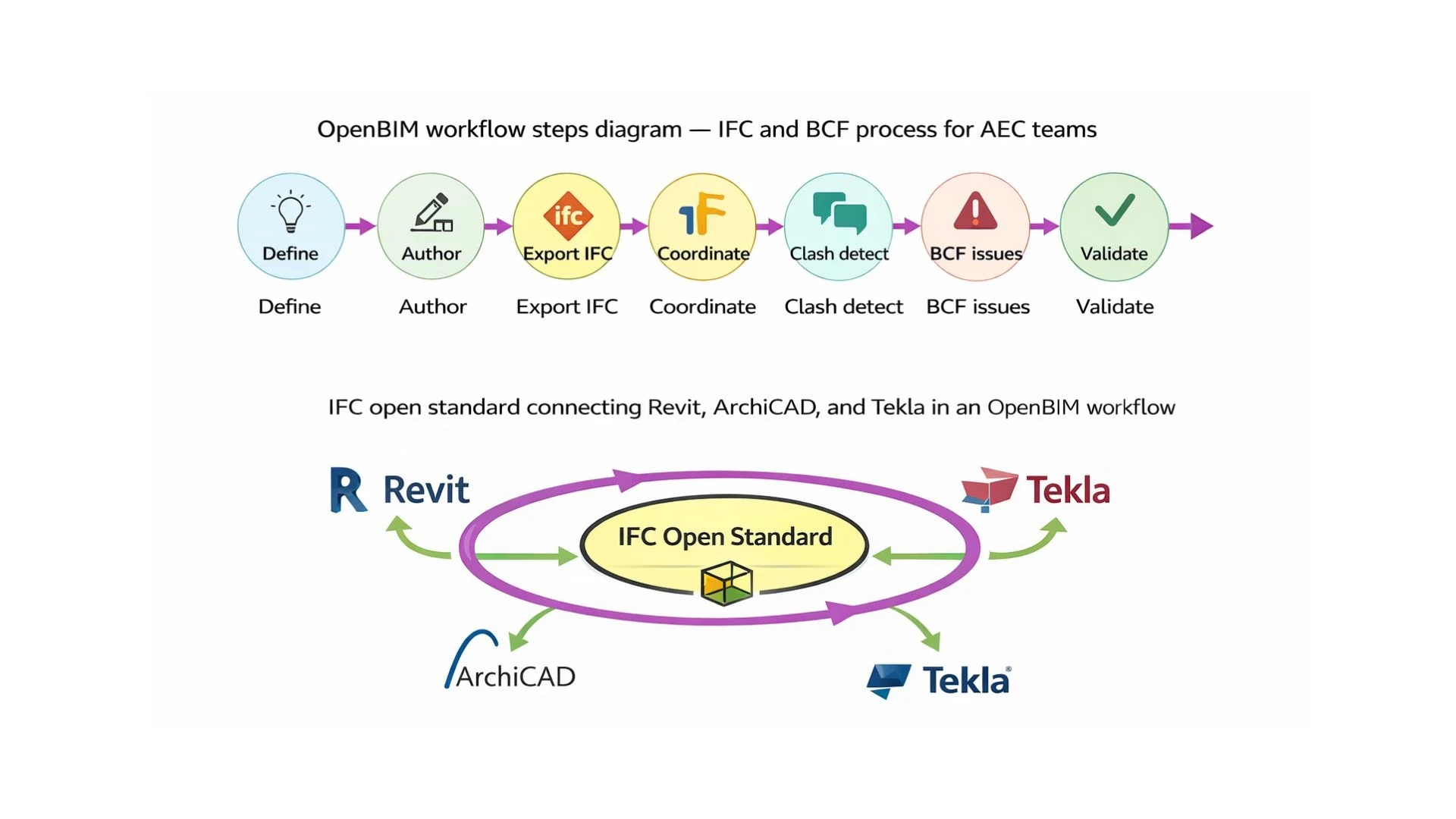
The openBIM workflow is proof of how information transcends between disciplines, tools and project staff using open standards at every exchange point. There indeed is no single method, but the steps listed below represent the core sequence most teams refer to on multi-disciplinary projects.
Step 1: Define Information Requirements: Before any modelling, the project team agrees on what data each discipline needs to pass on, when it is required, and in what format. This is later documented in a BIM Execution Plan (BEP).
Step 2: Author models in discipline-specific software: Each discipline works in the tool that’s best suited for their job. An architect uses software like ArchiCAD or Revit, a structural engineer models in Tekla, and an MEP engineer uses their preferred software. This proves that there is no common platform or software that must be used.
Step 3: Export to IFC format: At certain agreed intervals, each discipline exports its model to IFC, which is an open data format that all major BIM tools support. This is the point where the openBIM workflow makes cross-collaboration easy breezy.
Step 4: Coordinate models in a Common Data Environment (CDE): The IFC models from different disciplines are uploaded to a shared board such as BIM 360, Trimble Connect, or a similar CDE. This is the platform where models are integrated into a single view.
Step 5: Run clash detection: The integrated model is analysed for clashes or points where structural elements, pipes, ducts or other structural components from different disciplines land in conflicts. Clash detection at this step prevents costly on-site errors.
Step 6: Issue tracing using BCF: Identified issues are shared using BCF (BIM Collaboration Format), which is an open format that allows teams to comment, assign and resolve model issues irrespective of the software that they are using.
Step 7: Validate IFC and prepare for handover: Before the entire handover happens to the client or facility manager, the IFC model is validated against the project’s information requirements. This promises complete, accurate and usable data delivery for better asset management.
On large-scale infrastructure projects like rail development in India, this open BIM system allows fifteen or more consultants to coordinate from a single integrated model. It doesn’t matter what software is being utilised; this can happen without converting every file manually. To understand the implementation of this process in your project, you can refer to our BIM implementation guide.
Key OpenBIM Standards: IFC and BCF Explained Simply
The OpenBIM workflow is built on two crucial open standards. Understanding what they are and what they do is pivotal for any AEC professional working on any collaborative projects.
What is IFC (Industry Foundation Classes)?
IFC is the open, ISO-certified data format that contributes to the backbone of every OpenBIM workflow. It justifies how BIM data, including factors such as geometry, properties, relationships, and metadata, is structured so that any IFC-compatible software can read it precisely.
The moment an architect exports their Revit model to IFC, and a structural engineer opens it in Tekla, they are using IFC to transfer data. IFC helps avoid unnecessary file conversion, no manual re-entry, and no data loss. IFC is maintained by buildingSMART International and is the nearest thing the AEC industry has to a universal BIM language.
What is BCF (BIM Collaboration Format)?
BCF is an open format developed specifically for issue tracking and coordination in a BIM environment. When a clash is observed or a design question needs a quick resolution, a BCF issue can be created with a screenshot, a comment, and a reference to the exact location in the model. This can then be shared with any team member, regardless of the software they are using.
BCF eliminates the need for long email threads and disconnected mark-up documents. It keeps coordination inside the model, where everyone can access it.
Open BIM vs Closed BIM — What Is the Difference?
The choice between open and closed BIM affects how your entire project team collaborates. Here’s a clear comparison:
| Factor | Open BIM | Closed BIM |
| Data format | IFC, BCF — open standards anyone can use | Proprietary (.rvt, .pln etc) — vendor specific |
| Software flexibility | Any software that supports IFC | All teams must use the same vendor's tools |
| Collaboration | Multi-discipline, multi-software teams | Single software ecosystem only |
| Best for | Large projects with multiple firms | Small in-house teams using same software |
| Risk | Interoperability gaps if IFC export is not configured correctly | Vendor lock-in risk |
OpenBIM standards allow project teams the freedom to utilise the BIM software that’s best suited to their discipline without giving up on coordination. Closed BIM keeps everything inside a single vendor’s ecosystem, which works exceptionally well for in-house teams, but can create serious restrictions on large, multi-firm projects.
Most large Indian government and infrastructure projects are now transitioning towards openBIM as mandated interoperability requirements keep on increasing. For most AEC professionals in India today, learning OpenBIM workflows is the most valuable long-term investment.
Benefits of Using an OpenBIM Workflow
Adopting an openBIM workflow delivers measurable benefits across a complete project lifecycle and not just during the design coordination stage.
Reduced rework: When all disciplines share data through IFC, errors caused by manual file transfers or incompatible formats are struck off. Teams detect clashes in the model rather than on site, where fixing them might cost them more.
Better coordination across disciplines: The federated model offers every discipline, including architecture, structure, MEP and civil, a single and collaborative view of the project. Decisions made in one discipline are immediately accessible to all stakeholders.
Software Freedom: Firms are not locked into a single vendor’s tools. Each team utilises the software it can use in the best way, and openBIM standards ensure the data works across all of them.
Long-term data accessibility: Because IFC is an open, ISO-certified format, project data remains accessible even as software platforms change or vendors discontinue products. This is critical for asset owners managing buildings over decades.
Smoother handover to facility managers: At project completion, an IFC model validated against the project's information requirements gives facility teams accurate, structured data for maintenance, operations, and future renovations — without needing the original authoring software.
Modern digital construction projects demand transparency, scalability, and data that outlasts any single software platform. The open BIM workflow delivers all three.
Conclusion: Rethinking Workflows in an Open BIM World
Rather than searching for a single ideal openBIM workflow, AEC professionals should focus on adaptable, standards-based processes. openBIM is a mindset that prioritises collaboration, flexibility, and long-term value. When used thoughtfully, open BIM processes empower teams to deliver better, smarter, and more resilient projects.
For professionals looking to build these skills in a structured way, Kaarwan offers learning opportunities such as the BIM for Architects and Master Revit program, designed to introduce practical BIM workflows and real-world applications aligned with openBIM principles.
FAQs
1. What is an openBIM workflow?
An openBIM workflow refers to any BIM process that uses open standards to enable collaboration across different software platforms.
2. Is there a standard openBIM workflow for all projects?
No. Each project defines its own workflow based on requirements and tools.
3. Who develops openBIM standards?
They are developed by buildingSMART International.
4. Why are IFC standards important?
IFC standards enable reliable data exchange between BIM tools.
5. How does openBIM improve collaboration?
It allows multiple stakeholders to work together without software restrictions.
6. Is openBIM only for large projects?
No, it’s equally beneficial for small and medium-scale projects.
7. Can proprietary BIM tools support openBIM?
Yes, many tools support openBIM through IFC export/import.
8. Does openBIM reduce project risks?
Yes, by improving data clarity and reducing miscommunication.
9. Is openBIM future-proof?
Yes, open standards ensure long-term data accessibility.
10. How can professionals learn openBIM effectively?
Through structured BIM courses that focus on standards, workflows, and real-world use cases.