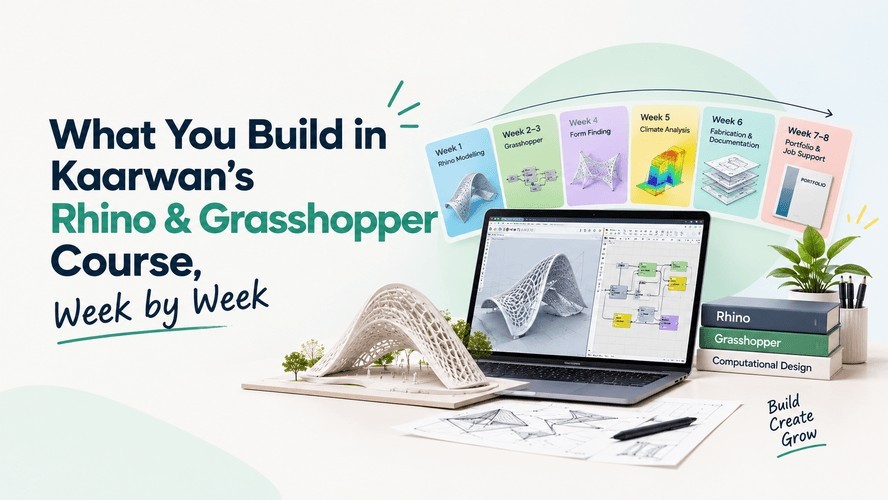
Kaarwan's Rhino & Grasshopper course runs 6+2 weeks, live online.
Here's what you build: Rhino modelling in Week 1, your first Grasshopper definitions in Weeks 2 and 3, form-finding in Week 4, climate analysis in Week 5, fabrication-ready drawings in Week 6, then a portfolio and job support in Weeks 7 and 8.
Most course pages describe the format and stop there. Few tell you what you'll have made by the end of each week. This guide walks through the rhino grasshopper course projects deliverable by deliverable, and goes deeper than the full course overview and format.
The course is led by Jerwin Geo, an architect and computational designer who is a visiting lecturer at the University of Hertfordshire and the University of Salford.
Also Read : 10 Benefits of Learning Rhino and Grasshopper for Parametric Design
What Will I Learn in a Grasshopper Course? The Eight Weeks at a Glance
Six weeks of skills, two weeks of portfolio. Here's the map before we zoom in on each stop.
| Week | Skill certificate | What you'll have made |
| 1 | Advanced Modelling in Rhino | NURBS surfaces with checked continuity, a subdivision model, a realistic render |
| 2 | Foundational Grasshopper for Parametric Design | A working definition that builds 3D objects from lists and data trees |
| 3 | Advance Grasshopper for Algorithmic Design | A paneled, tessellated surface driven by your own inputs |
| 4 | Form Finding Exploration | A form that finds its own shape through live simulation |
| 5 | Environmental Analysis and Generative Design | A climate and radiation study that feeds back into the design |
| 6 | Fabrication and Documentation | Fabrication-ready files and 2D drawings pulled from a Grasshopper model |
| 7–8 | Portfolio and job support | A Behance-ready portfolio and interview preparation |
That's the grasshopper course curriculum in one glance. Now the interesting part.
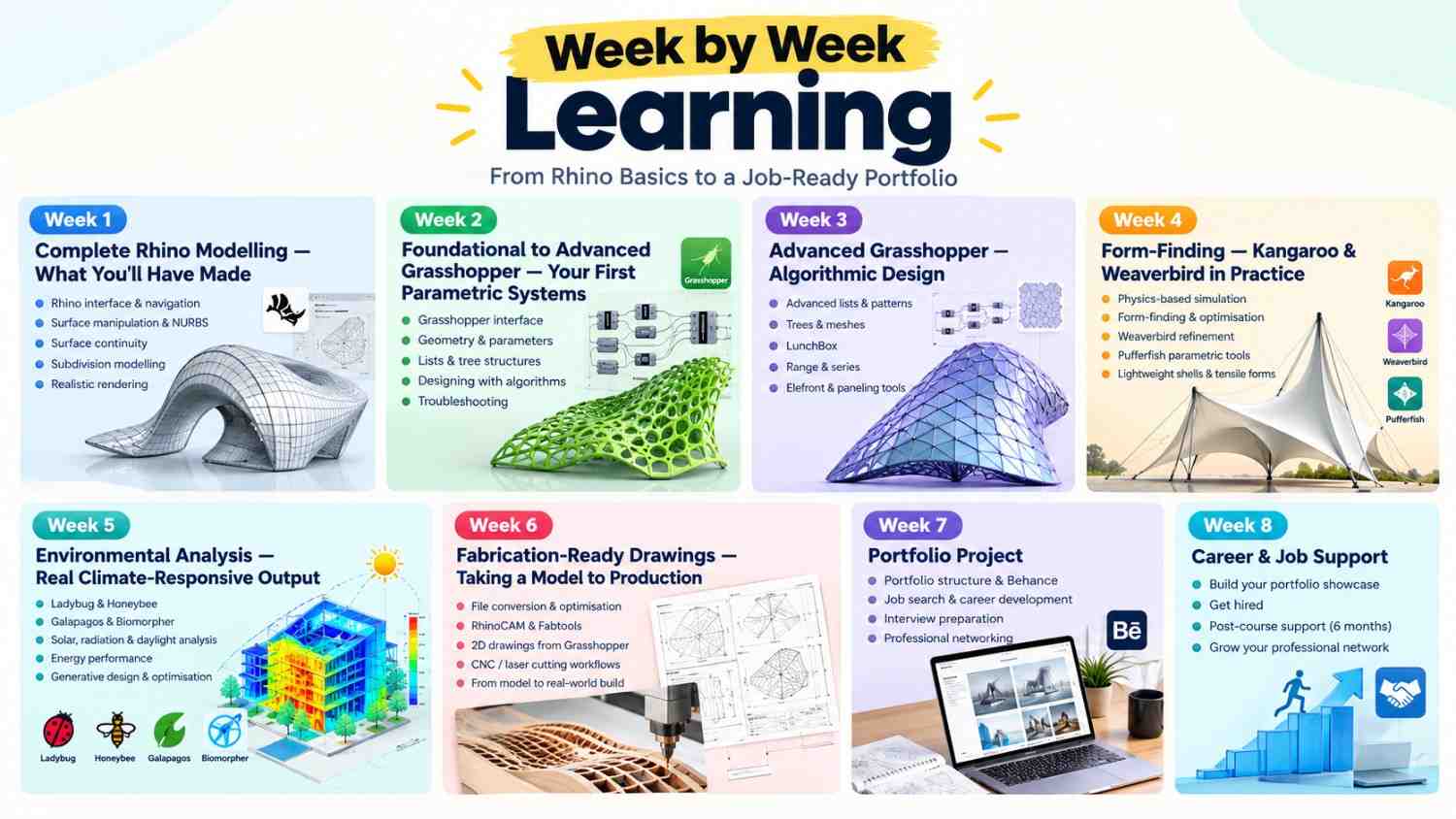
Week 1: Complete Rhino Modelling - What You'll Have Made
Week 1 ends with clean, continuity-checked NURBS surfaces, a subdivision model, and a rendered view you'd actually show someone.
The week starts with the Rhino interface and moves through surface manipulation, NURBS, surface continuity, subdivision modelling and realistic rendering. If you came up through AutoCAD or SketchUp, like a lot of us in Indian colleges, this is where the jump to freeform happens. Surface continuity sounds dry until a loft refuses to go smooth the night before a jury. Then it's the only thing that matters.
This maps to the Advanced Modelling in Rhino skill certificate. It's also the base for everything after. If you're curious why the pairing works so well, here's a look at how Rhino and Grasshopper work together.
Weeks 2–3: Foundational to Advanced Grasshopper - Your First Parametric Systems
By the end of Week 2 you'll have a working definition that builds 3D objects from lists and data trees, and you'll know how to debug it when it breaks.
It will break. Everyone's does. The week covers the Grasshopper interface, geometry and parameters, lists, tree structures, designing with algorithms and troubleshooting. Trees are where most beginners hit the wall. If you want to warm up before enrolling, practice these same skills before you enroll.
This maps to the Foundational Grasshopper for Parametric Design skill certificate.
Week 3 is where it starts feeling like design. You'll finish with a paneled, tessellated surface where the pattern responds to your inputs. The week covers advanced lists and patterns, trees and meshes, LunchBox, range and series, Elefront and paneling tools. This is also where the workflow automation side of Grasshopper starts paying off. Change one slider and fifty panels update, instead of fifty hours of redrawing.
This maps to the Advance Grasshopper for Algorithmic Design skill certificate.
Want the full week-by-week syllabus with software setup and assessment details? Download it from the course page, or enroll if you're ready to start building.
Week 4: Form-Finding - Kangaroo and Weaverbird in Practice
Week 4 gives you a form you didn't draw. You set the forces and the form settles into a shape on its own.
That's grasshopper kangaroo form finding. Kangaroo is a live physics engine inside Grasshopper for simulation, optimization and form-finding. Weaverbird smooths and refines the result, and Pufferfish adds more parametric tools to play with. Form-finding was pioneered by people like Antoni Gaudí, Frei Otto and Heinz Isler, who let physical simulation reveal the shape a material wants to take. You do the digital version, with real-time feedback as you push and pull. Lightweight shells and tensile forms also save material, which matters on Indian sites where every bag of cement is counted.
This maps to the Form Finding Exploration skill certificate.
Also Read : Top Rhino Architecture Projects You Should Know in Parametric Design
Week 5: Environmental Analysis - Real Climate-Responsive Output
Week 5 ends with a design that has been tested against sun, radiation and climate, then adjusted because of what the numbers said.
You work with Ladybug and Honeybee, then move into Galapagos and Biomorpher for generative optimisation. Skeleton Fattener and LunchBox handle the geometry side. This is ladybug honeybee environmental analysis, and it should matter to you if you're building in India. The country spans five climatic types, and a facade that works in Jaipur can fail badly in Chennai.
Policy is catching up too. The Bureau of Energy Efficiency's ECSBC 2024 builds on ECBC 2017 and covers commercial buildings with a connected load of 100 kW or more, or a contract demand of 120 kVA or more, with states adopting it. Knowing how to show energy and daylight performance is becoming part of the job. The tools are friendly to student budgets as well. Ladybug is free and open source, and it reads standard EnergyPlus weather files. Honeybee connects Grasshopper to EnergyPlus, Radiance, Daysim and OpenStudio. If you want the bigger picture on optimisation, there's more on generative design in Rhino.
This maps to the Environmental Analysis and Generative Design skill certificate.
Also Read : Key Design Features in Grasshopper for Parametric Architecture
Week 6: Fabrication-Ready Drawings - Taking a Model to Production
Week 6 gives you files a fabricator can actually use and drawings pulled out of your Grasshopper model.
A model that only lives on your screen isn't finished. The week covers file conversion and optimisation, RhinoCAM and Fabtools for more complex workflows, and translating Grasshopper models into 2D drawings. This is the step that gets a CNC shop or laser-cutting vendor to take your file seriously, whether they're in Delhi, Pune or Coimbatore. It's also what separates a pretty render from something you can build.
This maps to the Fabrication and Documentation skill certificate.
Also Read: Parametric Architecture with Rhino and Grasshopper
Weeks 7–8: The Portfolio Project That Comes Out of All of This
Weeks 7 and 8 turn six weeks of work into a portfolio you can send out. You cover portfolio structure and building one on Behance, job search and career development, interview preparation, and building a professional network.
Kaarwan's course page says you need a score of 750 out of 1000 to build your Kaarwan portfolio. It also lists six months of post-course job assistance. You can see what learners produce in the course page's showcase, like Aravinth's "Twisted Tunnel," a twisted, curved form built in Rhino. The same page lists learner transitions, including an architect with one year of experience who moved into a computational designer role at Morphogenesis. Your outcome depends on your portfolio and your effort, so treat these as examples rather than promises.
Rhino Grasshopper Course Syllabus: What's in the Full Version
This post shows you the outcomes. The full syllabus adds software setup and assessment details. You can download it from the course page for the Rhino & Grasshopper certification, and it's worth reading before you decide.
Also Read : How Grasshopper Software Is Changing Modern Architecture
Three Things to Walk Away With
- Each week has a concrete output, not just a topic list. Modelling, definitions, a form-found shape, an analysis, fabrication files, a portfolio.
- The order matters. Rhino first, Grasshopper logic second, then simulation, analysis and fabrication built on top.
- The weeks are mapped to named skill certificates, which gives you something specific to show employers.
Not ready for eight weeks yet? Kaarwan's Parametric Modelling in Rhino masterclass covers core parametric skills in a single session, a lighter first step.
FAQs
What projects do you build in a Grasshopper course?
In Kaarwan's course, each week has its own output. You build Rhino surface and subdivision models, then Grasshopper definitions and paneled surfaces, a form-found structure, an environmental analysis, and fabrication-ready files and drawings. Weeks 7 and 8 turn this into a portfolio.
Is there a final portfolio project in the Rhino & Grasshopper course?
Yes. Weeks 7 and 8 are built around the portfolio: structure, building one on Behance, interview preparation and networking. The course page also ties the Kaarwan portfolio to a score of 750+ out of 1000.
How much of the course is hands-on vs theory?
The curriculum is software-led. Every week is a tool or workflow rather than a theory topic, and the course also includes module-wise quizzes to check your understanding. Sessions are live online.
Can I see example student work from this course?
Yes. The course page features a "Parametric Design Projects by Our Learners" section, including Aravinth's "Twisted Tunnel" portfolio piece. Ask the counselling team for more examples from recent batches.