ASHRAE stands for the American Society of Heating, Refrigerating and Air-Conditioning Engineers - a mouthful, so everyone just says ASHRAE. It's been around since 1959 (born from a merger of two older engineering societies), and today it's less "American" and more genuinely global, with members across 130+ countries. It writes the technical standards, guidelines, and handbooks that most of the world's HVAC design software, textbooks, and building codes quietly lean on.
Now, why should a student or early-career MEP engineer in India care? A few honest reasons:
- Most hvac design standards taught in engineering colleges - load calculation methods, ventilation rate tables, comfort ranges - trace straight back to ASHRAE research, even when the course doesn't say so out loud.
- If you're eyeing a Gulf posting (and a lot of Indian MEP engineers eventually do), ASHRAE isn't a nice-to-have. It's often the actual reference standard written into the contract documents.
- Recruiters treat it as a credibility marker. Not a magic ticket, but a signal that you understand the "why" behind a design choice, not just the "how."
It also connects directly to the broader MEP discipline these standards govern - mechanical, electrical, plumbing, all pulling from overlapping rulebooks that eventually need to agree with each other on-site.
Also Read: What Is MEP BIM Modelling? Beginner Guide, Workflow & Career Scope
ASHRAE 62.1: Ventilation and Indoor Air Quality
This is the one you'll bump into constantly. ASHRAE 62.1 sets minimum ventilation rates for commercial and institutional buildings - how much outdoor air needs to come in per person, per square foot, depending on what the space is being used for. A classroom needs different fresh air rates than a server room. A hospital corridor is its own animal entirely (that's actually a separate standard, 170, which we'll touch on).
What 62.1 is really trying to prevent is what people in the industry still half-jokingly call "sick building syndrome" - stale, recirculated air building up CO2, VOCs, moisture, whatever else, until occupants start getting headaches and nobody can figure out why. The standard gives you two main routes to compliance: the Ventilation Rate Procedure (a more prescriptive, table-driven method) and the IAQ Procedure (which lets you get a bit more creative if you can demonstrate the outcome). Recent editions have also folded in demand-controlled ventilation logic and humidity thresholds, which matters more than it sounds like in a humid Indian climate where mould growth is a genuine design risk, not a theoretical one.
ASHRAE 90.1: Energy Efficiency Requirements
If 62.1 is about breathable air, 90.1 is about the electricity bill - and, increasingly, the planet. It's the baseline energy standard for commercial buildings (everything except low-rise residential), covering HVAC equipment efficiency, insulation, lighting power density, and controls like economizers and setback schedules.
Here's a fun tension that trips up a lot of new engineers: 90.1 wants you to bring in less outdoor air (because conditioning fresh air costs energy), while 62.1 wants you to bring in enough for health and comfort. Good design lives in that gap. That's literally what energy recovery ventilators exist to solve - pulling heat or coolness out of the exhaust air stream before it leaves the building, so you're not throwing away conditioned air for nothing. It's a small mechanical trick with a genuinely large cost impact, and it's the kind of thing that separates "the calculations were technically correct" from "this design actually makes sense."
Know the standards, want to apply them? Kaarwan's MEP BIM Certification Programme turns ASHRAE-grounded HVAC concepts into hands-on Revit MEP modelling and coordination work you can show employers.
Other Standards Worth Knowing
You don't need to memorize the entire ASHRAE index - nobody does, not even senior engineers. But a few names are worth recognizing when they show up:
- ASHRAE 55 - thermal comfort. Temperature, humidity, air speed, clothing insulation, all combined into a framework for "will people actually feel okay in this room."
- ASHRAE 189.1 - the green building standard, layering sustainability requirements on top of 55, 62.1, and 90.1 for LEED-adjacent or net-zero-focused projects.
- ASHRAE 15 & 34 - refrigerant safety and classification. Increasingly relevant as the industry shifts toward lower-GWP A2L refrigerants.
- ASHRAE 170 - ventilation specifically for healthcare facilities, where air pressure relationships between rooms can literally be a matter of infection control.
Worth knowing the names exist. Worth going deep on 62.1 and 90.1 first, since those are the two you'll actually be applying week to week.
Also Read: MEP Drawings in Construction - Types, Purpose & Complete Guide
ASHRAE vs ECBC vs NBC India: How the Standards Relate
Alright, the part people actually search for and rarely get a straight answer on.
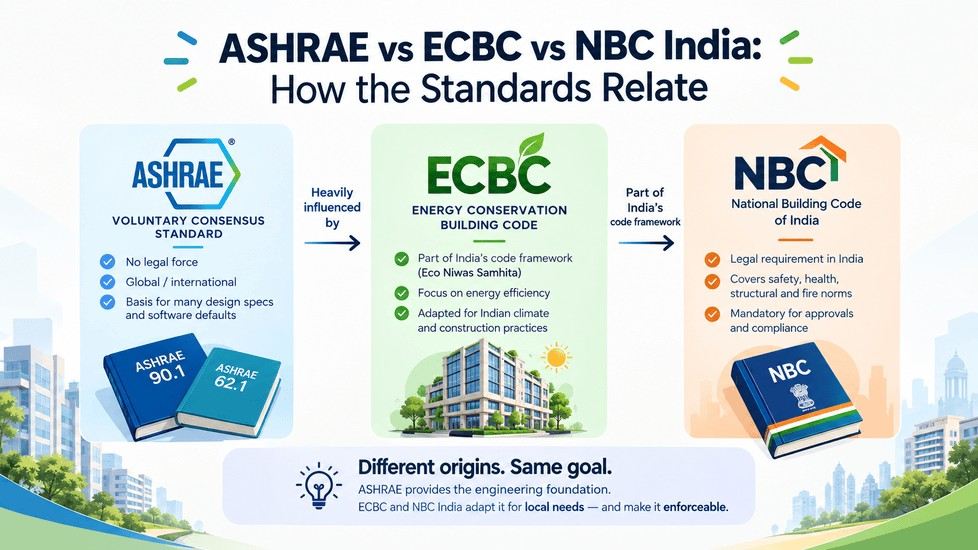
India has its own codes - the National Building Code (NBC) and the Energy Conservation Building Code (ECBC, now folded into the broader Eco Niwas Samhita / ECBC framework for various building types). These are the ones with actual legal teeth in India. ASHRAE has none, technically - it's a voluntary consensus standard developed by an American professional body.
So why does everyone keep talking about it here? Because ECBC and NBC were, in large part, built with heavy reference to ASHRAE 90.1 and 62.1 during their drafting. They're not identical twins, but they're clearly related - similar structure, similar logic, calibrated in places for Indian climate zones and construction practices instead of North American ones. Ventilation rate tables, for instance, might carry different numbers between NBC and 62.1 because they were adapted for local occupancy density assumptions.
The honest way to frame it, if you're working in India: NBC and ECBC are what governs your compliance and your approvals. ASHRAE is what most of the underlying engineering theory, the international project specs, and a chunk of the design software defaults are still built on. Knowing both - and knowing where they diverge - is genuinely more valuable than treating ASHRAE as some universal law that overrides local code. It doesn't. It just happens to be the shared ancestor of a lot of what came after.
Where ASHRAE Matters Most: Gulf and Premium Indian Projects
This is where the career math actually gets interesting. On a mid-tier residential project in a Tier 2 Indian city, you might barely reference ASHRAE by name - NBC and local municipal rules carry the day. But the moment you're working on a Gulf-based project - Dubai, Doha, Riyadh - ASHRAE standards are frequently written directly into the design brief, sometimes verbatim, because the Gulf construction industry leans heavily on international (largely American and British) reference standards.
Same goes for premium commercial builds in India chasing LEED or IGBC certification, hospitals with strict IAQ requirements, or data centres where ASHRAE's own thermal guidelines for IT equipment rooms (yes, that's a real ASHRAE publication too) get referenced directly. It's also part of why firms list ASHRAE credentials as a hiring signal - not because a certificate makes you a better engineer overnight, but because it tells a hiring manager you've already done the reading they'd otherwise have to walk you through.
A quick real-world flavor of this: a consultant working on a mid-rise office tower in Bengaluru told me they'd size the HVAC per ECBC for the compliance filing, then quietly cross-check the outdoor air numbers against 62.1 because the client - an MNC - wanted the building to "read" as internationally benchmarked for their global facilities team. Two rulebooks, one building, and the engineer needed fluency in both to not look lost in that conversation.
Also Read: BIM Course in India 2026 | Complete Guide for Architects & Engineers
Still choosing your specialization? If ventilation, energy codes, and system coordination genuinely interest you, Kaarwan's MEP BIM track builds the practical software fluency that pairs with this standards knowledge.
How to Get Started with ASHRAE Membership and Resources
Joining ASHRAE isn't expensive relative to what it unlocks - access to their handbooks, technical committees, local chapter events (India has active chapters in most major cities), and the option to eventually pursue certifications like the Building Energy Assessment Professional or Healthcare Facility Design Professional credentials down the line.
Membership itself isn't a certification - it's more like joining a professional community that happens to also gatekeep some seriously useful technical documents.
For someone still building their HVAC systems knowledge base, the practical order tends to be: understand the equipment and systems first, then layer the standards on top so you know why a chiller is sized the way it is or why a duct run has the CFM it does. Standards without system context tend to just feel like memorized trivia.
Also Read: Top MEP BIM Courses in India (2025)
Understanding the standards is genuinely step one. Applying them in an actual Revit MEP model, coordinating clashes, sizing ductwork against real project constraints - that's a different skill entirely, and it's where BIM coordination puts these standards into actual practice rather than leaving them as textbook theory.
FAQs
Is ASHRAE certification the same as ASHRAE membership?
No. Membership just means you've joined the society and get access to its resources and community. Certification (like Building Energy Assessment Professional) is a separate, exam-based credential you pursue on top of - or even without - membership.
Are ASHRAE standards legally mandatory in India?
Not directly. India's own codes - NBC and ECBC - are what carry legal weight here, though both were shaped heavily by ASHRAE 90.1 and 62.1 during their development, so the overlap is significant even without a legal mandate.
How does ASHRAE 62.1 differ from NBC's ventilation requirements?
Both set minimum outdoor air rates by space type, but the specific numbers can differ because NBC was calibrated for Indian occupancy patterns and climate zones, while 62.1 was built around North American assumptions. The methodology is similar; the exact figures aren't always identical.
Do I need ASHRAE knowledge for a career in Revit MEP or BIM coordination?
You don't need to be an ASHRAE expert to start, but understanding standards like 62.1 and 90.1 helps you make sense of why the model is being built a certain way, which makes you a genuinely stronger coordinator, not just a software operator.