

The AEC industry in India is not adopting BIM at this point; it’s building itself around it. What used to be a simple design tool is now growing into the backbone of how projects are planned, executed, and managed across a project’s entire life cycle. However, if you observe closely where the industry is heading, one thing is for sure: BIM trends in India in 2026 are less about software and more about strategy, data and global competitiveness.
From AI-powered workflows to government mandates and the rising global demand, the transition is already happening. And for architects, civil engineers and MEP professionals, understanding this transition is no longer an option. It is the difference between being relevant and staying behind.
BIM Trends India 2026 — Why This Year Is a Turning Point
While we are sitting in the year 2026, it is not the only reason why it keeps coming up in industry conversations. With the constant technological advancements and new trends coming in, there are multiple forces converging at the same time. While people are still trying to catch up, upskilling at the right time in the right technology has become crucial.
India’s infrastructure pipeline is expanding increasingly through initiatives like metro expansions, smart cities, and logistics corridors. At the same time, BIM mandates are getting stricter, especially for public projects. International standards like ISO 19650 are influencing structured data workflows, and Indian firms are expected to sit in parallel.
Here’s a snippet of what’s changing:
| Shift Area | Before | Now (2026) |
| BIM Usage | 3D Modelling | Lifecycle data management |
| Collaboration | File-based | Cloud-based CDE (Common Data Environment) |
| Decision-making | Reactive | Predictive (AI-powered) |
| Project Eligibility | Optional BIM | BIM required for bids |
This is what underlines the current BIM trends in India in 2026. It’s not really a gradual evolution; it’s a foundational shift. This is not going to be a momentary transition, but it’s going to influence the structural definition of how processes and workflows are going to evolve.
AI + BIM Is Reshaping AEC Workflows
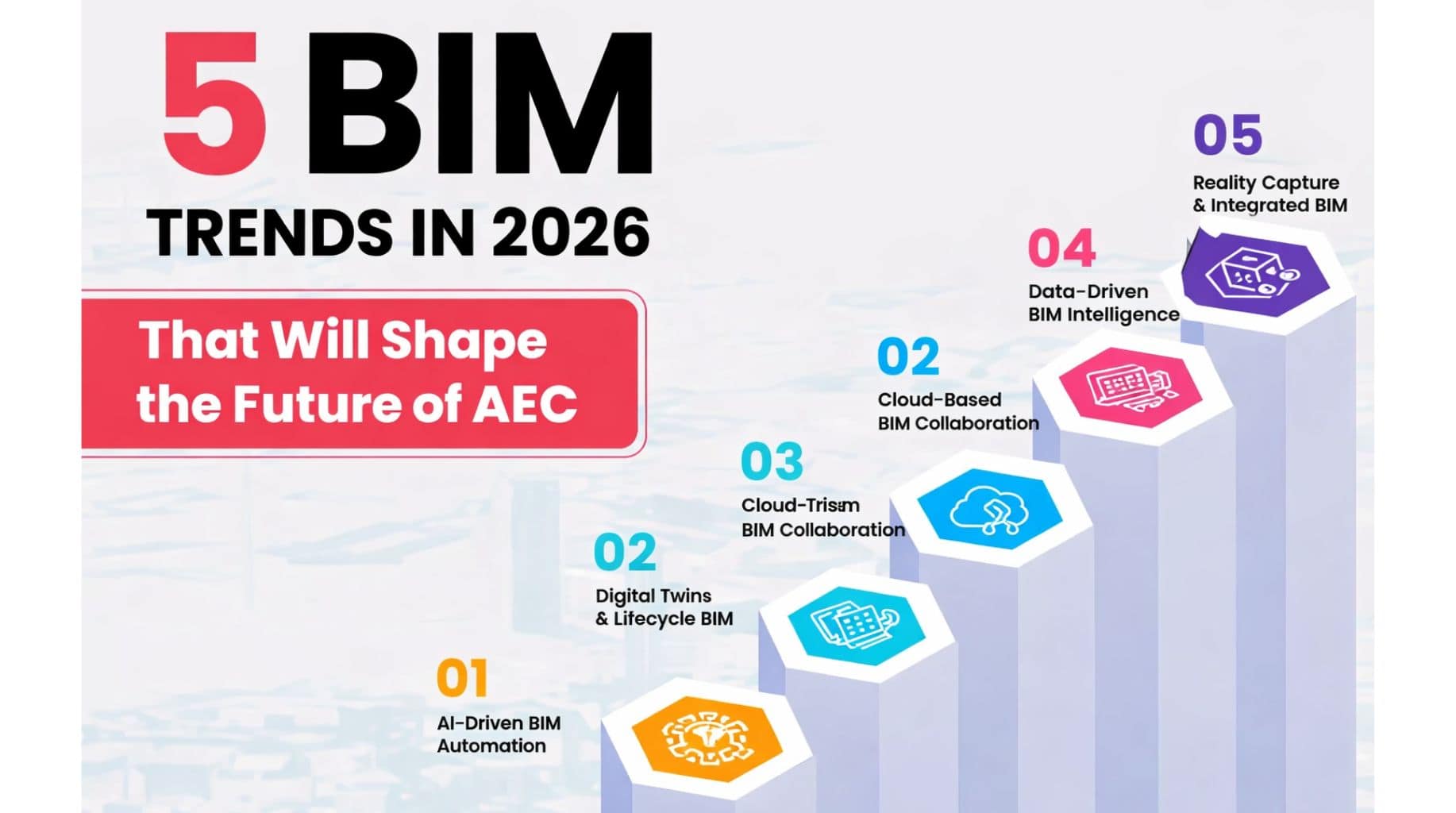
If there is one wave of influence that is housing at the core of everything, the convergence of AI and BIM.
Traditionally, BIM workflows involve a lot of manual collaboration. Clash detection, quantity takeoffs and model validation have always been time-consuming and susceptible to human error. But, AI is changing that.
Today, AI is capable of:
- Generating optimised design options via generative design
- Automatically detecting clashes before coordination meetings
- Predicting project delays using some historical data
- Automating repetitive documentation tasks
What this really comes down to is that engineers are striding away from drafting towards quick decision-making, and roles are shifting from “model creators” to “problem solvers.”
This switch has also become the defining moment for the BIM future in India in the AEC industry, where efficiency is not fueled by effort, but by intelligence and smart innovations.
Digital Twins & Lifecycle BIM Are Becoming Standard
One of the most crucial but often overlooked shifts is the increase in the use of digital twins.
A BIM model is not a static representation of a building anymore. It is developing into a live, data-rich model that keeps on functioning even post-construction. This integration makes it a vital tool to use it right from the ideation stage to construction and even after that during maintenance.
This matters especially for:
- Metro systems
- Smart city infrastructure
- Industrial facilities
- Airports
With digital twins, stakeholders can observe overall performance, predict maintenance issues and optimise any sort of operations in real time.
The implication of this is quite simple. Deliverables are no longer just about models or drawings. They are long-term data assets. This shift is pivotal to understanding BIM trends in India in 2026.
The Rise of Data-Driven BIM (4D, 5D & Beyond)
The name BIM or Building Information Modelling is self-explanatory. The term “information” comes from its characteristic of being data-driven. This justifies the use of 4D and 5D BIM.
- 4D BIM integrates time (project phasing)
- 5D BIM integrates cost (tracking budget)
This is majorly important for project managers and civil engineers, where cost overruns and delays are the most common challenges. Studies also suggest that data-driven BIM workflows can optimise planning efficiency by up to 20-30%. But beyond these numbers, the real value lies in manipulating values and planning in time.
| BIM Dimension | What It Adds | Who Benefits Most |
| 3D | Geometry | Architects |
| 4D | Time | Project Managers |
| 5D | Cost | Contractors |
| 6D+ | Sustainability & FM | Owners |
As projects become more intricate, this layered approach is coming out as a standard practice across BIM in the future of India in the AEC industry.
Cloud BIM & Common Data Environments Are Now Mandatory
The transition from local files to cloud platforms is already underway in many advanced firms. And this is not a choice, it’s more like a need. Common Data Environments, or CDE, like Autodesk Construction Cloud or BIM 360, are enabling teams to collaborate in real-time, irrespective of location. This is a primary need for projects involving multiple stakeholders across multiple cities or even countries.
However, the benefits are quite clear, including:
- Fewer coordination errors
- Faster approvals
- Better accountability
- Real-time updates
What used to be a competitive advantage has now become the foundation for many firms’ workflows and systems. And this is another reason why this has become a marker of BIM trends in India in 2026.
India’s BIM Mandates & Infrastructure Push
India’s infrastructure pushing towards BIM is not happening in isolation. It is being driven at a policy level.
In fact, BIM is already being used in:
- Metro projects (DMRC)
- Airports
- Smart Cities Mission
The industry is also witnessing an increased momentum towards establishing a national BIM framework, which is in sync with the global standards.
This has, in turn, also impacted the professionals. BIM is no longer a “good-to-have” skill. It is becoming crucial for:
- Project approvals
- Government tenders
- Large-scale infrastructure work
As a matter of fact, this also means that the “BIM trends in India in 2026” conversation is also a policy conversation and not just a temporary mandate.
Gulf Demand Surge — Why Indian BIM Talent Is in High Demand
While India’s domestic market is increasing by the minute, an equally important opportunity is actually outside the country.
The Gulf region, especially in Saudi Arabia and the UAE, is undergoing a huge construction boom. From NEOM to large-scale infrastructure projects, BIM is a need across most infrastructural developments.
Indian professionals are in high demand due to:
- Cost efficiency
- Familiarity with global standards
- Strong technical training
However, BIM is becoming a gateway to many international careers, and this global dimension is a crucial part of the whole “BIM future of India in the AEC industry” narrative.
MEP & Data Centre Boom — The Silent Growth Engine
One of the most underrated trends right now is the increase of MEP BIM, especially in data centre projects, and these centres require:
- High reliability standards
- Complex electrical and mechanical systems
- Extremely precise coordination
This has led to BIM becoming essential, not optional.
As India’s digital infrastructure grows, the demand for MEP BIM specialists is on the rise. For engineers looking to specialise, this is one of the most future-ready areas within the space of “BIM trends in India in 2026”
Computational Design & Grasshopper Going Mainstream
Another noteworthy shift is happening on the design side of the industry, with tools like Grasshopper making systems like parametric and computational design more accessible. What was once taken for granted is now entering into mainstream workflows, not just for aesthetics but also for optimising overall performance and improving efficiency.
These tools also allows architects to:
- Optimise structures based on performance
- Integrate environmental analysis right from the design stage
- Explore multiple design options super quickly
As design becomes more data-driven, computational tools will play a bigger role in designing the BIM future of India in the AEC industry.
What This Means for Architects, Civil & MEP Engineers
All these trends direct towards one thing. The nature of work in the AEC industry is evolving. Here’s how it’s changing:
| Role | Old Focus | New Focus |
| Architect | Design & Drafting | Data-driven design & coordination |
| Civil Engineer | Execution | Planning & BIM Integration |
| MEP Engineer | System Design | High-level coordination & simulation |
The professionals who adapt to this transition will look for more opportunities, both in India and across the world.
The BIM Future India AEC Industry — What Comes Next
Going ahead, BIM will continue to sprawl beyond just buildings and seep into infrastructure, urban planning, and asset management. The next phase of construction will most likely include:
- Wider adoption of digital twins
- Deeper AI integration
- Stronger regulatory frameworks
- Increased global collaboration
In this narrative, a BIM future in India in the AEC industry is merely a technological adoption; it’s about building a system that’s more efficient, transparent and a globally competitive ecosystem. The Future of BIM is not just about what’s going to come in the future or the next 2-3 years; it's about how it’s changing the industry right now and how systems are going to evolve in the future as a whole.
You can start your journey here
FAQs
1. What are the BIM trends in India in 2026?
AI integration, digital twins, 4D/5D BIM, cloud collaboration, and government mandates are shaping BIM adoption.
2. How is AI impacting BIM?
AI automates tasks like clash detection and enables predictive decision-making.
3. What are digital twins in BIM?
They are real-time models used for monitoring, maintenance, and lifecycle management.
4. What is 4D and 5D BIM?
4D = time scheduling 5D = cost estimation
5. Why is CDE important?
It enables real-time collaboration, reduces errors, and improves efficiency.
6. Is BIM mandatory in India?
Yes, especially for government and large infrastructure projects.
7. Why should AEC professionals learn BIM?
It improves efficiency, collaboration, and career opportunities.
8. Is there global demand for BIM professionals?
Yes, especially in the Middle East and large infrastructure markets.
9. Why is MEP BIM growing?
Due to complex projects like data centres requiring high precision.
10. What is the future of BIM in India?
More AI, digital twins, regulations, and global collaboration.




.png)