
If you have spent any time looking at MEP job postings recently, you have probably noticed something. Two job titles that look almost identical on the surface , MEP Engineer and MEP BIM Engineer , but seem to require completely different skill sets, attract different salaries, and sometimes sit in entirely different teams within the same firm.
And then you start wondering: are these actually the same job? Is BIM just Revit with a fancier title? Do I need to abandon everything I know about calculations and systems to make the switch?
No , and the confusion is understandable. These are genuinely different roles. But they are also deeply connected. One makes the other possible.
Quick answer: An MEP Engineer determines what systems a building needs , the calculations, the sizing, the code compliance. An MEP BIM Engineer figures out how those systems physically fit into the building , the 3D modelling, the clash detection, the coordination between structure, architecture, and MEP. On smaller projects, one person does both. On large ones, the roles split clearly. And understanding that split is what this guide is about.
What Does an MEP Engineer Do?
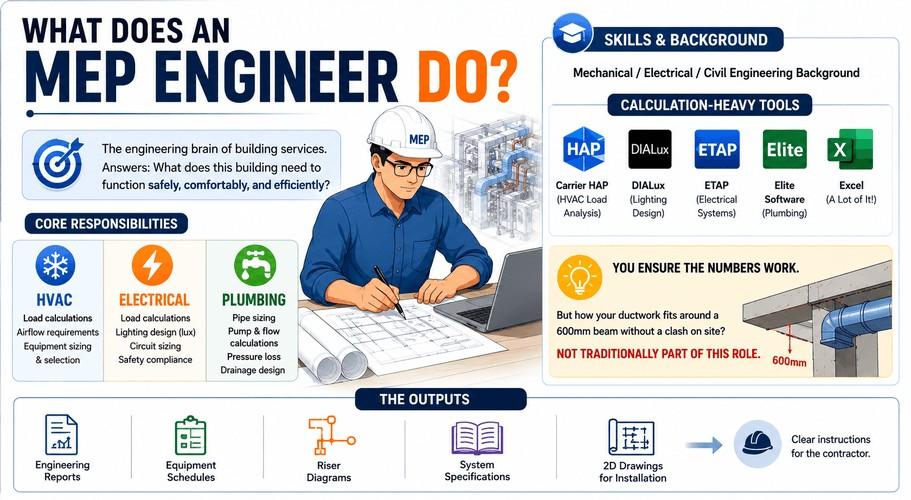
The MEP Engineer is the engineering brain of the building services team. Their job is to answer the question: what does this building need to function safely, comfortably, and efficiently?
Core responsibilities
An HVAC-focused MEP Engineer sizes air handling units, calculates heating and cooling loads, determines airflow requirements, and selects equipment. An electrical MEP Engineer handles load calculations, voltage drop analysis, lighting design to lux level specifications, circuit sizing, and electrical safety compliance. A plumbing MEP Engineer works on pipe sizing, pump head and flow rate calculations, pressure loss analysis, and drainage design.
All of it centres on performance, code compliance, and system specification. The outputs are engineering reports, equipment schedules, riser diagrams, system specifications, and sets of 2D drawings that tell a contractor what needs to be installed.
Skills and background
The MEP Engineer typically comes from a Mechanical Engineering, Electrical Engineering, or Civil Engineering background. The tools are calculation-heavy: Carrier HAP for HVAC load analysis, DIALux for lighting design, ETAP for electrical systems, Elite Software for plumbing, and , frequently , a lot of Excel.
The role is technically demanding in a discipline-specific way. You are deep in the physics of the systems you are designing. You are ensuring the numbers work. But the question of how your ductwork will physically coexist with a 600mm concrete beam without anyone discovering the conflict on site? That is not traditionally part of this role.
Also Read: MEP Full Form , What Is MEP in Construction
Advance your MEP career with BIM expertise. Join Kaarwan's BIM Certification for MEP Engineers and master industry-standard digital workflows.
What Does an MEP BIM Engineer Do?
If the MEP Engineer defines what systems are needed, the MEP BIM Engineer defines how those systems physically integrate into the building.
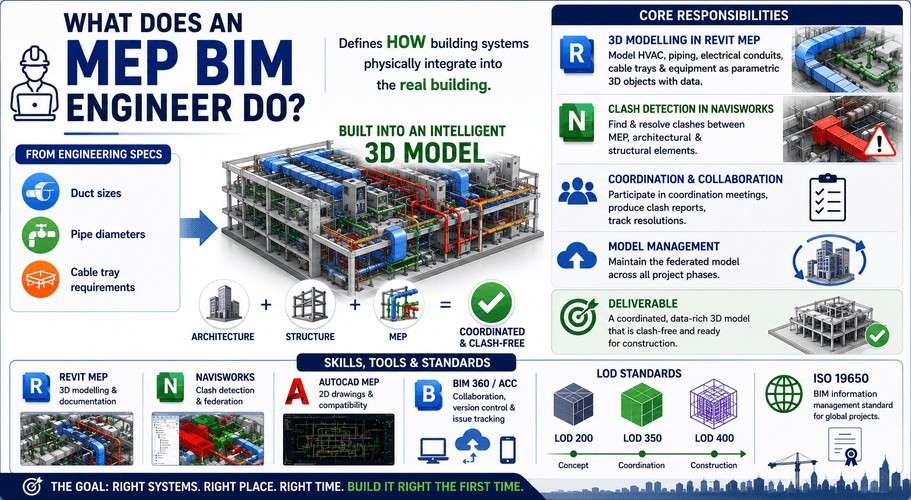
Their job is to take the engineering specifications , the duct sizes, the pipe diameters, the electrical cable tray requirements , and build them into an intelligent 3D digital model that represents the actual building. Not a schematic. The real building, with real geometry, real spatial constraints, and real relationships between MEP, architectural, and structural elements.
Core responsibilities
The MEP BIM Engineer models HVAC ductwork, piping, electrical conduits, cable trays, and equipment in Revit MEP , not as abstract lines but as parametric 3D objects that carry data. They run clash detection in Navisworks, identifying where a plumbing riser conflicts with a structural column, or where a duct runs through a beam that the structural engineer placed last week. They participate in coordination meetings, produce clash reports, track resolutions, and maintain the federated model across project phases.
The deliverable is not just a drawing set. It is a coordinated, data-rich 3D model where every pipe, duct, and conduit is correctly positioned relative to every architectural wall, structural element, and competing MEP system , and where those clashes have been resolved before anyone arrives on site.
Skills and background
The MEP BIM Engineer's skill set is more software-heavy and coordination-focused. Revit MEP for modelling, Navisworks for clash detection and federation, AutoCAD MEP for legacy drawing compatibility, BIM 360 or Autodesk Construction Cloud for collaboration and version control. Familiarity with LOD (Level of Development) standards is expected , knowing what a model should contain at LOD 200 versus LOD 350 versus LOD 400. ISO 19650 familiarity , the international standard for BIM information management , is increasingly required for firms working on government or international projects.
For a full breakdown of what MEP BIM modelling involves: What Is MEP BIM Modelling? A Beginner's Guide
MEP Engineer vs MEP BIM Engineer , Side-by-Side
Although MEP Engineers and MEP BIM Engineers work closely together, their day-to-day responsibilities, technical skills, and career paths differ significantly. Here's a side-by-side comparison of what sets these roles apart.
| Factor | MEP Engineer | MEP BIM Engineer |
| Primary skill | Engineering calculations, system sizing | 3D modelling, coordination, clash detection |
| Core question | What does the building need? | How does it physically fit? |
| Output | Engineering reports, specs, 2D drawings | Coordinated 3D models, clash reports, LOD deliverables |
| Software | HAP, DIALux, ETAP, Elite Software, Excel | Revit MEP, Navisworks, BIM 360, AutoCAD MEP |
| Works with | Clients, code compliance bodies, equipment vendors | Architects, structural engineers, MEP design team, contractors |
| Licensure path | PE track (in regulated markets), code knowledge | Less licensure-dependent, software and standards certification |
| Entry salary (India) | ₹3–5 LPA | ₹3.5–5.5 LPA |
| Mid-level salary (India) | ₹6–10 LPA | ₹7–13 LPA |
| Senior salary (India) | ₹10–18 LPA | ₹12–22 LPA |
The salary gap at senior levels reflects the cross-disciplinary coordination responsibility and software specialisation that MEP BIM Engineers carry. On large infrastructure projects , hospitals, airports, metro systems , the MEP BIM Engineer managing federated model coordination across five discipline teams has measurable impact on project cost and schedule, and firms pay accordingly.
Also Explore: Why BIM Is the Next Big Career Step for MEP Engineers
Software and Tools Compared
This is where the roles diverge most visibly.
MEP Engineer tools
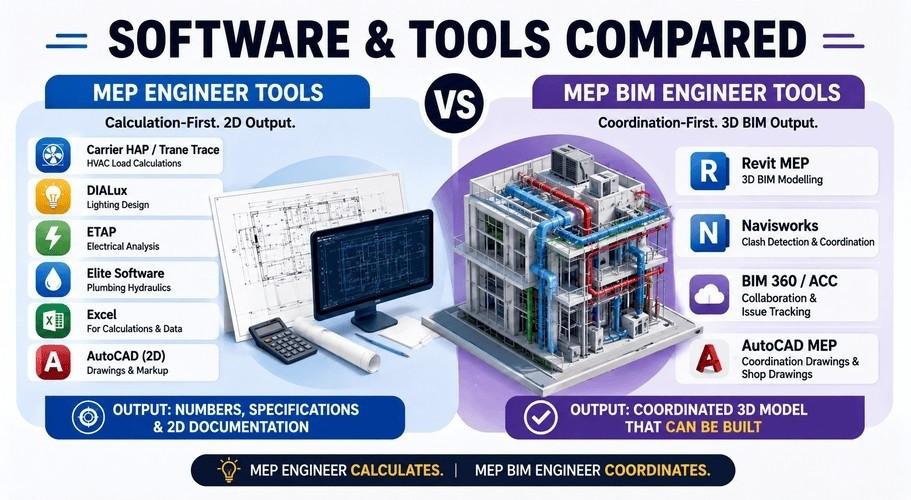
Carrier HAP or Trane Trace , for HVAC heating and cooling load calculations. DIALux , for lighting design. ETAP , for electrical power system analysis. Elite Software , for plumbing hydraulics. Excel , for almost everything else, honestly. And basic AutoCAD for 2D drawing production and markup.
These tools are calculation-first. They produce numbers, specifications, and 2D documentation. They are not coordination tools. They do not know what a structural beam looks like or whether the duct you just sized will physically fit in the ceiling void.
MEP BIM Engineer tools
Revit MEP , the primary modelling environment. Every duct, pipe, fitting, and piece of equipment is a parametric object with data attached to it. Navisworks , for federating the architectural, structural, and MEP models and running clash detection. BIM 360 / Autodesk Construction Cloud , for cloud-based collaboration, model version control, and issue tracking. AutoCAD MEP , still used for coordination drawings and shop drawing production on some projects.
These tools are coordination-first. The output is a model that can be built from , or at least can confirm that the design is buildable before anyone tries.
Also Read: Career Growth Roadmap for MEP Engineers
Salary Comparison , India and Global 2026
In India, the MEP BIM Engineer salary premium over a traditional MEP Engineer becomes significant from mid-level upward. An entry-level MEP Modeller earns ₹3.5 to ₹5.5 LPA , comparable to a fresh MEP design engineer. But a senior MEP BIM Coordinator at an international delivery centre in Bengaluru or Hyderabad, handling federated model coordination across a hospital or airport project, can earn ₹15 to ₹22 LPA. The equivalent traditional MEP Engineer at the same experience level typically earns ₹10 to ₹15 LPA.
Globally, the picture is even more favourable for BIM-skilled MEP professionals. In the UAE , where BIM is mandatory on most large projects , MEP BIM Engineers at mid-level earn AED 8,000 to AED 15,000 per month. In the UK, MEP BIM Coordinators earn £35,000 to £55,000 annually. In the US, the range is $65,000 to $95,000 for experienced MEP BIM professionals.
The consistent pattern across markets: BIM-skilled MEP professionals earn more, are hired faster for international roles, and have clearer advancement paths than those with traditional MEP design skills only.
For detailed city-wise and experience-wise salary data: BIM Engineer Salary in India
Can an MEP Engineer Become an MEP BIM Engineer?
Yes. And it is one of the most common career transitions happening in Indian MEP practice right now.
The honest version of this transition is that it is not a complete restart. An MEP Engineer transitioning to BIM does not unlearn their discipline knowledge , they apply it inside a modelling environment. Understanding why a duct needs to be a certain size makes you a significantly better MEP BIM modeller than someone who just knows how to draw in Revit but has no engineering foundation.
What to learn
Revit MEP is the non-negotiable starting point. Not surface-level , properly. Systems families, duct and pipe routing, MEP-specific parameters, how Revit handles sloped piping, how electrical circuiting works in Revit. The modelling tool needs to be fluent before coordination work can happen on top of it.
Navisworks is the second essential. Clash detection methodology, setting up clash tests, triaging results, and producing reports that discipline teams can act on. This is where MEP domain knowledge pays dividends , you know which clashes matter and which are minor spatial concerns.
ISO 19650 and LOD standards , not deep expertise initially, but enough familiarity that you understand project information management requirements and can follow a BIM Execution Plan.
Typical timeline
Three to six months of structured learning builds foundational Revit MEP and Navisworks skills. Six to twelve months including real project exposure , through certification projects, assisted roles, or current employer BIM initiatives , is enough to become competitive for MEP BIM Engineer roles. The MEP engineer to BIM engineer transition accelerates significantly when learning is project-based rather than purely tutorial-based.
Alos Read : MEP BIM international jobs India (2026).
Which Path Should You Choose?
This genuinely depends on four things. And the answer is different for different people.
If you are driven by the engineering side , the physics of systems, the satisfaction of a correctly calculated load or a code-compliant circuit , MEP Engineering is your strength. The calculation work is intellectually rewarding, the code compliance path offers career stability, and there will always be demand for engineers who understand the engineering fundamentals. You may eventually add BIM skills on top, but the engineering foundation is your core.
If you are drawn to the coordination and technology side , the idea of managing complex models across disciplines, finding and resolving spatial conflicts before construction starts, using software as a primary tool , MEP BIM Engineering is the stronger pull. The role grows increasingly rewarding as project complexity increases. Large hospitals, data centres, and airports are where this work gets genuinely interesting.
If you are early-career (fresh graduate or 0–2 years): starting in MEP design to build engineering fundamentals, then transitioning into BIM, is the path that produces the strongest long-term profile. MEP BIM Engineers who also understand the engineering rationale behind the systems they model are rare and consistently more valuable than those who can only model.
If you are mid-career and already have 3–7 years of MEP engineering experience: the BIM transition is the clearest route to a significant salary increase and international opportunities. Your domain knowledge is the differentiator. Add the software skills and you become the profile that large AEC delivery centres and international firms are specifically looking for.
On PE licensure: in markets like the US, MEP Engineering has a formal Professional Engineer (PE) licensure path that MEP BIM Engineers do not typically pursue. In India, formal licensure for MEP is less structured , but government-mandated BIM projects are starting to create their own credentialling requirements around ISO 19650 and BIM Execution Plan literacy.
Ready to transition from MEP engineering to BIM? Explore Kaarwan's BIM Certification for MEP Engineers and gain industry-ready coordination skills.
Conclusion
The clearest way to think about MEP Engineer vs MEP BIM Engineer: one answers "what" and the other answers "how." What systems does the building need? How do those systems fit in the building without conflicting with everything else?
Both questions matter. Both roles are needed. And increasingly in India's expanding infrastructure and commercial construction market, the professionals who can answer both , who bring engineering understanding into the BIM coordination role , are the ones commanding the best salaries and getting shortlisted for international work.
The path is clear. The demand is real.
Frequently Asked Questions
Q1: Is MEP BIM Engineer the same as MEP Engineer?
Not exactly , though the two roles are closely related and often overlap on smaller projects. An MEP Engineer focuses on design calculations, system sizing, and code compliance: the engineering analysis that determines what a building needs. An MEP BIM Engineer focuses on modelling those requirements into a 3D coordinated model, running clash detection, and ensuring the design is physically buildable within the building's geometry. On smaller firms and projects, one person does both. On large infrastructure projects, the roles split clearly , each requiring distinct tools and expertise.
Q2: Does an MEP BIM Engineer need a PE license?
In India, formal PE licensure for MEP professionals is not structurally mandated the way it is in the US (where NCEES administers the Professional Engineer exam for mechanical and electrical disciplines). MEP BIM Engineers in India typically build credibility through software certifications (Autodesk Revit, Navisworks), BIM standards familiarity (ISO 19650), and project portfolio rather than formal licensure. For MEP Engineers with PE ambitions in regulated international markets, the licensure path runs through the engineering design role rather than BIM coordination.
Q3: Can a fresher start directly as an MEP BIM Engineer?
Yes , this is increasingly common. Freshers who invest in structured MEP BIM training before entering the job market can start as BIM Modellers or junior MEP BIM Engineers. The realistic expectation at entry: you will be modelling under the guidance of senior coordinators and design engineers. MEP domain knowledge (understanding why systems are sized as they are, how HVAC, electrical, and plumbing work) accelerates your development significantly , even if you do not start in a pure engineering role. The best entry-level MEP BIM candidates combine software proficiency with enough MEP fundamentals to model intelligently rather than just mechanically.
Q4: Which pays more , MEP Engineer or MEP BIM Engineer?
At entry level, salaries are broadly comparable in India , ₹3 to ₹5.5 LPA for both. The divergence grows at mid and senior levels. Senior MEP BIM Engineers at large AEC delivery centres and international firms in Bengaluru, Hyderabad, and Mumbai consistently earn ₹12 to ₹22 LPA, compared to ₹10 to ₹18 LPA for traditional MEP Engineers at equivalent experience. For international roles , particularly UAE, UK, and GCC markets where BIM is mandated and demand is strong , the salary premium for MEP BIM professionals is more pronounced.
Q5: How long does it take to transition from MEP Engineer to MEP BIM Engineer?
Three to six months of focused, structured learning builds foundational Revit MEP and Navisworks skills adequate for entry-level BIM roles. Six to twelve months , including real project exposure through certification projects or current employer BIM initiatives , is enough to become competitive for MEP BIM Engineer roles. The transition is faster for MEP Engineers than for complete beginners because the domain knowledge (understanding MEP systems, why clashes matter, which coordination conflicts are critical) is already in place. What needs to be learned is the tool fluency and coordination methodology , not the underlying engineering.