
Quantity surveying does not get talked about enough. Most civil engineering students know it exists but have only a vague idea of what it actually involves, something to do with measurements and costs, probably. And then they graduate, get on site, and suddenly realise that someone is doing a genuinely critical job right next to them that they were never properly introduced to.
So let's fix that.
This guide covers what quantity surveying in civil engineering actually means, what QS engineers do day to day, what courses are available in India in 2026, and whether this is a career path worth seriously considering. No fluff. Just the real picture.
Read more: Jobs After Civil Engineering 2026 — Roles, Salary and Career Guide
What is Quantity Surveying in Civil Engineering?
Quantity surveying is the discipline within construction that manages and controls the financial side of a project, from the earliest cost estimate right through to the final account when construction is complete.
A quantity surveyor's job is to make sure the money makes sense. Every kilogram of steel, every cubic metre of concrete, every hour of labour, someone has to measure it, price it, document it, and track it against what was originally budgeted. That person is the quantity surveyor.
It is not just number-crunching, though. QS engineers get involved in contract preparation and negotiation, preparing Bills of Quantities for tendering, evaluating contractor bids, certifying payment applications, managing cost variations when designs change, and resolving financial disputes between contractors and clients.
The role sits at an interesting intersection, technical enough that you need to understand construction methods and materials, commercial enough that you need to understand contracts and cost management. It is genuinely cross-functional.
In countries like the UK and Australia, quantity surveying has been a recognised profession for decades. In India, it is a younger discipline but it is growing fast , particularly as larger infrastructure projects and international construction firms have brought more structured commercial management practices into the Indian market.
Build practical BIM and quantity takeoff skills with Kaarwan’s Professional BIM Certification Program for Civil Engineers using real-world workflows, tools, and live mentorship.
What Does a Quantity Surveyor Actually Do?
This is worth being specific about because "manages costs" can mean very different things depending on where you are in a project.
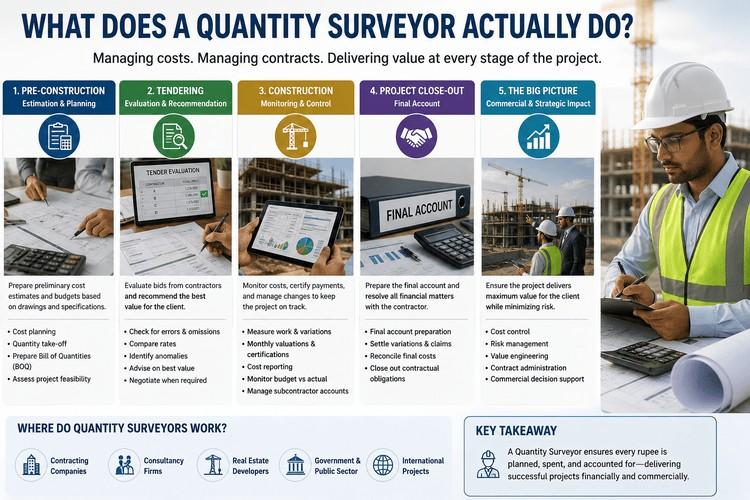
At the early stages, before construction begins, a QS engineer prepares preliminary cost estimates based on drawings and specifications. These estimates inform whether a project is financially viable and what the likely budget needs to be. They also prepare the Bill of Quantities, a detailed document that lists every item of work and material required, with quantities, so that contractors can price it accurately when submitting tenders.
During tendering, the QS evaluates the bids received from contractors. They check for errors, compare rates, identify any pricing anomalies, and advise the client on which bid represents the best value. This is commercially sensitive work and requires both technical understanding and negotiation capability.
During construction, the work shifts to monitoring actual costs against the budget. Monthly valuations of work completed are certified for payment. Variations, changes to the original design or scope, are measured and priced. Cost reports are prepared showing where the project stands financially relative to the budget.
At the end of the project, the QS prepares the final account, resolving all outstanding financial matters between the client and the contractor. This can involve negotiating disputed claims and variations, which sometimes gets complex.
The day-to-day reality varies by company and project type. At a large contractor, QS engineers might be focused more on internal cost reporting and subcontractor management. At a consultancy, the focus is more on client-side contract administration and independent valuations. As a developer, it is often a blend of both.
Read More: Surveying in civil engineering
Quantity Surveying Courses in India (2026)
The good news is that there are genuine options at different levels and price points. The not-so-good news is that the market is a bit crowded with short courses of variable quality. Here is a realistic breakdown.
PG Diploma in Quantity Surveying and Contract Management, NICMAR
NICMAR's one-year postgraduate diploma is the most credible formal qualification in quantity surveying and contract management available in India. It runs across two semesters, covers around 750 classroom hours, and goes deep into the full QS skillset, cost estimation, Bills of Quantities, contract administration, post-contract functions, monthly valuations, variation management, and dispute resolution.
The curriculum includes hands-on training in MS Project, Candy, and CalQuan. Students produce real deliverables, resource-loaded schedules, BOQ documents, and software-based estimates that form a portfolio. Class sizes are small, around 15-20 students, which means decent mentoring access.
The fee is significant, around Rs 5,10,000, and the entry requirement is a civil engineering degree with 50% aggregate. But for civil engineers who are serious about a QS or commercial management career, particularly at consultancy or PMC level, this is the benchmark qualification in India.
Short-Term QS Certificate Courses
These range from 40 to 90 days and are offered by training institutes like CAD Centre, CAD Desk, SMEClabs, and various Hyderabad-based institutes. They cover estimation, BOQ preparation, rate analysis, MS Excel for cost management, and the basics of tender documentation. Fees are substantially lower, typically Rs 15,000 to Rs 50,000, depending on the institute and duration.
The quality of these courses varies a lot. The best ones include actual practice on real project drawings, software exposure, and feedback from instructors with genuine industry experience. The weaker ones are largely theoretical with limited practical application. If you go this route, ask specifically about what project-based work is included before enrolling.
Learn BIM, BOQs, scheduling, and project coordination with Kaarwan’s Professional BIM Certification Program for Civil Engineers through live projects and industry-focused training.
BIM and Quantity Surveying Combined Courses
These are the most interesting developments in the QS training market in 2026. BIM tools, particularly Revit, now allow quantity takeoffs to be done directly from the 3D model, which is significantly faster and more accurate than manual measurement from 2D drawings. Some training programmes are beginning to integrate BIM-based quantity extraction with traditional QS methodology.
For civil engineers who are already learning or have learned BIM tools, this combination is genuinely marketable , it positions you at the intersection of digital construction and cost management, which is where the industry is heading.
Online QS Courses
Udemy has several quantity surveying courses with reasonable ratings. Courses covering BOQ preparation, bar bending schedules, rate analysis, and project estimation using AutoCAD and Excel are available at relatively low cost and include lifetime access. These are supplementary tools rather than primary qualifications. Good for building foundational knowledge or filling specific skill gaps, not for replacing structured institute training.
NICMAR also maintains a credible reputation for their programmes. For international benchmarking, RICS (Royal Institution of Chartered Surveyors) offers globally recognised certification. MRICS membership is the gold standard internationally, though the pathway is long and primarily relevant for those targeting Gulf or international careers.
Read More: BIM Engineer Salary in India
Key Skills You Build in a QS Course
Whether you are taking a 45-day certificate course or a year-long PG diploma, the core skills are broadly similar, just at different depths.
Measurement and Takeoff: Reading construction drawings accurately and extracting quantities, lengths, areas, volumes, and counts is the foundation of everything else. You cannot price what you have not measured correctly. This involves understanding both manual measurement methods and increasingly digital takeoff tools.
Bill of Quantities Preparation: A BOQ is a structured document that lists every item of work with descriptions and quantities. Preparing one requires not just measurement accuracy but also knowledge of standard descriptions, how items are classified, and how they are formatted for contractor pricing.
Rate Analysis: Understanding how a unit rate for any construction item is built up, material cost, labour cost, plant cost, overhead, profit, is what separates a QS engineer from someone who can just input numbers into a spreadsheet. Rate analysis is genuinely important and takes time to develop properly.
Bar Bending Schedule (BBS): Calculating steel reinforcement quantities from structural drawings , including cut lengths, bends, and lap lengths, is a core technical skill in Indian QS practice. It appears in every QS course and every QS interview.
Contract and Tender Management: Understanding different contract types (item rate contracts, lump sum contracts, EPC/turnkey), how tendering works, what goes into a bid, and how variations and claims are handled is the commercial layer that makes a QS engineer genuinely useful on a project.
Software Tools: MS Excel, genuinely, properly, advanced Excel, is the core tool for most QS work in India. AutoCAD for drawing reading. Primavera or MS Project basics for understanding programme-related claims. And increasingly, BIM software for model-based quantity extraction.
Read more: Civil Engineering Software List — Top Tools Used by Civil Engineers 2026
Quantity Surveyor Career Paths and Salary
Let's be honest about what the career trajectory looks like. It is not a fast-burn path. Entry-level salaries for QS engineers in India are modest. But it builds steadily, and the ceiling, particularly for those who add international project experience or RICS certification, is genuinely high.

Entry Level , Junior Quantity Surveyor / Billing Engineer: Rs 2.5–5 LPA for diploma or degree freshers with basic QS training. Roles involve assisting senior QS engineers with measurement, BOQ preparation, rate analysis, and basic billing work.
Mid Level, Quantity Surveyor / Estimation Engineer: Rs 5–13 LPA with 3–7 years of experience. At this level, you are managing the QS function for individual project packages, preparing and certifying valuations, managing subcontract QS work, and handling variations independently.
Senior Level, Senior QS / Commercial Manager: Rs 13–20 LPA with 8+ years and a strong project track record. Managing the commercial function across a project or programme. Potential RICS certification for international or Gulf market access.
Gulf and International Market: For experienced QS engineers with 5+ years of India market experience, Gulf construction markets, UAE, Qatar, Saudi Arabia, and Kuwait, offer tax-free packages that frequently translate to Rs 20–35 LPA equivalent. RICS membership is often required or strongly preferred.
Career Roles Available: Junior Quantity Surveyor, Billing Engineer, Estimation Engineer, Procurement Executive, Contract Administrator, Planning Engineer, Cost Manager, Commercial Manager, Project Manager.
The QS career path genuinely can lead to project management, particularly in EPC companies and real estate developers, where commercial skills are valued alongside engineering knowledge.
Upgrade your civil engineering career with Kaarwan’s Professional BIM Certification Program for Civil Engineers, featuring live training, real projects, certifications, and placement support.
Who Should Consider Quantity Surveying?
Honestly, not everyone. And that is worth saying clearly.
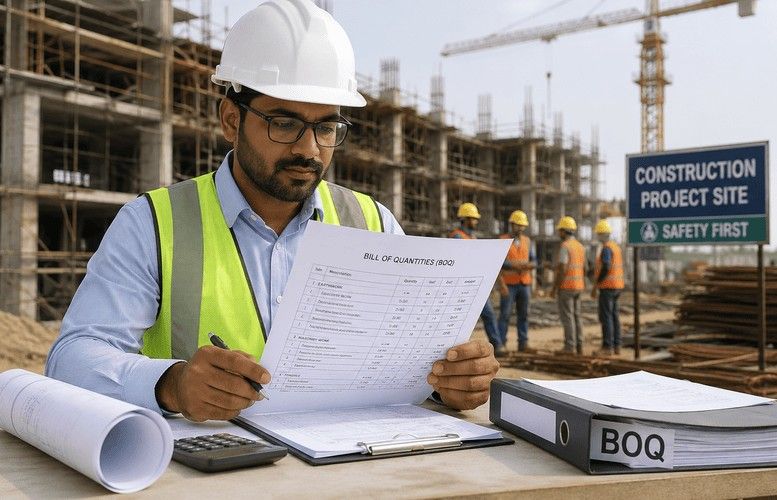
Quantity surveying suits civil engineers who are comfortable with numbers and precision, have patience for detailed documentation, enjoy the contractual and commercial side of construction rather than just the technical design side, and can work methodically under deadline pressure. The people who find QS genuinely satisfying tend to be the ones who like solving cost puzzles. Why is this project over budget? Where is the cost creeping in? How do we recover this variation claim?
If you are someone who wants to be on site and in the physical thick of construction, pure QS work might feel desk-heavy and frustrating. It is not the worst thing to try a short course, understand the work, and decide.
If you are a civil engineer who is already leaning toward a planning or commercial management direction rather than pure design or site work , quantity surveying is one of the best-defined and most transferable specialisations you can build.
Read More About Other Surveying Methods: Compass Surveying and Chain Surveying
QS in the Context of BIM, What's Changing
This is worth understanding because it is genuinely affecting the QS profession.
Traditionally, quantity takeoff meant a QS engineer with a scaled drawing, a scale rule, and a lot of patience manually measuring rooms, walls, floors, and structural elements. Or increasingly with digital PDFs and software like PlanSwift or Bluebeam doing the measurement digitally, but still from 2D drawings.
BIM changes this. When a project is modelled in Revit, every element in the model has dimensions and properties. Quantity schedules can be extracted directly from the model; you can pull off the volume of all concrete columns, the total area of floor slabs, and the linear length of all beams, in seconds. With Autodesk Construction Cloud or BIM 360, this data is live and updates automatically when the design changes.
This does not eliminate the QS role. It accelerates the measurement process and reduces manual errors, which means QS engineers can spend more time on higher-value work, rate analysis, contract management, value engineering, and risk assessment. The skill that BIM replaces is the tedious part of takeoff. The skill it rewards is understanding construction and costs well enough to validate and use that data meaningfully.
For civil engineers who are already learning BIM tools, adding QS knowledge is genuinely a career differentiator in 2026. The combination of model-based quantity extraction and traditional commercial skills is what firms building on BIM-enabled projects are actively looking for.
Frequently Asked Questions
What does a quantity surveyor do in civil engineering?
A quantity surveyor manages the financial and commercial aspects of construction projects, from preparing initial cost estimates and Bills of Quantities for tendering, through certifying payment applications during construction, to producing the final account at project completion. They also handle contract administration, variation management, and where necessary, dispute resolution.
What are the best quantity surveying courses in India?
For a formal postgraduate qualification, NICMAR's PG Diploma in Quantity Surveying and Contract Management is the most credible option in India. For short-term practical training, certificate courses at reputable institutes covering BOQ preparation, rate analysis, BBS, and software tools are available in cities like Hyderabad, Pune, Mumbai, and Bengaluru. Online courses on Udemy are useful for foundational learning and skill supplementation.
What is the salary of a quantity surveyor in India?
Entry-level QS engineers in India earn Rs 2.5–5 LPA depending on qualification and company type. With 3–7 years of experience, salaries range from Rs 5–13 LPA. Senior QS professionals at commercial management level reach Rs 13–20 LPA. For those with Gulf market experience or RICS certification, packages frequently exceed Rs 20 LPA in international markets.
Is quantity surveying a good career for civil engineers?
Yes , particularly for civil engineers who want to specialise in the commercial and contractual side of construction rather than pure design or site work. It is a well-defined specialisation with consistent demand across construction, EPC, real estate, and infrastructure sectors. The Gulf market specifically has strong ongoing demand for experienced Indian QS professionals. It is not the fastest-salary path at entry level, but the mid-to-senior trajectory is genuinely competitive.
What is a Bill of Quantities in civil engineering?
A Bill of Quantities is a document prepared by the quantity surveyor during the tendering process. It lists every item of work required for a construction project , including materials, labour activities, and associated quantities , so that contractors can submit a priced bid. It is the basis for comparing tenders and for managing the contract financially once construction begins.