How to Choose a Good Civil Engineering Seminar Topic
Picking a seminar topic is weirdly stressful for something that should not be.
You have got an entire field to choose from, bridges, smart cities, self-healing concrete, AI in construction, and somehow that makes it harder, not easier. Too many options and you end up going with whatever the person next to you picks. Which is usually whatever someone picked last year. Which is usually safe, generic, and something nobody in the room actually cares about.
So before you just Google "civil engineering seminar topics" and pick the third result, spend five minutes thinking about three things.
Is this actually relevant right now? The construction industry in 2026 is genuinely different from what it was even five years ago. BIM is becoming mandatory on serious projects. AI is being used in structural analysis and design. Drones are doing site surveys that used to take teams of people days. A topic that connects to what is actually happening in the industry will always land better than a recycled subject that has been presented at your college every semester for years.
Can you actually research this? Some topics sound brilliant until you realise there are four papers on them globally, and none are accessible to you. Before you commit, spend 20 minutes checking whether real case studies, industry reports, and published data exist. If they do, you are good. If they do not, find something else.
Is the scope manageable? "Sustainable Construction" is not a seminar topic. That is a degree programme. "Self-Healing Concrete, How Bacteria Repair Cracks and What It Could Mean for Indian Infrastructure Maintenance", that is a seminar topic. Specific enough to cover properly in 15–20 minutes. Broad enough to have something actually worth saying.
The best seminar topics are those that combine technical depth with current real-world applications.
Interested in topics like BIM, smart infrastructure, and digital construction? Go beyond presentations and learn how these technologies work on real projects with Kaarwan’s Professional BIM Certification Program for Civil Engineers.
Latest Seminar Topics for Civil Engineering 2026
Here are the top 10 latest civil engineering seminar topics that are genuinely relevant to where the industry is right now, not recycled lists from 2019. These are innovative seminar topics for civil engineering students who want to present something that actually starts a conversation in the room.
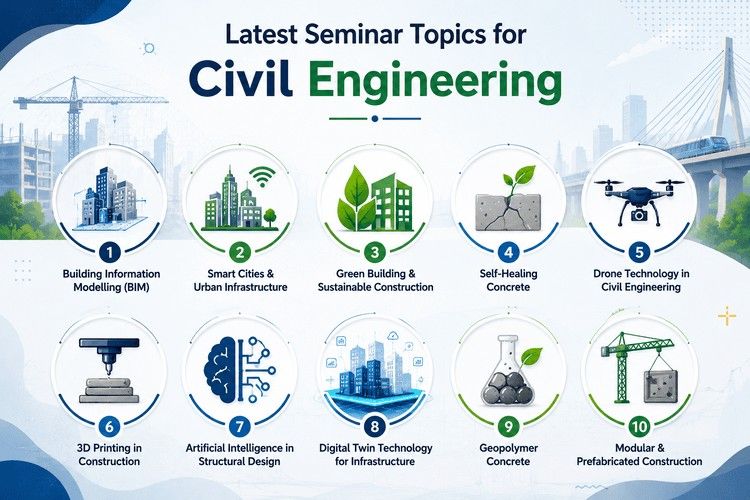
1. Building Information Modelling (BIM) in Civil Engineering : BIM is no longer a niche specialisation; it is fast becoming the standard on serious infrastructure projects in India and internationally. A seminar on this could cover how BIM differs from traditional CAD workflows, what Revit and Navisworks actually do on a live project, how clash detection saves cost before construction even starts, and why firms like AECOM, L&T, and WSP increasingly require it as a delivery standard. Strong technical depth, real case study material, and clear career relevance. One of the best technical seminar topics for civil engineering students in 2026.
2. Smart Cities and Urban Infrastructure: India's Smart Cities Mission is one of the largest urban planning initiatives the country has attempted. A seminar on this can cover IoT integration in city management, intelligent traffic systems, digital infrastructure planning, and what a smart city actually looks like on the ground, not just in a government document. The gap between the brochure and the reality is itself worth exploring.
3. Green Building and Sustainable Construction: LEED and GRIHA certifications are increasingly showing up as project requirements, not optional additions. Cover what green building standards actually involve, how energy-efficient design decisions get made, what sustainable materials look like in practice, and which Indian commercial projects have adopted these approaches seriously.
4. Self-Healing Concrete: This one genuinely gets attention in the room. Concrete that repairs its own cracks using bacteria embedded in microcapsules, it sounds like science fiction, but it is actively researched and increasingly used. The case for it is economic: maintenance costs of cracked infrastructure in India run into thousands of crores every year. Bio-concrete addresses that directly. Find one real project, explain the science clearly, and you have a strong presentation.
5. Drone Technology in Civil Engineering: Drones have moved from novelty to a practical site tool fast. Topographical surveys that once took days now take hours. Progress monitoring, safety inspections, inaccessible-site documentation, and all active drone applications on large infrastructure projects in India. Practical topic with strong visual material for your slides.
6. 3D Printing in Construction: A house was 3D-printed in Chennai in under 24 hours back in 2021. The technology has only moved forward since. Cover the materials used, speed and cost comparisons with conventional construction, structural considerations, and where this is realistically headed for Indian housing and infrastructure.
7. Artificial Intelligence in Structural Design: AI is being used to optimise structural member sizes, predict failure points, and run thousands of load combinations in seconds. Not speculative, firms are deploying these tools now. A seminar here can go technical on how machine learning models are trained on structural data or stay applied and focus on specific software and case studies. Either works.
8. Digital Twin Technology for Infrastructure: A digital twin is a real-time virtual replica of a physical structure that updates as the actual structure changes. Bridges, metro stations, and water treatment plants are all being modelled as digital twins internationally. Predictive maintenance, early structural stress warnings, and lifecycle cost modelling. Genuinely exciting topic with strong international case study material and growing India relevance.
9. Geopolymer Concrete: Ordinary Portland Cement production accounts for roughly 8% of global CO2 emissions. Geopolymer concrete, made from industrial by-products like fly ash and GGBS, dramatically reduces that footprint while maintaining comparable strength. Good technical depth, clear environmental argument, and India-specific context around fly ash availability make this grounded and credible.
10. Modular and Prefabricated Construction: Prefabrication is changing how fast and how cost-effectively buildings go up. Metro station components, affordable housing panels, industrial structures, and modular construction are growing fast in India. Quality control, reduced waste, faster timelines, there is solid data and plenty of real project examples to draw from.
Seminar Topics on Structural Engineering
Structural engineering seminar topics tend to be the most popular and also the most overused.
If you go this route, go specific. Not "earthquake-resistant buildings" as a general overview, but one technique, one material, one real case study examined properly. That is what separates a forgettable presentation from one that people ask questions about.
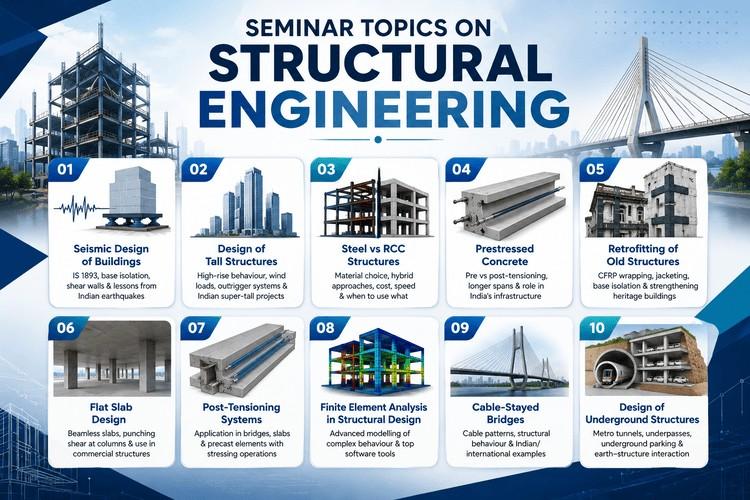
- Seismic Design of Buildings: IS 1893 requirements, base isolation systems, shear wall design, and real lessons from earthquake-affected Indian cities like Bhuj and Chamoli.
- Design of Tall Structures: How high-rise structural behaviour differs from low-rise, wind load considerations, outrigger systems, and examples from Indian super-tall projects.
- Steel vs RCC Structures: Comparative material choice for different project types, hybrid structural approaches, cost and speed tradeoffs, and when each makes engineering sense.
- Prestressed Concrete: Pre-tensioning vs post-tensioning, how prestressing extends span capabilities, and its role in India's bridge and flyover construction programme.
- Retrofitting of Old Structures: Carbon fibre wrapping, concrete jacketing, base isolator insertion, techniques for strengthening heritage and ageing buildings without demolition.
- Flat Slab Design: Analysis of column-supported slabs without beams, punching shear design at columns, and why flat slabs dominate commercial and parking structure design.
- Post-Tensioning Systems: Applied post-tensioning in bridges, slabs, and pre-cast elements, with the construction sequence and stressing operations explained clearly.
- Finite Element Analysis in Structural Design: How FEA models complex structural behaviour beyond what simplified analytical methods can handle, and which software does this well.
- Cable-Stayed Bridges: Cable arrangement patterns, structural behaviour under live and dynamic loads, and examples from Indian and international projects.
- Design of Underground Structures: Metro tunnels, underpasses, underground parking, what changes structurally when earth and groundwater surround the structure on all sides.
Read More: Structural Design Courses for Civil Engineering
Seminar Topics on Transportation Engineering
Transportation engineering topics have an advantage that others do not; there is always something being built, widened, redesigned, or debated right now in India. That means real, current case study material is almost always available if you look.
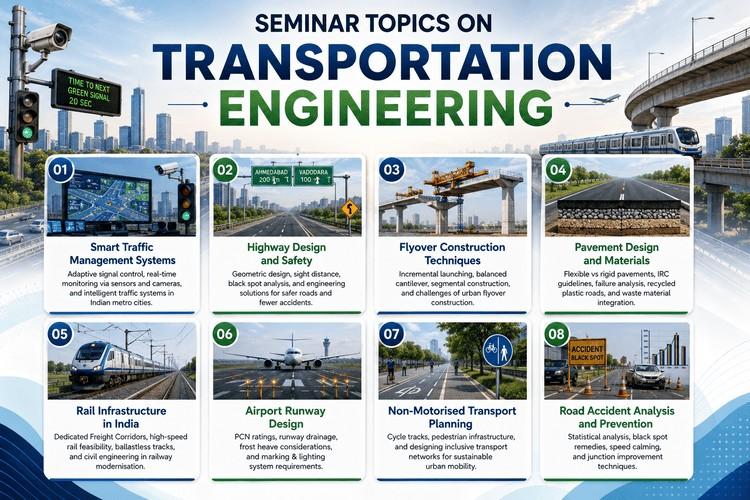
- Smart Traffic Management Systems: Adaptive signal control, real-time monitoring via sensors and cameras, and how Indian metro cities are beginning to actually deploy intelligent traffic systems beyond pilot projects.
- Highway Design and Safety: Geometric design standards, sight distance calculations, accident black spot analysis, and the engineering role in reducing India's road fatality numbers.
- Flyover Construction Techniques: Incremental launching, balanced cantilever method, segmental construction, and the specific engineering challenges of building flyovers in dense urban environments.
- Pavement Design and Materials: Flexible vs rigid pavement design, IRC guidelines, rutting and fatigue failure analysis, recycled plastic roads, and where waste material integration is actually working.
- Rail Infrastructure in India: Dedicated Freight Corridors, high-speed rail feasibility, ballastless track design, and the civil engineering contribution to India's railway modernisation.
- Airport Runway Design: Pavement classification number ratings, drainage design for runways, frost heave considerations, and marking and lighting system requirements.
- Non-Motorised Transport Planning: Cycle tracks, pedestrian infrastructure, and how Indian cities are starting, slowly, to design transport networks that do not treat walking and cycling as afterthoughts.
- Road Accident Analysis and Prevention: Statistical analysis of accident data, engineering countermeasures at black spots, speed-calming design, and junction improvement techniques.
Read More: Surveying in civil engineering for transportation projects
Seminar topics are great, but practical skills get you hired. Master BIM tools used on real infrastructure and construction projects through Kaarwan’s Professional BIM Certification Program for Civil Engineers and turn your technical knowledge into career-ready expertise.
Seminar Topics on Environmental Engineering
Environmental engineering topics are underrated for seminars. There is a tendency to think they are less technical than structural topics; they are not. Environmental Impact Assessment methodology, biological wastewater treatment processes, and sustainable drainage design all have real technical depth. And they are becoming more relevant, not less, as regulatory requirements tighten.
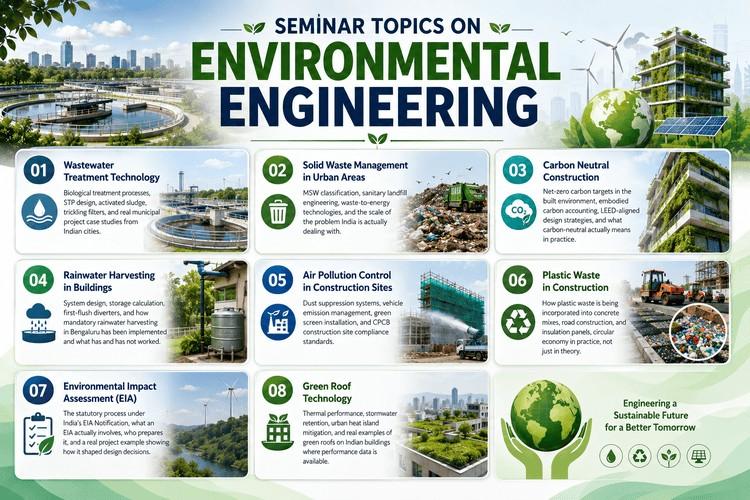
- Wastewater Treatment Technology: Biological treatment processes, STP design, activated sludge, trickling filters, and real municipal project case studies from Indian cities.
- Solid Waste Management in Urban Areas: MSW classification, sanitary landfill engineering, waste-to-energy technologies, and the scale of the problem India is actually dealing with.
- Carbon Neutral Construction: Net-zero carbon targets in the built environment, embodied carbon accounting, LEED-aligned design strategies, and what carbon-neutral actually means in practice.
- Rainwater Harvesting in Buildings: System design, storage calculation, first-flush diverters, and how mandatory rainwater harvesting in Bengaluru has been implemented and what has and has not worked.
- Air Pollution Control in Construction Sites: Dust suppression systems, vehicle emission management, green screen installation, and CPCB construction site compliance standards.
- Plastic Waste in Construction: How plastic waste is being incorporated into concrete mixes, road construction, and insulation panels, circular economy in practice, not just in theory.
- Environmental Impact Assessment (EIA): The statutory process under India's EIA Notification, what an EIA actually involves, who prepares it, and a real project example showing how it shaped design decisions.
- Green Roof Technology: Thermal performance, stormwater retention, urban heat island mitigation, and real examples of green roofs on Indian buildings where performance data is available.
Seminar Topics on Geotechnical Engineering
Geotechnical topics are genuinely underchosen for seminars, which means less competition and more opportunity to present something the evaluators have not seen fifteen times before. The other advantage is that geotechnical failures are dramatic and well-documented. Liquefaction in Bhuj. Slope failures on Kerala highways. Foundation settlements in coastal cities. Real events, real consequences, real engineering lessons.
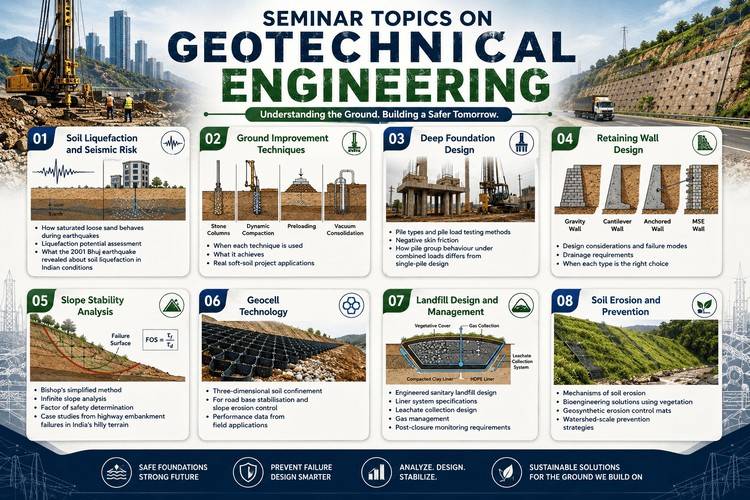
- Soil Liquefaction and Seismic Risk: How saturated loose sand behaves during earthquakes, liquefaction potential assessment, and what the 2001 Bhuj earthquake revealed about soil liquefaction in Indian conditions.
- Ground Improvement Techniques: Stone columns, preloading, dynamic compaction, and vacuum consolidation. When each technique is used, what it achieves, and real soft-soil project applications.
- Deep Foundation Design: Pile types, pile load testing methods, negative skin friction, and how pile group behaviour under combined loads differs from single-pile design.
- Retaining Wall Design: Gravity, cantilever, anchored, and MSE wall types, design considerations, failure modes, drainage requirements, and when each is the right choice.
- Slope Stability Analysis: Bishop's simplified method, infinite slope analysis, factor of safety determination, and case studies from highway embankment failures in India's hilly terrain.
- Geocell Technology: Three-dimensional soil confinement for road base stabilisation and slope erosion control, with performance data from field applications.
- Landfill Design and Management: Engineered sanitary landfill design, liner system specifications, leachate collection design, gas management, and post-closure monitoring requirements.
- Soil Erosion and Prevention: Mechanisms of soil erosion, bioengineering solutions using vegetation, geosynthetic erosion control mats, and watershed-scale prevention strategies.
Confused about where civil engineering is headed after college? Learn industry-standard BIM workflows, Revit, Navisworks, and real project coordination with Kaarwan’s Professional BIM Certification Program for Civil Engineers and build skills companies actively look for.
Read More: Civil engineering projects for students
Tips for Presenting a Civil Engineering Seminar
You have got a topic. Now you have to actually stand up and present it without it being a painful experience for everyone in the room, including you.
A few things that genuinely make a difference. Not generic presentation advice. Actual things that separate a memorable seminar from one people have forgotten by the time they reach the corridor.
1. Build a story, not a slide dump: Start with the problem, explain the solution, support it with evidence, and finish by explaining why it matters. That is your structure. Open with why the topic matters, not with a textbook definition, which is genuinely the most boring way to start anything. Explain the technical solution in language a human can follow. Back it up with real project data or case studies. End with what this means for someone sitting in the room who wants to work in civil engineering. And do not put paragraphs of text on your slides. Nobody reads them while you are talking. Nobody.
2. Find one real project and talk about it properly: An explanation of digital twin technology is okay. A specific account of how Singapore's national water agency uses digital twins to manage reservoir infrastructure in real time, and what that actually changed about maintenance costs and response time, is far more interesting. Every topic on this list has real case studies if you look for them. They are what make abstract engineering concepts feel like something that actually happens in the world.
3. Use specific numbers from recent sources: "Studies suggest BIM improves project efficiency" is nothing. "According to McKinsey, full digitisation of construction, including BIM adoption, could reduce project costs by 15 to 25 per cent" is something. Specific, sourced, recent. It takes 20 minutes to find good statistics. Those 20 minutes show.
4. Practise your time out loud. Actually, out loud: Not in your head. Most students discover when they run through it properly that they either rush through everything in 10 minutes or go significantly over. Both are problems. Record yourself once. Yes, it is uncomfortable. Do it anyway. Hit 15 minutes consistently before the day.
5. Prepare answers for three likely questions before you present: What is the limitation of this solution? Is this feasible in India at scale? What does it cost? What is the code or standard that governs this? Whoever is evaluating you will ask something. Having answers ready for the three most obvious questions means you do not freeze when a hand goes up.
These also apply if you are preparing PPT topics for civil engineering class presentations – same principles, just on a smaller scale.
Frequently Asked Questions
What are the best seminar topics for civil engineering students in 2026?
Honestly? The ones that connect to what is actually happening in the industry right now. BIM, digital twins, self-healing concrete, AI in structural design, smart city infrastructure, these are not buzzwords; they are things firms are actively working with and hiring for. A topic that has real Indian project examples available will always land better than one that only has international case studies. Evaluators notice when you have made the effort to contextualise your research. Explore [civil engineering courses to build on seminar topics] if you want to go deeper than the presentation.
How do I choose a seminar topic for civil engineering?
Three things. Is it relevant to 2026? Can you actually find enough material, case studies, industry data, and published research to build a proper presentation? And is the scope manageable for 15–20 minutes? The mistake most students make is picking something either so broad it becomes a surface-level overview of everything or so niche that almost no usable material exists. The sweet spot is a specific application of a relevant technology, backed by real examples. And pick something you are at least a little curious about. You are going to spend a week on this topic. Mild genuine interest makes that significantly less miserable.
What are innovative seminar topics for civil engineering?
Some of the most interesting choices for 2026 are digital twin technology for predictive infrastructure maintenance, geopolymer concrete as a low-carbon alternative to OPC, AI-powered structural health monitoring that flags issues before failure occurs, electro-bio grouting for soil stabilisation, and large-scale 3D-printed concrete construction. These are topics that are at the actual frontier of what the industry is exploring and debating right now. They tend to generate real questions from the audience, which makes for a better seminar experience than standing there hoping nobody asks anything.
Can BIM be used as a seminar topic for civil engineering?
Yes, and it is probably one of the strongest choices available right now. BIM is not a future concept. It is the current delivery standard on international infrastructure projects, and it is moving into large domestic Indian projects fast. A seminar on BIM has plenty to cover, including how it actually differs from CAD, what Revit and Navisworks do on a live project, what clash detection looks like, in practice, what ISO 19650 means for project information management, and where India sits on adoption compared to the UK and UAE. Strong technical depth, clear real-world relevance, and good case study material. Difficult to go wrong with it if you research it properly.