
What is a Site Engineer in Civil Engineering?
A site engineer in civil engineering is the person who makes sure that what is drawn on paper actually gets built on the ground — correctly, safely, and on time.
That sounds simple. It is not.
Every construction project — a residential tower, a metro corridor, a highway flyover, or a commercial complex — has a site engineer who is essentially the nerve centre of daily operations on the ground. They are the ones who show up before the labourers do, who know which column is going up today and which RCC slab needs to be cast before the weekend. They read the structural drawings, they coordinate with the contractor, they check the concrete cube strength, and they raise the daily progress report. And they do all of this while fielding questions from workers, managing material deliveries that are running late, and explaining why a particular section of wall does not match the drawing — again.
What is a site engineer in the larger context of a project? They are the bridge between the design office and the actual site. The architect and structural engineer produce the drawings. The project manager handles the big picture. The site engineer makes sure the nuts and bolts of daily construction execution happen the way they should. Without someone in this role, a project becomes chaotic very quickly.
The role is different from office-based engineering in a fundamental way — you are not analysing or designing; you are executing. That distinction matters. Site engineering is faster, more physical, more unpredictable, and in many ways more formative than any other early-career role in civil engineering. The things you learn in your first 2 years on site cannot be learned from a textbook or a software course. They come from being on the ground, watching how concrete behaves, understanding why a formwork failed, seeing what happens when a material specification is not followed.
Most civil engineering careers in India start here. And the trajectory from here determines almost everything that comes after.
Site Engineer Roles and Responsibilities
The job looks different on different projects and at different firms. But these 10 responsibilities show up almost universally — from a residential housing project in Pune to an infrastructure corridor in Hyderabad.
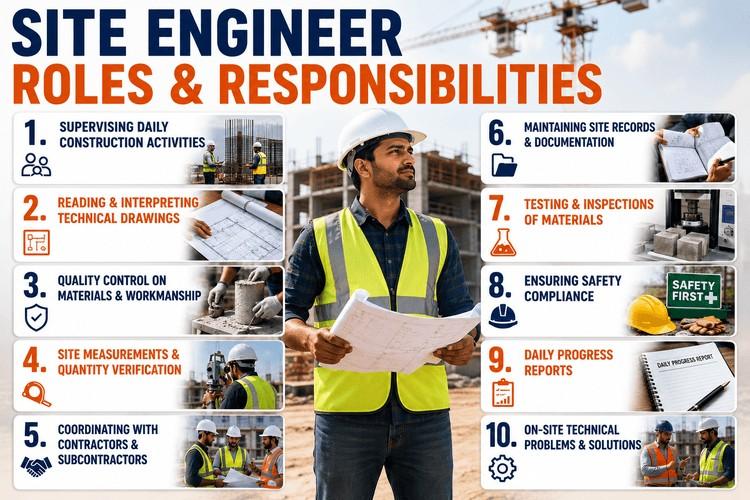
- Supervising daily construction activities — Making sure work happening on site matches the approved drawings and specifications. This is the core of the role. If something is being built incorrectly, the site engineer is the first person responsible for catching it.
- Reading and interpreting technical drawings — AutoCAD drawings, structural plans, architectural drawings, MEP coordination drawings — the site engineer needs to be fluent in all of them and able to translate what they see on paper to what the contractor and workers need to do on the ground.
- Quality control on materials and workmanship — This means checking that the concrete being poured meets the mix design specification, that reinforcement placement matches the bar bending schedule, and that brick masonry courses are level and plumb. Quality issues caught early are cheap. Caught late, they are expensive. Caught after the structure is built, they can be catastrophic.
- Site measurements and quantity verification — Before raising a bill or certifying a payment to a contractor or subcontractor, the site engineer measures and verifies the work completed. No measurement, no payment. That is how construction contracts work.
- Coordinating with contractors and subcontractors — Managing the relationship between the main contractor and various subcontractors — civil, structural, MEP — and making sure their work does not conflict or fall out of sequence.
- Maintaining site records and documentation — Daily site diaries, material test certificates, inspection request forms, site instructions, correspondence with contractors. The paperwork is constant, and it matters — especially when disputes arise later.
- Testing and inspections of materials – Testing cubes of concrete, soil compaction test, brick water absorption test, and rebar tensile test. The site engineer conducts these tests and compares their results with IS standards.
- Ensuring safety compliance – Safety compliance with PPE, safety briefing sessions before commencement of work, hazard identification and mitigation. Safety is non-negotiable in a proper construction project, and hence it is actively managed by the site engineer every day.
- Daily progress reports – The site engineer prepares a report at the end of each day describing the work done, problems encountered, materials consumed, and the next day’s plan. These reports are forwarded to the project manager and ultimately to the client.
- On-site technical problems – Whenever there is an issue with the drawings, damaged material, or a construction issue that needs to be sorted out, the site engineer becomes the first point of contact. It occurs many times each day on a construction site.
Upgrade from site execution to digital construction with Kaarwan’s Professional BIM Certification Program for Civil Engineers. Gain practical BIM skills that leading firms are actively hiring for in 2026.
Skills Required to Become a Site Engineer
Two categories. Both matter. Neither works without the other.
AutoCAD — Non-negotiable. You will spend a significant part of your working day reading AutoCAD drawings. Being able to open a DWG file, check dimensions, cross-reference details, and spot inconsistencies is a daily requirement.
Drawing reading — Structural, architectural, and MEP drawings. The ability to read and reconcile across different drawing sets is one of the most practically valuable skills a site engineer can have.
Soil testing and material testing — Understanding which tests are required, how they are conducted, what the IS code limits are, and how to interpret the results. Basic but critical.
Surveying and setting out — Using a total station or auto level to set out column positions, check floor levels, and verify road gradients. If your setting out is wrong, everything built on top of it is wrong.
Material knowledge — Concrete grades, steel grades, brick specifications, admixtures, and waterproofing systems. Understanding what goes into a structure and what properties each material needs to have.
BIM tools — Revit, Navisworks, BIM 360. These are becoming increasingly relevant even at the site level — for reviewing BIM models, checking clash reports, and coordinating between disciplines. Site engineers who understand BIM are meaningfully more hireable in 2026.
Read More: Civil engineering software list
Soft Skills
Communication — You are talking to labourers, contractors, project managers, and clients — all in the same day, all requiring a different register. Clear, honest, and direct communication prevents a large percentage of site problems before they become expensive.
Problem-solving — Things go wrong on construction sites. Always. The question is how fast you identify the problem and how good your proposed solution is. This is the skill that separates good site engineers from great ones.
Leadership — You are managing people. Contractors, foremen, workers — they take direction from you. Leadership on a construction site is not about being loud. It is about being clear, consistent, and present.
Time management — Multiple activities happening simultaneously, each with its own dependencies and deadlines. Keeping track of all of it without letting critical path items slip requires genuine time management skill.
Site Engineer vs Project Engineer — What is the Difference?
This question comes up constantly, and the confusion is understandable — the two roles work closely together, and there is real overlap in practice.
| Aspect | Site Engineer | Project Engineer |
| Primary Focus | On-site execution and daily construction supervision | Overall project coordination, planning, and technical management |
| Work Location | Primarily on site — outdoors, on the ground | Hybrid — site and office, more office as seniority increases |
| Reporting To | Project Engineer or Project Manager | Project Manager or client representative |
| Key Responsibilities | Supervising work, QC, measurements, DPRs, contractor coordination | Planning, scheduling, procurement, design coordination, budget tracking |
| Experience Level | Entry to mid level (0–5 years typically) | Mid level (3–7 years typically) — usually progresses from site engineer |
| Salary Range | Rs 3–9 LPA depending on experience and company | Rs 6–16 LPA depending on experience and company |
The honest summary: a site engineer is closer to the physical work of construction. A project engineer has broader visibility across the full project — planning, procurement, budgeting, client interface. Most project engineers in India started as site engineers. The site role is where you build the foundational knowledge that makes everything else possible.
Want to move beyond traditional site roles? Kaarwan’s BIM Certification Program helps civil engineers master BIM tools used on real infrastructure and construction projects across India.
How to Become a Site Engineer in India
It is a more straightforward path than most engineering careers, which is part of why it is often the first job a civil engineering graduate lands. But straightforward does not mean effortless.

Step 1 — Get a civil engineering degree or diploma, a B.E. or B. Tech in Civil Engineering is the standard entry qualification. Diploma holders can also access site engineer roles — particularly junior site engineer, site supervisor, and quality inspector positions. The degree opens more doors faster and typically comes with a higher starting salary.
Step 2 — Gain internship or trainee experience. Before your final year ends, get onto a construction site. Even 2–3 months of internship experience — where you are actually walking the site, reading drawings, and observing concrete pours — makes a meaningful difference in both your interview performance and your practical readiness when you join.
Step 3 — Learn key software. AutoCAD is the minimum. Add MS Project for schedule understanding. If you want to genuinely accelerate — and this is worth saying clearly — add BIM tools. Revit and Navisworks are not just for BIM coordinators in offices. Firms doing serious infrastructure work are increasingly expecting site-level familiarity with BIM models and coordination workflows.
Step 4 — Apply for junior site engineer roles. Target construction firms, EPC companies, and real estate developers directly. L&T, Tata Projects, Shapoorji Pallonji, Afcons, and NCC Limited — all hire fresh civil engineers at the site engineer level. PSU roles through GATE score are another track — NHAI, RVNL, NBCC — where the pay is better from day one and job security is significantly higher.
Step 5 — Get certified to grow faster. Professional certifications — BIM certification, PMP, quality management certifications — signal something important to employers: that you are investing in your own development rather than waiting for the role to teach you everything. Site engineers who add BIM certification to their profile get promoted to BIM Engineer or Project Engineer roles 2–3 years faster than those without.
For a detailed walkthrough of what the transition from site engineer to BIM civil engineer actually looks like.
Site Engineer Salary in India (2026)
Let's talk about the numbers that most guides either ignore or get wrong.
Site engineer salary in India varies significantly by experience, company type, and city. A site engineer at a mid-size contractor in Tier 2 city earns very differently from someone at L&T on a metro project in Mumbai. Here is a realistic breakdown based on 2026 market data from Naukri, AmbitionBox, and Jobted.
| Experience Level | Government Sector (₹ LPA) | Private Sector (₹ LPA) | MNC / International (₹ LPA) |
| Fresher 0–2 years | 2.5–4 | 3–5 | 4–7 |
| Junior 2–5 years | 4–7 | 5–9 | 7–12 |
| Mid 5–8 years | 7–10 | 8–14 | 12–18 |
| Senior 8 years+ | 10–15 | 14–22 | 18–30 |
A few things worth noting about these numbers. Government and PSU roles — accessed through GATE or SSC JE — often pay more at entry level than private construction companies, especially once you factor in housing allowance, medical, and pension benefits. The private sector ceiling is significantly higher at mid to senior level, particularly at large EPC firms and international consultancies. Cities like Mumbai, Bengaluru, and Pune pay 20–30% more than Tier 2 cities for equivalent roles and experience.
Site engineers with BIM skills earn 40–60% more than those without. A BIM-certified site engineer moves into BIM Coordinator or Project Engineer roles faster — and that jump typically means Rs 3–5 LPA more within 18 months of making the transition.
Read More: Jobs after civil engineering and career growth
Career Growth Path for Site Engineers
The site engineer role is not the destination. It is the starting point. And where you go from here depends largely on what skills you add and which direction you deliberately choose to move.
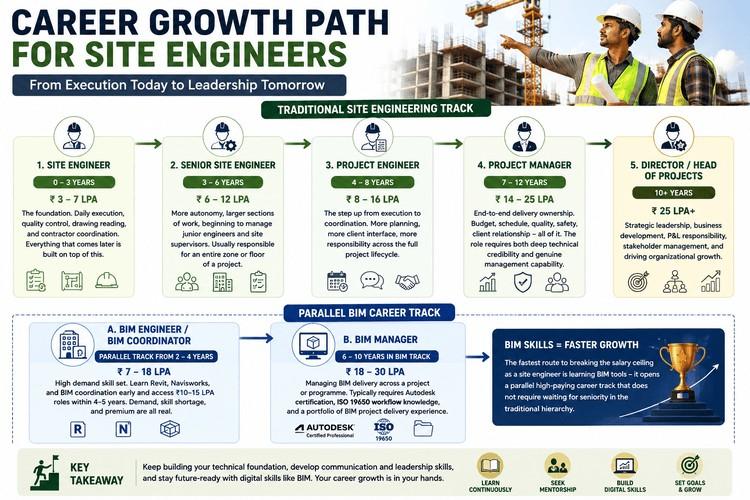
Site Engineer — 0–3 years — Rs 3–7 LPA The foundation. Daily execution, quality control, drawing reading, and contractor coordination. Everything that comes later is built on top of this.
Senior Site Engineer — 3–6 years — Rs 6–12 LPA More autonomy, larger sections of work, beginning to manage junior engineers and site supervisors. Usually responsible for an entire zone or floor of a project.
Project Engineer — 4–8 years — Rs 8–16 LPA The step up from execution to coordination. More planning, more client interface, more responsibility across the full project lifecycle. This is where strong communication and planning skills start mattering as much as technical knowledge.
Project Manager — 7–12 years — Rs 14–25 LPA End-to-end delivery ownership. Budget, schedule, quality, safety, client relationship — all of it. The role requires both deep technical credibility and genuine management capability.
BIM Engineer / BIM Coordinator — Parallel track from 2–4 years — Rs 7–18 LPA. This is the route worth paying attention to if you are a site engineer reading this. The BIM career track runs parallel to the traditional progression — you do not have to wait 8 years to reach the salary level of a Project Manager. Site engineers who pick up Revit, Navisworks, and BIM coordination skills early are accessing Rs 10–15 LPA roles within 4–5 years of starting work. The demand is real, the skill shortage is real, and the premium is real.
BIM Manager — 6–10 years in BIM track — Rs 18–30 LPA Managing BIM delivery across a project or programme. Typically requires Autodesk certification, ISO 19650 workflow knowledge, and a portfolio of BIM project delivery experience.
The fastest route to breaking the salary ceiling as a site engineer is learning BIM tools — it opens a parallel high-paying career track that does not require waiting for seniority in the traditional hierarchy.
Learn Revit, Navisworks, and BIM workflows with Kaarwan’s Professional BIM Certification Program for Civil Engineers. Build industry-ready skills that help site engineers grow faster and access higher-paying roles.
Frequently Asked Questions
What is a site engineer in civil engineering?
A site engineer in civil engineering is the professional responsible for managing daily construction activities on a project site — making sure the work follows approved drawings, meets quality standards, stays safe, and stays on schedule. They are the link between the design team and the construction crew. Most civil engineering careers in India begin here, and the role provides practical grounding that no amount of classroom learning can replace.
What is the salary of a site engineer in India?
Site engineer salary in India in 2026 ranges from Rs 3–5 LPA at the fresher level in the private sector to Rs 14–22 LPA at the senior level in large EPC companies. Government and PSU roles accessed through the GATE score typically start at Rs 4–7 LPA with additional housing, medical, and pension benefits. City, company, and experience all affect the number significantly — engineers in Mumbai and Bengaluru earn 20–30% more than equivalent roles in Tier 2 cities. Site engineers who add BIM skills to their profile consistently earn 40–60% more than those without, based on 2026 job market data from Naukri and AmbitionBox.
What are the responsibilities of a site engineer?
A site engineer's responsibilities cover the full range of daily construction management — supervising work on site, reading and interpreting drawings, checking material quality, taking measurements for billing, coordinating with contractors and subcontractors, maintaining site records, overseeing safety compliance, and preparing daily progress reports. On a busy site, no two days look exactly the same. The problems that come up are different every day, which is one of the reasons experienced site engineers are valuable — they have seen the problems before.
What is the difference between a site engineer and a project engineer?
A site engineer is focused on on-the-ground execution — what is being built today, whether it is being built correctly, and whether the materials are right. A project engineer has a broader scope — planning, procurement, budgeting, design coordination, and client management. Most project engineers started as site engineers and built up enough experience and capability to take on a wider remit. The salary reflects this — project engineers typically earn Rs 6–16 LPA versus Rs 3–9 LPA for site engineers at equivalent experience levels.
How can a site engineer grow their career faster?
Three things accelerate career growth as a site engineer faster than anything else. First, take on responsibility deliberately — volunteer for the most complex and visible work on site, not the most comfortable. Second, learn software that the market is hiring for — AutoCAD is the baseline, but BIM tools (Revit, Navisworks) are what separate the engineers accessing Rs 10–15 LPA roles at 4–5 years of experience from those who are still at Rs 6–8 LPA. Third, get certified. A BIM certification or PMP signals to employers that you are investing in your own capability, not waiting for the role to teach you everything. Site engineers who do all three regularly move into BIM Engineer or Project Engineer roles 2–3 years faster than their peers.