
If you are a civil engineering student trying to figure out where to apply or a working engineer thinking about your next move, the list of companies matters more than people admit.
Not just for the job. For what you learn, who you work with, what kind of projects go on your CV, and, honestly, what your salary ceiling looks like five years from now. A fresh civil engineer who joins a mid-size contractor doing residential projects in one city and a fresh civil engineer who joins an EPC giant working on a metro rail corridor are going to have very different career trajectories by year three. Same degree. Very different outcomes.
So here is a properly researched look at the top civil engineering companies in India in 2026 , what they do, what they are known for, what they are currently building, and what working there actually means for your career.
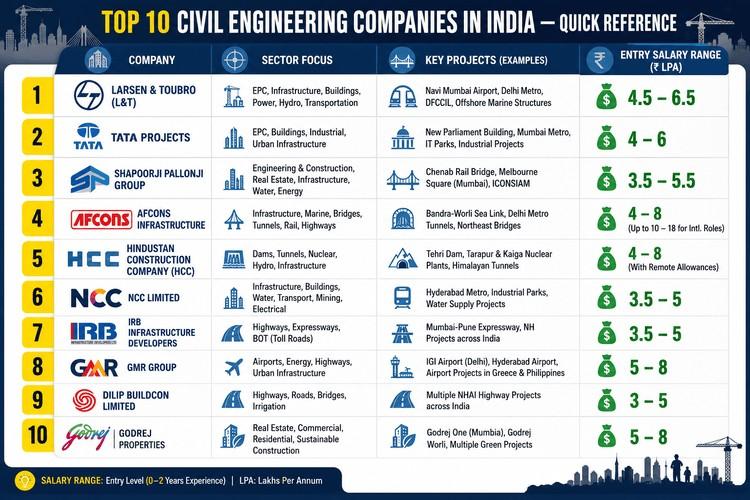
Larsen and Toubro (L&T), The Benchmark
Ask any civil engineering student in India which company they want to join, and L&T comes up within the first 30 seconds. Every time. There is a reason for that, and it is not just the brand name.
L&T Construction is the largest EPC company in India by revenue and order book. But what actually matters for a young engineer is what working there does to their career. The answer is: a lot. They have built training infrastructure that most Indian construction firms have never bothered investing in, structured Graduate Engineer Trainee programmes, internal promotion pathways, and cross-project exposure that gives you a view of the full project lifecycle, not just one site in one city. A fresher at L&T in year two knows things about procurement systems, BIM coordination workflows, and quality management that engineers at smaller firms figure out only by year five, if at all.
Current projects read like a wish list of infrastructure work, Navi Mumbai International Airport civil packages, metro rail in multiple cities, Dedicated Freight Corridor sections, and offshore marine structures in the Middle East. The scale is sometimes hard to even picture.
Hiring: L&T recruits heavily from NIT and IIT campuses for GET roles. Off-campus applications go through Naukri or their careers portal year-round. Fresh engineers start at Rs 4.5–6.5 LPA. Engineers with BIM skills, Revit, Navisworks, and BIM 360 are specifically shortlisted for coordination and planning roles, often at a salary step above equivalent candidates without those skills.
Tata Projects Limited, Quality That Shows Up in the Details
There is one project that changed how a lot of people looked at Tata Projects. The new Parliament Building in New Delhi, delivered in 2023, complex, high-visibility project completed on schedule. That kind of project does not happen by accident. It reflects something about how Tata Projects runs its operations.
They are not the oldest or the biggest. But they have a reputation for doing things carefully, quality systems, digital construction tools, and structured project governance. Engineers who have worked there talk about the environment being noticeably more process-driven than most Indian contractors. That is either a feature or a bug, depending on who you are. For someone who wants to understand how a well-run large project actually works, it is a feature.
The technology adoption is real. BIM integration, drone-based site monitoring, and project management software that actually gets used, Tata Projects is genuinely ahead of most peers on this. Engineers who walk in with BIM skills land in coordination and planning roles faster.
Hiring: Entry-level roles start at Rs 4–6 LPA. Merit-based internal promotion means technically strong engineers move quickly. If building a long career rather than jumping companies every two years is the goal, Tata Projects is worth considering seriously.
Top civil engineering companies are hiring engineers with BIM, Revit, and coordination skills. Learn them through Kaarwan’s Professional BIM Certification Program for Civil Engineers and strengthen your career opportunities in 2026.
Shapoorji Pallonji Group, 160 Years Is Not a Marketing Line
Some companies put their founding year on their website, and it means nothing. Shapoorji Pallonji was founded in 1865. That one actually means something.
The depth of technical capability that comes from 160 years of building things in India, across materials, soil conditions, structural systems, political and regulatory environments, is hard to replicate. They work across six business categories: engineering and construction, real estate, infrastructure, water, energy, and financial services. Afcons Infrastructure, their civil engineering subsidiary, handles the heavy infrastructure side, covered separately below.
On the building side, the Shapoorji Pallonji name shows up on some of the most recognisable structures in Mumbai, premium residential towers, commercial complexes, and landmark institutional buildings. The Chenab Railway Bridge in Jammu, currently the world's highest single-arch railway bridge, is being built by the group. That project alone tells you what kind of technical complexity they are comfortable with.
Hiring: Entry-level engineers typically start at Rs 3.5–5.5 LPA. The company values drawing literacy, site execution discipline, and quality management from day one. For engineers based in Mumbai or Pune, Shapoorji Pallonji offers consistent and varied project exposure that is hard to find at smaller firms.
Read More: Types of civil engineering disciplines
Afcons Infrastructure, This Is Where the Hard Projects Go
Afcons is where you end up when someone needs to build something that has not been built before. Or at least, not in that location, at that depth, with those geological conditions.
They are the undisputed leader in marine construction in India. The Bandra-Worli Sea Link in Mumbai, structurally one of the most demanding cable-stayed bridge projects ever executed in India, was Afcons. The underground metro tunnels in Kolkata and Delhi. Multiple high-altitude bridge projects in Northeast India, where just getting equipment to the site requires its own logistics strategy. Internationally, they work across the Middle East, Africa, and Southeast Asia on similarly non-standard projects.
If you want to spend your career doing straightforward residential or commercial site supervision, Afcons is probably not the right fit. But if tunnels, marine foundations, high-altitude bridge construction, and genuinely complex geotechnical problems are what interest you, there is no better Indian company to be at.
Hiring: Afcons recruits for site-based roles across India and internationally. International postings in the Middle East or Africa come with significantly better compensation; mid-level engineers in these roles are often earning Rs 10–18 LPA equivalent. BIM adoption is growing particularly on international deliveries.
Hindustan Construction Company (HCC), For Engineers Who Want to Go Somewhere Difficult
Nuclear power plant civil structures. High-altitude tunnels in Himalayan terrain. Hydroelectric dams in geological conditions require the kind of geotechnical engineering that does not come from textbooks.
That is HCC's world. They built civil infrastructure for the Tarapur and Kaiga nuclear stations. They were involved in the Tehri Dam, one of the tallest rockfill dams in the world. Their tunnelling portfolio in Jammu and Kashmir and the Northeast covers terrain that most contractors would not even quote on.
This is not a company for engineers who want comfortable city postings and a 9-to-5. Projects are often remote, timelines are long, and conditions are difficult. But the technical density of what you learn on an HCC project is genuinely rare. Engineers who spend 4–5 years at HCC on tunnelling or dam projects develop a specialisation that is in extremely short supply in the Indian market, and that kind of scarcity has its own salary implications.
Hiring: HCC hiring is selective, particularly for specialised roles. Freshers start around Rs 4–8 LPA depending on project and location, with remote project allowances adding significantly to take-home. Not for everyone. For the right engineer, possibly the best technical experience available in India.
Want to stand out at companies like L&T, Tata Projects, or Afcons? Build in-demand BIM skills with Kaarwan’s Professional BIM Certification Program for Civil Engineers and become job-ready for large-scale infrastructure projects.
NCC Limited (Nagarjuna Construction Company), Underrated and Worth a Second Look
NCC does not get talked about as much as L&T or Tata Projects in placement discussions. Which is a bit strange, they are one of the largest listed construction companies in India by revenue, with over four decades of infrastructure delivery across buildings, transportation, water, electrical, mining, and industrial sectors.
That breadth is actually the point. An engineer who spends 4–5 years at NCC and deliberately moves across project types, a building package, then a water infrastructure project, then a metro civil package, builds a genuinely varied base of experience that is harder to get at companies which specialise in one segment. For engineers who want to eventually move into project management rather than deep technical specialisation, a variety of experience is valuable.
NCC is particularly active across South India, Telangana, Andhra Pradesh, Karnataka, Tamil Nadu, which makes them especially relevant for engineers based in these regions who want to stay close to home without sacrificing company quality or project scale. BIM adoption is growing on their larger packages.
Hiring: Entry salaries range from Rs 3.5–5 LPA. Direct applications through Naukri or their careers page work alongside campus placement. AmbitionBox reviews suggest the company has above-average ratings for work-life balance and job security, which, on serious construction projects, is not always a given.
Read More: Civil engineering software skills for placement
IRB Infrastructure Developers, Building the Road Network India Actually Needs
India is in the middle of one of the largest highway expansion programmes in the world. NHAI is awarding packages at a pace that would have seemed implausible a decade ago. IRB Infrastructure is one of the companies that has been consistently winning and delivering these packages, under the Build-Operate-Transfer model, which means they are not just contractors walking away after handing over the road. They finance it, build it, operate it, and maintain it for concession periods that can run 20–25 years.
That long-term ownership changes the engineering calculus in interesting ways. Pavement design life matters. Drainage durability matters. The long-term maintenance cost of every structural decision matters in a way it simply does not for a company that hands keys over and moves on. Engineers at IRB learn to think about infrastructure with a lifecycle lens, not just a construction lens.
Recent packages include multiple four-lane and six-lane stretches on the NHAI network across various states, including expressway programme sections that are genuinely changing travel times between Indian cities.
Hiring: Site engineering, quality, and planning roles across the project network. Freshers start at Rs 3.5–5 LPA. Highway project experience is highly transferable; engineers who have 3–4 years of road and bridge site experience are sought across the infrastructure sector.
GMR Group, A Different Kind of Infrastructure Career
GMR is not a construction company in the traditional sense. They are an infrastructure developer, meaning they conceive, fund, build, and then operate large assets over their economic lifetime. The primary domains are airports and energy.
The IGI Airport in New Delhi, India's busiest airport, handling tens of millions of passengers annually, is managed by GMR. The Hyderabad Rajiv Gandhi International Airport was designed, built, and is operated by them. Internationally, they have airport development projects in Greece and the Philippines. The civil engineering involved in running an operational airport, airside pavement design and maintenance, taxiway structural integrity, terminal expansion in an active operational environment, drainage for massive impervious areas, is a different and highly specialised body of work.
For civil engineers who want a more corporate environment, longer-term asset management work alongside construction, and exposure to genuinely complex built infrastructure in urban settings, GMR offers a career profile that you cannot access at a pure construction contractor.
Hiring: Entry technical roles start at Rs 5–8 LPA. The structure is more corporate than a typical construction site environment, and the career trajectory tends toward asset management and operations rather than pure project delivery.
Dilip Buildcon, If Speed Is the Metric, They Win
Dilip Buildcon has built a specific and well-deserved reputation in the Indian highway sector: they build fast. Genuinely faster than most comparable companies. NHAI has recognised them multiple times for completing highway packages significantly ahead of schedule, which in Indian infrastructure is notable because late delivery is the norm, not the exception.
The operational model behind that speed is equipment ownership. Dilip Buildcon owns one of the largest construction equipment fleets in India, including excavators, pavers, compactors, and piling rigs. Owning rather than renting means availability, control, and cost discipline that contractors dependent on equipment hire cannot match. For an engineer on a Dilip Buildcon site, that translates to a faster pace of work, tighter schedules, and the kind of execution pressure that either makes you very good very fast or burns you out.
It is not the easiest environment. But for engineers who thrive in fast-paced site conditions and want a CV full of completed highway packages in a short time frame, Dilip Buildcon delivers that.
Hiring: Active hiring for site roles on highway packages across India. Freshers start at Rs 3–5 LPA. The learning curve is steep. The pace is demanding. And yes, the field experience you accumulate in three years would take five years at a slower firm.
Read More: Jobs after civil engineering and career growth
Godrej Properties, Where Sustainable Construction Is Actually Happening
Not every civil engineering career needs to be on a highway in the middle of nowhere or a tunnel 200 metres underground. Some of the most interesting and commercially relevant work happening in Indian construction right now is in sustainable building, LEED certification, embodied carbon tracking, green material specification, passive design, and Godrej Properties is doing it more seriously than almost any other Indian developer.
Their residential and commercial projects across Mumbai, Pune, Bengaluru, and the NCR consistently target IGBC and LEED certifications. The material specifications, quality standards, and construction management systems on a Godrej Properties project are noticeably more rigorous than at developers who treat green certification as a marketing exercise rather than an engineering commitment.
BIM adoption is growing. The corporate culture is structured, more like a professional services environment than a typical construction site hierarchy. For engineers who want to combine site and office work, build expertise in sustainable construction, and work within a company that takes quality seriously, Godrej Properties is a genuinely strong option that is underrepresented in campus placement conversations.
Hiring: Roles start at Rs 5–8 LPA for freshers. The appraisal system is merit-based and more formalised than with pure contractors. Engineers with BIM skills and an understanding of green building standards are specifically valued.
Your degree gets you shortlisted. BIM skills help you grow faster. Join Kaarwan’s Professional BIM Certification Program for Civil Engineers to prepare for high-value roles in top infrastructure and construction companies.
What Skills Do These Companies Actually Look For?
Every company on this list will tell you they want engineers with "strong fundamentals and good communication." That is true and also completely unhelpful. Here is what actually moves your application forward.
AutoCAD and drawing reading: This is not optional. Every company expects it. If you are applying for any site or coordination role and you cannot open a DWG file, check dimensions, and cross-reference structural and architectural drawings, your application is going nowhere.
BIM tools, Revit, Navisworks, BIM 360: This is the skill that separates applications in 2026. L&T, Tata Projects, NCC, Godrej Properties, all actively running BIM on large projects. Engineers who can navigate a federated BIM model, review clash reports, and understand ISO 19650 project information workflows are getting interview calls that engineers without these skills are not. The salary premium for BIM-proficient civil engineers at these companies is 40–60% over equivalent experience without BIM skills.
Surveying and setting out: Total station operation, auto level, and GPS-based setting out for large infrastructure projects. Companies like IRB and Dilip Buildcon need engineers who can actually work the instruments on site, not just know the theory.
Quality management: IS codes, material testing, inspection and test plans, non-conformance report processes. Quality-focused engineers who understand how to run QC systems on large projects are valued at every company on this list.
Communication and reporting: Daily progress reports, contractor correspondence, progress presentations to clients. Every senior engineer and project manager at these companies will tell you that the ability to communicate clearly and write a coherent technical report is rarer than it should be, and is noticed immediately when someone has it.
Which Company Should You Target?
Honest answer: it depends on what kind of civil engineer you want to become.
If you want the broadest exposure and the strongest brand on your CV for the long term, L&T or Tata Projects. The training, the project diversity, and the name recognition are unmatched.
If you want to specialise in complex structures, tunnels, or marine works, Afcons or HCC. The technical depth is rare and the international project exposure is real.
If you want highway and transportation infrastructure: IRB Infrastructure or Dilip Buildcon. Fast-paced, equipment-intensive, and building an India that looks meaningfully different every year.
If you want a structured corporate environment with a sustainable construction focus: Godrej Properties or Tata Projects. The culture, the BIM adoption, and the career framework are more formalised than pure construction contractors.
If you are in South India and want a large company with regional presence: NCC Limited is a strong option that is often underrated in placement discussions.
The honest reality is that the company you join matters less than the quality of the work you do there. A motivated engineer at Dilip Buildcon who takes initiative on site, learns quickly, and adds BIM skills will outpace a passive engineer at L&T every time.
Frequently Asked Questions
Which is the best civil engineering company to work for in India?
Larsen and Toubro is generally considered the strongest company for civil engineers in India , the training infrastructure, project diversity, and growth opportunities are unmatched. Tata Projects is a strong second, particularly for engineers interested in digital construction and structured project management environments. The best company for you specifically depends on what kind of projects and career trajectory you are targeting.
What salary can I expect at top civil engineering companies in India as a fresher?
Fresher salaries at the top construction companies in India in 2026 range from Rs 3.5–6.5 LPA depending on the company, the role, and the location of posting. L&T and Tata Projects pay at the higher end of this range for Graduate Engineer Trainee roles. Specialist companies like Afcons and HCC may pay less at entry level but offer international project allowances that add significantly to total compensation. Engineers with BIM certification consistently access the higher end of the salary range.
Do top construction companies in India hire diploma holders?
Yes , most companies on this list hire diploma holders for junior site engineer, site supervisor, and quality inspector roles. Degree holders typically access higher starting salaries and faster promotion timelines, but diploma holders with strong site skills and AutoCAD proficiency are actively recruited by companies like NCC Limited, Dilip Buildcon, and IRB Infrastructure for field-based roles.
Which civil engineering companies in India use BIM?
L&T, Tata Projects, Shapoorji Pallonji, Afcons, Godrej Properties, and NCC Limited are all actively running BIM on large infrastructure and building projects. The adoption is fastest on metro rail, airport, and premium real estate projects where international clients or Indian clients with global standards require BIM-based project delivery. Engineers who join these companies with existing BIM skills are placed into coordination and planning roles faster than those learning on the job.
How do I get placed in top civil engineering companies in India?
Most top companies recruit through campus placements at NITs, IITs, and other accredited engineering colleges. For off-campus applications, Naukri, LinkedIn, and company careers portals are the most reliable channels. The profile that consistently gets called is one that shows strong fundamentals , AutoCAD proficiency, site internship experience, clear project exposure , combined with at least one differentiating skill, which in 2026 increasingly means BIM tools. A BIM certification from a recognised programme adds credibility that a standard civil engineering degree alone does not provide.