Architectural Door Hardware
Door hardware may appear to be a collection of small accessories, but each component plays a critical role in how a door functions, feels and performs over time. From supporting the weight of a door to controlling its movement, securing an opening and protecting adjacent surfaces, hardware selection directly influences durability, accessibility, safety and architectural aesthetics. Choosing the right hardware requires understanding not just its appearance, but also the door material, weight, frequency of use and installation requirements.
Understanding Components
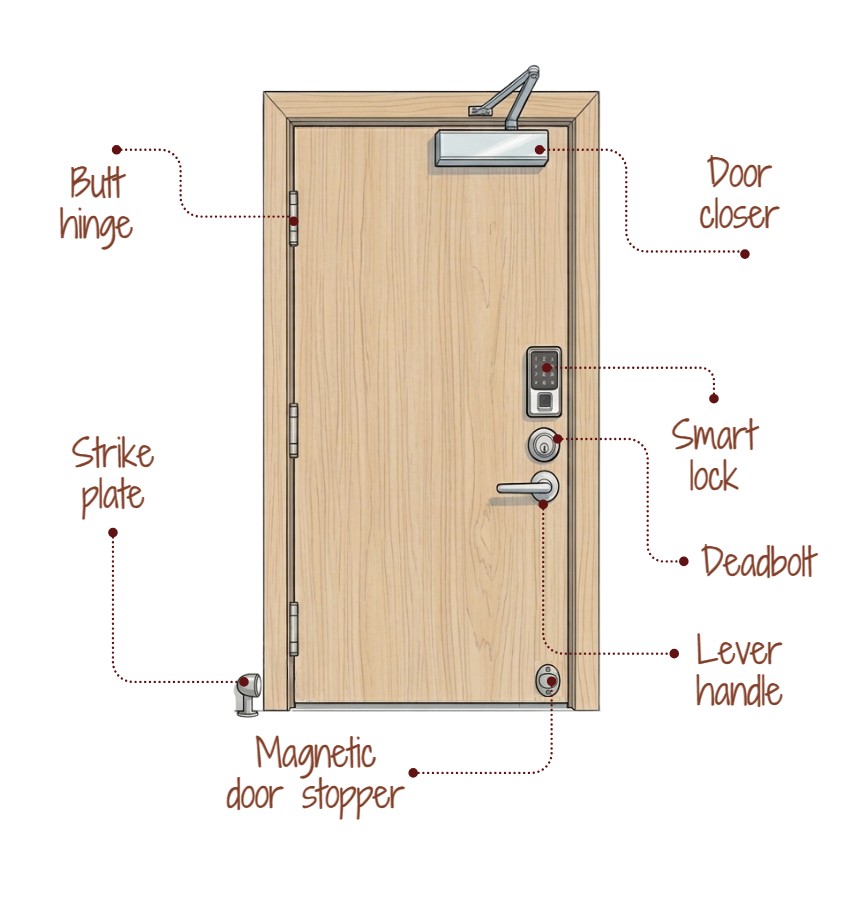
A door hardware assembly typically combines multiple components, each serving a specific function. Butt hinges allow the door to swing, while a door closer controls its return movement and ensures it closes smoothly. A strike plate receives the latch bolt and protects the door frame at the locking point. Door stoppers prevent the door from hitting walls, furniture or glazing, with magnetic variants holding the door open when required. Lever handles operate the latch mechanism, while deadbolts provide an additional locking mechanism independent of the spring-loaded latch. Smart locks introduce keyless access through PINs, cards, fingerprints or mobile applications. These components work together to form a complete door system rather than functioning as isolated fittings.
Types of Door Hinges
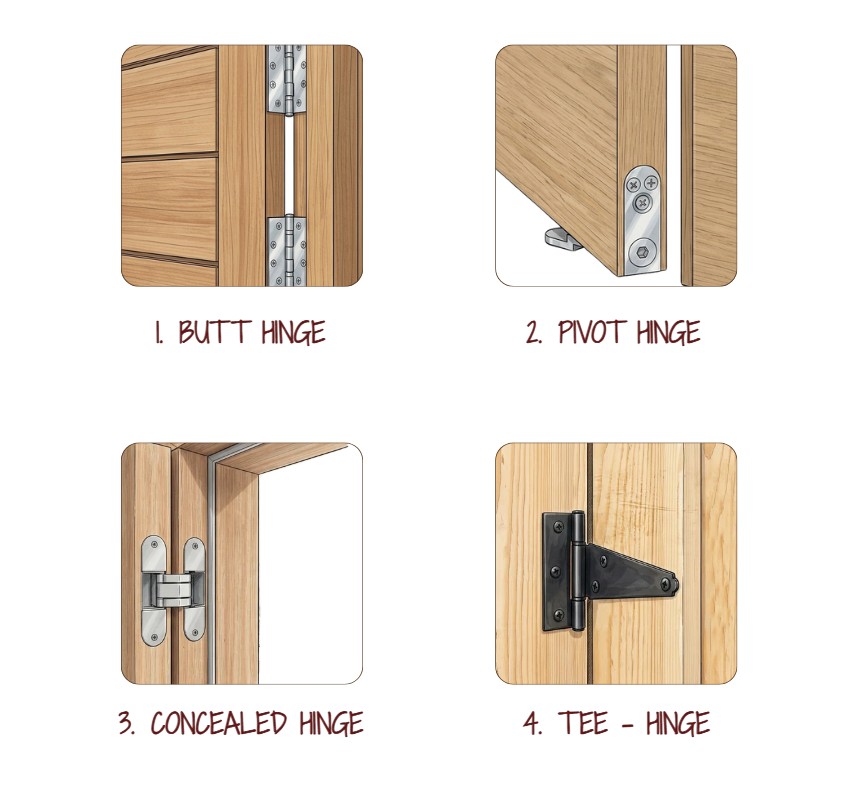
Butt Hinge
Butt hinges are among the most commonly used hinges in residential and commercial buildings. They consist of two rectangular metal leaves connected by a central knuckle and pin, with one leaf fixed to the door and the other to the frame. They are generally recessed into the door edge and frame, allowing the hinge to sit flush when the door is closed. Butt hinges are suitable for timber doors, flush doors and many framed door assemblies. For heavier doors or high-frequency use, ball-bearing hinges reduce friction during movement and can offer smoother operation and improved wear performance. Their durability depends on the hinge material, size, bearing type, door weight and quality of installation.
Pivot Hinge
Pivot hinges support a door through pivot points positioned at the top and bottom, rather than along the conventional side-mounted hinge axis. This arrangement can distribute loads differently and is often used for tall, heavy or architecturally prominent doors. Pivot systems can also accommodate oversized doors and create a clean appearance with minimal visible hardware. However, their installation requires accurate alignment, suitable structural support and a compatible floor and head detail. They are particularly useful for large entrance doors, contemporary interiors and doors where a different swing arrangement is desired.
Concealed Hinge
Concealed hinges remain hidden when the door is closed, creating a clean, uninterrupted appearance without visible hinge knuckles. Depending on the system, they may allow adjustment in multiple directions, helping align the door after installation. They are commonly used in flush doors, modern interiors, concealed-frame doors and minimalist architectural designs. Concealed hinges are not interchangeable across all door types; their load capacity, opening angle, door thickness and frame compatibility must be checked before specification. Higher-quality concealed hinges are particularly useful where precise alignment and a refined finish are important.
T-Hinge
T-hinges feature a long strap-shaped leaf that extends along the door surface and a shorter leaf attached to the frame, forming a T-shaped profile. Unlike butt hinges, they are generally surface-mounted, making them suitable for doors where recessing the hinge is difficult or undesirable. T-hinges are frequently used for garden gates, shed doors, utility doors, rustic timber doors and lightweight exterior applications. Their extended fixing plate distributes loads over a larger area, but the hinge and fasteners must still be selected according to door weight, exposure to weather and frequency of operation.
Types of Door Handles
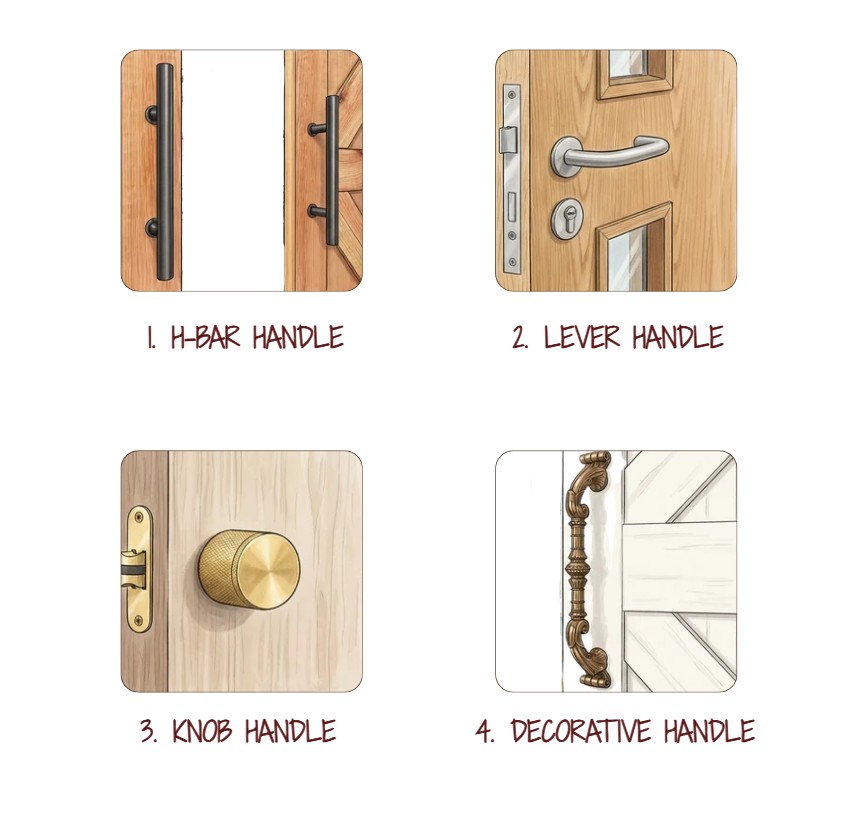
H-Bar Handles
H-bar handles are elongated pull handles with a simple bar-shaped profile, typically fixed at two points. They are commonly installed on glass doors, main entrance doors, commercial spaces and contemporary residential entrances. Their minimal geometry makes them visually clean while providing a comfortable grip for pulling or pushing doors. Stainless steel is a popular choice for high-traffic applications because of its strength and corrosion resistance, although the grade and finish should be selected according to the environment.
Lever Handles
Lever handles operate a latch by rotating a lever downward or upward, making them easy to use without requiring a tight grip or twisting motion. They are widely used for bedroom doors, office doors, passage doors and accessible spaces. Lever handles are available in straight, curved, minimalist and ergonomic profiles, with variations in rose plates and backplates. For frequently used doors, the strength of the internal mechanism and the handle’s resistance to loosening are just as important as its external finish.
Door Knobs
Door knobs operate by rotating a rounded or shaped knob to retract the latch. They are commonly used for residential interiors, including bedrooms, bathrooms and passage doors. Their compact form works well with traditional, contemporary and heritage-inspired interiors. However, knobs generally require a twisting grip, which can make them less convenient for children, elderly users or people with limited hand mobility compared to lever handles.
Decorative Handles
Decorative door handles prioritise visual character while retaining the necessary function of opening and closing a door. They may include sculptural pulls, antique brass fittings, ornate cast-metal designs, ceramic knobs or customised handles. These are frequently used on feature doors, wardrobes, heritage interiors, boutique spaces and bespoke furniture. When selecting decorative hardware, check the grip, fixing arrangement, material quality and operating mechanism to ensure that the design is practical for everyday use.
Conclusion
Door hardware is a small but essential part of architectural detailing. The right hinge ensures smooth movement and structural support, the handle improves usability, the lock provides security, and accessories such as closers and stoppers protect the door and surrounding surfaces. Hardware should be specified according to door weight, material, exposure, usage frequency, accessibility and maintenance requirements. A well-designed door is not just about the leaf or frame—it is about how every component works together to create a reliable and seamless experience.
These were some insights on Types of door hardware. Stay tuned for more information on other significant topics in the AEC industry and follow Kaarwan for such detailed guides!
FAQs
1. Which hinge is best for a heavy wooden door?
Heavy-duty butt hinges, particularly suitable ball-bearing hinges, or properly specified pivot systems are commonly used. The choice depends on the door’s weight, dimensions, frame construction and frequency of use.
2. What is the difference between a butt hinge and a pivot hinge?
A butt hinge is fixed along the door edge and frame, allowing it to rotate around a vertical hinge pin. A pivot hinge supports the door through pivot points, usually at the top and bottom, and can be suitable for larger or heavier doors.
3. Where are concealed hinges commonly used?
Concealed hinges are used in flush doors, modern interiors, concealed-frame systems and minimalist designs where visible hinge hardware is undesirable.
4. Are lever handles better than door knobs?
Lever handles are generally easier to operate because they require less grip strength and do not need a twisting motion. They are often preferred for accessibility and frequently used doors.
5. What should be considered when selecting door hardware?
Consider the door’s material, thickness, weight, opening direction, usage frequency, security requirements, accessibility, weather exposure, corrosion resistance, finish and compatibility between hardware components.