
Structural design is one of those career tracks that civil engineers either get into early and love , or discover later and wish they had started sooner. It is technical. It is demanding. The learning curve when you first open ETABS and try to model a multi-storey building from scratch is genuinely humbling.
But here's the thing. Structural design engineers are among the highest-paid civil engineering specialists in India. They work on projects that matter , high-rise towers in Bengaluru, infrastructure bridges for NHAI, industrial sheds for Tata and Siemens. The work is visible, consequential, and increasingly in demand as India's construction and infrastructure sector keeps expanding.
If you are a civil engineer thinking about specialising in structural design, this guide is for you. Not a list of every course that exists , just a clear, honest breakdown of what the structural design course market in India looks like in 2026, what skills actually matter, and which learning paths are worth your time and money.
Why Structural Design is Worth Specialising In
A generic civil engineering background gets you through the door. Structural design specialisation gets you into the room where the interesting decisions happen.
Structural engineers in India with genuine proficiency in ETABS, STAAD Pro, and foundation design consistently command salaries that are 30-50% higher than generalist site engineers at the same experience level. At consultancies doing commercial towers and infrastructure projects, a structural design lead with 8-10 years of experience reaches Rs 18-22 LPA. That is a meaningful premium over what a generalist civil engineer earns at the same point in their career.
The demand side is equally real. India's National Infrastructure Pipeline covers highways, metros, bridges, airports, industrial corridors , all of it needs structural engineers who can actually design and not just oversee execution. Design consultancies across Mumbai, Pune, Bengaluru, Hyderabad, and Chennai are consistently hiring. Companies like AECOM, WSP, Jacobs, L&T, and Tata Projects have structural design teams that run near capacity.
And there is a newer dimension to this in 2026 , the integration of BIM with structural design. Structural models built in Revit Structure, coordinated through Navisworks, and delivered to ISO 19650 standards are now standard requirements on international projects and increasingly expected on large domestic ones. Structural engineers who combine traditional software proficiency with BIM coordination capability are the ones getting hired fastest and paid most.
Read more: Civil Engineering Software List — Top Tools Used by Civil Engineers 2026
What Skills Does a Structural Design Course Actually Need to Teach You?
Before looking at specific courses, it is worth understanding what the job actually requires , because not all courses cover the full picture.
Structural analysis fundamentals: Understanding how loads travel through a structure, how moments and shear forces are distributed, what happens at supports and connections, this is the bedrock. You cannot be a good structural design engineer without genuinely understanding structural behaviour. Not just clicking buttons in software. Actually understanding.
RCC design: Reinforced concrete design using IS 456, beams, columns, slabs, footings, retaining walls, staircase structures. This is the core for most Indian structural engineering roles. You need to know the code, understand the design philosophy, and be able to validate software output against manual checks.
Steel design: IS 800, structural steel design for industrial sheds, warehouses, mezzanine floors, towers, transmission structures. Steel structure roles are a growing sub-sector, particularly in industrial and infrastructure projects.
Seismic design: IS 1893, earthquake-resistant design. Non-negotiable for any structural engineer working on buildings in seismic zones. India has significant seismic activity across zones II through V, and this affects design decisions for almost every structure in urban areas.
Foundation design: Isolated footings, combined footings, raft foundations, pile caps. The structure ends at the foundation, and a structural engineer who cannot design what the columns sit on has a gap.
Software proficiency: STAAD Pro and ETABS are the two primary structural analysis and design software tools used in India. Most structural roles require at least one of them, and preferably both. AutoCAD for drawing production. Revit Structure for BIM-integrated structural modelling.
Drawing production: Structural drawings and bar bending schedules are the outputs that get built on-site. An engineer who can model in ETABS but cannot produce clean, readable structural drawings is only half-useful to an employer.
A good structural design course in India should cover all of this , not just the software interface, but the design logic that makes the software output meaningful.
Explore the BIM Civil Program from Kaarwan to learn Revit, AutoCAD, and practical BIM workflows through industry-focused training designed for aspiring civil engineers and construction professionals.
Types of Structural Design Courses Available in India
The market for structural design courses in India runs from short online modules at a few hundred rupees to 400-hour diploma programmes at Rs 80,000 and above. Here is how to think about the categories.
Executive Diplomas and PG Diplomas (3-6 months)
These are the most comprehensive options. CADD Centre's Executive Diploma in Structural Design is a well-known programme in this category, 400 hours, covering structural manual calculations, detailing, estimation, AutoCAD, STAAD Pro, and ETABS across both RCC and steel design. It runs in-centre and is designed for practising civil engineers who want a serious skill upgrade.
ASTS Global offers a similar range of PG Diploma programmes of 2-4 months in steel structural engineering, covering Tekla, STAAD Pro, AutoCAD, and project documentation. These are specifically for engineers who want to go deep on steel structures for industrial projects.
These programmes sit at roughly Rs 60,000-100,000 and are suited for engineers who are clear about wanting structural design as their career direction and want a comprehensive, portfolio-generating course.
BIM and Structural Design Combined Programmes (3-5 months)
These are the most strategically valuable options in 2026. A structural design and BIM combined course teaches you to work in STAAD Pro or ETABS for structural analysis alongside Revit Structure for BIM modelling, Navisworks for coordination, and BIM execution plan workflows for international project delivery.
This combination is what design consultancies doing international projects , or Indian BIM delivery centres working on international mandates , are specifically looking for. Engineers who can produce a structurally designed Revit model at LOD 300/350 with clash detection capability are a different hire from someone who can only do ETABS.
Kaarwan's BIM Certification Program for Civil Engineers covers exactly this intersection: Revit Structure, Navisworks, Civil 3D, BIM 360, and coordination workflows built around real project delivery. For structural engineers who want to future-proof their skill set while also accessing the higher-paying BIM coordination market, this is the most direct path.
Online Course Platforms, Coursera and Udemy
For engineers who want to build specific skills at lower cost and on a flexible schedule, these platforms are genuinely useful.
On Coursera, L&T EduTech offers a well-structured set of structural engineering courses , "Design Basics of RCC Buildings", "Structural scheme setting and ETABS Analysis of RCC Building", "Steel Multi Storey Building System Design", "Concrete Multi Storey Building System Design". These are 1-12 week courses at intermediate and advanced levels, taught by L&T's engineering faculty, and carry verifiable certificates. The ratings are strong, 4.7 to 4.9 out of 5 across these courses.
NPTEL through Swayam offers the "Design of Structural Systems" course , a 12-week free course covering fundamentals, load analysis, material selection, and Indian standard codes. Excellent for theoretical depth and GATE preparation. Free to audit.
On Udemy, "Fundamentals of Structural Analysis", "Structural Steel Design", and "Indeterminate Structures and the Moment Distribution Method" are among the highest-rated courses. These range from Rs 399-499 during sale periods and give you lifetime access. Good supplementary tools for building foundational understanding or filling specific knowledge gaps.
The honest caveat on online platforms: they are excellent for specific skill development and theoretical depth, but they do not replace structured project-based training for practical design capability. Use them alongside, not instead of, a proper course.
Free Resources for Baseline Learning
NPTEL's structural engineering courses from IIT faculty are available free on Swayam and YouTube. If you are a student still building fundamentals, starting here before spending on a paid course is a smart approach. The content is genuinely rigorous.
Class Central aggregates free and paid structural modelling courses from edX, Swayam, YouTube, and other platforms in one place , useful for discovery if you want to compare options.
Explore Kaarwan’s BIM Civil Program to master Revit Structure, Navisworks, and practical BIM workflows that help civil engineers build high-demand structural design and coordination careers in India.
Software You Need to Learn , Ranked by Career Value in 2026
Let's be direct about this because the software landscape for structural design can feel overwhelming when you are starting out.
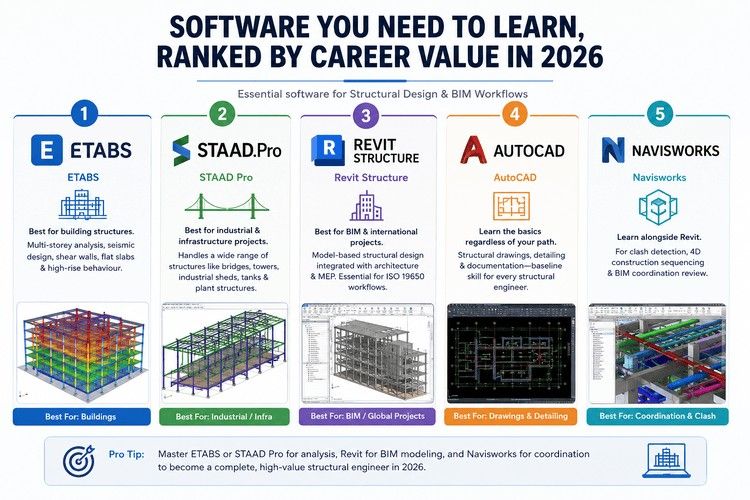
ETABS
Learn this first if you are targeting building structures. ETABS is purpose-built for multi-storey building analysis , it handles seismic design, shear walls, flat slabs, and high-rise behaviour better than any other tool. It is the standard software at structural design consultancies working on commercial and residential buildings in India. L&T EduTech's ETABS course on Coursera is one of the best accessible options.
STAAD Pro
Learn this if you are targeting industrial structures or government projects. STAAD Pro handles a broader range of structure types, industrial sheds, bridges, towers, water tanks, and plant structures. It is widely used in government departments, NHAI-related work, and heavy industrial projects. Many structural roles in India require STAAD Pro specifically.
Revit Structure
Learn this for BIM and international projects. If you want to work at consultancies doing international projects, in BIM delivery centres, or at firms following ISO 19650 workflows, Revit Structure is non-negotiable. It allows model-based structural design integrated with architecture and MEP disciplines. The skill premium for Revit-proficient structural engineers in India is real and consistent.
AutoCAD
Learn the basics regardless of which direction you go. Structural drawings still need to be produced and read. AutoCAD fluency is a baseline expectation.
Navisworks
Learn this alongside Revit. For clash detection, 4D construction sequencing, and BIM coordination review , Navisworks is the tool. Engineers who can run a coordination review and produce a clash report are genuinely valuable on BIM projects.
How to Choose the Right Structural Design Course for You
There is no single right answer here; it depends on where you are in your career and where you want to go.
If you are a fresh civil engineering graduate with no structural software experience, start with NPTEL or Udemy foundational courses to build structural analysis understanding. Then move to a structured institute programme that covers ETABS or STAAD Pro with real project work. Do not spend money on an advanced course before you have the basics solid.
If you are a site engineer with 2-5 years of experience who wants to move into design, A diploma-level programme at CADD Centre or a BIM plus structural design course is the right move. You already understand construction; what you need is the design and software layer. That combination makes you significantly more employable at design consultancies than a fresher with the same certificate.
If you are already in a design role but want to move into BIM and international project work, Revit Structure, combined with Navisworks and BIM coordination workflow training, is the priority. This is the fastest path to both a higher salary and international project exposure. Kaarwan's BIM Civil Programme is designed exactly for this transition.
Questions to ask before you enrol anywhere:
Does the course include real project work , actual model files, not just software walkthroughs? Does the faculty have genuine industry experience in structural design, not just software training? Is there portfolio support , will you leave with project files you can show in interviews? Is there placement assistance that continues until you get a role, not just until the course ends? And are the software versions being taught current , 2024-2026 versions, not older interfaces?
Read More: Jobs after civil engineering course in India
Real-World Example: What Structural Design Upskilling Actually Achieves
Here is a realistic example of what this career path looks like in practice.
A civil engineer working as a site engineer at a mid-size construction firm in Pune , 3 years of experience, Rs 4.5 LPA salary. He completes a 4-month structural design diploma covering ETABS, STAAD Pro, foundation design, and structural drawing production. He builds a portfolio of 3-4 project files. He targets structural design consultancy roles.
Within 6 months of completing the course, he moves into a Junior Structural Engineer role at a Pune-based design consultancy , Rs 6.5 LPA. Three years later, he is at Rs 10-12 LPA handling structural design for commercial buildings up to 15 floors.
The same engineer, if he had added Revit Structure and BIM coordination capability alongside the structural design training, would have been eligible for structural BIM coordinator roles at firms like AECOM or WSP , starting at Rs 7-9 LPA as a fresher to the role and reaching Rs 14-18 LPA by senior level.
The structural design specialisation alone adds value. Structural design plus BIM adds significantly more.
Explore Kaarwan’s BIM Civil Program to master Revit Structure, Navisworks, and practical BIM workflows that help civil engineers build high-demand structural design and coordination careers in India.
Structural Engineer Salary in India 2026: What the Numbers Look Like
Salary data from Naukri.com, AmbitionBox, and Glassdoor India (2026):
| Experience Level | Structural Engineer Salary | BIM Structural Engineer |
| Fresher 0–2 years | Rs 3.5–5 LPA | Rs 4–7 LPA |
| Junior 2–5 years | Rs 6–10 LPA | Rs 8–14 LPA |
| Mid-level 5–8 years | Rs 10–16 LPA | Rs 14–20 LPA |
| Senior 8–12 years | Rs 16–22 LPA | Rs 20–28 LPA |
| Principal / Lead 12yr+ | Rs 22–35 LPA | Rs 28–40 LPA |
The premium for BIM structural capability is consistent across experience levels. It reflects genuine market demand, not inflated expectations, but actual salary data from firms hiring these profiles right now.
Frequently Asked Questions
Which is the best structural design course for civil engineers in India in 2026?
The best course depends on your current level and career goal. For comprehensive offline training covering ETABS, STAAD Pro, structural detailing, and drawing production, a diploma-level programme at a reputed institute is the most thorough option. For engineers who want to add BIM to their structural skill set, which is where the market premium sits in 2026, a combined BIM and structural design programme that covers Revit Structure, Navisworks, and coordination workflows alongside structural analysis tools is the highest-value investment.
Which is better for civil engineers, STAAD Pro or ETABS?
They serve different primary purposes. ETABS is purpose-built for multi-storey building analysis and is the preferred tool at most structural consultancies doing commercial, residential, and high-rise projects. STAAD Pro handles a broader range of structure types and is more commonly used for industrial structures, infrastructure projects, and government department work. Ideally, learn both, but if you have to prioritise, let your target job sector guide the choice. Consultancy for buildings, ETABS first. Industrial and infrastructure, STAAD Pro first.
Can I learn structural design software online?
Yes, platforms like Coursera with L&T EduTech content, NPTEL on Swayam, and Udemy all offer good structural design software courses. L&T EduTech's ETABS and structural design courses on Coursera are particularly well-rated for the Indian market. Online courses work best for specific skill-building and theory depth. For comprehensive project-based training that produces a portfolio, an in-person or live online programme with mentored project work is more effective.
What is the salary of a structural design engineer in India?
Structural design engineers in India earn Rs 3.5-5 LPA at the fresher level and Rs 10-16 LPA at the mid-level with 5-8 years of experience. Senior structural design leads at established consultancies reach Rs 20-28 LPA. Engineers who add BIM structural modelling capability command a consistent premium of 30-50% at equivalent experience levels. Source: Naukri.com, AmbitionBox, Glassdoor India (2026).
Do I need a BIM course if I already know ETABS and STAAD Pro?
Not necessarily, if your target is purely domestic structural consultancy work, but if you want to work at international firms, BIM delivery centres, or on projects following ISO 19650 standards, BIM capability is increasingly mandatory rather than optional. It is also the fastest route to higher salary brackets. The combination of structural analysis proficiency and Revit structural modelling is what the highest-paying civil engineering roles in India are looking for in 2026.