
If you've been applying for civil BIM roles in the UAE, Saudi Arabia, or Qatar and getting silence back, you're probably asking yourself the wrong question. The question isn't "what's wrong with my resume?" The question is: "do I actually understand how GCC civil BIM hiring works?"
These markets operate differently. The scale of projects is different. The speed of mobilisation decisions is different. And the criteria recruiters use to evaluate candidates , especially for civil and infrastructure BIM roles , are significantly more specific than what most Indian engineers expect when they first start targeting Gulf opportunities.
This guide walks through the actual GCC civil BIM hiring funnel from ATS screening through to final client-side interviews, including what gets you shortlisted, what gets you quietly filtered out, and the country-specific nuances that matter if you're targeting UAE versus Saudi Arabia versus Qatar specifically.
For context on the Gulf vs. India BIM salary comparison that makes this career move worth pursuing , those numbers are real, and they explain why competition for GCC civil BIM roles from Indian candidates is intense.
Why GCC Hiring Works Differently for Civil BIM Roles
Saudi Arabia's Vision 2030 programme, NEOM, Red Sea Global, and Qatar's post-FIFA legacy infrastructure are not small project additions. These are multi-decade, multi-billion dollar programmes creating sustained demand for civil BIM professionals at every level , modeler through coordinator through manager. The BIM market across the GCC is projected to keep growing well past 2030, and the Gulf is investing in digital delivery compliance faster than almost any other region globally.
But here's what that actually means for hiring: firms working on these projects cannot afford to fly a candidate from India for an interview, absorb the cost of visa processing, accommodation, and mobilisation , and then find out three weeks in that the candidate overstated their Navisworks experience or doesn't understand LOD compliance. The cost of a bad hire in a GCC context is significant. So the evaluation process is front-loaded , they filter hard before anyone gets on a plane.
This is the core reason why the GCC civil BIM hiring funnel is longer, more technical, and more demanding than hiring for equivalent roles in India. It's not about being exclusionary; it's about the economics of international recruitment. Understanding that reality changes how you approach every stage of the process.
Also Read: Moving From Civil Engineer to BIM Coordinator , Kaarwan
The GCC Civil BIM Hiring Funnel, Stage by Stage
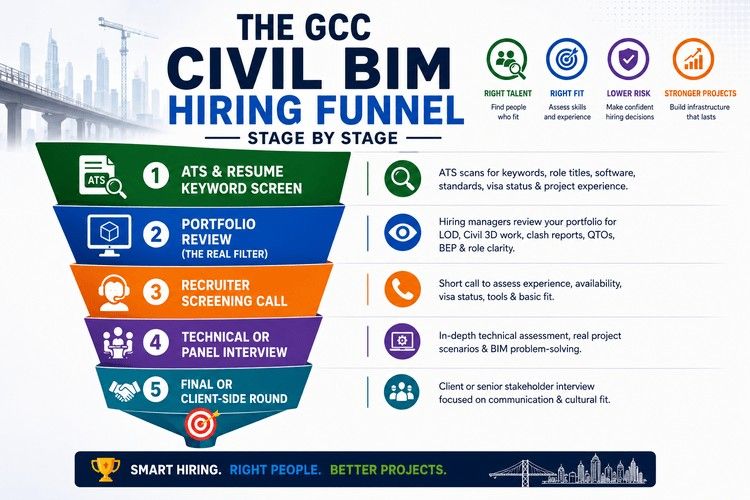
Stage 1 : ATS and Resume Keyword Screen
Before a human sees your CV, an ATS parses it. Platforms like Bayt, Naukrigulf, and GulfTalent are the primary job portal channels for GCC construction hiring, and each has its own parsing logic. Firms also run their own ATS systems , SAP SuccessFactors, Taleo, iCIMS , depending on the size of the company.
What the ATS is actually scanning for in a civil BIM context:
Role title match, "Civil BIM Engineer" and "BIM Modeler , Civil" are different strings. If the job posting says "Civil BIM Coordinator" and your CV says "BIM Coordinator (Civil Works)," the match rate drops. Use exact title phrasing from the posting wherever your experience legitimately supports it.
Software names , exact strings, "Navisworks Manage," not "Navisworks." "Autodesk Civil 3D," not "Civil 3D" (though many systems recognise both). "Revit Structure" for structural BIM roles, not just "Revit." If you've used Tekla Structures for steel detailing, spell it out exactly.
Standards and compliance terms. ISO 19650, BEP (BIM Execution Plan), LOD (and the specific levels , LOD 300, LOD 350, LOD 400), CDE (Common Data Environment), IFC. These are the GCC hiring keywords for civil BIM that distinguish someone who understands the compliance framework from someone who just uses Revit.
Visa and mobilisation status, This one surprises candidates. "Immediately available," "transferable iqama" (for Saudi Arabia), "NOC available," or "visit visa" are frequently searched terms. If you're already in the GCC, your CV should say so explicitly.
Project-type keywords, Road and highway, bridge, metro rail, drainage, infrastructure, utility relocation, site grading , these are the civil-specific project types GCC firms search for. An architectural BIM background won't rank well here even if the software skills overlap.
Stage 2 : Portfolio Review (The Real Filter)
This is where the majority of civil BIM applications from Indian candidates get screened out. The portfolio stage happens fast , experienced civil BIM hiring managers at firms like AECOM, Mott MacDonald, and L&T Infrastructure often spend less than ten minutes on an initial portfolio scan. In that time, they're making a rapid assessment of whether this candidate works at infrastructure-level detail or design-presentation level.
What gets a portfolio advanced:
- LOD-labeled model screenshots with explicit notation of what level each is at and what project phase it supports
- Civil 3D work: road corridor alignments, drainage profiles, site grading models, earthwork volume outputs
- Navisworks clash detection evidence: before-and-after documentation of specific clashes resolved, not just a clean federated model screenshot
- Quantity take-off schedules extracted from models , this is data-management proof, not just geometry
- BEP or project documentation pages showing standards compliance awareness
- Clear attribution of your specific role on team projects
What gets a portfolio rejected, fast:
- Photorealistic renders as the primary content (signals architecture background, not civil infrastructure)
- 3D perspective views without any supporting documentation or drawing output
- No LOD labeling anywhere
- "Worked on XYZ project" team credit with no indication of what specifically you modeled or coordinated
Also Read: Civil BIM Portfolio: What to Include and What to Avoid , Kaarwan
Stage 3 : Recruiter Screening Call
If the portfolio passes, the first human interaction is usually a 20–30 minute call with an in-house recruiter or a specialist recruitment agency recruiter. This is primarily logistics and basics , availability, salary expectations, visa status, notice period. But civil BIM recruiters in the GCC will also probe here:
- Which disciplines have you coordinated (structural + MEP? Civil + architectural?)
- What's your experience level with Navisworks , clash detection only, or full model federation and reports?
- Have you worked to ISO 19650 or any other formal BIM standard?
- What LOD levels have you worked at, and for what project phases?
The answers need to be specific. "I've worked with Navisworks on projects" doesn't pass this screen. "I ran bi-weekly clash detection cycles across structural and MEP federated models on a hospital build in Hyderabad, generated clash reports categorized by severity, and tracked resolution through to the next model drop" , that's a different answer.
Stage 4 : Technical or Panel Interview
For mid-to-senior civil BIM roles in the GCC, the technical interview is where most international candidates get caught out. GCC technical panels are often chaired by someone with hands-on BIM coordination experience themselves , a senior coordinator, BIM manager, or digital delivery lead. They will probe:
- How you'd set up a BIM Execution Plan for a highway project
- How you'd handle a model conflict between a civil infrastructure model and a structural bridge model
- Your familiarity with ISO 19650 information management requirements
- Real scenarios: "Walk me through how you resolved a critical clash between a primary drainage pipe and a piled foundation on your last project"
Some firms use live technical exercises , asking candidates to work through a clash detection scenario, modify a Revit model to meet LOD specifications, or extract a quantity schedule. This is not unusual for mid-level and above roles. If your skills are primarily tutorial-based rather than project-based, these exercises will expose it.
Also Read : Top Civil Engineering Companies in India
Stage 5 : Final or Client-Side Round
For large EPC and infrastructure firms, there's sometimes a client-side interview before final offer , particularly on Saudi Arabia or Qatar mega-projects where the end client (NEOM, Ashghal, Qatar Rail, Royal Commission) has approval rights over key hires. This round focuses less on technical execution and more on communication, stakeholder management, and cultural fit for a multinational project environment.
Get the LOD-labeled models, clash detection outputs, and coordination deliverables that pass GCC portfolio reviews , with Kaarwan's BIM Civil certification and real project workflow training. Apply today.
What Recruiters Are Actually Scoring at Each Stage
CV Keyword Signals GCC Recruiters Search For
Beyond the ATS, the human recruiters searching Bayt, Naukrigulf, and LinkedIn Recruiter are using Boolean search strings. Understanding what those strings look like helps you understand what to include.
A typical Boolean search for a civil BIM coordinator role in the UAE might look like:
"Civil 3D" OR "Navisworks" AND ("BIM Coordinator" OR "BIM Engineer") AND ("civil" OR "infrastructure") AND ("UAE" OR "Dubai" OR "GCC")
That's five distinct keyword signals in one search. If any one of them is missing from your profile, you don't surface. This is why the GCC ATS BIM resume structure matters , not just the content, but the placement and frequency of these terms.
Portfolio Evaluation Criteria
The three dimensions civil BIM portfolios are scored on:
Modelling depth: Does the work show understanding of how the model serves downstream use? LOD-labeled content, proper model organization, evidence of standard naming conventions. Not just "I made a 3D model."
Coordination evidence: Clash detection reports, multi-discipline coordination examples, RFI response documentation. The GCC prioritizes people who prevent problems, not just model them.
Documentation quality: Drawing output, schedules, quantity extractions, material take-offs. A model that produces nothing downstream isn't commercially useful. GCC recruiters want proof the model drives real deliverables.
Also Read : Civil BIM Resume Format & Samples for 2026
Software and Standards Proficiency
The practical floor for most civil BIM coordinator and engineer roles in the GCC is LOD 300 , accurate enough for coordination and construction planning, with element data attached. LOD 350 is expected for clash-sensitive work and fabrication-adjacent outputs. If your portfolio only shows LOD 200-level work (basic massing, approximate positions), you're below the practical threshold for most roles.
Civil 3D is the infrastructure tool GCC firms expect. If your background is Revit-heavy without Civil 3D for actual infrastructure work , road alignments, corridor design, drainage , you may be better positioned for structural or building-sector civil BIM roles rather than highway and infrastructure specifically.
FIDIC contract literacy is increasingly valued , not just BIM software. Understanding how BIM deliverables map to FIDIC contractual obligations (Red Book for re-measurement, Yellow Book for design-build) signals professional maturity that purely technical candidates lack.
Certifications That Carry Weight in the Gulf
Autodesk Certified Professional (ACP) for Civil 3D or Revit is recognized across GCC firms and hiring portals. It's a fast credibility signal that gets past early screening faster than course completion certificates from training institutes.
ISO 19650 awareness training is increasingly expected for coordinator roles. Not necessarily a formal certification, but demonstrated knowledge of the information management framework , BEP, EIR, LOD/LOI matrix, CDE management.
Saudi Council of Engineers (SCE) registration is a practical requirement for on-site roles in Saudi Arabia, not just a nice-to-have. If you're targeting KSA specifically, SCE registration should be in progress or planned as part of your move preparation. This is separate from BIM credentials and is the professional engineering registration that Saudi Arabia requires for engineers working on local projects.
buildingSMART certification is gaining traction on public sector projects in the UAE and Qatar, where international BIM standards compliance is explicitly mandated.
Soft Signals - Communication and Mobilisation Readiness
GCC project teams are genuinely multinational , Indian, Filipino, British, Arab, American engineers often work side by side on the same coordination model. The ability to communicate clearly in technical English, write professional RFI responses, and navigate coordination meetings across cultures isn't optional. Recruiters probe this in the screening call and technical interview.
Mobilisation readiness is also evaluated explicitly. How quickly can you actually start? Do you have a valid passport? Do you need visa processing? For Saudi Arabia specifically , do you have NOC-eligible iqama, or are you relocating from India? These practical questions affect which candidates get prioritised for open positions with immediate start dates.
Country-Specific Nuances Civil BIM Candidates Should Know
UAE
The UAE is the most accessible GCC market for Indian civil BIM professionals. Dubai Municipality, DEWA, and ADDC are the key authority bodies whose compliance requirements civil BIM coordinators need to understand for building and infrastructure work respectively. The hiring process is relatively faster than Saudi Arabia, partly because UAE firms have more flexibility in workforce composition. Firms in Dubai's technology and design districts (particularly those handling BIM for real estate developers like Emaar and Aldar) lean toward candidates with exposure to both architectural coordination and civil/structural integration.
Saudi Arabia , Saudization, SCE Registration, and Vision 2030
Saudi Arabia is simultaneously the most significant opportunity market and the most complex to navigate. Vision 2030 programmes , NEOM, the Red Sea Project, Diriyah Gate, ROSHN , are creating genuinely large-scale demand for experienced civil BIM professionals. But Saudization (the Nitaqat programme) means firms have workforce nationalisation quotas to meet. This doesn't typically exclude Indian engineers at coordinator and senior levels (these are often categorized as specialist roles with lower Saudization pressure), but it does mean competition for these roles is structured differently than in the UAE.
SCE registration (Saudi Council of Engineers) is a hard requirement for engineers working on Saudi projects. Start this process before your job search, not after receiving an offer , it takes time. Candidates who can demonstrate SCE registration in progress are treated more seriously by Saudi-based recruiters than those who haven't started.
Keywords to which GCC civil BIM jobs in Saudi Arabia will particularly pay attention: NEOM experience (where applicable), Saudi Aramco projects exposure, standards of the Royal Commission (for Jubail/Yanbu industrial projects), SBC (Saudi Building Code) knowledge.
Qatar , Ashghal, Qatar Rail, Post-FIFA Legacy
Qatar's major infrastructure programme continues to run on post-FIFA momentum , airport expansion, metro legacy infrastructure, North Field energy projects, and Lusail City development. Ashghal (the Public Works Authority) and Qatar Rail are the primary civil infrastructure clients, and each has its own BIM requirements that are increasingly formalized around ISO 19650. QCS (Qatar Construction Specifications) knowledge is valued for candidates targeting Ashghal-led projects.
Qatar's hiring tends to be project-specific and often tied to major EPC contractors rather than direct client hiring. Roles appear when projects are mobilising. Timing matters more in Qatar than in the UAE, where a broader range of firms is constantly hiring.
Common Reasons Civil BIM Candidates Get Screened Out
Generic resume with no Gulf-specific keywords: A civil engineering resume that doesn't include terms like LOD, ISO 19650, CDE, clash detection, FIDIC, or any GCC-relevant project type won't pass ATS screening for most Gulf job portals.
Portfolio with no coordination evidence: Clean 3D models without clash reports, without LOD labels, without any documentation output are treated as architectural or academic-level work. Civil BIM roles need infrastructure coordination proof, not just modeling demonstrations.
Overstated software claims: Claiming Navisworks proficiency but being unable to explain clash matrix setup or report generation. Claiming Civil 3D experience without being able to discuss corridor design, grading, or drainage. GCC technical interviews expose this immediately, and it damages the recruiter relationship across your entire application.
Unclear mobilisation timeline: Candidates who are vague about when they can actually start, what visa they need, or whether their notice period is negotiable get deprioritised for roles with immediate start requirements , which is most GCC construction project roles.
Architecture-heavy portfolio for infrastructure roles: A portfolio built for architectural BIM (renderings, facade studies, space planning) applied to civil infrastructure roles. The technical reviewers notice immediately and it signals mismatch.
How to Prepare as an Indian Civil BIM Candidate Targeting GCC Roles
Portfolio checklist (minimum required to be a viable GCC civil BIM portfolio):
- One LOD 300 infrastructure model in Civil 3D (road corridor, drainage or grading) where LOD is indicated
- Proof in Navisworks for clash detection: before/after comparison, severity of clashes indicated
- Quantity take-off or schedule extracted from model
- Specific role attribution on any team projects , what exactly did you model or coordinate?
- BEP documentation or ISO 19650 process evidence (even from training project)
Resume keyword alignment: Before submitting any GCC application, check your resume against the job description. Match exact software names. Add relevant standards terms. Include the project types that match the role. If you're on Bayt or Naukrigulf, update your profile keywords to match your target role title precisely.
Certification sequencing: ACP for Civil 3D or Revit first , fastest credibility signal. ISO 19650 awareness training second if targeting coordinator-level. SCE registration third if Saudi Arabia is your primary target market.
Language check: Your RFI-style communication (written English for coordination purposes) should be professional and concise. If this isn't natural yet, it's worth practicing before the technical interview stage.
For a complete guide to BIM courses in India that build these skills in a structured way, that's the right starting point before beginning a GCC application process. Once you clear the recruiter screen, prepare for the technical interview here , the coordination scenarios and technical probe questions in that guide are directly relevant to GCC panel interviews.
Also Explore: GCC BIM salary comparison vs India , Kaarwan
Ready to Build GCC-Ready Civil BIM Skills?
Kaarwan's BIM Certification for Civil Engineers covers Civil 3D, Navisworks coordination, and ISO 19650-aligned workflows , the exact skills GCC civil BIM recruiters screen for. Explore now.
Closing Thoughts
The GCC civil BIM hiring funnel is genuinely demanding, and it's structured that way for practical reasons , international recruitment is expensive, project timelines are unforgiving, and the cost of a technical mismatch is high for everyone involved.
But the funnel is also learnable. The ATS keywords are documentable. The portfolio requirements are specific and achievable. The country-specific nuances are navigable once you know they exist.
The candidates who succeed in GCC civil BIM hiring aren't necessarily the most experienced , they're the ones who understand what signals each stage of the funnel is evaluating and prepare deliberately for each one. LOD-labeled civil infrastructure portfolio. ISO 19650-aware coordination language. Exact software name matching on the resume. SCE registration in progress for Saudi-bound applications.
Get those signals right, and the funnel opens considerably. For the portfolio foundation that makes this preparation possible, Kaarwan's BIM Certification Program for Civil Engineers builds the coordination deliverables, LOD-compliant models, and documentation outputs that GCC civil BIM recruiters actually screen for.
FAQs
Do GCC recruiters interview candidates virtually before flying them in?
Yes , universally now. Since 2021, virtual screening has become standard practice across GCC construction firms. The typical sequence is a recruiter screening call via phone or Teams, followed by a technical panel interview via video, followed by a final round that may or may not require physical presence. For senior roles on projects like NEOM, there is sometimes a client-side video interview before final approval. Physical mobilisation only happens after an offer is accepted.
What LOD level should a civil BIM portfolio show for GCC roles?
LOD 300 is the practical floor for most coordinator and engineer roles. This means models accurate enough for coordination review and construction planning, with element data (material type, approximate quantities) attached. LOD 350 , fabrication-level detail, with connection information and contractor-specific data , is expected for senior coordinator and structural detailing roles. LOD 400 appears on specialist roles. If your portfolio only shows LOD 200 (basic massing, approximate positions), you're below the threshold GCC civil BIM roles require.
Is an Autodesk certification enough to get shortlisted for GCC BIM jobs?
No , but it helps. An ACP (Autodesk Certified Professional) for Civil 3D or Revit is a credibility signal that passes early screening faster. But it doesn't substitute for project evidence. GCC technical panels want to see what you've delivered , clash reports, coordination packages, LOD-labeled models , not just certification PDFs. Treat the ACP as supporting evidence and your portfolio as the primary argument.
How important is ISO 19650 knowledge for GCC hiring?
Increasingly important, especially for coordinator roles on public-sector projects in the UAE, Qatar, and Saudi Arabia. Dubai Municipality's BIM mandate and Ashghal's BIM requirements both align with ISO 19650 information management frameworks. You don't necessarily need formal certification, but you need to be able to discuss BEP structure, EIR compliance, LOD/LOI matrices, and CDE management in a technical interview. Candidates who can't speak to ISO 19650 in a coordinator-level interview are progressively at a disadvantage.
Do I need prior Gulf project experience to be considered?
Not for entry and junior coordinator roles, but it is a significant advantage for mid-level and senior positions. The reason is practical: GCC projects move fast, and candidates with prior Gulf experience understand the pace, the multinational team dynamics, and the local authority approval processes without a learning curve. Candidates without Gulf experience can compensate by demonstrating LOD compliance, strong coordination evidence, and explicit ISO 19650 familiarity , these signal professional-grade process awareness that partially substitutes for regional exposure.
What keywords should a civil BIM CV include for Gulf ATS systems?
At minimum: Navisworks (Manage specifically if you've used the coordination version), Civil 3D, Revit Structure, LOD 300/350, ISO 19650, BIM Execution Plan (BEP), Common Data Environment (CDE), clash detection, federated model, FIDIC (if any contract exposure), plus your specific project types (highway, bridge, metro, drainage, utility). For Saudi Arabia roles specifically: Saudi Council of Engineers (SCE), Saudi Building Code (SBC). For UAE: Dubai Municipality compliance, DEWA (if MEP-adjacent).
How long does the GCC civil BIM hiring process usually take?
Typically 4–12 weeks from application to offer, depending on the firm size and role seniority. Smaller specialist firms and recruitment agencies can move faster (4–6 weeks). Large EPC contractors with client-side approval requirements can run 8–12 weeks. Saudi Arabia typically takes longer than the UAE due to SCE verification requirements and Saudization compliance checks.
Does Saudi Arabia's Saudization policy affect Indian BIM candidates?
Saudization (the Nitaqat programme) creates workforce nationalisation quotas that affect all Saudi employers. However, specialist engineering and BIM roles , particularly at coordinator, engineer, and manager levels , typically have lower Saudization pressure because these positions require specific technical skills that the Saudi national workforce pipeline hasn't yet filled at scale.