
Here's something that doesn't get said enough: most of the portfolio advice available online was written for architects. And if you're a civil or structural BIM engineer building your portfolio using that advice, you're probably putting together something that looks impressive but completely misses what infrastructure hiring managers actually want to see.
Renderings. Visual storytelling. Aesthetic composition. That's the language of architecture portfolios. Civil BIM hiring is a different conversation entirely.
Recruiters at EPC firms, infrastructure consultancies, and BIM outsourcing companies working on roads, metro systems, bridges, and commercial structures are screening for evidence , not presentation. They want to know if you can produce accurate structural models at the right LOD, whether you understand how a clash detection workflow actually runs, and whether the documentation you can generate from a model would actually be useful to a contractor on site.
Most civil engineers doing BIM work are sitting on genuinely strong evidence of these things. The problem is they either haven't collected it or don't know how to frame it. That's what this guide addresses.
Also Read: Civil BIM Resume Guide , Kaarwan
Why a Civil BIM Portfolio Is Different From an Architecture Portfolio
What Recruiters at Infrastructure and EPC Firms Actually Screen For
The civil BIM hiring world has a specific screening logic. A technical reviewer at Mott MacDonald, L&T, AECOM, or a mid-sized BIM outsourcing firm in Pune or Bengaluru isn't going in with the same criteria as an architecture studio. They're not asking "does this look good?" They're asking:
- Does this person understand LOD , and have they applied it correctly?
- Can they produce a coordination package that would actually be usable for a contractor?
- Do they know the difference between a model that's visually complete and one that's data-complete?
- Have they worked in a multi-discipline environment, or just modeled in isolation?
Technical accuracy, standards compliance, and evidence of coordination across disciplines , those are the three things that matter. Visual polish is a distant fourth.
Why Architecture-Style Renderings Don't Work Here
Renderings signal design intent. Civil BIM hiring managers want documentation of execution.
If you open your civil BIM portfolio with a photorealistic render of a bridge, that's actually a mild red flag , it tells the reviewer you might be thinking about this role the same way an architect thinks about theirs. The deliverables that matter in civil BIM are coordination drawings, clash reports, quantity take-offs, shop drawing packages, and LOD-labeled model views. Those are what get built. Those are what the portfolio should prove you can produce.
What to Include in a Civil BIM Portfolio
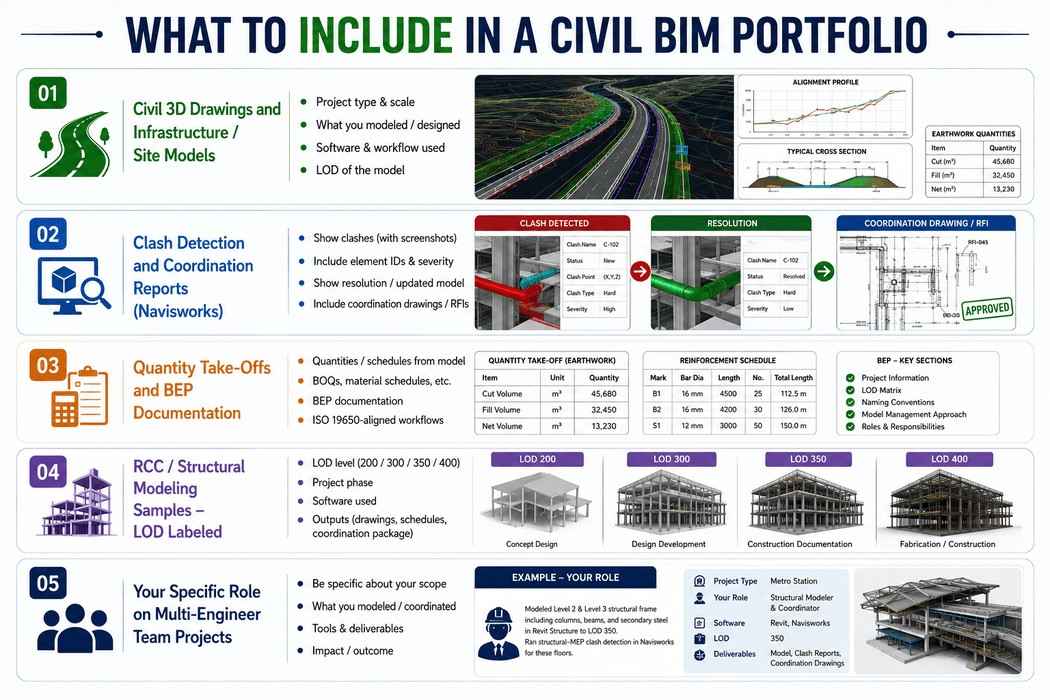
Civil 3D Drawings and Infrastructure/Site Models
This is the most directly relevant content for civil infrastructure roles. Roads, highway corridors, site grading, drainage networks, alignment profiles , if you've produced any of this in Civil 3D, it belongs in the portfolio with proper context.
Don't just drop a screenshot. For each project, include:
- A brief description of the project type and scale (even if you have to anonymize the client name)
- What you specifically modeled or designed
- Which software and workflow you used
- What LOD the model was built to
For example: "12 km road corridor in Civil 3D for a four-lane NH expansion , included alignment geometry, vertical profile design, cross-sections at 20m intervals, and earthwork volume calculations extracted directly from model. LOD 300."
That's a portfolio entry. A screenshot of a corridor model without any of that context is just a picture.
For freshers and recent certification holders: academic or training projects count here. A training project where you built a 3 km corridor model, set up grading, and extracted cross-section sheets is legitimate portfolio content , just label it clearly as a training project. Don't misrepresent it as professional work, but don't hide it either.
Also Explore: Civil BIM Software , Kaarwan
Clash Detection and Coordination Reports (Navisworks)
This section is where a civil BIM portfolio really differentiates itself. Anyone can model. Coordination is the skill that actually prevents rework on site.
The most effective way to present clash detection work is before-and-after. Show the clash as flagged , ideally with a Navisworks screenshot showing the conflict, the element IDs, and the clash severity. Then show the resolution , the updated model with the routing change, the revised coordination drawing, or the RFI documentation.
A single well-documented clash resolution is more compelling than a screenshot of a clean federated model. The clean model tells a reviewer "this looks finished." The clash resolution tells them "I understand why it matters."
Context matters here too. What kind of project? What disciplines were being coordinated , structural and MEP? Civil and architectural? What LOD? On multi-discipline infrastructure projects like metro stations or hospital builds, MEP and structural systems competing for ceiling space in tight voids is one of the most common coordination challenges. If you've worked through that, show it specifically.
Quantity Take-Offs and BEP Documentation
This one gets overlooked, but it shouldn't. Including a quantity take-off or schedule extracted from a BIM model demonstrates something that most portfolio guides miss: that you understand BIM as a data management process, not just a modeling exercise.
A material schedule extracted from your Revit structural model. A quantity take-off for earthwork volumes from a Civil 3D corridor. A reinforcement schedule pulled directly from a structural family. These outputs show a hiring manager that your model is data-rich and usable downstream , not just geometrically correct.
BEP (BIM Execution Plan) documentation or familiarity with ISO 19650-aligned workflows is increasingly expected at coordinator level. If you've developed or contributed to a BEP on any project , even a training one , include a page showing the key sections (project information, LOD matrix, naming conventions, model management approach). It signals professional-grade process awareness.
RCC/Structural Modeling Samples , LOD Labeled
If you've done structural BIM work , columns, beams, slabs, foundations, rebar detailing , include it with the LOD explicitly stated. LOD labeling is the fastest way to signal BIM fluency to a technical reviewer. LOD 200 versus LOD 350 versus LOD 400 means very different things in terms of model utility, and a reviewer who sees you understand that difference will notice.
For each structural modeling sample, state:
- LOD level (LOD 200 / 300 / 350 / 400)
- Project phase it corresponds to (concept, design development, construction documentation)
- Software (Revit Structure, Tekla, etc.)
- What was extracted from the model (drawings, schedules, coordination package)
A common gap in civil BIM portfolios: modelers include structural model screenshots but don't label the LOD. The model might be LOD 350 quality, but without the label, the reviewer can't tell , and they won't assume the best.
Don't build a portfolio from tutorial screenshots. Kaarwan's BIM Civil course trains you on real coordination workflows so your portfolio proves what you can actually do. Apply now.
Your Specific Role on Multi-Engineer Team Projects
This is critical for credibility, and it's one of the things that hiring managers say they look for most carefully. Infrastructure BIM projects are team efforts. If you're presenting work from a team project , which most professionals are , be specific about exactly what you owned.
Not "I worked on the structural BIM model for a metro station project." Instead: "I modeled the Level 2 and Level 3 structural frame including columns, beams, and secondary steel in Revit Structure to LOD 350, and ran structural-MEP clash detection in Navisworks for those floors."
The second version is checkable, specific, and honest. The first version could mean anything from "I was the lead coordinator" to "I fixed a family naming issue once." Vague team project claims get discounted hard in technical interviews.
If you worked on a large project where you owned a discrete, well-defined piece of work , a floor, a discipline, a coordination package, a specific model section , claim that piece specifically and describe it in full.
Also Read: Moving From Site Engineering to BIM , Kaarwan
What to Avoid
Generic Software-List-Only Pages with No Project Context
A page that says "Software: Revit, Civil 3D, Navisworks, Dynamo, AutoCAD" with no project to show it in action is the portfolio equivalent of the resume skill section that lists software without proof. It's not useless, but it's not a portfolio. It's a list.
Every tool you claim proficiency in should appear in at least one project entry demonstrating how you used it, for what kind of project, and what it produced.
Overloading with Renders Instead of Technical Deliverables
One or two rendered views to provide visual context for a project , acceptable. A portfolio dominated by rendered 3D perspectives with no drawing output, no coordination evidence, no LOD labeling, and no documentation? That reads as an architecture portfolio by mistake.
Civil hiring managers are looking at portfolios quickly. If the first three pages are photorealistic renders and the coordination drawings are buried on page nine, you've already lost the frame.
Also Read: Civil BIM Resume Format & Samples for 2026
Confidential or NDA-Protected Client Data , How to Anonymize It Correctly
This is a real issue that working professionals navigate, and most portfolio guides don't address it properly. Many of your best projects will have confidentiality restrictions , client names, project values, proprietary system designs, structural calculations that belong to the firm.
The right approach: ask for written permission before including any project work. For projects where full permission isn't granted, anonymize appropriately:
- Remove client logos, company names, project names
- Blur or replace identifying details in drawing title blocks
- Describe the project generically: "Structural BIM coordination for a 40-storey mixed-use tower in Mumbai" rather than naming the client or project
- Use general figures rather than exact values: "approximately ₹200 crore project" rather than the specific contract sum
What you don't do: strip the client name but leave everything else intact , a specific LOD 350 structural model for a very recognizable building shape in a specific city is still identifiable. Use judgment.
Academic and training projects from certification programs belong to you completely , no NDA issues. For freshers especially, these are the cleanest portfolio content available.
Claiming Team Output as Solo Work
Using "I" for work you contributed to as part of a team is a credibility risk that can end a technical interview badly. If the interviewer asks you to explain the coordination approach for a project and it turns out you modeled two floors while a team of eight people ran the actual coordination strategy, that gap shows immediately.
The distinction isn't shameful. Most real project work is collaborative. Be specific: "I was responsible for the Level 3–5 structural model in Revit, working within a 12-person BIM team. I contributed to one coordination cycle but the overall BEP and clash management was led by the BIM Coordinator." That's honest and still demonstrates real skill.
Format and Structure Tips
Digital vs. PDF , What Infrastructure Firms Actually Prefer
For most civil BIM roles, a well-organized PDF is the standard expectation , it's portable, printable, and doesn't depend on the reviewer having specific software. Keep the file size under 10MB for email compatibility. Name it clearly: YourName_CivilBIM_Portfolio_2026.pdf
For coordinator and senior engineer roles where you have significant project history, a supplementary online portfolio (LinkedIn, Behance, or a personal domain) can host larger model screenshots, coordination report excerpts, and additional project detail that doesn't fit in a PDF. Link to it from the PDF.
Avoid interactive or software-dependent formats unless specifically requested. An interviewer trying to open your portfolio on their phone during a commute should not have to install a plugin.
Also Read: Top Civil Engineering Companies in India
Page Count and Visual-to-Text Ratio for a Technical Portfolio
Two to four projects is the right range for most civil BIM portfolios. Not ten. Not twenty. Two to four, done well. Quality over quantity is universally stated in portfolio advice and universally ignored.
Each project should get two to three pages: a brief project description and your specific role, the key technical deliverables (model views, drawing sheets, clash reports, schedules), and a short note on what the model was used for downstream.
Visual-to-text ratio: roughly 60% technical visuals, 40% explanatory text. The visuals are the evidence; the text is the context that makes the evidence legible. Without the text, a reviewer is guessing. Without the visuals, you're just telling them what they need to see rather than showing it.
Also Explore: Transitioning Into a BIM Coordinator Role , Kaarwan
Build the Portfolio and the Skills Together
Kaarwan's BIM Certification for Civil Engineers gives you the real project deliverables , Civil 3D models, coordination outputs, clash reports , that make a portfolio worth showing. Explore it today.
Closing Thoughts
The civil BIM portfolio isn't complicated to build , but it requires a deliberate choice to frame your work as engineering evidence rather than visual presentation. Clash reports over renders. LOD-labeled model views over photorealistic perspectives. Documented coordination role over vague team project credit.
Two or three projects done properly , with context, LOD labels, real deliverables, and honest role attribution , will outperform a 20-page collection of screenshots every time. Start there.
And if you haven't yet done the kind of BIM work that belongs in a portfolio, the path forward isn't to fake it , it's to build it. A structured BIM certification program that produces real Civil 3D corridor models, Revit coordination packages, and Navisworks clash reports gives you legitimate portfolio content from day one. That's the foundation the rest of the job hunt builds on.
Kaarwan's BIM Certification for Civil Engineers is built around exactly this , real project deliverables, coordination workflows, and outputs you can actually put in a portfolio. See the full programme on the Kaarwan website.
FAQ
What software should a civil engineer's BIM portfolio show?
Civil 3D for infrastructure and roadway work, Revit or Revit Structure for structural and building BIM, and Navisworks for clash detection and coordination , these are the three most expected tools for civil BIM roles in India in 2026. Dynamo (visual scripting in Revit) is a strong addition for any engineer with automation experience. Tekla Structures is expected for heavy structural and steel detailing roles. Don't list tools you haven't used in a project context , technical interviewers will probe them. Show each tool in at least one portfolio project with a concrete deliverable attached to it.
How many projects should be in a civil BIM portfolio?
Two to four is the right range. Five at most, if each project is genuinely distinct in terms of project type, software used, or coordination scope. One very strong project , documented with LOD labels, coordination evidence, and drawing outputs , is worth more than eight shallow entries. The common mistake is treating the portfolio as an archive of everything you've ever done. It's a curated argument for why you're the right hire. Curate accordingly.
Can I include confidential client projects in my portfolio?
Yes, with permission , and with proper anonymization if full permission isn't granted. Get written approval from your employer before including any project. For projects under NDA, remove all identifying details: client names, project names, exact locations, proprietary system details. Describe the scope generically but accurately. A project described as "LOD 350 structural coordination for a 12-storey commercial building in Hyderabad" is informative without violating confidentiality. Academic and certification training projects have no NDA constraints , for freshers especially, these are your cleanest content.
Is a civil BIM portfolio different from a structural engineering portfolio?
Meaningfully different in emphasis. A structural engineering portfolio focuses on design calculations, load analysis, structural detailing, and compliance with IS codes , it's primarily a technical analysis document. A civil BIM portfolio focuses on digital model production, coordination deliverables, documentation extracted from models, and evidence of BIM process workflow (LOD, BEP, CDE). There's overlap , structural modeling in Revit or Tekla belongs in a civil BIM portfolio , but the framing shifts from "here's what I designed" to "here's how I modeled, coordinated, and documented it in a BIM environment." If you're a structural engineer moving into BIM, the portfolio transition involves reframing your existing project work through this lens.