

-(1)-(1)-(1)-(1)-(1)-(1)-(1)-(1)-(1)-(1)-(1)-(1).png)
How Does a Trombe Wall Work?
Architecture has always been synonymous with form and function, blending technology and spaces that enhance lifestyle. The concept of solar heating has been around for centuries now. It started with humans being dependent on the sun to build their civilisations, to now people utilising solar heating methods for their daily chores.
It all started with adobe and stone walls acting like silent guardians that trapped heat by day and released it by night, providing comfort before modern technology entered the space. Fast forward to the era of the 1920s, when European architects created their versions of it by bringing a new twist to the ancient concept. Trailblazers like Otto Haesler and Walter Gropius designed housing that elevated sunlight into an asset, making these homes lathered in the warm sun.
_1746008607742.jpg)
Image credits: Archdaily
However, in the year 1967 came the debut of the Trombe wall in Odeillo, France. Named after the engineer, Felix Trombe, the wall was designed by combining glass with a dark, heat-absorbing material to slowly circulate warmth into the house. A Trombe wall has been more than just a simple wall; it’s a sun-powered solution that mimics a load-bearing structure.
What sets the Trombe wall apart?
The duality of a Trombe wall explains its versatile design. Architects have been engineering them to the modern age, incorporating features like convection vents, radiant barriers to trap heat, and even water-filled steel containers (also called drum walls) for efficient thermal storage. You can also adjust their colours, materials, and dimensions to ensure the uniqueness of these walls.
Beyond functionality, Trombe walls are the torchbearers of sustainability. 20% of annual heating needs were supplied by a Trombe wall at Zion National Park. This proves that sometimes the simplest and most elegant solutions can help us live lightly on the planet. While other challenges like balancing aesthetics or responding to climate variability still exist, architects continue to optimise these systems and blend aesthetics with functionality.
Travelling from ancient wisdom to cutting-edge innovation, solar heating reminds us that sometimes the solutions to our daily problems are inspired by nature itself. With all the sunlight absorbed, architecture is now moving towards a harmonious future.
Constructing a Trombe Wall:
Architects utilise Trombe walls in conjunction with eaves, windows, and other design elements to balance out the solar heat delivery. The well-placed windows allow the sun’s heat to enter the building early in the morning while blocking excess heat gain during mid-afternoon. At the same time, a Trombe wall soaks up the heat and stores heat during the evening.
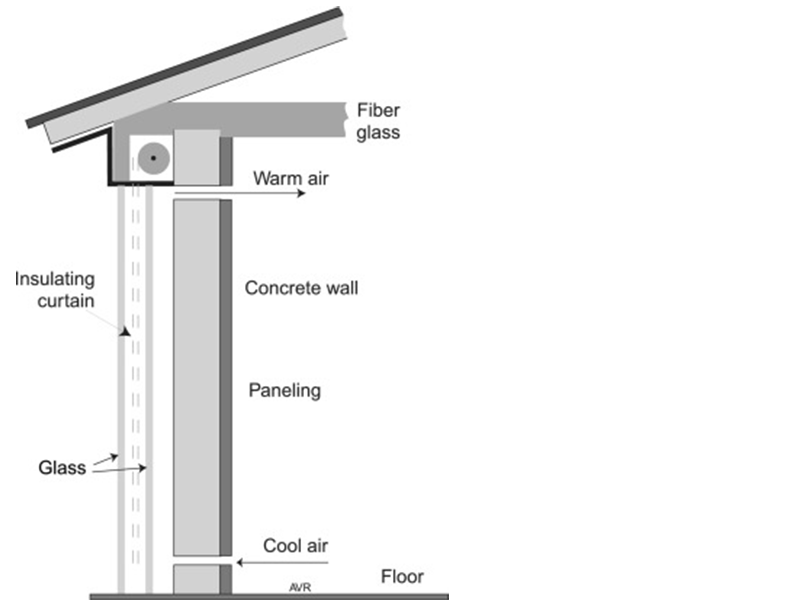
Image credits: Science Direct
Here’s how a Trombe wall is constructed:
- A Trombe wall consists of an 8-16 inch thick masonry wall layered with a dark, heat-absorbing material, with a double layer of glass.
- The glass is placed from approximately ¾” - 6” away from the masonry wall, creating a vacuum.
- The daylight heat from the sunlight passes through the glass only to get absorbed by the dark surface, retained in the wall, and conducted slowly inward through the masonry. Adding a selective surface to a Trombe wall optimises its performance by limiting the amount of infrared energy reflected through the glass.
- This selective surface entails a metal foil sheet that’s glued to the outside of the wall that absorbs all the radiation that’s visible on the solar spectrum and reflects minor amounts of infrared range.
- High absorption turns light into heat at the surface of the wall, and low emittance prevents the heat from going back to the glass again.
When it comes to a 16-inch-thick Trombe wall, heat will take approximately 8 - 10 hours to reach inside the building. Meaning? Rooms remain comfortable and cosy during the day and receive slow and even heating up to hours after the sun sets. This greatly reduces the need for conventional healing and cooling. A room that is heated by a Trombe wall is, anyway, more comfortable than those heated by forced-air furnaces because of the warm wall, even at low temperatures.
Examples of Trombe Wall Use in Architecture
Trombe walls are designed to absorb and store solar energy to heat buildings naturally, making Trombe walls one of the best passive solar design elements. These walls have been used in multiple sustainable and unconventional architectural projects. Here are some well-known examples:
1. Passive Solar Houses - Santa Fe, New Mexico
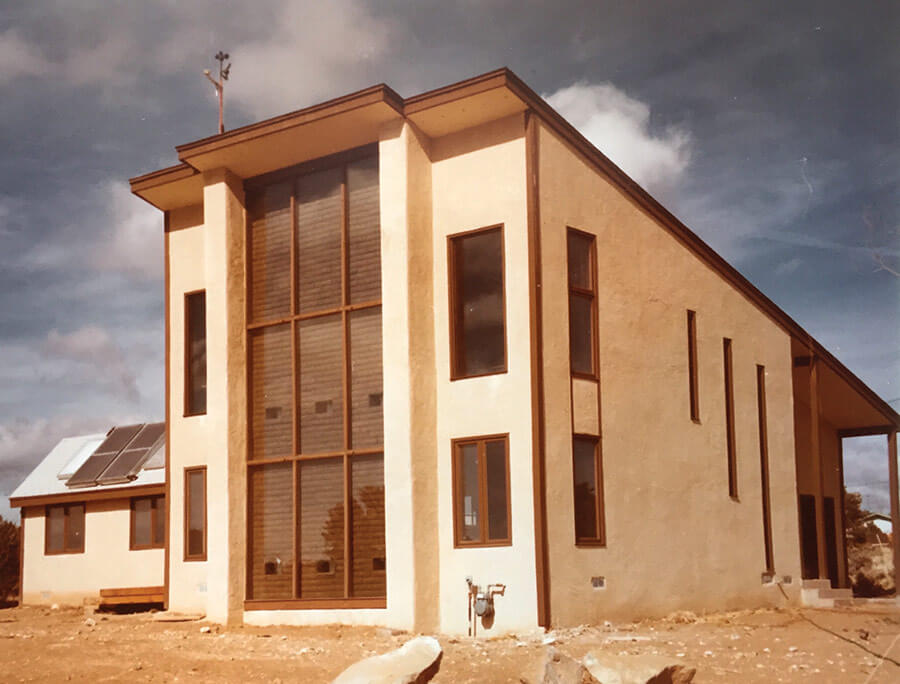
Image credits: American Solar Energy Society
About: Any homes that are built in this region (especially the ones built around the 70s and 80s) used Trombe walls as a part of experimental passive solar architecture.
Construction: This 1,995 sq. ft. house was designed with a passive solar house featuring a two-storey Trombe wall built of 12” thick “slump block” containing cement and reinforced with No. 2 rebar. This 250 sq. ft. Trombe wall, with a 3 ft. overhang, is supplemented by direct-gain windows on each side, making up 140 sq.
Materials: Adobe or concrete walls painted black with glass layered up in the front.
2. The Solar House - University of Delaware (1973)
-(1)-(1)_1746009058714.png)
Image credits: University of Delaware
About: This experimental house used Trombe walls alongside other solar passive techniques in design. It helped in pioneering early solar home research.
Construction: A glass pane was installed a few inches in front of the masonry wall, creating an insulating air gap. This technique allows the sunlight to pass through the glass, heat the wall, and then radiate warmth into the interior space over time. This enables passive solar heating.
Material: This Trombe wall was constructed using concrete and brick (simple masonry) painted in heat-absorbing, dark colours to increase the solar gain.
Kaarwan Free Career Helpline
Materials Used in Trombe Walls:
A Trombe wall is designed to absorb solar heat and gradually release it, so that the materials used are the foundation of its performance. Here are some commonly used materials:
1. Core Wall Materials (Thermal Mass)
- Concrete - Cost-effective, dense
- Brick - Good thermal mass
- Stone - Durable, thermally massive
- Water-filled containers - Better heat storage
- Rammed Earth - Eco-friendly, high heat retention
- Adobe - Traditional material, great thermal performance.
2. Glazing Materials (Upper Layer)
- Single/Double-pane glass
- Polycarbonate sheets
- Low-emissivity (Low-E) glass
3. Absorptive Coating
- Matte black paint that maximises solar heat absorption
- Selective coatings that absorb heat but reduce re-radiation losses.
Conclusion:
Trombe walls are an unconventional and unvarying example of passive solar design that merges sustainability and simplicity. By using the basic principles of storage, heat absorption, and slow release, the need for artificial heating reduces, which then helps maintain thermal comfort naturally. Whether you’re designing to cut down energy use or designing for a cold climate, incorporating a Trombe wall in your building will always be a smart, eco-friendly choice!
As the AEC industry is striding towards a climate-responsive design, techniques like these remind us that the best innovations stem from nature. Amalgamating nature and technology can give you the best design output. In the contemporary age of design, technologies like Building Information Modelling or BIM can help you redefine future-led designing. Kaarwan is one of the platforms that can help you upskill in such technologies and soar in your career. You can check out our Professional Revit & BIM Certification Program.




.png)