The 1896 Plague
The bubonic plague outbreak of 1896 was more than a public health disaster for Bombay. It exposed the consequences of decades of overcrowding, inadequate sanitation and unplanned urban growth, forcing colonial authorities to rethink how the city was built and expanded. From the creation of the Bombay Improvement Trust to the reclamation of Back Bay and the emergence of Marine Drive’s Art Deco skyline, the epidemic became a turning point in Bombay’s urban transformation.
When the Plague Hit Bombay
The bubonic plague reached Bombay in 1896, with the first officially recognised cases reported in September in the Mandvi area, near the city’s docks. The disease, believed to have arrived through maritime trade, spread rapidly through the densely populated neighbourhoods of the island city. By early 1897, the outbreak had escalated dramatically, claiming thousands of lives and triggering widespread panic. Residents fled Bombay in large numbers, businesses struggled, and the city’s commercial activity was severely disrupted. The epidemic continued to recur for years, making it one of the most devastating public health crises in Bombay’s history.
A City Built on Overcrowding
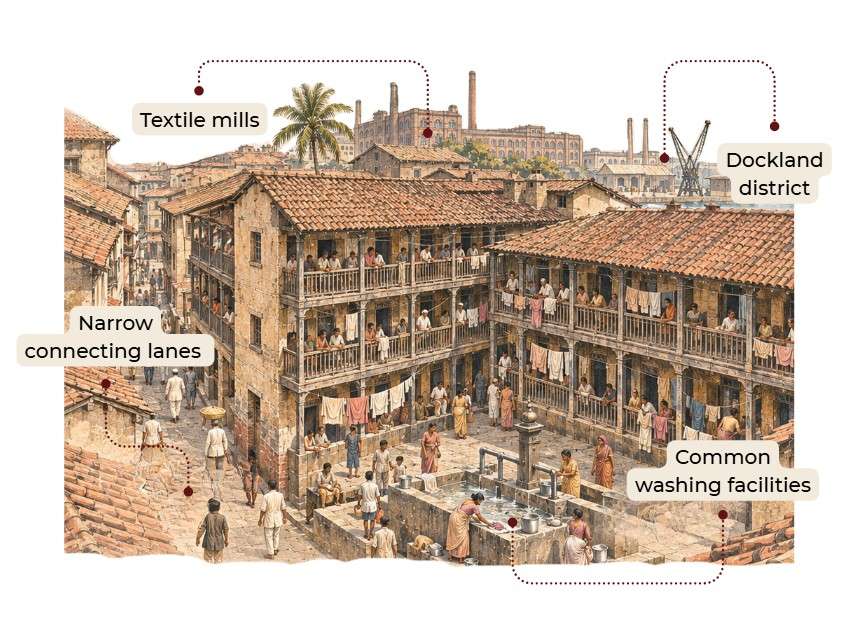
The plague exposed the poor living conditions in Bombay’s working-class neighbourhoods. Rapid industrialisation, particularly the growth of textile mills, had drawn large numbers of workers into the city, while housing and infrastructure struggled to keep pace. Many workers lived in densely occupied chawls—multi-storey residential buildings with small rooms, narrow corridors, limited ventilation and shared sanitation facilities. Overcrowded interiors, inadequate drainage, damp spaces and poor waste disposal created unhealthy living conditions. Although the plague was transmitted through infected fleas associated with rodents, these conditions contributed to environments where infestations and disease risks could thrive. The crisis revealed how housing design, sanitation and urban density were closely connected to public health.
The Bombay Improvement Trust and a New Urban Vision
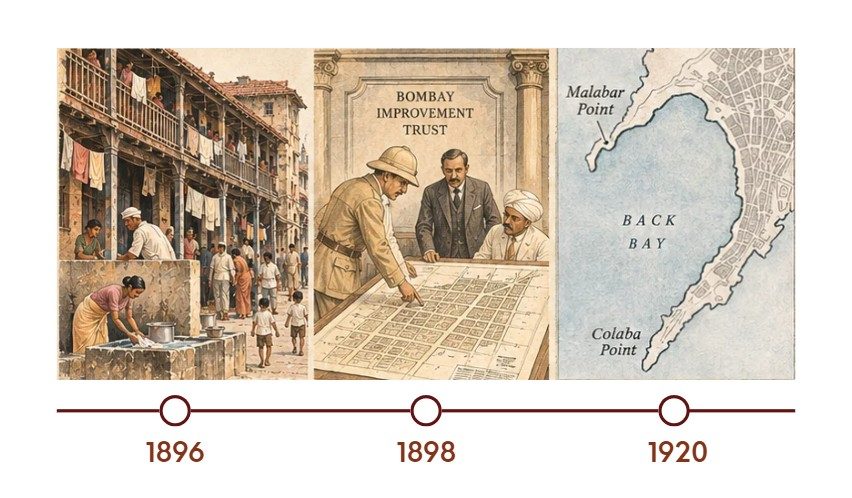
In response to the epidemic, the Bombay City Improvement Trust (BIT) was established in 1898 to address congestion, insanitary housing and inadequate urban infrastructure. It marked a significant shift towards organised urban planning in Bombay. The Trust undertook slum clearances, road widening, drainage improvements, new housing schemes and the development of land further north to relieve pressure on the crowded city centre. Major roads, including Princess Street and Mohammed Ali Road, were developed or improved to open up congested neighbourhoods and encourage ventilation. New suburban schemes in Dadar, Matunga, Wadala and Sion introduced wider streets, open spaces and planned residential layouts. However, these improvements came at a cost: demolition and redevelopment displaced thousands of working-class residents, and rehousing often failed to keep pace with the scale of displacement.
Back Bay Reclamation and the Birth of Marine Drive
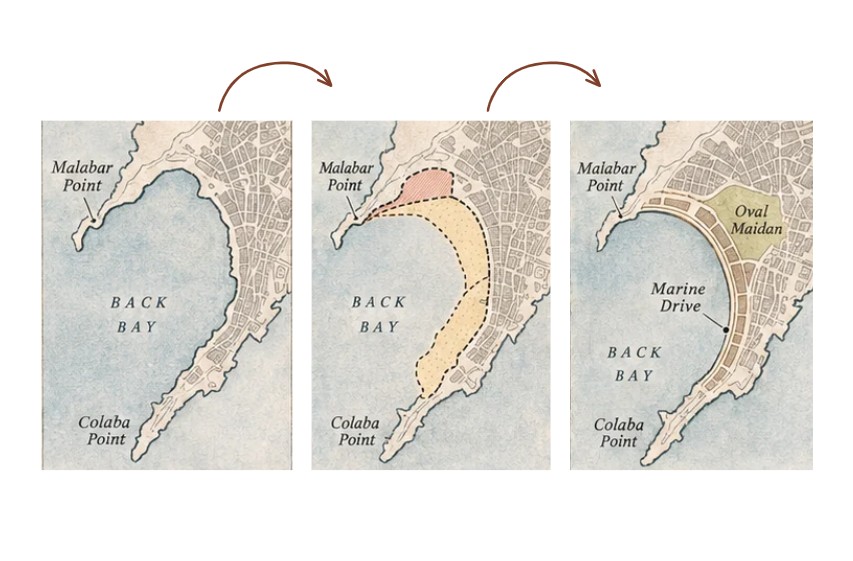
The plague also intensified the need to expand Bombay beyond its congested southern districts. Reclamation projects offered a way to create new land for residential, commercial and civic development. The Back Bay Reclamation Scheme, pursued in the early twentieth century and developed through the 1920s, transformed parts of the western waterfront by extending the city into the sea. Although the project faced financial, engineering and administrative controversies, sections of the reclaimed land eventually became the foundation for Marine Drive and adjoining urban development. The new waterfront created space for roads, promenades and residential buildings, changing Bombay’s relationship with its coastline. It was no longer simply a congested port city; it was evolving into a modern metropolis with a planned waterfront and a new urban edge.
From Sea Breeze to Art Deco
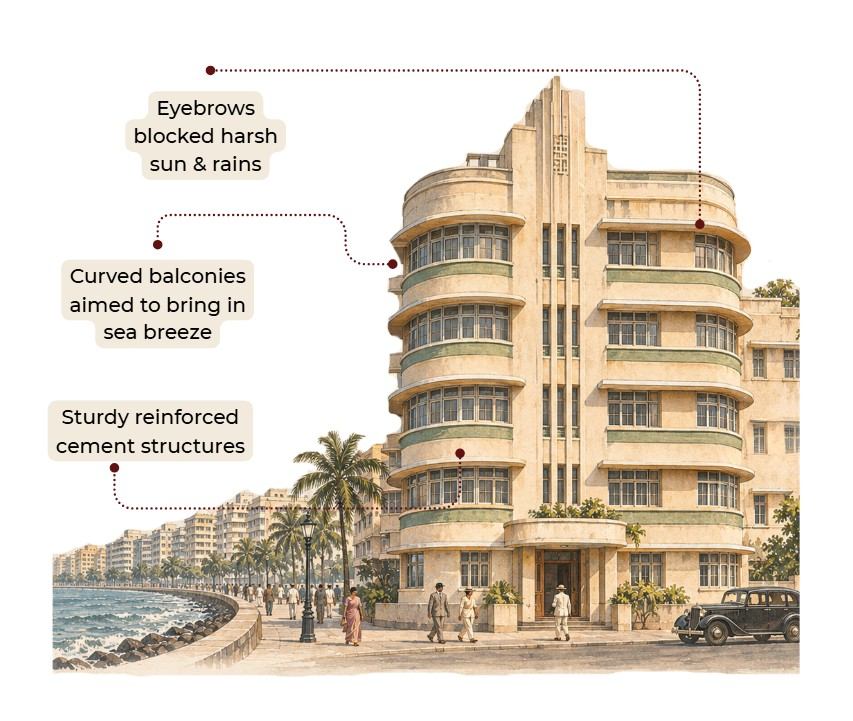
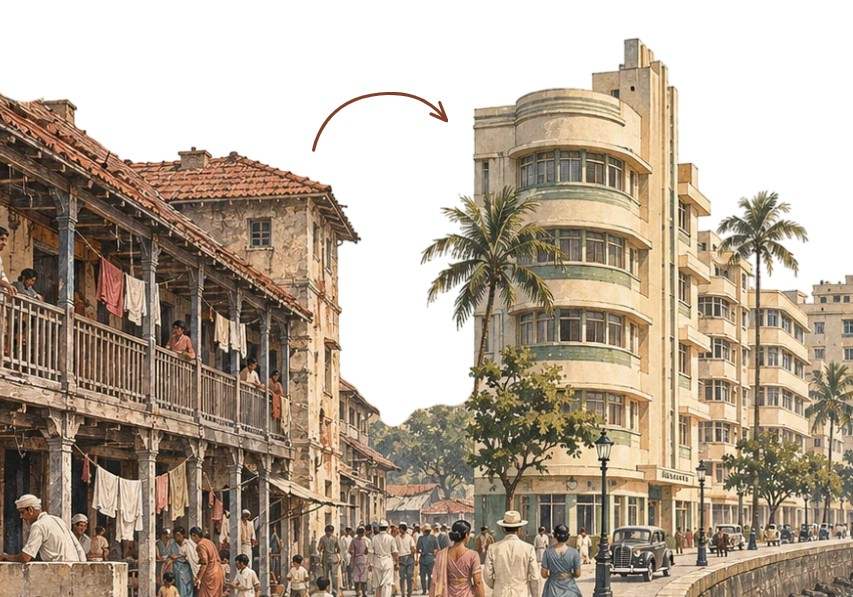
The reclaimed land along Marine Drive and around the Oval Maidan opened new possibilities for architectural development. By the 1930s, Art Deco had become a prominent architectural style in Bombay, shaping residential blocks, cinemas and commercial buildings across the new western precincts. The style’s streamlined façades, curved balconies, geometric detailing, vertical emphasis and modern materials reflected the city’s growing aspirations towards cosmopolitan living. The waterfront also offered a different residential environment from the congested inner-city neighbourhoods, with more open space and exposure to coastal air.
The Art Deco neighbourhoods also represented modernity, status and a new lifestyle—one largely accessible to the city’s middle and upper classes.
Conclusion
The 1896 plague changed Bombay’s urban trajectory by exposing the relationship between disease, housing and infrastructure. It accelerated the introduction of organised urban planning, road networks, suburban development, reclamation and new architectural typologies. Yet the transformation was uneven: while parts of the city gained improved infrastructure and modern housing, many working-class communities faced displacement without adequate rehabilitation. The epidemic did not simply change Bombay’s buildings—it reshaped the city’s priorities, boundaries and urban identity, leaving a legacy that can still be read in Mumbai’s streets, suburbs and waterfront architecture today.
These were some insights on the imapct of plague on Bombay. Stay tuned for more information on other significant topics in the AEC industry and follow Kaarwan for such detailed guides!
FAQs
1. When did the bubonic plague first hit Bombay?
The plague was detected in Bombay in September 1896, with early cases reported in the Mandvi neighbourhood near the docks.
2. Why did the plague spread rapidly in Bombay?
Overcrowded housing, poor sanitation, inadequate drainage, rodent infestations and densely populated neighbourhoods contributed to the conditions in which the epidemic spread.
3. What was the Bombay Improvement Trust?
Established in 1898, the Bombay Improvement Trust was a colonial urban development body tasked with improving sanitation, clearing congested neighbourhoods, constructing roads, developing suburbs and addressing housing conditions.
4. How did the plague influence the development of Marine Drive?
The outbreak intensified the urgency of urban expansion and infrastructure reform. Subsequent reclamation projects, including the Back Bay scheme, created land that later became part of the Marine Drive waterfront and its surrounding development.
5. How did the plague influence Art Deco architecture in Mumbai?
The plague did not directly create Art Deco, but the urban reforms, expansion and reclamation projects that followed helped create new precincts where Art Deco residential and commercial architecture flourished in the 1930s.