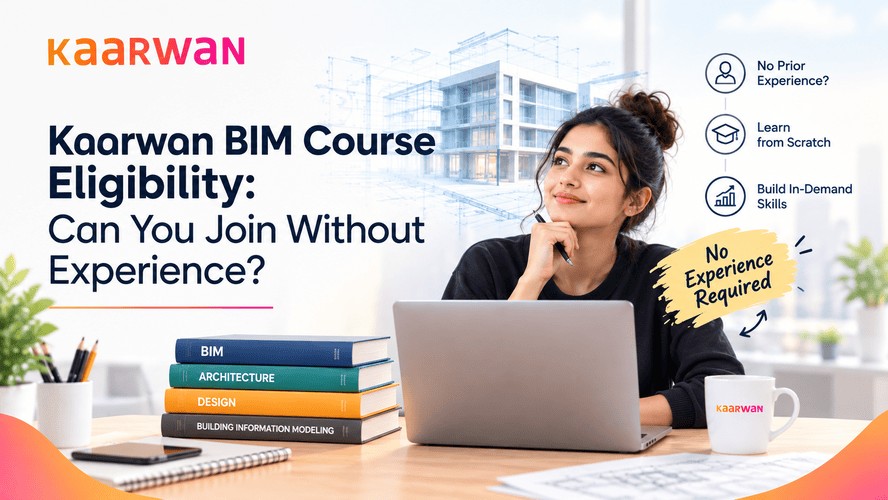
If you've been looking at Kaarwan's BIM course and wondering whether you need prior experience to join, it's a reasonable question. One of the biggest concerns for learners is whether they'll be able to keep up if they've never worked with Revit or BIM software before.
The good news is that prior Revit or BIM software experience isn't required. However, there is an important distinction to understand when it comes to your academic or professional background.
Let's break down the eligibility requirements and what you should have before starting the course.
Who Can Join Kaarwan's BIM (Revit) Course?
There's no entrance test or admission exam required to join the program. You don't need prior Revit experience or previous exposure to BIM software.
However, the course does assume that you already have a working foundation in architecture, civil engineering, or MEPF concepts. Kaarwan's BIM program is not designed to re-teach the core AEC concepts you would typically learn through your academic or professional background. Instead, it focuses on helping you apply that existing knowledge through Revit, BIM workflows, digital modelling, coordination, and documentation.
You'll also need basic computer skills, such as managing files and folders, installing software, and navigating everyday digital workflows. These are not advanced technical requirements, but they will help you focus on learning Revit and BIM rather than basic computer operations.
If You're a Complete Beginner With No Software Background
If you've never used Revit or BIM software before, you can still join the program. The course introduces Revit fundamentals and builds your software skills progressively through learning, practice, assignments, and project work.
The important distinction is between being a beginner in the software and being a beginner in the AEC discipline.
Being new to Revit is not a problem. However, you should already understand the relevant architecture, civil engineering, or MEPF concepts for your field. The course focuses on teaching you how to implement that knowledge digitally rather than covering the underlying AEC theory from the beginning.
If You're an Architecture or Civil Engineering Student
Architecture and civil engineering students with a relevant academic foundation are eligible to join the program.
Your academic background provides the theoretical and technical foundation, including areas such as planning, building components, structural concepts, construction methods, or other concepts relevant to your specialization. The BIM course builds on that foundation by showing you how to model, coordinate, document, and manage projects using Revit and BIM methodology.
The same principle applies to MEPF students. You are expected to understand the technical fundamentals of your discipline, while the course focuses on translating that knowledge into a digital BIM environment.
In other words, the course connects the AEC knowledge you already have with the software skills needed to implement it digitally.
If You're Switching Careers From an Unrelated Field
This depends largely on your existing background.
If you already have an AEC background but have limited experience with digital tools or BIM, the program can help you transition from conventional workflows to BIM-based processes. For example, an architect who has primarily worked with hand drawings or AutoCAD can use the program to develop Revit and BIM skills without having to start over with the fundamentals of architecture.
However, if you're coming from a completely unrelated field with no background in architecture, civil engineering, or MEPF, you'll need to build that foundational knowledge first. The program assumes that learners already understand the relevant AEC concepts and are ready to learn how those concepts are implemented through BIM software and workflows.
If You're a Working Professional With Limited Time
Plan to dedicate around 20–24 hours per week to the course. This includes live sessions, self-paced learning, software practice, assignments, and project work.
The workload requires consistent participation rather than relying on occasional catch-up sessions. Since Revit and BIM are practical, skill-based areas, regular hands-on practice is important for building confidence and applying concepts effectively.
The 20–24 hour weekly commitment should be planned consistently throughout the course, particularly during assignment and project-heavy phases.
What You Don't Need Before Joining
- No entrance test or admission exam
- No prior Revit experience
- No prior BIM software experience
- No professional BIM work experience
- No previous experience with a specific BIM tool
What you do need is a relevant foundation in architecture, civil engineering, or MEPF concepts, depending on your discipline.
What Actually Helps You Succeed in the Course
A few factors can make a significant difference to your learning experience:
- A solid AEC foundation: You should understand the core concepts relevant to your architecture, civil engineering, or MEPF discipline.
- Basic computer skills: You should be comfortable managing files and folders, installing software, and navigating everyday digital workflows.
- A consistent time commitment: Be prepared to dedicate around 20–24 hours per week to sessions, practice, assignments, and projects.
- Regular hands-on practice: Revit and BIM skills develop through repeated application, so consistent practice is essential.
- A practical approach to learning: The focus is on applying your existing AEC knowledge through software and BIM workflows.
- Project work: The projects you complete during the course can help demonstrate your practical skills through a portfolio, while your certification provides formal recognition of the training.