
Key Components in a Bridge
Bridges are complex structural systems designed to safely transfer loads across obstacles such as rivers, valleys, or transportation corridors. While they may appear simple at a glance, every bridge is a carefully coordinated assembly of components working together to handle forces like compression, tension, shear, and dynamic loads from traffic and environment. Understanding bridge terminology is essential for architects, civil engineers, and students, as it builds clarity around how these structures are conceived, detailed, and constructed. From the elements that directly carry vehicular loads to those that ensure durability and safety over time, each component plays a specific role within the overall system.
This guide breaks down key bridge components in alphabetical order, explaining their function and relevance in real-world bridge design.
Bridge Terminology Explained
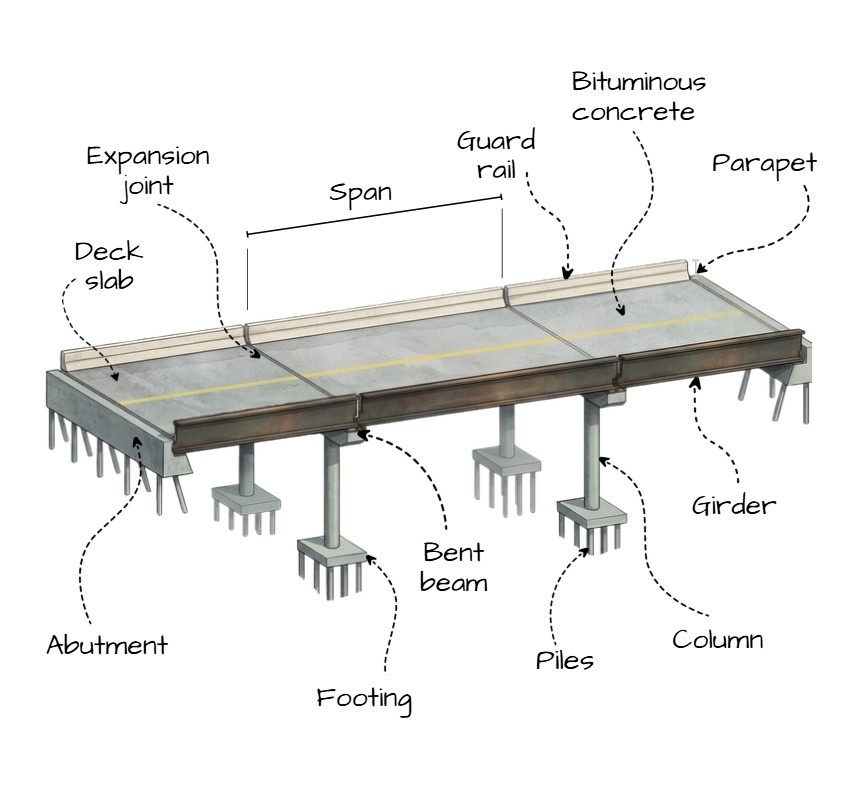
Abutment
The abutment is the end support of a bridge, located at the edges where the structure meets the ground. It serves a dual purpose: supporting the superstructure (deck and girders) while also retaining the soil of the approach embankment. Structurally, abutments transfer loads from the bridge into the foundation system below, often working in combination with footings or piles. In design, they must resist vertical loads as well as lateral earth pressure from retained soil, making them critical for both stability and durability. Architecturally, abutments also define the visual threshold between land and bridge.
Bent Beam
A bent beam refers to a transverse structural element supported by columns or piers, forming part of the substructure that carries the superstructure above. In bridge construction, a “bent” typically consists of vertical supports (columns) and a horizontal beam (bent cap or beam) that distributes loads from girders. This system is especially common in multi-span bridges, where repeated bents provide intermediate support. The bent beam ensures load transfer across columns while maintaining structural continuity and alignment.
Bituminous Concrete
Bituminous concrete is the asphalt-based wearing course laid on top of the bridge deck. It provides a smooth driving surface, protects the underlying deck slab from direct exposure to traffic and weather, and enhances waterproofing. From a performance standpoint, it must accommodate thermal expansion, resist cracking, and provide skid resistance. Its flexibility makes it particularly effective in absorbing minor surface stresses, though it requires periodic maintenance and resurfacing.
Column
Columns are vertical structural members that transfer loads from the superstructure down to the foundation. In bridges, they are typically part of piers or bents and are designed to resist axial loads, bending moments, and sometimes lateral forces such as wind or seismic activity. The spacing and height of columns influence the overall span configuration and visual rhythm of the bridge, making them both structural and architectural elements.
Deck Slab
The deck slab forms the topmost structural surface of the bridge, directly supporting vehicular or pedestrian movement. Usually constructed in reinforced concrete, it distributes loads to underlying girders or beams. Beyond load transfer, the deck slab also integrates drainage systems, expansion joints, and protective layers like bituminous concrete. Its design must balance strength, durability, and serviceability, ensuring minimal deflection and resistance to cracking under repeated loading.
Expansion Joint
Expansion joints are specialized connections that allow controlled movement between different parts of a bridge. Due to temperature variations, traffic loads, and material behavior, bridges expand and contract over time. Expansion joints accommodate this movement without causing structural damage or cracking. They are typically placed between spans or at abutments and must be designed to maintain a continuous driving surface while preventing water ingress into the structure below.
Footing
Footings are the foundation elements that distribute structural loads from columns or abutments into the ground. Depending on soil conditions, they can be shallow (spread footings) or deep (pile caps connected to piles). In bridge design, footings must be carefully engineered to prevent settlement, overturning, or bearing failure. Their size and type are determined by load intensity and geotechnical characteristics of the site.
Girder
Girders are the primary horizontal load-bearing members of a bridge, supporting the deck slab and transferring loads to piers or abutments. They can be made of steel, prestressed concrete, or composite systems, depending on span length and design requirements. Girders are critical in defining the structural system of a bridge—whether it is a beam bridge, box girder bridge, or truss-supported system. Their depth and spacing directly influence load distribution and overall efficiency.
Guard Rail
A guard rail is a safety barrier installed along the edges of a bridge deck to prevent vehicles from veering off. Unlike parapets, which may be more solid and architectural, guard rails are typically lighter, often made of steel, and designed to absorb impact energy. They play a crucial role in road safety, especially on high-speed or elevated bridges, while maintaining visual openness.
Parapet
The parapet is a protective wall or barrier along the edge of a bridge, often more solid and continuous than a guard rail. It serves both safety and architectural purposes, providing edge protection for pedestrians and vehicles while contributing to the visual identity of the bridge. In some cases, parapets may integrate lighting, signage, or decorative detailing, making them an interface between engineering and design expression.
Piles
Piles are deep foundation elements used when surface soil lacks sufficient bearing capacity. Driven or bored into the ground, they transfer loads to deeper, more stable strata through end bearing or skin friction. In bridge construction, piles are commonly used beneath abutments and piers, especially in riverbeds or soft soils. They are essential for ensuring long-term stability and minimizing settlement.
Span
The span of a bridge refers to the distance between two supports, such as abutments or piers. It is a fundamental parameter that influences structural design, material choice, and construction method. Short spans may use simple beam systems, while longer spans require more complex solutions like trusses, arches, or cable systems. Span length also impacts the number of supports needed and the overall efficiency of the structure.
Understanding bridge terminology provides a foundational lens through which complex structures can be read, designed, and evaluated.
Conclusion
Each component—from the deck slab that carries traffic to the piles hidden deep below—plays a specific role in ensuring stability, durability, and safety. While some elements are visible and shape the architectural character of the bridge, others remain concealed yet are equally critical to performance. Together, they form an integrated system where structural logic and design intent converge. For architects and engineers alike, mastering these terms is a step toward more informed, precise, and contextually responsive bridge design.
FAQs
1. What is the most important component of a bridge?
There is no single most important component; all elements—from deck slab to foundation—work together to ensure structural performance and safety.
2. What is the difference between a girder and a beam?
A girder is typically a larger primary beam that supports smaller beams or deck slabs, acting as the main load-carrying member.
3. Why are expansion joints necessary in bridges?
They allow for thermal expansion and contraction, preventing cracks and structural damage.
4. What is the role of piles in bridge construction?
Piles transfer loads to deeper, stable soil layers when surface soils are weak.
5. How does span length affect bridge design?
Longer spans require stronger or more complex structural systems and influence material selection and construction methods.