
Types of Gate Designs
Gate design in architecture goes far beyond aesthetics—it directly impacts circulation, security, spatial efficiency, and user experience. Whether designing a compact urban residence, a villa entrance, or a commercial facility, selecting the right gate type requires a clear understanding of movement mechanisms, space constraints, and functional priorities.
From traditional hinged systems to advanced automated solutions, each gate type responds differently to site conditions, frequency of use, and architectural intent. This guide breaks down the most commonly used gate types—swing, sliding, bi-fold, telescopic, and automated sliding gates—through a practical lens covering operation, spatial logic, and design application.
Swing Gate
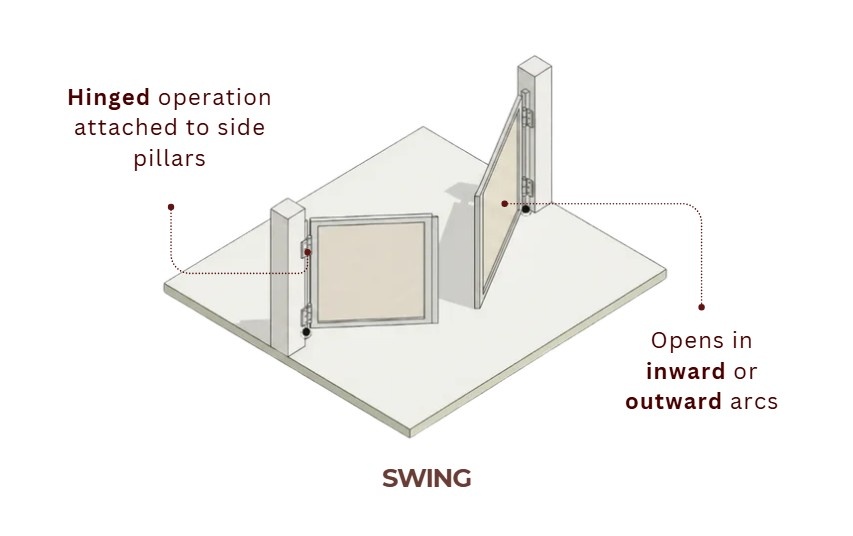
Swing gates are among the most traditional and widely used gate systems, consisting of one or two shutters attached to vertical supports using hinges. They operate through a rotational movement, opening either inward or outward in an arc.
From an architectural standpoint, swing gates are structurally straightforward and visually versatile. They work well with materials like wood, wrought iron, or mild steel, allowing both modern and classical expressions. However, their biggest spatial implication is the clear swing radius required for operation. This makes them best suited for sites with adequate front or internal setback, where the gate can open without obstruction.
In terms of experience, swing gates feel formal and grand, especially in double-leaf configurations, often used in villas or bungalow entrances. They are also easier to install and maintain compared to more complex systems, but become inefficient in tight urban conditions.
Sliding Gate
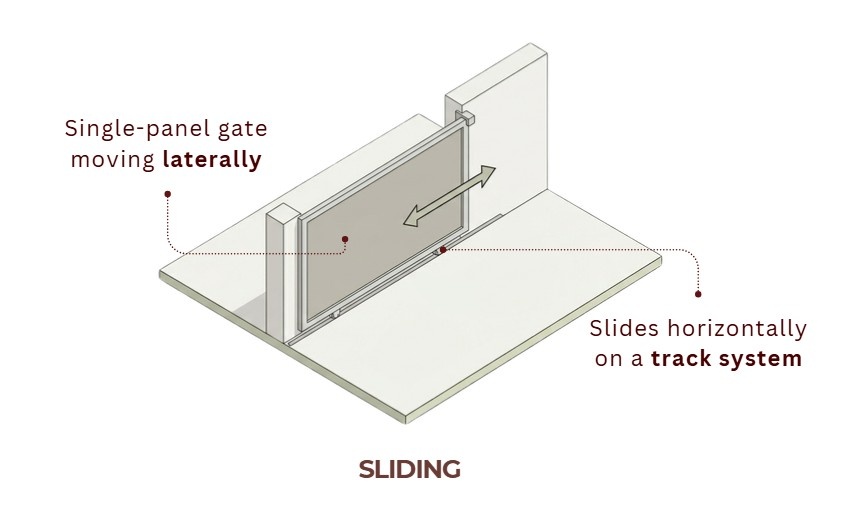
Sliding gates consist of a single rigid panel that moves horizontally along the boundary wall. The movement is either supported by a ground track or a cantilever system, depending on design and site constraints.
Architecturally, sliding gates are highly efficient in terms of space utilization. Since they do not require any swing clearance, they are ideal for compact plots, row housing, and urban residences where driveway depth is limited. The primary requirement shifts to side clearance, as the gate needs sufficient wall length to slide open.
In terms of design language, sliding gates often lean toward modern aesthetics, with clean horizontal or vertical patterns, perforated metal sheets, or composite panels. Functionally, they are smoother to operate and easier to automate, making them a preferred choice in contemporary architecture.
Bi-Fold Gate
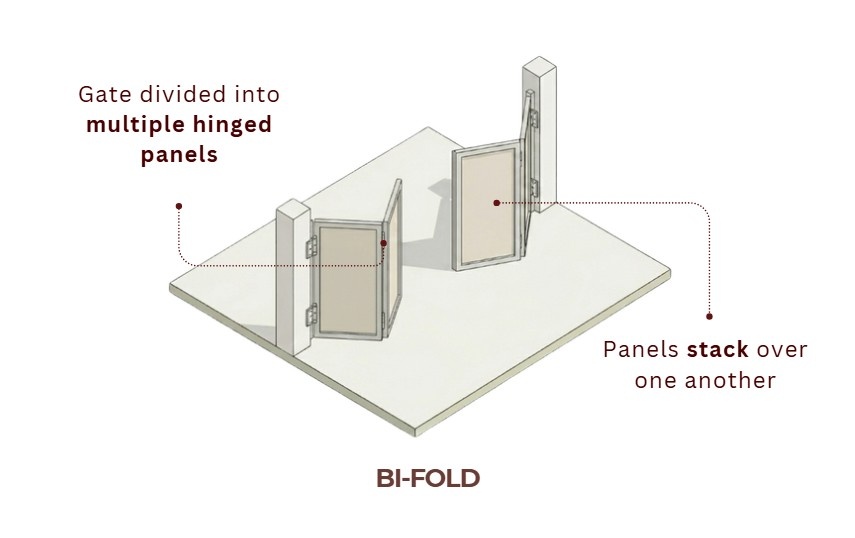
Bi-fold gates are a hybrid system where each gate leaf is divided into two panels connected by hinges. As the gate opens, these panels fold onto each other, reducing the overall projection into the driveway.
This system addresses one of the key limitations of swing gates—excessive opening radius. By folding in sections, bi-fold gates require significantly less depth clearance, making them suitable for sites where space is restricted but a hinged system is still preferred.
Architecturally, bi-fold gates introduce a slightly more mechanical and dynamic expression, often used in modern residential or semi-commercial contexts. They are particularly useful for wide entrances, where a full swing gate would be impractical.
However, they involve more moving parts and hinges, which increases maintenance complexity and requires precise detailing during fabrication and installation.
Telescopic Sliding Gate
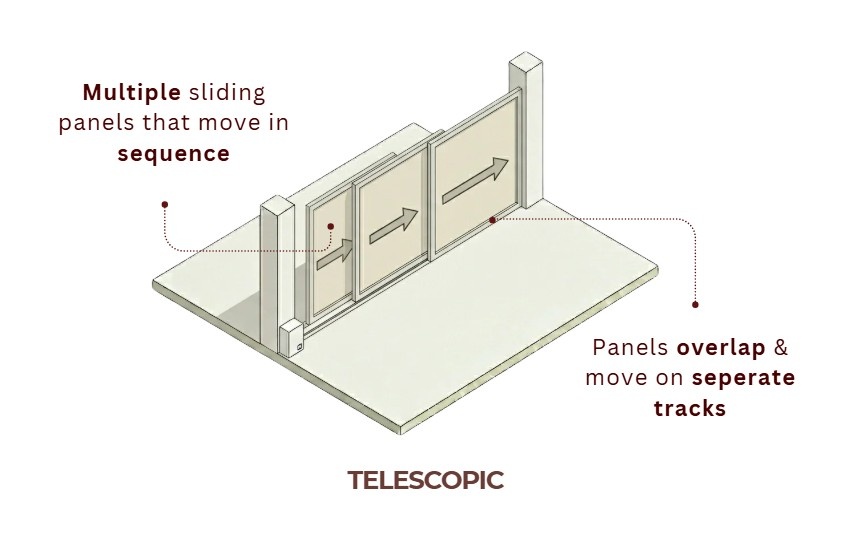
Telescopic sliding gates are an advanced variation of sliding systems, consisting of multiple panels that slide and stack over one another in a synchronized manner. Each panel moves at a different speed, allowing them to collapse into a compact stack.
This type is specifically designed for sites where both depth and side space are limited. Unlike a standard sliding gate that requires full panel width for stacking, telescopic systems reduce this requirement significantly by layering panels.
From a spatial planning perspective, this makes them highly efficient for tight urban plots, commercial entries, or high-density housing. They are also useful for wide openings where a single large panel would be too heavy or impractical.
Visually, telescopic gates tend to have a more technical and modular appearance, often expressed through repeated vertical or horizontal divisions. They require precise engineering and are generally more expensive due to their complexity.
Automated Sliding Gate
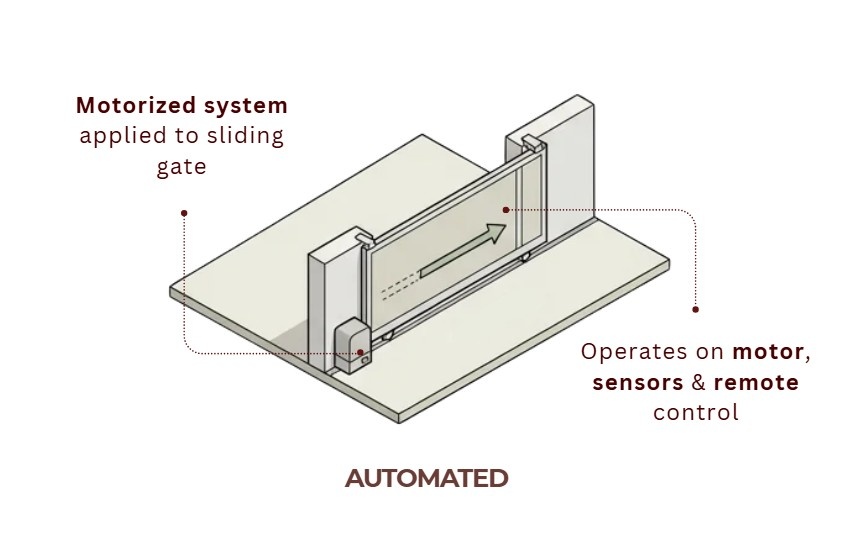
Automated sliding gates are not a separate form but an enhanced system applied to sliding mechanisms, integrating motors, sensors, and remote operation.
Functionally, these gates operate via electric motors connected to gear systems, enabling controlled opening and closing through remotes, keypads, or smart systems. They are especially relevant in contexts requiring frequent access, security control, and user convenience.
From an architectural standpoint, automation influences not just operation but also detailing and planning. Provision must be made for:
• Motor placement
• Power supply
• Safety sensors
• Track precision
Spatially, automated sliding gates retain the same advantages as manual sliding systems but enhance efficiency in high-traffic scenarios such as apartment complexes, villas, and commercial buildings.
Aesthetically, they align well with contemporary architecture, often paired with sleek materials and minimal detailing.
Conclusion
Choosing the right gate type is a balance between space availability, frequency of use, security needs, and architectural expression. While swing gates offer simplicity and traditional appeal, sliding systems respond better to urban constraints. Bi-fold and telescopic gates provide adaptive solutions for tighter sites, and automation introduces a layer of comfort and control.
Ultimately, the gate should not be treated as an afterthought—it is a threshold element that defines entry experience while solving real spatial challenges.
These were some insights on Types of Gate Designs in Architecture. Stay tuned for more information on other significant topics in the AEC industry and follow Kaarwan for such detailed guides!
FAQs
1. Which gate type is best for small plots?
Sliding or telescopic sliding gates are ideal as they eliminate the need for swing clearance and optimize limited space.
2. What is the main disadvantage of swing gates?
They require significant opening space, which can be a constraint in compact urban sites.
3. Are sliding gates better than swing gates?
Not universally—sliding gates are better for tight spaces, while swing gates are simpler and more economical for larger plots.
4. When should telescopic gates be used?
When both side space and depth are restricted, especially for wider openings.
5. Are automated gates suitable for residential projects?
Yes, especially for villas and apartments where convenience, security, and frequent access are key priorities.