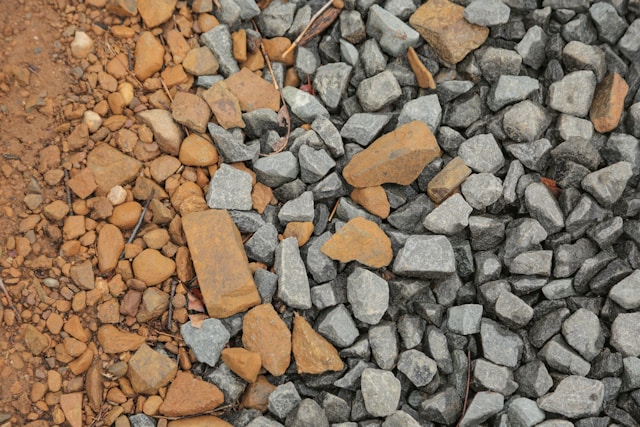
Aggregates in Construction
Aggregates are granular materials that form the bulk of concrete and many other construction materials. They may be obtained naturally, produced by crushing rock, or manufactured from recycled and industrial sources. In concrete, aggregates are bound together by cement paste and contribute significantly to the mix’s volume, strength, dimensional stability and durability. Their size, grading, shape, surface texture, strength, porosity and cleanliness all influence concrete performance. IS 383:2016, Coarse and Fine Aggregates for Concrete — Specification, provides the principal Indian requirements for aggregates used in concrete.
Aggregates can be classified in several ways. This article first considers them according to their material source, and then according to particle shape. It is important to note that these classifications overlap: for example, crushed basalt can be a coarse aggregate, while its particles may also be angular in shape.
Types of Aggregates Based on Material
Fine Aggregate
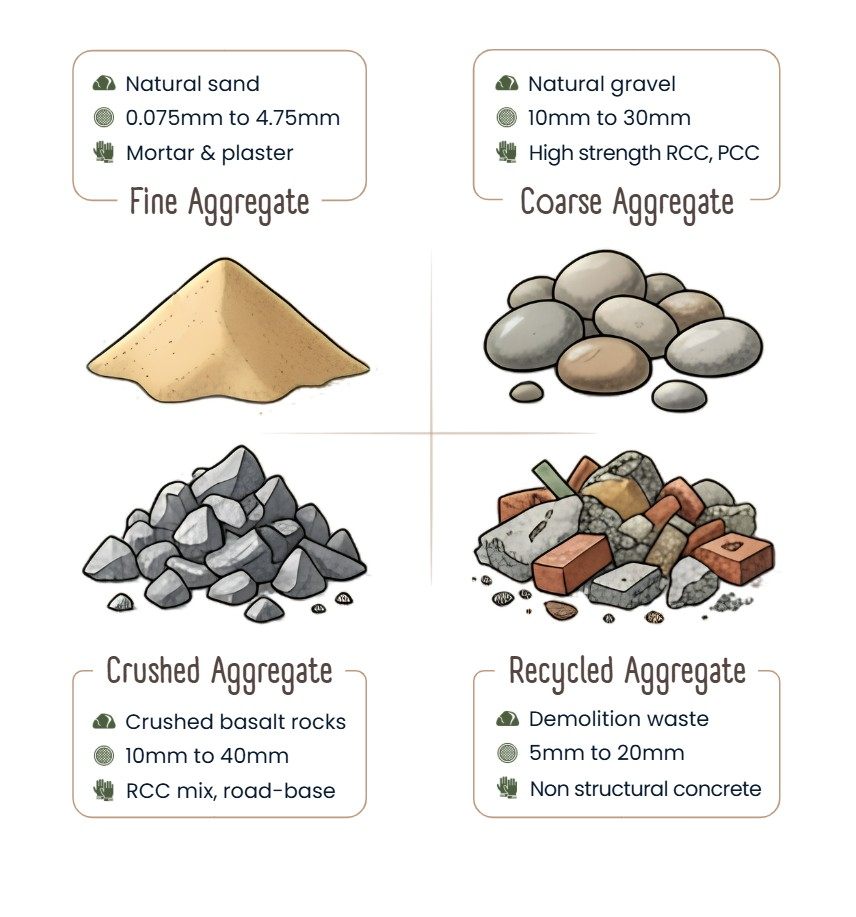
Fine aggregate consists predominantly of smaller particles that pass through the 4.75 mm IS sieve, with grading controlled through specified sieve sizes. Natural sand is one common source, formed through the natural disintegration and deposition of rock, although fine aggregate can also be produced by crushing stone or gravel. Its mineral composition therefore depends on its geological source rather than being universally composed of one particular mineral.
Fine aggregate occupies the spaces between coarse aggregate particles and combines with cement and water to form the mortar fraction of concrete. Its grading influences workability, water demand, finishing and the amount of cement paste required. Fine aggregate is used extensively in concrete, mortar, plaster and other cement-based mixes. IS 383:2016 further divides fine aggregate into grading Zones I to IV based on particle-size distribution, making grading an important consideration.
Coarse Aggregate
Coarse aggregate comprises particles larger than 4.75 mm, although the material is supplied in specified nominal sizes and gradings rather than as one uniform particle size. Under IS 383, coarse aggregates may be uncrushed gravel or stone, crushed gravel or stone, partially crushed material, or aggregates produced from non-natural sources.
Coarse aggregate forms the structural skeleton of concrete, reducing the volume of cement paste required and contributing to load transfer and dimensional stability. Its strength, toughness, abrasion resistance, grading and surface characteristics affect the resulting concrete. Common nominal sizes specified for concrete include 10, 12.5, 16, 20, 40 and 63 mm, with the appropriate size selected according to the mix, member dimensions and reinforcement arrangement.
Crushed Aggregate
Crushed aggregate is produced by mechanically crushing rock or natural gravel into particles of the required size and grading. Basalt is one possible parent rock, but crushed aggregate can also be produced from other suitable rocks such as granite, limestone or sandstone.
Crushing generally produces particles with rough surfaces and angular or irregular forms, which can provide good mechanical interlock and bond with cement paste. However, increased angularity and surface area can also affect workability and paste demand. The suitability of crushed aggregate for concrete depends on measured properties such as crushing resistance, impact resistance, abrasion resistance, soundness and deleterious-material content, rather than simply on the fact that it has been crushed.
Recycled Aggregate
Recycled aggregate is produced by processing previously used construction materials, particularly demolished concrete and other construction and demolition waste. Recycled concrete aggregate can contain natural aggregate particles surrounded by adhered old cement mortar, making its characteristics different from those of freshly quarried aggregate. IS 383 recognises recycled concrete aggregate and recycled aggregate among aggregates produced from sources other than natural deposits.
The adhered mortar can increase porosity and water absorption and may influence density, strength and durability. Consequently, recycled aggregate needs appropriate processing, grading and quality assessment before use. Depending on its quality and the applicable specification, it can be used in concrete and other construction applications, while mix proportioning must account for its physical characteristics. The suitability of recycled aggregate should therefore be determined through testing rather than assuming that all demolition waste has the same performance.
Types of Aggregates Based on Shape
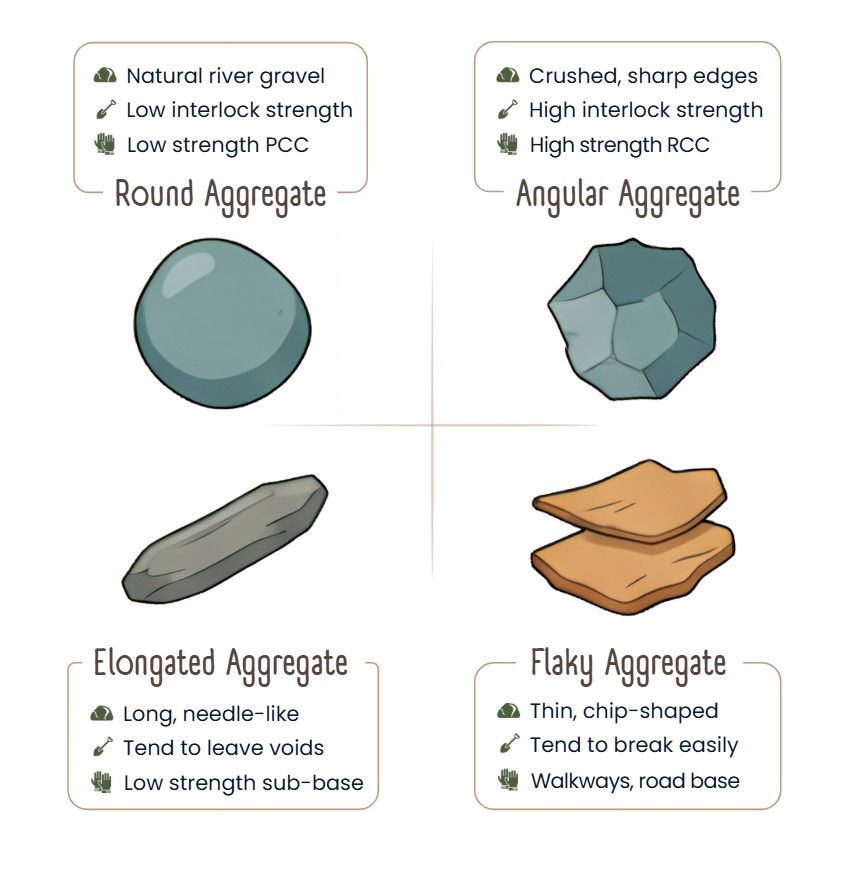
Particle shape is particularly important because it influences packing, interlocking, surface area, workability and the amount of cement paste needed. Shape characteristics such as flakiness and elongation are assessed through the methods specified in the IS 2386 series, while IS 383 establishes requirements for aggregates used in concrete.
Round Aggregate
Round aggregates have naturally rounded particles with comparatively smooth surfaces, commonly associated with materials such as naturally deposited gravel. Their smooth surfaces and rounded geometry allow particles to move more easily against one another, generally improving workability and reducing internal friction. However, they provide less mechanical interlock than angular particles.
Round aggregate can therefore be advantageous where ease of handling and placement is important, but its suitability for structural concrete depends on its overall grading and tested physical properties. Natural gravel is recognised as a source of coarse aggregate under IS 383, but the standard does not classify every rounded aggregate as automatically suitable or unsuitable based on shape alone.
Angular Aggregate
Angular aggregates have sharp edges and relatively irregular particle geometry, commonly resulting from the crushing of suitable rock. Their rough surfaces and angular edges provide greater mechanical interlock between particles and can contribute to strong aggregate-paste interaction. The trade-off is that angular particles generally create greater internal friction, which can reduce workability and increase paste or water requirements for a given consistency.
Angular crushed aggregate is widely used in structural concrete, pavements and other load-bearing applications when it meets the relevant grading, strength, durability and cleanliness requirements. Its shape alone, however, does not determine concrete strength; the quality of the aggregate and the complete concrete mix remain decisive factors.
Elongated Aggregate
Elongated aggregate consists of particles that are noticeably longer than their other dimensions. Such particles can interfere with efficient packing and may align preferentially during handling or compaction. This can increase voids and make achieving uniform compaction more difficult.
Elongation is therefore an important aggregate shape characteristic, particularly for applications where particle packing and mechanical performance matter. Instead of treating every elongated particle as automatically unsuitable, aggregate quality is evaluated using the relevant flakiness and elongation tests under IS 2386, along with the requirements applicable to its intended use. Excessive elongated particles are generally undesirable in concrete and pavement applications because they can adversely affect packing, handling and durability.
Flaky Aggregate
Flaky aggregates are thin, plate-like particles whose thickness is small relative to their other dimensions. Their geometry makes them less effective at forming a dense, stable particle arrangement and can make compaction more difficult. They may also be more vulnerable to breaking or crushing under handling and loading than well-shaped particles.
Flakiness is assessed using the flakiness index in accordance with IS 2386 Part 1, and requirements for permissible aggregate characteristics depend on the intended application and relevant specification. Excessive flaky particles are generally undesirable because they can increase voids and adversely affect workability, compaction and mechanical performance. Shape should therefore be considered alongside grading and other tested properties rather than used as the sole basis for accepting or rejecting an aggregate.
A key point is that no aggregate type is universally “best.” The appropriate material depends on the concrete grade, structural application, required workability, exposure conditions, available materials and compliance with the relevant Indian Standard.
Conclusion
Aggregates provide the physical framework of concrete and significantly influence its fresh and hardened properties. Fine aggregate fills the spaces within the mix, while coarse aggregate forms its main granular skeleton. Crushed and recycled aggregates demonstrate how the source and processing of aggregate can change its behaviour, while particle shape — from rounded to angular, elongated or flaky — affects packing, interlock and workability.
For Indian construction, aggregate selection should be based on tested properties, grading and the requirements of the relevant standards, particularly IS 383:2016 and the IS 2386 series.
These were some insights on Types of Aggregates. Stay tuned for more information on other significant topics in the AEC industry and follow Kaarwan for such detailed guides!
FAQs
1. What are the main types of aggregates used in construction?
Aggregates can be classified by size, source, material and shape. Common categories include fine aggregate, coarse aggregate, crushed aggregate and recycled aggregate, while common shape descriptions include round, angular, flaky and elongated particles.
2. What is the difference between fine and coarse aggregate?
Fine aggregate is predominantly material passing the 4.75 mm IS sieve, while coarse aggregate is generally material retained above this size. Their grading and proportions work together to create a dense concrete mix.
3. Is crushed basalt the same as crushed aggregate?
No. Crushed aggregate describes how the aggregate is produced, while basalt identifies the parent rock. Crushed aggregate can be produced from several suitable rock types, including basalt.
4. Are flaky and elongated aggregates suitable for concrete?
Excessive flakiness and elongation can adversely affect packing, workability and mechanical performance. Their acceptability should be assessed against the relevant requirements and test methods rather than assuming that every particle with these characteristics is unacceptable.
5. Which Indian Standard covers aggregates for concrete?
IS 383:2016, Coarse and Fine Aggregates for Concrete — Specification, is the principal Indian Standard covering requirements for aggregates used in concrete. Tests for properties such as shape, crushing, impact, abrasion, soundness and water absorption are covered through the relevant parts of IS 2386.