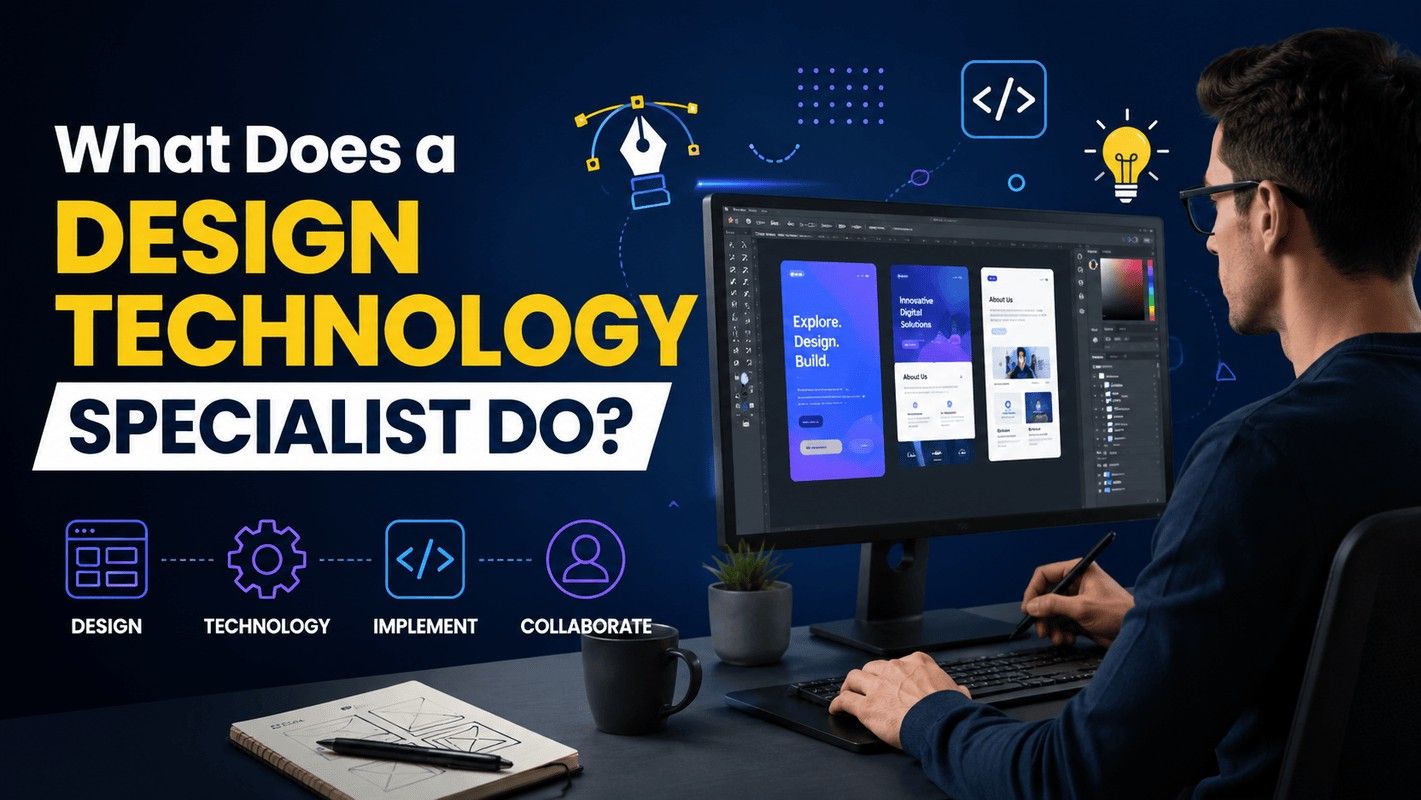
Let's be honest , the first time most people hear "Design Technology Specialist," they picture someone who's either very deep in software or doing some sort of futuristic BIM wizardry. And honestly? They're not entirely wrong. But the real picture is a lot richer than that.
This is one of those roles where the job title barely scratches the surface of what the person actually does every day. So if you're an architecture or engineering student trying to figure out whether this career path makes sense for you , or a working professional eyeing a shift , stick around. Let's actually break it down.
Who Is a Design Technology Specialist?
At its core, a Design Technology Specialist (often shortened to DT Specialist) is someone who makes technology work for design teams , not the other way around. They sit at the intersection of digital tools, workflows, and people. Think of them as the person who not only knows which software does what, but also understands how to stitch it all together into something usable at a firm-wide level.
The American Institute of Architects (AIA) formally recognizes the title within their job taxonomy , you'll find it listed as DT Specialist I, DT Specialist II, and DT Manager, each representing increasing levels of scope and leadership. That formal recognition matters. It signals that this isn't a role someone invented out of nowhere , it has a real, structured place in the AEC industry.
One quick but important distinction: a Design Technology Specialist is not the same as a BIM Specialist or a Computational Design Specialist , though the three roles often overlap and sometimes get lumped together. More on that in a bit.
Also Read: What is Computational Design? A Beginner's Guide , Kaarwan
Core Responsibilities of a Design Technology Specialist
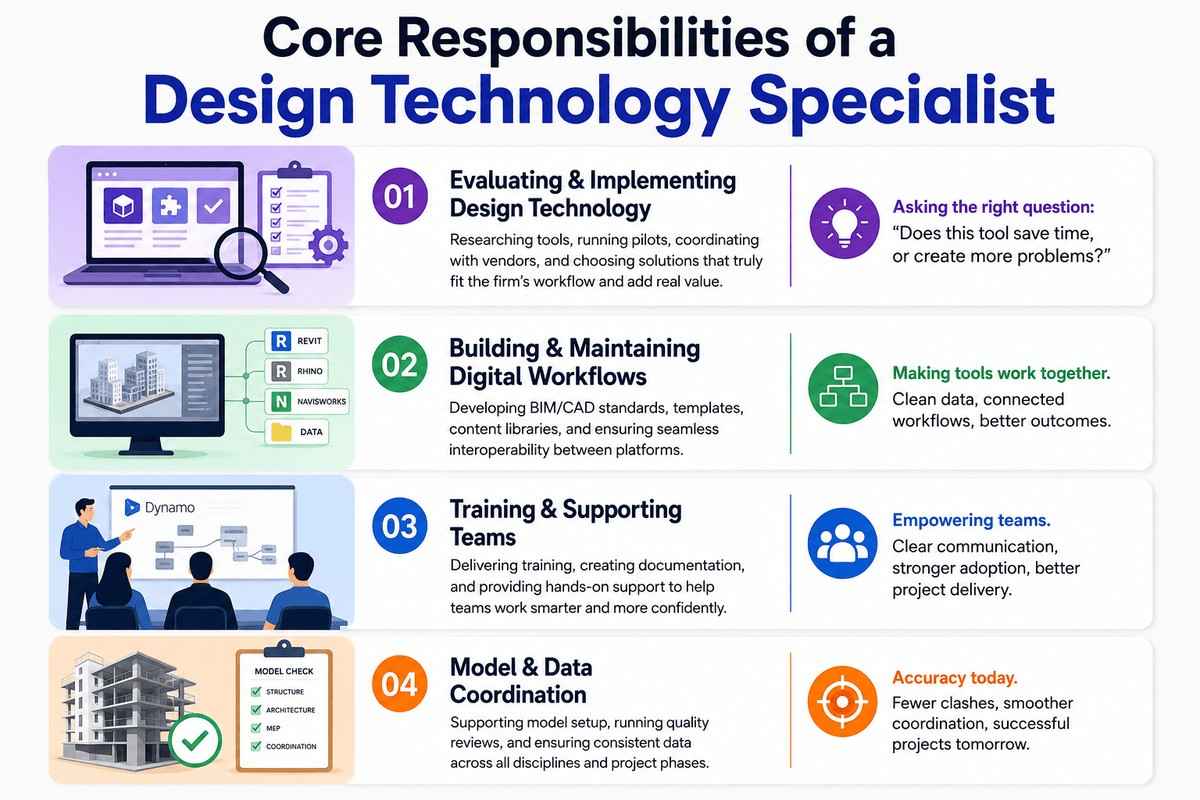
Evaluating & Implementing Design Technology
This is probably the part of the job that's least glamorous but arguably the most impactful. DT Specialists spend a surprising amount of time researching tools , running pilots on new software, coordinating with vendors, and figuring out what actually fits their firm's workflow versus what just looks impressive in a demo. Not every firm needs every tool. Part of the value a DT Specialist brings is helping their team not waste time on things that don't serve them.
They're the ones asking: "Does adopting this plugin actually save the team three hours a week, or does it create three hours of new problems?"
Building & Maintaining Digital Workflows
Once the right tools are in place, someone has to actually build the infrastructure that makes them work together. That's the DT Specialist.
This includes developing BIM and CAD standards, creating templates, building content libraries, and making sure different platforms can talk to each other without constant manual intervention. Interoperability , the ability to move data cleanly between Revit, Rhino, Navisworks, and other environments , is a big part of this work. If models are getting corrupted every time someone exports a file, the DT Specialist is the person who fixes the root cause, not just the symptom.
Training & Supporting Teams
Here's something people don't always expect: DT Specialists spend a lot of time teaching. They run internal training sessions, create documentation, and act as the first point of contact when someone on the team is stuck with a tool. This requires a rare combination of technical depth and communication clarity.
A good DT Specialist doesn't just know how Dynamo works , they can explain it to a project architect who's never scripted anything in their life and make it feel approachable. That's a skill in itself.
Model & Data Coordination
DT Specialists often support model management at a project level too , helping set up the right structure at kickoff, running quality reviews, and making sure data stays consistent across disciplines. This is especially relevant on large, multi-disciplinary projects where small inconsistencies in model setup can snowball into coordination nightmares later.
Also Explore: BIM Coordinator Career Path , Kaarwan
Design Technology Specialist vs BIM Specialist vs Computational Design Specialist
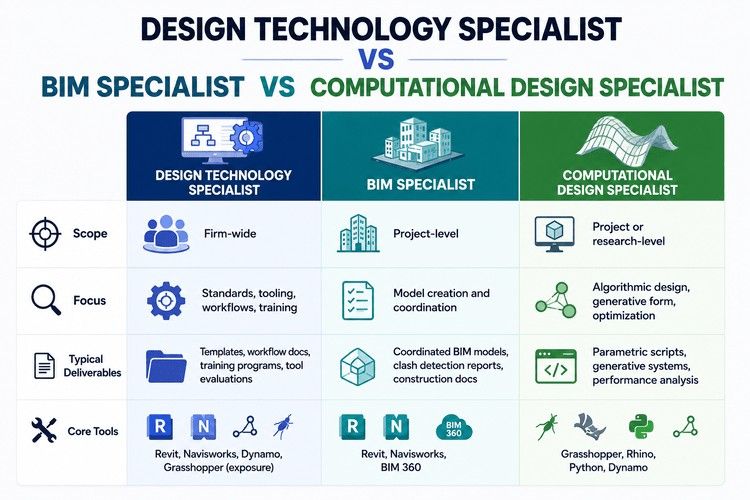
This is probably the most common source of confusion, so let's clear it up properly.
| Design Technology Specialist | BIM Specialist | Computational Design Specialist | |
| Scope | Firm-wide | Project-level | Project or research-level |
| Focus | Standards, tooling, workflows, training | Model creation and coordination | Algorithmic design, generative form, optimization |
| Typical Deliverables | Templates, workflow docs, training programs, tool evaluations | Coordinated BIM models, clash detection reports, construction docs | Parametric scripts, generative systems, performance analysis |
| Core Tools | Revit, Navisworks, Dynamo, Grasshopper (exposure) | Revit, Navisworks, BIM 360 | Grasshopper, Rhino, Python, Dynamo |
The clearest way to think about it: a BIM Specialist is focused on the model itself , making sure it's accurate, coordinated, and usable for construction. A Computational Design Specialist is more research-and-exploration oriented, using algorithms and parametric systems to solve design problems. A Design Technology Specialist is the one making sure the whole ecosystem , tools, standards, people , works together efficiently across the firm.
They're complementary roles, not competing ones. Some firms have all three. Smaller firms might have one person wearing two of these hats.
A real-world example: Ami Nigam, who worked as a Design Technology Specialist at UNStudio before becoming Head of Technology at Benoy, described how his role grew from pure BIM into a more holistic DT function , covering complex geometry understanding, computational design processes, and firm-wide BIM strategy. That's exactly the kind of evolution this role tends to follow.
Also Read: Computational Design Specialist Salary.
Ready to master Rhino and Grasshopper? Join Kaarwan's certification program with job support and gain industry-relevant computational design expertise.
Skills Required to Become a Design Technology Specialist
Technical Skills
Software fluency is non-negotiable. The most commonly required tools include:
- Revit , for BIM modeling, documentation, and parametric family creation
- Navisworks , for clash detection and project coordination
- Dynamo , for visual scripting and workflow automation inside Revit
- Rhino + Grasshopper , exposure is increasingly expected, even if you're not doing deep parametric design work
- Rhino.Inside , for bridging Rhino geometry into Revit workflows
Beyond individual tools, DT Specialists need to think in terms of systems , understanding how data moves between platforms and where things break down.
Also Explore: BIM Specialist Career Comparison.
Process Thinking
This is the part that separates a great DT Specialist from someone who just knows software. They have to be able to zoom out and ask: "Where is the bottleneck in this workflow? What would actually save this team time?" That kind of systems thinking doesn't come from a tutorial , it develops through experience and curiosity.
Communication & Training Ability
Technical skills without communication ability are only half the package. DT Specialists regularly need to explain complex processes to non-technical colleagues, write clear documentation, and run training that people actually retain. If you're someone who enjoys both figuring things out and explaining them to others, this role genuinely rewards that.
Vendor Management
Especially at larger firms, DT Specialists coordinate with software vendors , evaluating new tools, negotiating access, and sometimes participating in beta programs or feedback loops. It's a surprisingly external-facing part of the job.
Also Read: Top BIM Skills Every Architect Should Know.
Career Path & Salary Snapshot
The trajectory for a Design Technology Specialist usually looks something like this: you start in a more execution-focused role , maybe as a BIM coordinator or a junior designer with strong software skills , and gradually move into a position where you're shaping the technology strategy for your team or firm.
Salary-wise, the role is competitive. In India, figures typically range from ₹8–15 lakhs per annum depending on experience and firm size, with senior specialists at international firms earning significantly more. In the US, the range sits between $85,000–$120,000+ annually.
For a deeper look at compensation across BIM-adjacent roles, check out Kaarwan's full BIM role salary breakdown and current BIM hiring trends for a clearer picture of where the market is heading.
Ready to Build These Skills?
Want to build advanced computational design skills? Explore Kaarwan's Advanced Rhino & Grasshopper Certification and take the next step in your design career.
Closing Thoughts
The design technology specialist role is still growing , in recognition, in scope, and in relevance. As AEC firms scale up their digital practices and deal with increasingly complex projects, having someone who owns the tooling, standards, and workflows at a firm-wide level isn't just nice to have. It's becoming essential.
If you're someone who loves being at the intersection of technical problem-solving and helping people work better, this role is worth taking seriously. The career path is real, the demand is growing, and the skills are learnable.
Start where you are. Pick up the tools. And don't underestimate how much value comes from being the person who helps others understand them too.
Want to explore the tools and workflows that matter most for this career? Kaarwan's Advanced Rhino & Grasshopper Certification course is a strong place to start , built for architecture and design professionals who want to work at the edge of what's possible.
FAQ
Is a Design Technology Specialist the same as a BIM Manager?
Not exactly. A BIM Manager tends to have a more project-centric or firm-level BIM governance role , focused on standards, model quality, and deliverables tied to BIM execution plans. A DT Specialist has a broader remit that includes tool evaluation, interoperability, and training, and often engages more deeply with emerging technologies like computational design tools and automation workflows. In some firms the roles overlap; in others they're clearly distinct. The AIA's formal taxonomy treats them as separate positions.
Do you need a coding background to become a Design Technology Specialist?
Not necessarily , but it helps. Most DT Specialists work extensively with visual programming tools like Dynamo and Grasshopper, which don't require traditional coding. Some exposure to Python or C# is increasingly valuable, especially for automation tasks, but it's rarely a hard requirement for entry. The emphasis is more on systems thinking and software fluency than raw programming ability.
What software should I learn first?
If you're starting from scratch, Revit is the most universally expected foundation. From there, adding Dynamo (for automation within Revit) and Grasshopper (for parametric workflows) significantly broadens your options. Navisworks is also worth learning early if you're interested in the coordination side of the role. The combination of Revit + Dynamo + Grasshopper covers a large portion of what most DT Specialist job postings ask for.
Is this a good entry point into computational design careers?
Yes , and it's actually one of the more practical routes. Rather than going deep into pure algorithmic design from day one, the DT Specialist path builds a solid foundation in how digital tools actually function within real project environments. From that foundation, moving toward more computational work (if that's where your interest lies) becomes much more manageable. Firms like UNStudio have produced specialists who started in BIM/DT roles and grew into leading computational design functions over time.