

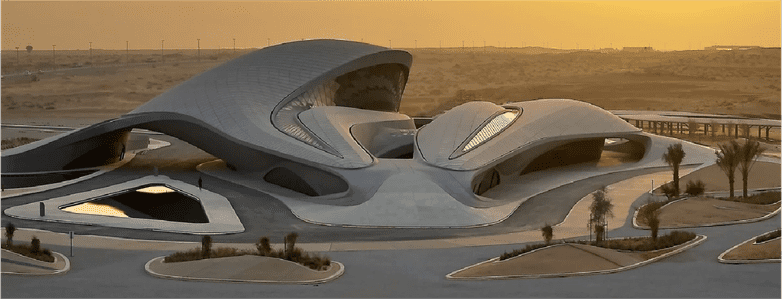
Few architects have redefined the boundaries of form and imagination quite like Zaha Hadid. Known as the “Queen of the Curve,” Hadid’s work championed fluid geometries, dynamic spaces, and fearless experimentation. But behind the sweeping lines and futuristic silhouettes was a design ethos deeply intertwined with computation.
Today, parametric modelling has become a standard tool in the AEC industry, with Rhino and Grasshopper leading the charge. Yet much of its cultural and creative momentum can be traced back to Zaha Hadid’s legacy. Her practice not only adopted digital tools early but also shaped the architectural language that parametric workflows continue to emulate.
The Early Embrace of Digital Tools
In the 1990s, when many firms still relied heavily on manual drawings, Zaha Hadid Architects (ZHA) began experimenting with digital modelling and scripting. The studio saw computers not as a constraint but as a canvas for fluidity. This forward-looking approach made them pioneers in computational design long before it became the industry norm.
Projects like the Vitra Fire Station (1993) showed the seeds of this language, but it was with later works like the MAXXI Museum in Rome or the Guangzhou Opera House that parametric thinking fully blossomed. These projects demonstrated how digital processes could orchestrate complexity—turning ambitious forms into buildable realities.
_1758103987176.png)
Signature Traits that Inspire Parametric Workflows
- Fluid Geometries Hadid’s work often echoes natural systems—waves, dunes, and landscapes—translated into architectural form. Parametric tools today allow designers to replicate such fluidity, adjusting curves and surfaces with precision through algorithms.
- Dynamic Spaces Instead of static rooms, ZHA projects often flow seamlessly into one another. Grasshopper scripts now help architects simulate these transitions, creating spaces where movement defines form.
- Structural Expression Zaha’s architecture is never about skin-deep aesthetics. The structural logics—whether twisted towers or cantilevered roofs—are integral to the geometry. Parametric models today embed structural rules directly into design iterations, reflecting this same philosophy.
- Performance and Sustainability. While early projects focused on form, later works began integrating daylight analysis, environmental performance, and fabrication logic. This aligns perfectly with how parametric workflows now connect design with data-driven analysis.
Case Studies: Zaha’s Influence on Built Form
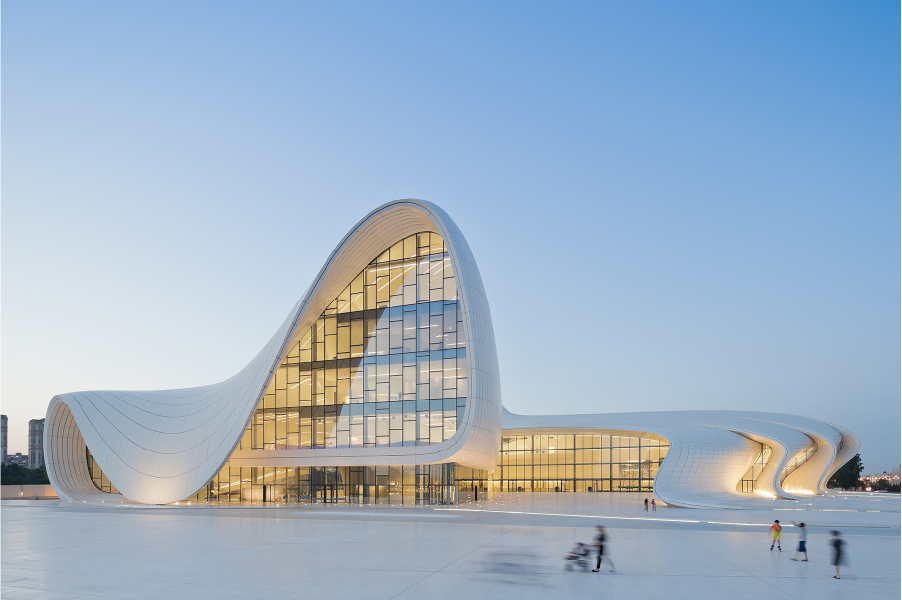
Heydar Aliyev Centre, Baku
Perhaps the most iconic expression of Hadid’s vision, the Heydar Aliyev Centre embodies seamless fluidity—its facade and roof merging into one continuous surface. Such a project relies heavily on parametric modelling to rationalise complex curves into manufacturable components. For today’s AEC professionals, it remains a reference point for how algorithms can bridge imagination and construction.
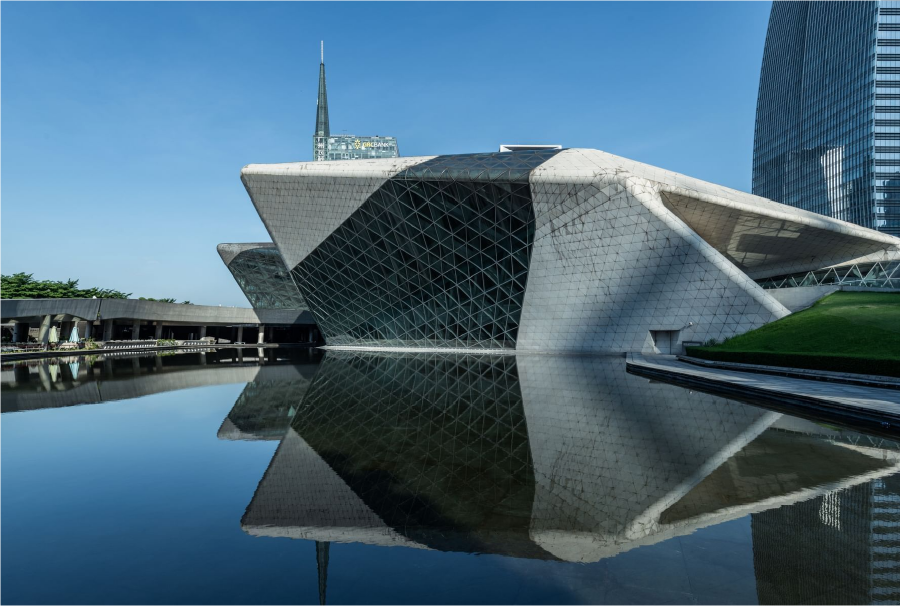
Guangzhou Opera House, China
Shaped like river pebbles eroded by water, the Guangzhou Opera House demonstrates how organic geometries can emerge from computational logics. Its double-curved glass and steel facade required advanced digital workflows to resolve each panel. For students of Grasshopper, it is a masterclass in translating free-flowing geometry into rational grids.
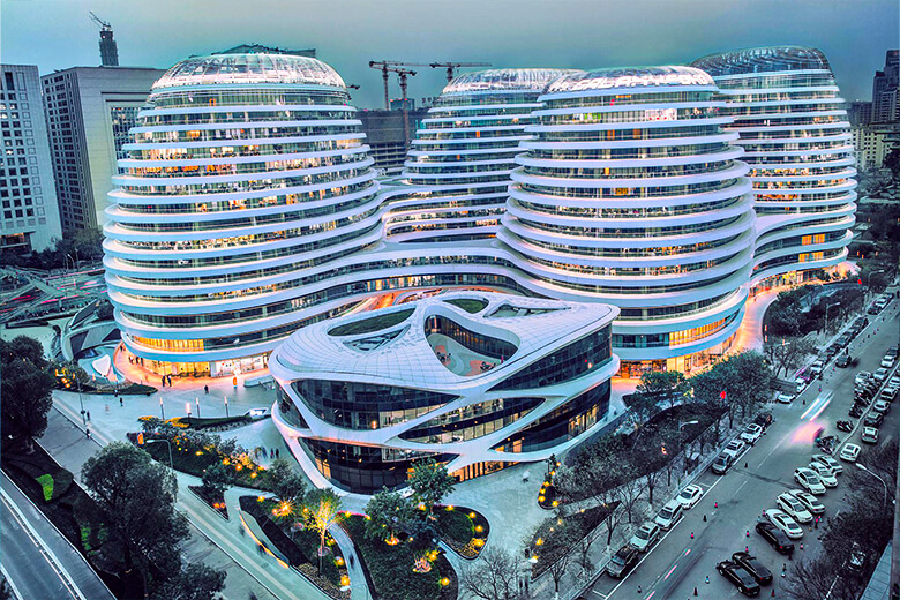
Galaxy SOHO, Beijing
This commercial complex showcases four domed volumes that weave into each other with continuous bridges and terraces. Parametric modelling was critical in generating smooth transitions, optimising circulation, and managing complex structural relationships. It illustrates how design and urbanism can merge seamlessly when guided by computational tools.
Her Legacy for Today’s AEC Professionals
Zaha Hadid’s legacy is not merely about iconic buildings—it is about mindset. For AEC professionals learning BIM, Grasshopper, or computational workflows, her work offers three enduring lessons:
- Think without boundaries: Parametric tools are only as powerful as the imagination behind them. Hadid’s fearless approach to geometry reminds designers to see beyond convention.
- Bridge art and performance: While sculptural, her projects always responded to structure, site, and programme. This balance is essential when working with today’s data-driven models.
- Collaborate across disciplines: Many of ZHA’s breakthroughs were possible because architects, engineers, and fabricators worked from a shared digital model—an ethos mirrored in today’s BIM workflows.
At Kaarwan, we believe education should be accessible to all. Our short, affordable workshops help you explore career options while preparing for premium opportunities. (Highlights this week GATE Strategic Prep Masterclass, Thesis 5-Day Bootcamp, BIM and Computational Design).
The Digital Future Inspired by Hadid
Contemporary practices across India and the world now build on Zaha Hadid’s pioneering work. Whether it is a parametric jaali facade in Jaipur, a biomimetic residence in Surat, or climate-responsive shading in New Delhi, her influence is visible in the ambition and elegance of parametric design.
For Kaarwan’s learners, Hadid’s story is more than inspiration; it is a reminder that mastering tools like Rhino, Grasshopper, and BIM is about unlocking creativity. Digital workflows are not an end in themselves but a pathway to shaping new worlds, just as Hadid envisioned.
Curious about computational design?
Explore our 1-Day Rhino Design Masterclass, a low-commitment way to dip your toes into the niche before investing your time, energy, and money in a full course. However, with Kaarwan, you’ll find affordable and accessible programmes and flexible pay options.
Come with an open mind, discover what excites you (mentors, syllabus, etc.), and gauge the scope you see (alumni portfolios) for yourself in this evolving field.
FAQs
1. How did Zaha Hadid influence parametric modelling?
Her projects embraced fluid geometries and computational processes early on, demonstrating how digital tools could create complex, buildable forms.
2. What software tools align with Hadid’s legacy today?
Rhino and Grasshopper are widely used for parametric design, along with BIM platforms for collaboration and fabrication workflows.
3. Which Zaha Hadid project is most referenced in computational design?
The Heydar Aliyev Centre is often cited for its seamless parametric surfaces and fabrication strategies.
4. Why should AEC professionals study Zaha’s work?
Her projects demonstrate how parametric tools can merge creativity with performance, offering valuable lessons for contemporary practice.
5. Is parametric modelling only for large-scale projects?
No. While Zaha’s projects were often monumental, parametric workflows can be applied to any scale—from residential facades to urban infrastructure.




.png)