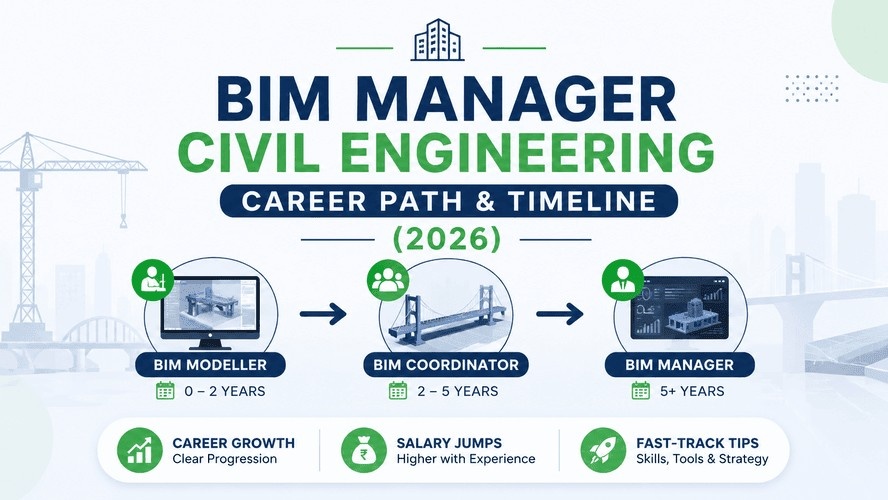
There's one question that keeps popping up among civil engineers who've already dipped their toes into BIM: how long is this whole climb actually going to take? Not the vague "depends on experience" answer everyone gives, but a real, stage-by-stage picture of what it takes to go from BIM Modeller to BIM Manager.
Here's the short version: most people are looking at 7–11 years on the standard route. The longer version? That timeline isn't set in stone. Some engineers cut it down considerably by making smart moves early, while others get stuck at Stage 2 for years without even noticing it's happening.
This guide lays out the complete BIM Manager career path for civil engineers , what each stage looks like, which skills unlock the next one, what typically holds people back, and what genuinely helps them move faster. If you're a civil engineer weighing up whether this path is worth pursuing, this is the page built to answer exactly that.
Also Read: BIM Civil Engineer Salary in India 2026 , What These Roles Pay at Each Level , Kaarwan
Can a Civil Engineer Really Become a BIM Manager?
Absolutely , and civil engineers are, in many ways, better set up for this than people assume.
Here's the reasoning: a BIM Manager Civil Engineering role isn't really about who knows the software best. It's about grasping how construction projects actually run, how information moves between disciplines, and how to steer digital delivery at the project or company-wide level. Civil engineers already carry structural understanding, hands-on site exposure, project management experience, and a working sense of how infrastructure gets built. None of that knowledge disappears , it becomes the foundation for BIM leadership.
Think about it this way: a structural engineer who understands load paths will write a far more useful BIM Execution Plan for a civil project than a software specialist who can't interpret a structural drawing. Someone who's spent time on-site during construction understands exactly why clash detection matters , in a way a purely software-focused trainer simply doesn't.
The BIM Manager role builds an extra layer on top , workflow strategy, ISO 19650 compliance, CDE oversight, team leadership, and standards authorship , stacked onto engineering fundamentals civil engineers already possess. That blend is genuinely rare and valuable, and it's exactly why the pay jumps at this level.
To put the financial upside in perspective: BIM Manager salaries in India generally fall between ₹15 LPA and ₹30+ LPA, depending on experience, the type of firm, and the scale of projects involved. For the full picture, check out Kaarwan's BIM manager salary in India breakdown , the numbers are noticeably higher than both standard civil engineering roles and entry-level BIM positions.
The Realistic BIM Manager Career Timeline for Civil Engineers
This is where most career guides get vague. Competitors tend to hand-wave with phrases like "a few years" or "steady growth." Here's the version that actually commits to specifics.
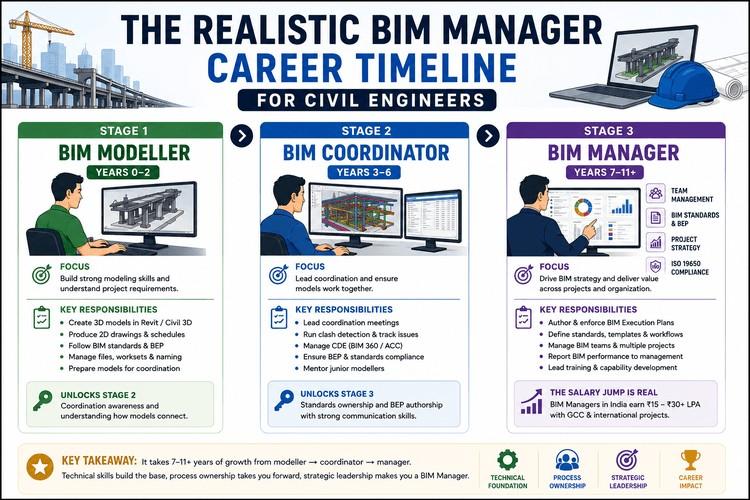
Stage 1 , BIM Modeller (Years 0–2)
This is where everyone starts. The focus here is building a technical base , modeling with precision, mastering the software stack at a production standard, and understanding what separates a genuinely usable model from one that just looks right.
Core responsibilities:
- Building discipline-specific 3D models in Revit or Civil 3D
- Sticking to the project's BIM standards and BIM Execution Plan
- Generating 2D documentation , plans, sections, schedules , from 3D models
- Using correct naming conventions, worksets, and file organization
- Getting models coordination-review ready
The skill that unlocks Stage 2: an eye for coordination. The modellers who progress are the ones who start wondering how their model fits with everyone else's , who reviews it, what a clash report is really telling them, what happens in the coordination meeting. Those who stay put as modellers are usually the ones who model well but never get curious about the bigger workflow around them.
What holds people back here: treating Revit like glorified AutoCAD , dropping in elements instead of building parametric, information-rich models. That habit builds technical debt that turns into a reputation problem down the line. Also worth flagging: skipping portfolio-building. By the close of Year 2, you should have solid documented evidence of your modelling work , LOD tags, project context, and your specific contribution.
Stage 2 , BIM Coordinator (Years 3–6)
This is the real turning point. It's where the journey shifts from purely technical execution to owning the process. Being a BIM Coordinator as a civil engineer is fundamentally about orchestrating how different discipline models come together , not just producing your own content in isolation.
Core responsibilities:
- Running multi-discipline model coordination meetings
- Managing clash detection in Navisworks Manage and following resolutions through
- Checking models against the BIM Execution Plan for compliance
- Overseeing the Common Data Environment (BIM 360 / Autodesk Construction Cloud)
- Guiding junior modellers
- Liaising with architects, structural engineers, MEP consultants, and contractors on coordination matters
The skill that unlocks Stage 3: owning the standards and writing the BEP yourself. Coordinators on the verge of becoming managers can draft a BIM Execution Plan from the ground up, rather than simply following someone else's. They understand ISO 19650 as a working framework , not a line on a certificate , and they can put it into practice. They've also picked up enough communication skill to walk a project director who has no idea what a federated model is through a coordination bottleneck.
What holds people back here: this is the most common stalling point. Engineers who stay locked into clash detection and model uploads , without building out BEP knowledge, CDE management ability, and cross-stakeholder communication , can remain coordinators indefinitely. Coordination skills are essential, but they're not enough on their own to reach BIM Manager. The missing piece is the strategic layer.
A real-world example worth noting: Rania Abdelfattah, a Digital Delivery and Information Strategy professional who's written extensively about this transition, draws a sharp line , a BIM Manager's real job isn't managing models, it's managing how information moves through a project. That's a fundamentally different mindset from coordination work.
Stage 3 , BIM Manager (Years 7–11+)
At this point, the work becomes genuinely strategic. A BIM Manager Civil Engineering role isn't a glorified senior coordinator position , it functions at an organizational level. You're now shaping how BIM gets delivered, whether across a single project or the entire firm.
Core responsibilities:
- Writing and enforcing BIM Execution Plans across projects
- Setting organization-wide BIM standards, templates, and naming conventions
- Assessing and rolling out new tools and workflows
- Overseeing BIM teams spread across multiple projects
- Reporting on BIM performance to senior leadership
- Handling client-facing conversations around digital delivery requirements
- Owning ISO 19650 compliance at both project and organizational levels
- Running internal training and building team capability
This is where the civil engineering background pays off again. A BIM Manager who can genuinely engage with structural engineers, site teams, and MEP consultants , because they've actually done that engineering work themselves , earns a level of credibility a pure software specialist struggles to match.
The pay jump at this stage is substantial. BIM Managers here typically earn ₹15–30+ LPA in India, with those on GCC projects or working for international firms landing at the higher end. Demand stays consistent across infrastructure, commercial, and industrial sectors alike.
Also Explore: BIM Career Opportunities Abroad.
From LOD standards to BEP workflows and Navisworks coordination, Kaarwan's BIM Certification for Civil Engineers covers every skill milestone on the BIM Manager career path. Apply now.
What Actually Speeds Up the Timeline (and What Doesn't)
The real accelerants
Owning clash detection, not just showing up to it. There's a real gap between attending coordination meetings and actually running them. Engineers who step up to lead the clash detection process , setting up Navisworks tests, producing reports, tracking resolution cycles , build coordinator-level skills far faster than those who just sit in on the meetings.
Getting in front of clients early. The quickest route from coordinator to manager almost always runs through direct client or consultant interaction. BIM Managers need to be able to translate digital delivery into plain language for non-technical stakeholders. Engineers who chase that exposure , presenting coordination reports, sitting in on client reviews , develop a communication skill that's genuinely tough to build any other way.
Working with ISO 19650, not just knowing about it. "Familiar with ISO 19650" is a line on a resume. Actually applying it , EIR, BEP, CDE management, information delivery cycles , on a real project is what builds real capability. Seek out firms or projects that use the framework, even if it means asking for that exposure directly.
Structured BIM training that teaches workflow, not just software. This is exactly where Kaarwan's BIM Civil certification program adds real value , not as a substitute for project experience, but by filling in the structured knowledge gaps that learning on the job tends to leave behind. Understanding why LOD 350 matters, how to actually read a BEP, how information delivery cycles tie back to ISO 19650 , these are things most engineers piece together slowly over years, or absorb quickly in a structured program and start applying immediately.
What doesn't speed things up
Stacking software certificates without real project work behind them. An Autodesk Certified Professional badge shows baseline ability , it says nothing about whether you can own coordination or write a BEP.
Staying purely in modelling past Year 3. The learning curve on modelling flattens out. Staying in execution-only work without picking up coordination and strategy skills has limited upside after the first couple of years.
Sitting back and waiting to be promoted. BIM Managers tend to emerge from people who've already been doing manager-level work informally for a year or two before the title catches up. Writing BIM standards documentation, pitching workflow improvements, mentoring junior staff , that's what actually gets noticed.
BIM Manager vs. BIM Coordinator: What Changes at Each Level
| BIM Coordinator | BIM Manager | |
| Primary focus | Project-level model integration | Firm/program-level BIM strategy |
| Decisions | Clash resolution, model compliance, coordination scheduling | Standards, technology stack, team structure, BEP authorship |
| Team scope | Discipline modellers across a single project | BIM team across multiple projects or the organization |
| Client interface | Coordination-level; rarely principal contact | Regularly interfaces with clients on digital delivery requirements |
| Standards role | Follows and enforces the BEP | Authors the BEP; defines the firm's BIM standards |
| ISO 19650 | Working knowledge; implements existing processes | Deep implementation knowledge; owns compliance strategy |
| Tools focus | Navisworks, BIM 360 / ACC, Revit | Full CDE ecosystem, Dynamo/automation, audit and analytics tools |
| India salary range | ₹7–12 LPA (mid-level) | ₹15–30+ LPA |
The simplest way to frame the difference: a BIM Coordinator manages models. A BIM Manager manages information. Two genuinely different jobs, built on two different ways of thinking.
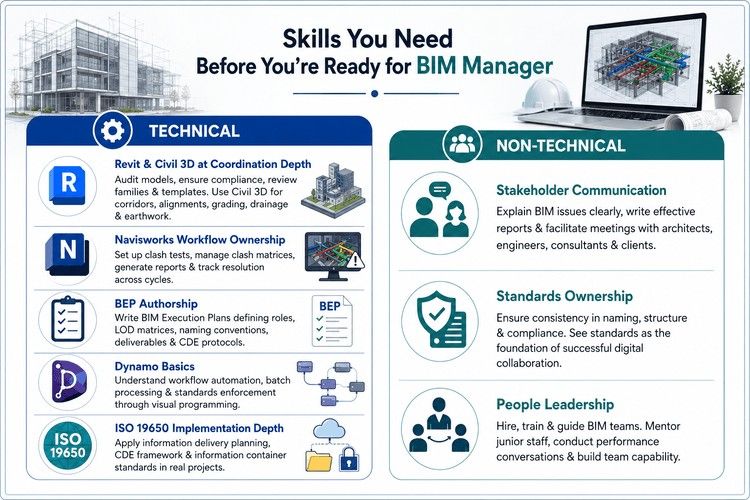
Skills You Need Before You're Ready for BIM Manager
Technical
Revit and Civil 3D at a coordination level. Not just modelling for production , the ability to audit models, check compliance, and review families and templates against standards. Civil 3D matters specifically for infrastructure work: corridor design, alignments, grading, drainage, earthwork volumes.
Navisworks at a workflow-ownership level. Setting up clash tests, managing clash matrices across disciplines, generating reports, and tracking resolution across cycles. This goes beyond just running a clash test , it means owning the entire coordination process.
Writing a BEP from scratch. The ability to author a BIM Execution Plan , defining model responsibilities, LOD matrices, naming conventions, deliverable schedules, and CDE protocols. Most engineers have read a BEP. Managers are the ones who write them.
Basic Dynamo literacy. Not necessarily advanced scripting, but enough visual programming know-how to understand workflow automation, batch processing, and how scripting can enforce standards.
ISO 19650 at implementation level. Information delivery planning, the common data environment framework, information container standards , understanding how the framework structures real project information management, not just in theory.
Non-Technical
Stakeholder communication. Being able to explain a coordination constraint to a project director who's never modelled anything. Writing a clear coordination report. Running a meeting where architects, structural engineers, MEP consultants, and a client rep are all at the table.
Ownership of standards. Genuinely caring about consistency, naming, structure, and compliance , not as red tape, but as the thing that lets collaborative digital delivery function at scale.
Leading people. BIM Managers hire, train, and direct BIM teams. Mentoring junior staff, handling performance conversations, and growing team capability is a real requirement of the job , not a nice-to-have.
Also Read: BIM Course in India 2026 , Kaarwan's BIM Civil Certification Program , Kaarwan
Ready to Accelerate Your Path to BIM Manager?
Kaarwan's BIM Civil certification program builds the coordination skills, project portfolio, and structured knowledge that can meaningfully shorten the Years 0–6 learning curve. Explore the program and see where it fits your timeline.
Closing Thoughts
The BIM Manager Civil Engineering path is one of the clearest, most well-defined progressions in the AEC industry. Three stages, each with its own skill milestones, each with a known condition for unlocking the next.
What stretches this journey out for most people isn't a lack of ability , it's staying too long in pure execution work, not chasing coordination ownership, and never building the strategy and standards layer that actually defines the manager role. Those are behavioral gaps, not knowledge gaps , which means they're fixable.
For anyone currently at, or approaching, Stage 2, it's worth reading the full path from Modeller to Coordinator to Manager in parallel , it goes deeper specifically on the coordinator stage.
Structured training won't replace the years of project experience the role demands. But it does strip out years of trial-and-error from Stages 1 and 2 , and that's precisely what turns a 10-year path into one that takes 6 or 7.
FAQs
How long does it take to become a BIM manager from a civil engineering background?
The realistic range is 7–11 years on the standard track: roughly 0–2 years as a BIM Modeller, 3–6 years as a BIM Coordinator, with the BIM Manager role emerging somewhere in the 7–11+ year range. This can be compressed , sometimes down to 5–7 years , for engineers who take on coordination ownership early, build ISO 19650 fluency, combine structured training with project experience, and develop BEP authorship skills before the formal title arrives.
Can a civil engineer become a BIM manager without an architecture background?
Yes , and civil engineers often have an edge over architecture-trained BIM professionals in infrastructure and EPC settings. Structural knowledge, on-site experience, project management exposure, and a genuine understanding of how infrastructure gets built are all directly relevant to BIM Manager roles on civil projects. What civil engineers typically need to add is workflow strategy, information management standards (ISO 19650), CDE management, and the stakeholder communication skills the manager role calls for.
What is the BIM manager salary in India for civil engineers?
BIM Managers with a civil engineering background in India typically earn between ₹15–30+ LPA, with senior roles at large infrastructure firms, international EPC contractors, or BIM consultancies sitting at the top end. Professionals targeting GCC markets (UAE, Saudi Arabia, Qatar) usually see notably higher packages , see Kaarwan's full BIM manager salary data for a detailed city-and-role breakdown.
Is BIM Coordinator a mandatory step before BIM Manager?
Not strictly mandatory as a title, but the skills built in the coordinator role , clash detection ownership, multi-discipline coordination, CDE management, BEP compliance , are all prerequisites for BIM Manager. Engineers who jump straight from modelling to management without genuine coordination experience tend to struggle with the stakeholder management and standards ownership sides of the role.
What certifications help civil engineers become BIM managers faster?
Autodesk Certified Professional (ACP) for Revit Structure or Civil 3D signals baseline technical competency and helps clear ATS filters. ISO 19650 training (awareness or practitioner level) signals depth in information management , directly relevant to BIM Manager roles and increasingly expected on government-funded projects. buildingSMART certification is gaining international recognition.