Let's be honest, "What civil engineering course should I do?" sounds like a simple question, but it absolutely isn't. Because the answer depends entirely on where you are right now. Are you in Class 10 and exploring options? Already holding a diploma and wondering what's next? A working engineer who wants a better salary and doesn't know where to start? All three situations need completely different answers.
This is a complete civil engineering courses list that covers every stage — not in a vague "here are some options" way, but actually useful, with real information you can act on.
Civil Engineering Courses After 10th
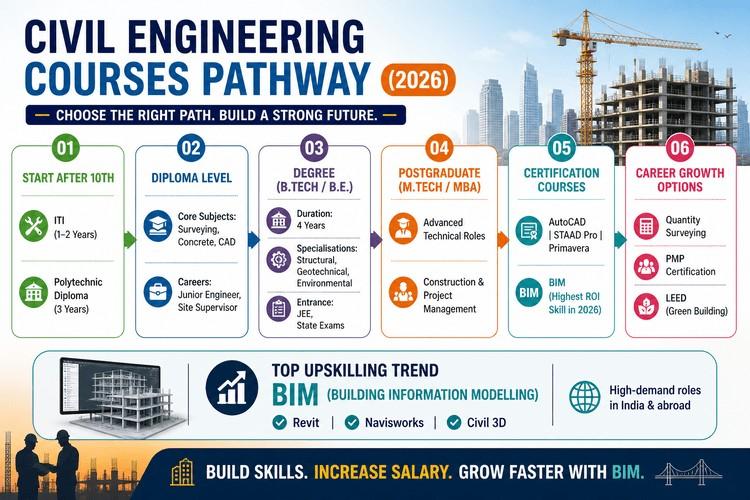
So you have finished Class 10, and you are interested in civil engineering. Good news — you do not have to wait years to get started. There are two real routes from here, and both have genuine merit depending on what you want.
ITI Courses
ITI programmes are the fastest way in. They run for one to two years, and they are genuinely practical — you are learning on tools, on drawings, on actual field methods rather than sitting through theory lectures. For civil engineering specifically, Draughtsman Civil is the most popular ITI trade. You learn technical drawing, basic AutoCAD, building plans, map reading. Surveyor is another solid option — levelling, chain surveying, basic site measurements. Construction Technician covers building materials and site operations at entry level.
These are not glamorous. But they work. Government ITI fees are low — sometimes as little as Rs 10,000 for the whole programme. Graduates who take site work seriously and build their skills can progress into supervisory roles faster than most people expect.
Polytechnic Diploma
This is the bigger commitment — three years — but also the more credible qualification for most civil engineering after 10th career paths. The Diploma in Civil Engineering from a government polytechnic is what most people mean when they say "civil engineering after 10th." State entrance exams like JEECUP in UP, DET in Delhi, MSBTE in Maharashtra — these are what you need to clear to get into the better polytechnics.
We will go deeper on the diploma in the next section because it deserves its own space.
Civil Engineering Diploma Courses
The three-year Diploma in Civil Engineering is probably the most common starting point for civil engineers in India. And when it is done well — with actual engagement in the practical work, some AutoCAD proficiency, a site internship if you can get one — it opens real doors.
The civil engineering diploma course curriculum runs through six semesters.
First year covers Engineering Drawing, Building Materials, basic maths.
Second year gets more interesting — Surveying, Structural Analysis basics, Concrete Technology, AutoCAD.
By third year you are looking at Estimation and Costing, Construction Management, Construction Drawing, and project work.
After the diploma, what can you actually do? Junior Engineer roles with private contractors. Draughtsman or CAD technician positions. Site supervisor at smaller firms. Government jobs through PWD, CPWD, and municipal corporation recruitment — consistently open for diploma holders and genuinely stable. Or, and this is worth knowing, lateral entry into a B.Tech programme. You skip first year and complete the degree in three more years instead of four.
The salary at the entry level is not high. That is just the reality. But diploma engineers who pick up software skills — AutoCAD confidently, or better yet Revit — and who show initiative on site tend to move up faster than people assume.
Eligibility: Class 10 pass, typically 45 to 50% aggregate in Science and Mathematics.
Duration: 3 years.
Approximate fee: Rs 15,000 to Rs 80,000 per year at government polytechnics.
Upgrade your career with the Kaarwan Professional BIM Certification Program for Civil Engineers—master in-demand tools, gain real project experience, and receive placement support to unlock higher-paying civil engineering opportunities.
Civil Engineering Degree Courses
A B.E. or B.Tech in Civil Engineering is a four-year undergraduate programme that provides complete technical and theoretical knowledge of the field.
If you are going through 11th and 12th with Physics, Chemistry and Maths and your sights are set on a civil engineering degree, JEE Main is the primary entrance exam. JEE Advanced for IITs. State-level exams — MHT-CET, KCET, WBJEE, TANCET — for state institutions. BITSAT for BITS Pilani. The competition for top colleges is real. But the spread of civil engineering degree courses across India is wide — NITs, state government colleges, and several solid private universities all offer strong programmes.
What does the degree give you that the diploma does not? Depth. You go much further into Structural Analysis, Foundation Design, Geotechnical Engineering, Fluid Mechanics, Environmental Engineering, Transportation Engineering. You also have electives in the final two years — and in 2026 several institutions are offering electives in Building Information Modelling, Remote Sensing and GIS, and Green Building Design. These matter because they are what employers are actually asking for.
IIT Roorkee, IIT Bombay, IIT Madras, IIT Kharagpur, NIT Trichy, NIT Warangal — for civil engineering specifically, these names carry weight. But honest truth: the institution matters less than what you do during and after the degree. Skills and project experience speak louder than the name on your certificate in this field.
Eligibility: Class 12 with Physics, Chemistry and Mathematics, typically 60% and above.
Duration: 4 years (3 years for lateral entry diploma holders).
Approximate fee: Rs 80,000 to Rs 2,00,000 per year at NITs; Rs 2,00,000 to Rs 5,00,000 per year at private colleges.
Civil Engineering PG Courses
Not everyone needs a postgraduate degree. Worth saying that upfront. If your goal is site supervision, BIM coordination, or junior project management, a master's is probably not the priority right now. But if you want to go deep into a specialism, move into research, or qualify for senior technical or management roles at large firms — PG makes sense.
M.Tech / M.E.
Two years. GATE score is the standard entry route. Specialisations worth knowing about in 2026 include Structural Engineering, Geotechnical Engineering, Construction Technology and Management, Environmental Engineering, and Water Resources Engineering. GATE-qualified candidates at IITs and NITs also receive a monthly stipend, which makes the financial picture more manageable.
MBA in Construction Management
Specifically for civil engineers who want to move into project leadership, contracts management, or business development at construction companies. NICMAR in Pune is the most well-known institution for this pathway in India — genuinely respected across the industry. If you are five or six years into your career and the technical ceiling feels solid but the management track is calling, this is what people in that position usually look at.
Eligibility: B.E./B.Tech in Civil Engineering, typically 60% and above. Duration: 2 years in most programmes.
Civil Engineering Certificate Courses
Certificate courses are short, focused, and usually done alongside a job. And for working civil engineers in 2026 — they are often more immediately career-moving than another year of formal study.
The civil engineering certificate space covers a wide range. AutoCAD certification if you are not yet confident on it. STAAD Pro for structural analysis. Primavera P6 for project scheduling — genuinely in demand at large contracting firms. LEED AP for green building roles. PMP (Project Management Professional) for engineers heading toward a management track.
But the certificate course that is generating the most career movement for civil engineers in India right now is BIM — and specifically, Autodesk-certified BIM training that covers Revit, Navisworks, Civil 3D, and coordination workflows.
This is where Kaarwan comes in.
Kaarwan's BIM Certification Program for Civil Engineers is one of the most comprehensive industry-focused civil engineering certificate programmes available in India in 2026. It is not a passive video course. It is live, instructor-led, project-based — you are building real models, running real coordination workflows, and getting feedback from practitioners who work on actual AEC projects.
What the programme covers: Autodesk Revit for structural modelling, Navisworks for clash detection and 4D simulation, Civil 3D for infrastructure design, Dynamo for parametric automation, BIM 360 for cloud collaboration, and ISO 19650-compliant Common Data Environment workflows. That is 8 plus BIM tools across 6 months — not just theory, but hands-on application on real project case studies.
What you get at the end: an Autodesk-recognised certification, a documented portfolio on Behance that you can show employers, and 6 months of placement support from Kaarwan's dedicated placement team — which stays with you until you actually land a role, not just until the course ends.
For a diploma holder or a fresh B.Tech graduate wondering which civil engineering certificate is worth the investment — this is the one that is translating directly into job offers at firms like AECOM, WSP, Mott MacDonald, Techture, and specialist BIM delivery centres across Mumbai, Pune, Bengaluru, Hyderabad, and Chennai.
Upgrade your career with the Kaarwan Professional BIM Certification Program for Civil Engineers—master in-demand tools, gain real project experience, and receive placement support to unlock higher-paying civil engineering opportunities.
Courses After Civil Engineering and After Diploma
This is probably the most practically useful section for most people reading this. You are already in civil engineering in some form. Maybe you finished your diploma and you are on site. Maybe you completed your B.Tech two or three years ago and your salary has plateaued. Whatever the situation — what you do next matters enormously.
Let us just say it directly. In 2026, the single highest-ROI upskilling investment for a civil engineer is BIM.
That is not a trend anymore. It is the present reality of how serious infrastructure and building projects are being delivered — particularly for international clients, government mega-projects, and any firm bidding on work where BIM deliverables are a contract requirement. BIM-trained civil engineers are accessing salary levels their non-BIM peers simply are not. And this gap is widening.
Other courses after civil engineering worth considering:
Quantity Surveying — through NICMAR short programmes or RICS qualification pathways. QS skills are valued in both India and internationally, particularly in the Gulf market. PMP for engineers five or more years in who want to formalise project management credentials. LEED Accredited Professional for sustainability and green building-focused roles.
- Quantity Surveying - through NICMAR short programmes or RICS qualification pathways. QS skills are valued in both India and internationally, particularly in the Gulf market.
- PMP for engineers with five or more years who want to formalise project management credentials.
- LEED Accredited Professional for sustainability and green building-focused roles.
For diploma holders specifically: lateral entry B.Tech is worth seriously considering if government employment or senior technical roles are the goal. For the private sector — particularly BIM delivery centre roles in metro cities — diploma holders with strong Revit and coordination skills are being hired at salaries that previously required a degree and years of experience. That is a genuine shift in the market, and it is happening now.
Online Civil Engineering Courses
Online civil engineering learning has genuinely improved. A few years ago it was patchy — passive video content with limited practical value. In 2026 there are some legitimately useful options worth knowing about.
NPTEL is the starting point for any civil engineering student who wants to strengthen core technical knowledge. Delivered by IIT and IISc faculty, free to access, with paid certification exams through the SWAYAM portal. If you are preparing for GATE, this is your primary resource.
Coursera and edX have civil engineering and construction management courses from international universities — Delft, MIT, Leeds. Good for broadening perspective on sustainable infrastructure and construction management. Content is often auditable for free; certificates cost money.
Autodesk's own learning platform is the most practical free resource for software skills. Official learning paths for Revit, AutoCAD, Navisworks, Civil 3D. Completing these paths and sitting the official certification exams is genuinely valued by employers who use these tools daily.
Kaarwan offers the most comprehensive live online BIM civil engineering classes in India. Live sessions with industry practitioners, real project-based learning, model feedback, and a structured curriculum that takes you from zero BIM knowledge to Autodesk-certified in six months. If you are looking for online civil engineering courses that actually translate into job offers — not just certificates — this is the programme built specifically for that outcome.
Upgrade your career with the Kaarwan Professional BIM Certification Program for Civil Engineers—master in-demand tools, gain real project experience, and receive placement support to unlock higher-paying civil engineering opportunities.
Frequently Asked Questions
What is the best civil engineering course after 10th?
The three-year Diploma in Civil Engineering from a government polytechnic is the most complete option. It gives you technical foundations, qualifies you for junior engineering roles, and opens the lateral entry B.Tech route later. If you need something shorter, the ITI Draughtsman Civil trade gets you into the workforce in one to two years with a more focused skill set.
What is the scope of a civil engineering diploma course in 2026?
Strong — particularly for diploma holders who add digital skills. AutoCAD as a baseline. Revit and BIM tools if you want to target delivery centre roles at international AEC firms. Government recruitment through PWD and CPWD remains steady. The salary gap between diploma holders with software skills and those without has widened noticeably in the past two years.
What are the best courses after civil engineering for career growth?
BIM certification is the highest-ROI option for most civil engineers right now — especially if you are targeting private sector roles or international opportunities. PMP for project management. Quantity Surveying for cost and contracts. LEED AP for green building. Of all of these, BIM consistently delivers the fastest salary impact.
What are the best courses after a diploma in civil engineering?
Two clear paths. Lateral entry B.Tech for a formal degree and government job eligibility. BIM certification for faster salary growth in the private sector. Both are legitimate — it depends entirely on where you want to go.
Are online civil engineering classes worth it in 2026?
For core knowledge and GATE prep — absolutely, especially NPTEL. For BIM and software skills — yes, but the format matters enormously. Live programmes with real project work and mentor feedback consistently produce better career outcomes than passive video courses. Watching someone else use Revit is not the same as building a model and getting actual feedback on it.