
IS codes, or Indian Standard Codes, are technical standards published by the Bureau of Indian Standards (BIS) that govern design, materials, and construction practices for civil engineering in India.
Here is a question that trips up more engineering students than it probably should , what exactly are IS codes, and why does every senior engineer treat them like scripture?
The list of IS codes for civil engineering is not something a committee invented to make design complicated. IS codes, Indian Standard Codes, are published by the Bureau of Indian Standards (BIS), which is the national regulatory body under the Ministry of Consumer Affairs. They exist to make sure that a building designed in Hyderabad, a bridge in Assam, and a water tank in Rajasthan are all designed to the same minimum safety standard. Without them, every engineer would be making independent calls on concrete strength, load assumptions, seismic zones, and foundation depths, and the results of that would be exactly as dangerous as it sounds.
Every IS code goes through a rigorous technical committee review process before it is published. They are revised periodically as new research, new materials, or lessons from structural failures change what we know. IS 800 for steel structures, for instance, went through a major revision in 2007 that shifted the design philosophy from the working stress method to the limit state method, a significant change that every structural engineer working after 2007 had to understand and apply.
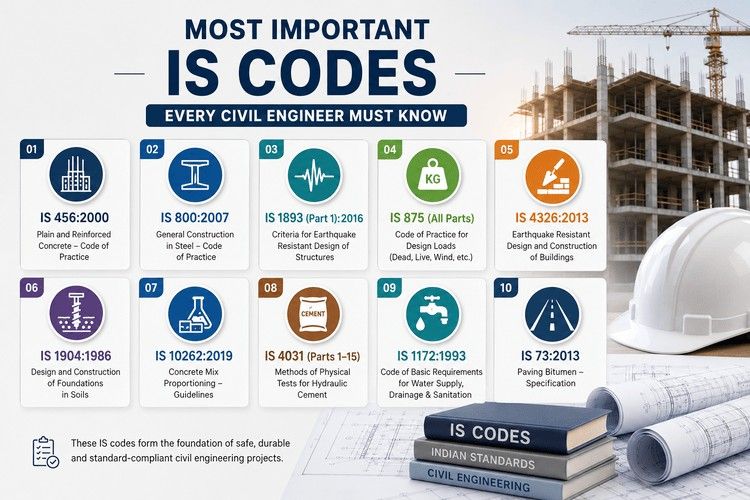
IS code list for civil engineering covers everything from how to test cement to how much wind load to apply to a coastal building to how deep a pile foundation needs to go in different soil types. Below is a comprehensive IS code list for civil engineering, organised by category.
Read More: Best Civil Engineering Course
Learn to apply IS codes in real BIM Civil Engineering projects with Kaarwan’s industry-focused BIM Civil Program designed for students, graduates, and working civil engineers.
IS Codes for Structural Design and Concrete
Structural design is where most civil engineers spend a significant part of their working lives. And the IS codes that govern structural design, for concrete and steel, are the ones every practising engineer needs to know cold. Not just know of. Know.
IS Codes for Concrete
Concrete is the most used construction material in India. And IS codes for concrete are some of the most referenced documents in any structural design office or construction site quality lab.
| IS Code | Title | What it covers | When to use |
| IS 456:2000 | Code of Practice for Plain and Reinforced Concrete | Complete design guidelines for RCC structures, materials, mix, durability, structural design philosophy, and quality control | Every RCC design project has this as the primary code |
| IS 10262:2019 | Concrete Mix Proportioning, Guidelines | Procedure for designing concrete mixes to achieve target strength, workability, and durability | Whenever a concrete mix design needs to be prepared for a project |
| IS 516 (Part 1):2018 | Methods of Tests for Strength of Concrete | Procedures for testing compressive, flexural, and tensile strength of hardened concrete | Quality control on any concrete structure , cube tests, beam tests |
| IS 1199 (Part 1–6) | Methods of Sampling and Analysis of Concrete | Sampling procedures, workability tests , slump, compaction factor, Vee-Bee, flow | Any site where fresh concrete quality needs to be assessed before casting |
| IS 4031 (Parts 1–15) | Methods of Physical Tests for Hydraulic Cement | Testing cement for compressive strength, consistency, setting time, and soundness | Material testing before any concrete construction begins |
| IS 9103:1999 | Specification for Admixtures for Concrete | Standards for chemical admixtures, plasticisers, superplasticisers, retarders, accelerators | When admixtures are being used in a concrete mix design |
| IS 13920:2016 | Ductile Design and Detailing of Reinforced Concrete Structures Subjected to Seismic Forces | Detailing requirements for RCC structures in earthquake zones, beam-column joints, lap splices, and confining reinforcement | Every RCC structure in seismic zones II through V |
| IS 3370 (Parts 1–4) | Code of Practice for Concrete Structures for Storage of Liquids | Design and construction of water tanks, reservoirs, and liquid-retaining structures | Water tanks, overhead reservoirs, underground sumps |
| IS 6452:1989 | Specification for High Alumina Cement for Structural Use | Requirements and testing for high alumina cement used in special structural applications | Special applications, refractory structures, and early-strength requirements |
| IS 8112:2013 | Specification for 43 Grade Ordinary Portland Cement | Requirements for 43 grade OPC , physical and chemical properties | General construction where 43-grade cement is specified |
| IS 12269:2013 | Specification for 53 Grade Ordinary Portland Cement | Requirements for 53 grade OPC | High-strength concrete, prestressed concrete, where high early strength is needed |
| IS 383:2016 | Coarse and Fine Aggregate for Concrete , Specification | Grading, physical, and chemical requirements for aggregates used in concrete | Material selection and testing for all concrete mix designs |
Read More: Best Structural Design Courses for Civil Engineers in India (2026)
IS Codes for Steel Structures
Steel structure design is governed by a separate and equally important set of IS codes. IS 800 is the big one , every structural engineer in India should know it in some depth.
| IS Code | Title | What it covers | When to use |
| IS 800:2007 | General Construction in Steel , Code of Practice | Complete design of steel structures using limit state method , beams, columns, connections, stability | Any steel structure , industrial sheds, trusses, high-rise steel frames |
| IS 1786:2008 | High Strength Deformed Steel Bars and Wires for Concrete Reinforcement | Specifications for Fe415, Fe500, Fe550, Fe600 grade TMT bars | Specifying and testing rebar for all RCC construction |
| IS 2062:2011 | Hot Rolled Medium and High Tensile Structural Steel | Material specifications for structural steel plates, flats, channels, angles | All structural steel fabrication |
| IS 808:1989 | Dimensions for Hot Rolled Steel Beam, Column, Channel and Angle Sections | Standard section dimensions, weights, and properties for rolled steel sections | Structural steel section selection and detailing |
| IS 4923:1997 | Hollow Steel Sections for Structural Use , Specification | Circular, square, and rectangular hollow sections , dimensions and properties | Steel structures using hollow sections , trusses, purlins, industrial frames |
| IS 1161:1998 | Steel Tubes for Structural Purposes | Requirements for welded and seamless steel tubes used in structural applications | Tubular steel structures , scaffolding, handrails, special structural sections |
| IS 3502:2009 | Steel Chequered Plates | Specifications for hot-rolled chequered plate used in flooring and anti-slip applications | Industrial flooring, mezzanine decking, stair treads |
| IS 7215:1974 | Tolerances for Fabrication of Steel Structures | Acceptable tolerances for dimensions and fit-up of fabricated steel members | Quality control during steel structure fabrication |
Master BIM workflows, IS codes, and real project coordination with Kaarwan’s BIM Civil Program built for future-ready civil engineers.
IS Codes for Soil and Foundation
Geotechnical work is where a lot of structural failures originate , not in the building above ground but in the decisions made about what is below it. These IS codes govern soil testing, foundation design, and the interaction between structures and the ground they sit on.
| IS Code | Title | What it covers | When to use |
| IS 1904:1986 | Code of Practice for Design and Construction of Foundations in Soils: General Requirements | Basic principles for foundation design , shallow and deep foundations, general requirements | Starting point for any foundation design |
| IS 2131:1981 | Method for Standard Penetration Test for Soils | Procedure for conducting SPT in boreholes , blow counts, N-values, interpretation | Geotechnical investigation for any structure requiring soil bearing capacity data |
| IS 2720 (Parts 1–41) | Methods of Test for Soils | Comprehensive soil testing , moisture content, grain size, Atterberg limits, compaction, permeability, shear strength, consolidation | Soil testing at different stages of geotechnical investigation |
| IS 6403:1981 | Code of Practice for Determination of Bearing Capacity of Shallow Foundations | Methods for calculating safe bearing capacity of soil under shallow foundations | Foundation design for buildings, structures with spread footings |
| IS 8009 (Parts 1–2) | Code of Practice for Calculation of Settlements of Foundations | Settlement calculation for shallow and deep foundations | Any project where differential settlement is a concern |
| IS 2911 (Parts 1–4) | Code of Practice for Design and Construction of Pile Foundations | Design and construction of driven, bored, and under-reamed piles , all pile types | Any structure on soft, weak, or deep-bearing-stratum soil requiring piles |
| IS 1080:1985 | Code of Practice for Design and Construction of Simple Spread Foundations | Design of simple spread footings , isolated and strip foundations for low-rise structures | Residential and low-rise commercial structures |
| IS 12070:1987 | Code of Practice for Design and Construction of Shallow Foundations on Rocks | Design requirements for foundations bearing directly on rock | Hill infrastructure, rocky terrain structures |
A quick real-world note on IS 2911 , pile foundation design. When the Bandra-Worli Sea Link was being designed in Mumbai, the marine and coastal soil conditions required extremely detailed geotechnical investigation and pile design under this code. The foundation design is often what makes or breaks a structure in challenging conditions, and IS 2911 is the code that governs the most critical foundation system in Indian construction.
IS Codes for Loads and Design Criteria
These are the codes that answer the fundamental question every structural engineer faces: what forces is this structure going to experience, and how do I design for them? Get the load assumptions wrong and everything built on top of them is wrong too.
IS 875 and IS 1893 together form the backbone of all structural load design in India. Every civil engineer , not just structural specialists , should understand what these codes do.
| IS Code | Title | What it covers | When to use |
| IS 875 Part 1:1987 | Code of Practice for Design Loads , Dead Loads | Unit weights of building materials and stored materials for dead load calculation | Dead load calculation for every structure |
| IS 875 Part 2:1987 | Code of Practice for Design Loads , Imposed Loads (Live Loads) | Minimum live loads for floors, roofs, stairs, and structural elements based on occupancy type | Live load assignment for any building design |
| IS 875 Part 3:2015 | Code of Practice for Design Loads , Wind Loads | Wind pressure calculation based on terrain category, building height, location, and shape | Any structure taller than low-rise residential in an exposed location |
| IS 875 Part 5:1987 | Code of Practice for Design Loads , Special Loads and Load Combinations | Loads from temperature, soil pressure, fluid pressure, and load combination factors | When non-standard loads or complex load combinations need to be considered |
| IS 1893 (Part 1):2016 | Criteria for Earthquake Resistant Design of Structures , General Provisions and Buildings | Seismic zone classification, response spectra, design lateral forces, building irregularity checks | Every structure in a seismic zone , essentially all structures in India |
| IS 4326:2013 | Earthquake Resistant Design and Construction of Buildings , Code of Practice | Construction practices and design detailing for earthquake-resistant masonry and RC buildings | All construction in seismic zones III, IV, and V |
| IS 13828:1993 | Improving Earthquake Resistance of Low-Strength Masonry Buildings , Guidelines | Retrofitting and construction guidelines for low-strength masonry structures | Rural construction, heritage structures, low-cost housing in seismic areas |
IS 1893 deserves a specific mention. The 2016 revision updated the seismic zone map and changed several design provisions that had been in place since 2002. Engineers who learned seismic design before 2016 needed to update their practice , and those who have not are still applying outdated zone classifications on live projects. This matters. Seismic design is not academic.
Learn Revit, Navisworks, and BIM-based civil engineering workflows while applying IS codes through practical industry projects at Kaarwan.
IS Codes for Water Supply and Sanitation
Water supply and sanitation engineering has its own set of IS codes that govern everything from pipe specifications to basic per capita water demand calculations. These are essential for civil engineers working on municipal infrastructure, plumbing design, or rural water supply schemes.
| IS Code | Title | What it covers | When to use |
| IS 1172:1993 | Code of Basic Requirements for Water Supply, Drainage and Sanitation | Minimum water requirements per capita for different uses , domestic, commercial, institutional | Water supply system planning and design |
| IS 1726:1991 | Cast Iron Pits for Water and Sewage Purposes | Specifications for cast iron pipes used in water mains and sewage systems | Specifying and testing cast iron pipes in water supply networks |
| IS 458:2003 | Precast Concrete Pipes (with and without Reinforcement) | Requirements for concrete pipes for drainage, culverts, and sewerage | Drainage and sewer line design and material specification |
| IS 3114:1994 | Code of Practice for Laying of Cast Iron Pipes | Installation procedures for cast iron water mains | Water supply main laying and jointing |
| IS 784:2001 | Prestressed Concrete Pipes (including Specials) | Specifications for prestressed concrete pipes used in water transmission | Large diameter water transmission mains |
| IS 2065:1983 | Code of Practice for Water Supply in Buildings | Plumbing design for internal water supply , pipe sizing, pressure requirements, storage | Building plumbing design for residential, commercial, institutional structures |
IS Codes for Road and Highway Design
One thing that confuses students and junior engineers regularly is that road design in India uses both IS codes and IRC codes, and the two are different. IS codes are published by the Bureau of Indian Standards. IRC codes are published by the Indian Roads Congress, a separate technical body specifically for road and bridge standards. Most road design work references IRC more heavily than IS, but there are IS codes for road materials that are important to know.
| IS Code | Title | What it covers | When to use |
| IS 73:2013 | Paving Bitumen , Specification | Viscosity grades of paving bitumen (VG10, VG30, VG40) for road construction | Specifying and testing bitumen for flexible pavement construction |
| IS 217:1988 | Specification for Cutback Bitumen | Requirements for cutback bitumen , grades RC, MC, SC , used in surface dressing and prime coats | Road surface treatment, tack coat, prime coat applications |
| IS 15462:2019 | Polymer and Rubber Modified Bitumen , Specification | Requirements for polymer-modified bitumen used in high-performance pavements | High-traffic roads, expressways, flyover decks |
| IS 5640:1970 | Method of Test for Determination of Aggregate Impact Value of Soft Coarse Aggregates | Testing aggregate resistance to impact , aggregate quality assessment for road construction | Material testing for road base and bituminous layers |
IRC vs IS , the quick distinction: IRC 37 covers flexible pavement design. IRC 58 covers rigid pavement design. IRC 78 covers bridge substructure and foundation. These are the codes you actually use when designing roads and bridges , IS codes for roads cover specific material standards rather than overall design methodology.
Start your BIM Civil Engineering journey with Kaarwan and gain practical skills used by top infrastructure and construction companies in India.
Read More: Types Of Civil Engineering
How to Access IS Codes in India
This is the practically useful bit that most IS code lists skip over entirely.
IS codes are published and sold by the Bureau of Indian Standards. There are a few ways to access them.
The official route is the BIS website, www.bis.gov.in, where you can purchase individual IS codes or subscribe to the BIS e-library for digital access. The e-library gives you searchable PDF access to the codes you need, which is far more practical than carrying physical booklets on site. Individual codes can cost between Rs 100 and Rs 600, depending on the document.
University libraries and engineering college libraries typically hold physical copies of the most frequently used codes , IS 456, IS 800, IS 875, IS 1893, IS 2720 series. Students can usually access these for free through their institution.
Some engineering departments and government agencies maintain internal copies of relevant IS codes for project reference. If you join a consultancy or EPC company, you will usually find that the firm has licensed access to the BIS e-library as a standard resource.
One thing to be careful about , unofficial copies of IS codes circulate on the internet freely. Some of these are outdated versions. IS codes get revised, and using a superseded version on a live project is a real risk. Always verify the year of the edition you are using against the current BIS catalogue. IS 800:2007 superseded IS 800:1984, for instance, and the design approach changed significantly between the two.
Frequently Asked Questions
What are IS codes in civil engineering?
IS codes , Indian Standard Codes , are technical standards published by the Bureau of Indian Standards that govern design, material specifications, testing procedures, and construction practices for civil engineering work in India. They are mandatory reference documents for structural design, foundation design, load calculations, and material quality control.
What is the most important IS code for civil engineering?
Depends on what you are doing, but if pressed for one answer, IS 456:2000 is probably the most universally referenced. It covers the design of plain and reinforced concrete structures, which underpins almost everything built in India. IS 800:2007 is the equivalent for steel structures. IS 1893 is the most critical for seismic design.
Where can I download IS codes for civil engineering?
Officially, IS codes are available for purchase through the BIS website at www.bis.gov.in. The BIS e-library portal (bis.org.in/other/portals.htm) provides digital access. Many engineering colleges have institutional subscriptions. Free PDF copies circulate online, but some are outdated. Always check the publication year and whether the code has been revised before using any copy in design work.
What is IRC code in civil engineering?
IRC codes are published by the Indian Roads Congress, a separate body from BIS, specifically for road and bridge design. IRC 37 covers flexible pavement design, IRC 58 covers rigid pavement design, and IRC 78 covers bridge substructure and foundation. IS codes cover materials and general construction; IRC codes cover road and bridge design methodology.
What is the difference between IS codes and IRC codes?
IS codes are published by the Bureau of Indian Standards and cover a broad range of civil engineering materials, testing, and design across all structure types. IRC codes are published by the Indian Roads Congress specifically for road and bridge engineering. For road pavement design, you use IRC 37 (flexible) or IRC 58 (rigid). For bridge design, IRC 6 (loads), IRC 78 (substructure), and others.
How many IS codes are there for civil engineering?
There are over 20,000 IS codes across all engineering and industrial sectors in India. Of these, the civil engineering division (CED committees) covers several thousand codes across concrete and cement, structural engineering, soil and foundation, water supply, construction practices, and more.