
What are the Different Types of Civil Engineering?
Most people hear "civil engineering" and picture construction sites. Hard hats, concrete, cranes. That's not wrong, but it's maybe 20% of the picture.
Civil engineering is divided into several disciplines, each focusing on a completely different aspect of how infrastructure gets designed, built, and maintained. The eight main civil engineering branches are structural, geotechnical, transportation, environmental, water resources, construction engineering and management, coastal and marine, and urban engineering. Some of these overlap. Most of them interact. But each one is its own world with its own problems to solve, its own tools, its own career trajectory.
And here's the thing about these fields of civil engineering that nobody really tells you early enough: specialising in one branch genuinely changes your career outcomes. Not slightly. Significantly. A civil engineer who goes deep on structural design earns more, gets hired faster, and has clearer career progression than someone who stays a generalist for years. That pattern holds across all the civil engineering disciplines. Employers know what they need. The clearer you are about which direction you're going, the easier it is to get there.
This guide breaks down all eight branches honestly: what the work actually looks like, what it pays, and which type of person tends to do well in each on.
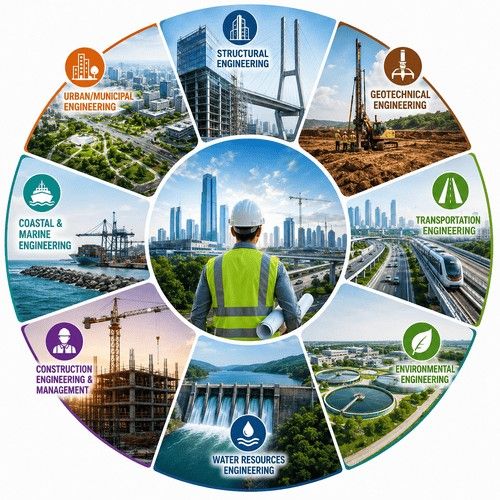
Structural Engineering
Ask any civil engineering student which branch they have heard of most, and structural engineering comes up first. Almost every time. And honestly, the reputation is deserved.
Structural engineering is the discipline that answers one fundamental question before anything else gets built: Will this actually stand up? Structural engineers design and analyse the load-bearing framework of buildings, bridges, dams, metro stations, towers, stadiums, and industrial structures. They figure out how to make a 30-storey tower resist wind loads. How to design a bridge that carries thousands of vehicles daily without failing. How to ensure a building in a seismic zone does not collapse when the ground shakes.
The day-to-day is a mix of software work and coordination. ETABS is the standard for multi-storey building analysis in India, seismic design, shear wall behaviour, flat slabs – all of it. STAAD Pro handles a broader range of structure types, including industrial sheds, water tanks, bridges, and towers. AutoCAD for drawing production. And Revit Structure is increasingly used for BIM-integrated structural modelling on projects that follow international delivery standards.
What makes structural engineering particularly interesting as a career is that you can see the output. The building you designed gets built. That matters to a lot of people, the sense that the work is tangible.
Salary-wise: freshers start at Rs 3.5–5 LPA. Mid-level structural engineers with 5–7 years and real software proficiency reach Rs 8–14 LPA. Senior design leads at established consultancies, Rs 18–22 LPA. Add BIM structural coordination to that skill set, and the numbers go up further.
Read more: Structural design courses for civil engineers
Geotechnical Engineering in Civil Engineering
Geotechnical engineering is defined as the branch of civil engineering concerned with the study of earth materials, soil, rock, and groundwater, and how they behave when structures are built on or into them.
Every structure built on this planet sits on the ground. And the ground is almost never what it looks like from the surface.
Underneath a construction site in Mumbai, there might be soft marine clay that compresses under load and causes uneven settlement. In Bengaluru, the rock is close to the surface but irregular; some columns hit solid granite, others hit weathered material. In the Indo-Gangetic plains, the alluvial deposits are deep and variable. In the Northeast, the seismic conditions mean that soil liquefaction is a real design concern. No two sites are the same. That is what makes geotechnical engineering in civil engineering genuinely interesting and genuinely important.
The work starts before design begins. Geotechnical engineers run site investigations, soil borings, Standard Penetration Tests, and laboratory analysis of samples to build a picture of what the ground is made of and how it will respond to load. From that data, they produce reports that tell the structural engineer what kind of foundation the building needs, whether the slopes are stable, and whether ground improvement is necessary before construction can start.
The scope extends well beyond foundation design. Retaining walls. Slope stabilisation for highway embankments. Tunnel design. Deep excavation support. Ground improvement using stone columns, preloading, or dynamic compaction. Pile design for heavy structures. All geotechnical work.
Industries that hire geotechnical engineers include infrastructure consultancies, construction firms, NHAI, metro rail corporations, dam developers, and international AEC firms.
Key software: PLAXIS for finite element soil-structure analysis, GeoStudio for slope stability and seepage, GEO5 for foundation and retaining structure design.
Salaries: Rs 4–6.5 LPA to start, Rs 10–18 LPA at mid to senior level. Because qualified geotechnical specialists are genuinely scarce relative to demand, this is a branch where deep expertise commands a real premium.
Want to grow in structural, transportation, or construction engineering? Learn BIM workflows, Revit, Civil 3D, and industry-standard tools with Kaarwan’s Professional BIM Certification Program for Civil Engineers.
Transportation Engineering
Drive on any new expressway in India, and there is a moment, usually right when the road curves cleanly into a hill, or the underpass opens up unexpectedly smoothly, where you think, 'Someone planned this really well.'
That someone is a transportation engineer.
Transportation engineering handles how people and goods actually move, roads, highways, metro alignments, airport runways, port access roads, rail corridors, and traffic signal systems. The work starts long before construction does. Traffic studies, demand forecasting, route alignment analysis, geometric design of the road itself, pavement layer design for the specific soil and climate conditions at that location. Then drainage, because a perfectly designed road that floods every monsoon is functionally useless.
Career-wise, this branch is in a genuinely strong position in India in 2026. NHAI has spent more on highway development in the last few years than in the preceding decade combined. Metro corridors are being planned in cities that barely had flyovers ten years ago. The demand for transportation engineers, at government agencies, at design consultancies, and at contractors executing the work, is consistent and real.
Career roles: highway design engineer, traffic engineer, transport planner, rail corridor consultant, infrastructure project manager.
Software: AutoCAD Civil 3D for road design, OpenRoads Designer for BIM-aligned highway projects, VISSIM for traffic simulation. Salaries start around Rs 3.5–5.5 LPA. Experienced transportation engineers on NHAI or metro projects reach Rs 7–12 LPA. Senior consultants at international firms earn Rs 15–22 LPA.
Read More: Top Software Used in Every Civil Engineering Discipline in 2026
Environmental Engineering
Environmental engineering is civil engineering's most quietly urgent discipline.
It covers water treatment, wastewater management, solid waste systems, pollution control, Environmental Impact Assessments, and sustainable construction practices. Not the most glamorous-sounding list. But consider this: no major infrastructure project in India gets environmental clearance without an EIA. Environmental engineers prepare and defend those assessments. They also design the water treatment plants that supply cities with clean drinking water, the sewage treatment plants that process what comes back, and the solid waste systems that deal with what millions of people generate every single day.
The Flint water crisis in the US is the most widely cited example of what happens when environmental engineering is neglected or overridden. A city changed its water source without proper corrosion control treatment, and the result was widespread lead contamination that affected thousands of residents, particularly children, with long-term health consequences. Environmental engineers are the ones who exist precisely to prevent that kind of failure.
In India, the regulatory environment for environmental compliance is tightening. EIA requirements are stricter. LEED and green building certifications are becoming more common conditions on commercial projects. Environmental engineering is a growing field, not just ethically important but also commercially in demand.
Career roles: environmental consultant, EIA specialist, sustainability engineer, water treatment design engineer.
Key software: EPANET for water distribution network modelling, AutoCAD for design documentation. LEED AP certification adds a meaningful salary premium.
Salaries: Rs 3.5–6 LPA at the fresher level. With experience and LEED credentials, Rs 6–11 LPA at mid-level. Specialist environmental consultants with regulatory expertise and international project experience reach Rs 12–20 LPA.
Water Resources Engineering
Water is infrastructure. Not a metaphor, literally. Dams, canals, irrigation networks, flood control systems, water supply pipelines, these are physical structures built by engineers and maintained by governments. Water resources engineering is the discipline that designs and manages all of it.
This branch covers dam design, canal and irrigation system design, flood forecasting and control, hydrological studies, watershed management, and groundwater assessment. The government departments of irrigation and water resources across India's states are among the largest engineering employers in the country, and they hire specifically for this discipline.
The work has a genuine social impact. An irrigation scheme that reliably delivers water to farming communities changes livelihoods. A flood protection embankment that prevents a town from being inundated every monsoon saves lives. There is a satisfaction in that kind of engineering that is different from commercial building design, and many water resources engineers choose this path for exactly that reason.
Key roles: hydrologist, dam design engineer, irrigation consultant, water resources planning engineer.
Software: HEC-RAS for hydraulic modelling of rivers and flood plains, SWMM for stormwater management, GIS tools for watershed mapping and spatial analysis.
Salaries: Rs 3.5–5.5 LPA to start. Experienced water resources engineers reach Rs 7–14 LPA. Dam design specialists and water planning consultants on international projects earn Rs 15–20 LPA.
Construction Engineering and Management
If structural engineers design what gets built, and geotechnical engineers check what it sits on, construction engineering and management is what makes it actually happen.
On time. Within budget. Without injuring anyone. Without the contractor walking off-site because of a payment dispute. Without three different subcontractors showing up at the same section of slab on the same morning. All of that coordination is construction management, and it is significantly harder than it sounds.
Construction managers plan the project, schedule the activities, manage the resources, control the costs, administer the contracts, and make real-time decisions when things go wrong. Things always go wrong. A material delivery is delayed. A monsoon shuts down the site for three weeks. The drawings have a clash that nobody caught in the design. The construction manager is the one who figures out how to recover.
The types of civil engineering jobs in this branch span the full range of seniority more than any other discipline. A site engineer fresh out of college earns Rs 3.5–5 LPA. A planning engineer with 3 years of experience earns Rs 6–8 LPA. A project manager who has delivered a Rs 200 crore hospital complex earns Rs 12–20 LPA. A construction director running a portfolio of infrastructure projects for L&T or Tata Projects can earn Rs 25–45 LPA. The ceiling is genuinely high, and the career progression, for the right person, is faster than almost any other civil engineering career path.
Software: Primavera P6 for schedule management on large projects, MS Project for mid-scale work, and BIM tools increasingly for coordination and 4D construction simulation.
Coastal and Marine Engineering
Niche. Underdiscussed. And, for the engineers who end up here, surprisingly well-paid.
Coastal and marine engineering deals with structures and systems at the meeting point of land and sea. Ports and harbours, jetties, breakwaters, seawalls, coastal erosion protection, offshore platforms, and maritime infrastructure. India has a coastline of over 7,500 km, and port development is a stated priority under multiple national infrastructure programmes. Chennai, Mumbai, Kochi, Vizag, Kandla, all have active port expansion and development happening right now.
The international dimension of this discipline is also worth knowing about. The Middle East, Southeast Asia, and Northern Europe all have significant coastal engineering markets, and the salaries in these markets for experienced engineers are well above what the domestic market offers.
Most coastal engineers enter through geotechnical or structural backgrounds and move into this specialisation through project exposure or postgraduate study. It is a smaller community than other civil engineering branches, which means less competition for the senior roles.
Salaries in India for experienced coastal engineers: Rs 10–20 LPA. International coastal engineering roles: Rs 25–40 LPA equivalent.
Read More: Jobs after Civil Engineering.
Choosing a civil engineering specialisation is easier when you also build practical BIM skills. Join Kaarwan’s Professional BIM Certification Program for Civil Engineers and become industry-ready for modern infrastructure projects.
Which Type of Civil Engineering is Right for Your Career?
Genuinely, there is no single best branch. The right one is the one whose problems you find interesting on a bad day, not just a good one. That said, here is a clear comparison across all 8 civil engineering disciplines so you have the data to make an informed decision.
| Branch | Avg Salary India (₹ LPA) | Demand Level | Best Software to Learn | Best For |
| Structural Engineering | 3.5–22+ | Very High | ETABS, STAAD Pro, Revit Structure | Analytical thinkers who like design, calculation, and visible outcomes |
| Geotechnical Engineering | 4–18 | High | PLAXIS, GeoStudio, GEO5 | Engineers interested in soil science, fieldwork, and investigative problems |
| Transportation Engineering | 3.5–22 | Very High | Civil 3D, OpenRoads, VISSIM | Those drawn to large infrastructure and government sector work |
| Environmental Engineering | 3.5–20 | Growing Fast | EPANET, AutoCAD | Engineers who want technically rigorous work with clear public impact |
| Water Resources Engineering | 3.5–20 | Steady | HEC-RAS, SWMM, GIS | Engineers interested in hydrology, irrigation, and government sector stability |
| Construction Engineering and Management | 3.5–45 | Very High | Primavera P6, MS Project, Revit | People who thrive on leadership, problem-solving, and fast career progression |
| Coastal and Marine Engineering | 10–40 | Niche but High | AutoCAD, hydraulic modelling tools | Engineers targeting international and port-sector roles |
| Urban/Municipal Engineering | 3.5–18 | Growing | GIS, AutoCAD | Engineers interested in smart city planning and urban infrastructure |
One thing worth stating clearly, regardless of which civil engineering branch you choose, BIM skills are now required across structural, geotechnical, transportation, and construction disciplines. The market has moved. Engineers who combine discipline-specific expertise with BIM coordination capability consistently earn more and access better projects. That is not a trend anymore. It is the baseline expectation for serious projects.
Frequently Asked Questions
What are the main types of civil engineering?
Civil engineering splits into eight primary disciplines – structural, geotechnical, transportation, environmental, water resources, construction engineering and management, coastal and marine, and urban engineering. Most civil engineering degrees give exposure to all of them at some level.
Which type of civil engineering has the highest salary in India?
Construction engineering and management has the highest salary ceiling at the senior project director level , Rs 25–45 LPA for large infrastructure delivery. For the first decade of a career, structural engineering and BIM-integrated roles offer the fastest salary growth. Coastal and marine engineering has the highest salary potential for those targeting international roles.
What is geotechnical engineering in civil engineering?
Geotechnical engineering is defined as the branch of civil engineering that studies soil, rock, and groundwater behaviour and their interaction with engineering structures. Geotechnical engineers investigate sites before construction begins, design foundations, assess slope stability, and produce reports that every other discipline on a project depends on. In India, qualified geotechnical specialists are genuinely scarce relative to demand, which makes this a branch where deep expertise pays well.
Which civil engineering discipline is best for government jobs?
Transportation engineering and water resources engineering have the most government job openings in India. NHAI, state PWDs, BRO, CPWD, and Indian Railways hire transportation engineers regularly through GATE and direct recruitment. State irrigation departments, CWC, and NWDA hire water resources engineers.
What software do civil engineers use across different disciplines?
It varies significantly by branch. Structural engineers use ETABS, STAAD Pro, and Revit Structure. Geotechnical engineers use PLAXIS, GeoStudio, and GEO5. Transportation engineers use AutoCAD Civil 3D, OpenRoads Designer, and VISSIM. Environmental engineers use EPANET and AutoCAD.