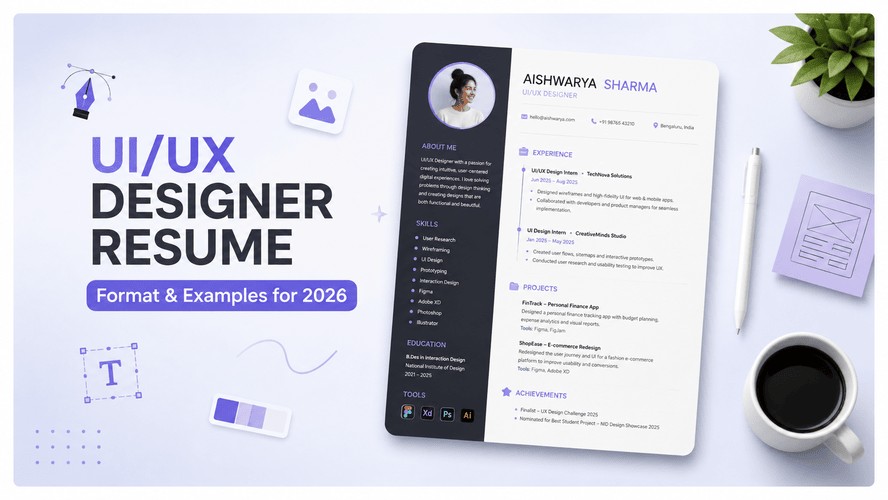
So you've been grinding through Figma files, sitting through user interviews, maybe even lost a little sleep over a prototype that just wouldn't behave. And now you're staring at a blank resume, wondering how on earth you fit all of that into one page without it sounding like a shopping list of tools.
Here's the thing nobody tells you upfront: a UI/UX designer resume doesn't work like a resume for most other jobs. Recruiters hiring for design roles genuinely check your portfolio before they read your bullet points. Sometimes they don't even open the resume at all until the portfolio's convinced them you're worth a closer look. Which means your resume has a slightly different job to do - it needs to get someone to click that link, not just list what you know.
We've reviewed a fair number of resumes from students and early-career designers coming out of design programs in India, and honestly, the same few mistakes show up again and again. Tool lists with no outcomes attached. Portfolio links buried at the bottom in tiny grey text. Zero mention of the actual thinking behind a project. Let's fix all of that.
Also Read : Best UI/UX Design Courses in India (2026): Comparison Guide
What Makes a UI/UX Resume Different From Other Design Resumes
Quick gut check before we get into formatting: if you're applying for a graphic design or interior design role, your resume mostly needs to prove you can execute - good taste, clean visuals, maybe a client list. UI/UX hiring works differently, and it's worth sitting with that difference for a second.
A hiring manager scanning your ui ux designer resume wants to know if you can think in systems. Can you take a vague, messy user problem and actually get somewhere with it? Your resume is proof of employability on paper, sure, but your portfolio is proof of process. And in UX hiring specifically, process is the whole game.
That's why, more than any other design field, UX recruiters read the portfolio first and treat the resume as a supporting document. So don't try to cram every detail of your design process into your resume bullets - that's what the case studies are for. Your resume's job is to get someone curious enough to click through and see the work. If you're still figuring out how to build that portfolio in the first place, this piece on how to build a UI/UX portfolio is a good place to start before you even touch your resume.
Still building your case studies? Kaarwan's Advanced UI/UX Design Course helps you design real projects that turn your resume and portfolio into an actual hiring advantage.
UI/UX Designer Resume Format (Section by Section)
There's no single "correct" template floating around out there, whatever some websites might claim. But there is a structure that consistently works because it mirrors how a recruiter's eyes actually move down the page.
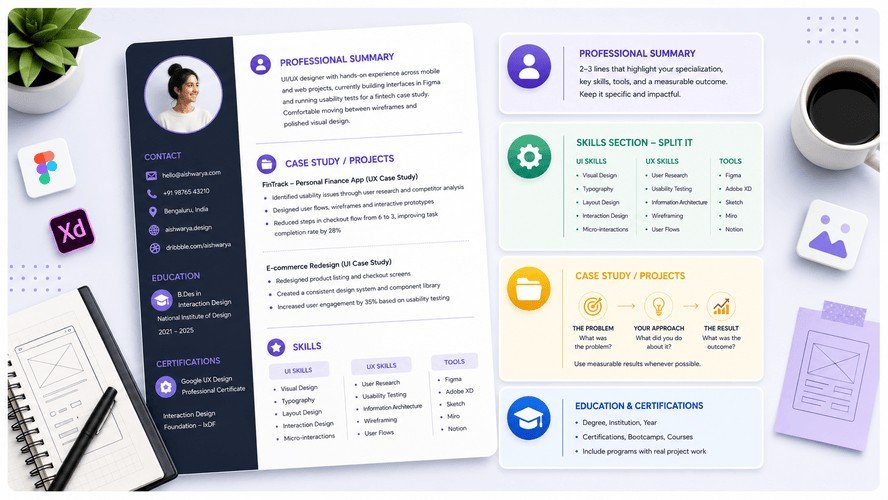
Professional summary
Two to three lines, max. This isn't the place to write "passionate UI/UX designer who loves creating beautiful interfaces" - every third resume says that, and it means nothing. Instead, name your specialization (visual-heavy UI, research-heavy UX, or genuinely both), mention your tools, and if you have even one measurable outcome, drop it in.
Something like: "UI/UX designer with hands-on experience across mobile and web projects, currently building interfaces in Figma and running usability tests for a fintech case study. Comfortable moving between wireframes and polished visual design."
Not flashy. Just specific enough that it doesn't sound like it was copy-pasted from a template site.
Skills section - split it, don't dump it
This is where a lot of ui ux design resume drafts fall apart. People just throw every tool and buzzword they've ever encountered into one giant blob. Split it into three buckets instead:
- UI skills - visual design, typography, layout, interaction design, micro-interactions
- UX skills - user research, usability testing, information architecture, wireframing, user flows
- Tools - Figma (still the default across Indian hiring, for what it's worth), Adobe XD, and anything else you're genuinely comfortable in
Splitting it this way does two things. It shows the recruiter you understand the difference between UI and UX in the first place (you'd be surprised how many resumes don't demonstrate this), and it makes the section instantly scannable.
Case study / project section
If you've got real work experience, this can live inside your Experience section. If you're a student or fresher, this basically becomes your main event - treat your coursework and personal projects with the same seriousness you'd give a paid job. More on that in a second.
For each project, aim for: what the problem was, what you did about it, and what happened as a result. Even a soft result - "reduced steps in the checkout flow from 6 to 3" - beats a vague line like "designed checkout flow." If you want to get sharper at articulating this kind of narrative, writing stronger UX case studies is worth a read - the same storytelling logic applies to your resume bullets, just compressed.
Education and certifications
Keep this simple: degree, institution, year. If you've done a certification course - a UX bootcamp, a UI/UX design certification, anything structured - list it here too, especially if you're early in your career and don't have a design degree to lean on. Recruiters in India do notice certifications, particularly when they come with a portfolio of real project work attached, which is usually the case with structured programs.
UI/UX Designer Resume for Freshers (No Experience)
Okay, this is probably why a lot of you clicked on this in the first place. Let's talk about it honestly.
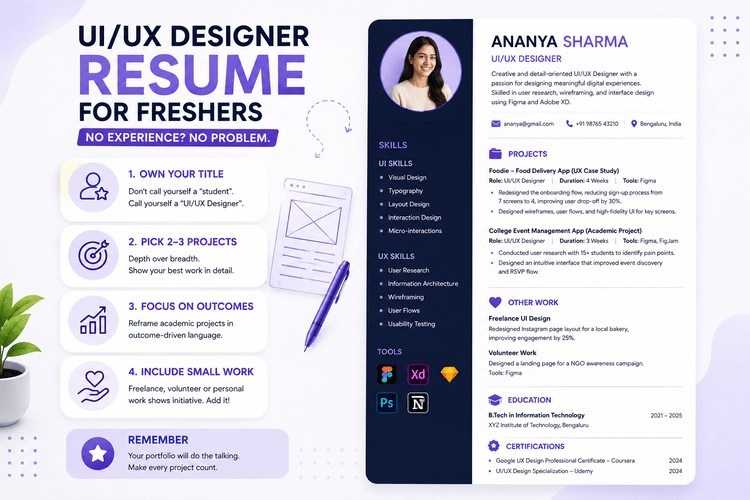
If you don't have paid work experience, don't panic and don't pad your resume with irrelevant part-time jobs just to fill space. What you actually need to do is present your coursework, capstone projects, and personal projects as real, professional-grade work. Because - and this matters - that's exactly how they'll be judged anyway, once someone opens your portfolio.
A few things that genuinely move the needle for a ui ux designer resume for freshers:
- Don't call yourself a "student" in your headline. Call yourself a "UI/UX Designer." You did the work; own the title.
- Pick 2-3 projects, not seven. Depth over breadth, every time. A recruiter would rather see one project explained properly than five explained in a single line each.
- If your project was academic (a college assignment, say), reframe it in outcome language anyway. "Designed a food delivery app UI as a course project" is fine, but "Redesigned the onboarding flow for a food delivery app concept, cutting the sign-up process from 7 screens to 4" tells a story.
- Mention any tools-based freelance or volunteer work, even small stuff. Redesigned a friend's small business Instagram page layout? Helped a local NGO with a basic landing page? That counts. It shows initiative, and initiative is basically the only currency freshers have.
If you're still building out your skill set before you even get to the resume stage, it might help to look at what a structured UI/UX design course actually covers - sometimes the resume problem is really a "I need more real projects" problem in disguise.
How to Link Your Portfolio the Right Way
We're giving this its own section because, honestly, it's the single biggest thing separating a UI/UX resume from every other kind of design resume out there. Get this wrong and it doesn't matter how good your bullet points are.
A few ground rules:
Put it near your name, not buried at the bottom. Right under your contact details, alongside your email and LinkedIn. Not in a footer. Not in tiny 8pt font. It should be one of the first three things anyone sees.
Use a clean, working hyperlink. Sounds obvious, but broken portfolio links are shockingly common - people change hosting providers or rename Behance projects and forget to update the resume. Test it. Click it yourself right before you send the application.
Don't just link your homepage. If you can, link directly to your best 2-3 case studies, or at least make sure your homepage makes it dead easy to find them in one click. Nobody's digging through six tabs to find your actual work.
Consider a QR code only if you're printing your resume (for a portfolio review day or a design fair, say). For anything digital, a plain hyperlink does the job - no need to get fancy.
Keep your portfolio link consistent everywhere. Resume, LinkedIn, email signature - same link, always updated. It's a small thing that quietly signals you're organised, which, for a UX role, is not nothing.
Common Mistakes on UI/UX Resumes
A few patterns we keep running into, in no particular order:
- Listing tools without outcomes. "Proficient in Figma" tells nobody anything. What did you make in Figma, and what happened because of it?
- No metrics at all, anywhere. Even soft, honest estimates ("reduced form fields from 12 to 7," "tested with 8 users across 2 rounds") do more work than adjectives like "seamless" or "intuitive."
- A dead or missing portfolio link. Covered above, but it bears repeating because it's genuinely the most common self-sabotage move.
- Trying to explain your entire design process in the resume. That's your portfolio's job. Your resume should tease it, not replicate it.
- Overdesigned resumes that ATS software can't parse. Yes, you're a designer and yes, your resume should look decent - but a heavily graphic, multi-column resume can get mangled by applicant tracking systems before a human even sees it. Clean, simple, one column, readable fonts. Save the visual flexing for your portfolio.
- Using the exact same resume for every application. If a job description specifically mentions "usability testing" or "design systems," and you've got that experience, make sure those exact phrases show up somewhere in your resume too.
Want a resume recruiters actually click through? Kaarwan's Advanced UI/UX Design Course pairs mentorship with live projects so your portfolio backs up every line you write.
Key Takeaways
A strong user experience designer resume isn't about cramming in every skill you've ever touched - it's about being specific, being honest about your level, and making sure your portfolio link is doing the heavy lifting it's supposed to do. Freshers especially: don't undersell your coursework. Treat it like real work, because to a recruiter reading your case studies, it is.
And your resume doesn't have to do all the work alone. Once you know roughly what companies are paying for the role you're targeting - worth checking our breakdown of UI/UX designer salary in India before you start negotiating - you can pitch your experience at the right level instead of underselling yourself. And once your resume gets you in the door, it's worth prepping with a look at common UI/UX interview questions, since a lot of them circle back to the exact projects you've just listed here.
Get the structure right, keep your bullet points outcome-focused, and let your portfolio finish the conversation your resume starts.