
Types of Door Opening Mechanisms
Door opening mechanisms are more than just functional details—they directly influence circulation, spatial efficiency, user comfort, and visual character within a built environment. The way a door opens determines how furniture is arranged, how spaces connect, and how movement flows through interiors. From conventional hinged systems to space-saving sliding and concealed pocket solutions, each mechanism comes with its own clearance requirements, structural logic, and design expression. For architects and interior designers, selecting the right door mechanism is a strategic decision that balances usability, aesthetics, and spatial constraints.
Hinged Door
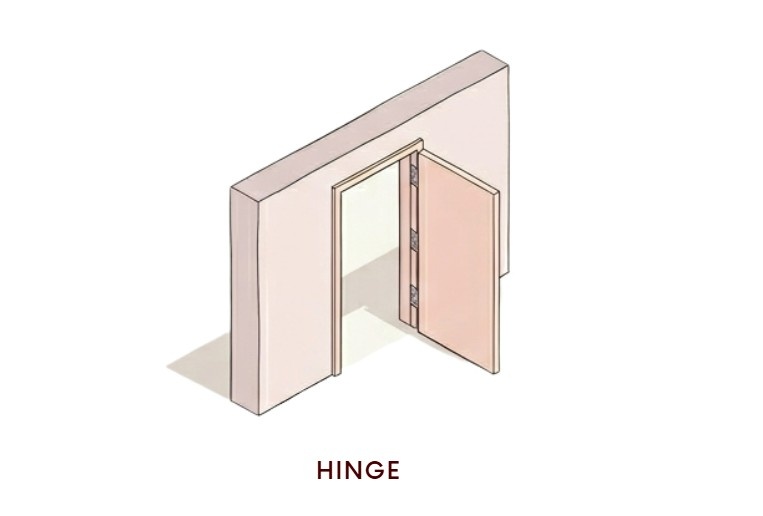
The hinged door is the most traditional and widely used mechanism, consisting of a single shutter fixed to the frame with side-mounted hinges that allow it to rotate along a vertical axis. Its working is straightforward, with the door swinging inward or outward based on hinge placement and design intent. Architecturally, hinged doors require clear swing space equal to the width of the door leaf, which directly impacts furniture layout and circulation zones. Despite this spatial demand, they offer excellent sealing, acoustic control, and privacy, making them ideal for bedrooms, offices, and enclosed rooms. Structurally, hinged systems are simple, cost-effective, and easy to install, with minimal hardware complexity. In terms of design, they can range from minimal flush shutters to highly detailed panelled or solid wood doors, fitting into both modern and traditional aesthetics. However, in compact layouts, their swing clearance can become a limitation.
Sliding Door
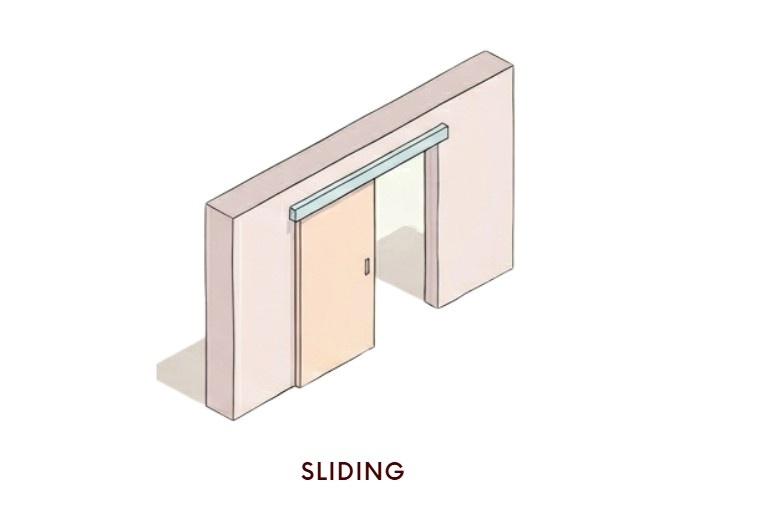
Sliding doors operate by moving horizontally along a track, typically mounted at the top, with the barn-style variant featuring an exposed track and visible hardware that becomes part of the design language. The door panel glides parallel to the wall, eliminating the need for swing clearance but requiring adequate wall length for the panel to slide across. Architecturally, this makes them highly efficient in tight or space-constrained layouts, while also enabling flexible partitioning between spaces. The barn-style system, in particular, introduces a rustic or industrial aesthetic, with metal tracks and rollers adding visual character. However, since the door does not seal tightly against the frame, it offers reduced acoustic and visual privacy compared to hinged systems. These doors are commonly used in bedrooms, studio apartments, cafés, and adaptive reuse spaces where both functionality and design expression are important.
Pivot Door
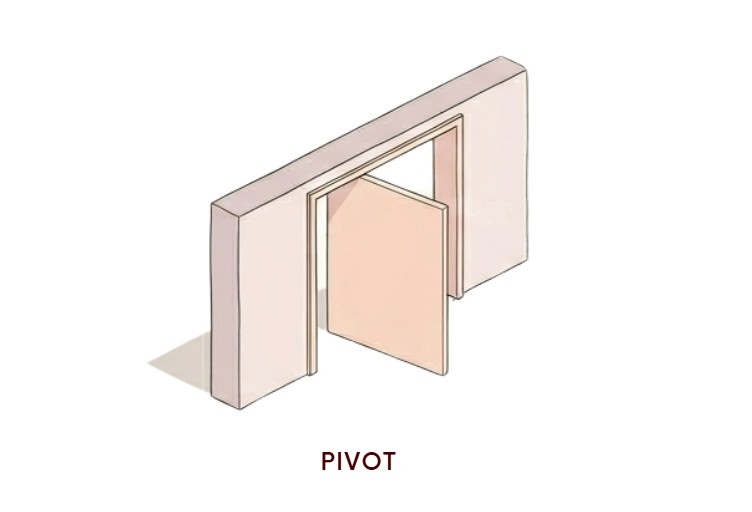
Pivot doors rotate on a pivot hinge system located at the top and bottom of the door, typically offset from the edge rather than aligned with it. This creates a distinct opening motion where the door swings on a central or offset axis, often resulting in a more fluid and balanced movement. Architecturally, pivot doors can accommodate larger and heavier panels, making them ideal for grand entrances and statement openings. They require clearance on both sides of the pivot axis, which must be carefully planned within the layout. Structurally, the load is transferred through the pivot hardware to the floor and lintel, allowing for slimmer frames and cleaner detailing. In terms of design, pivot doors are associated with modern, high-end architecture, often used in luxury residences, galleries, and commercial lobbies. Their ability to create a dramatic entry sequence makes them a strong visual feature, though they require precise installation and higher cost investment.
Bi-fold Door
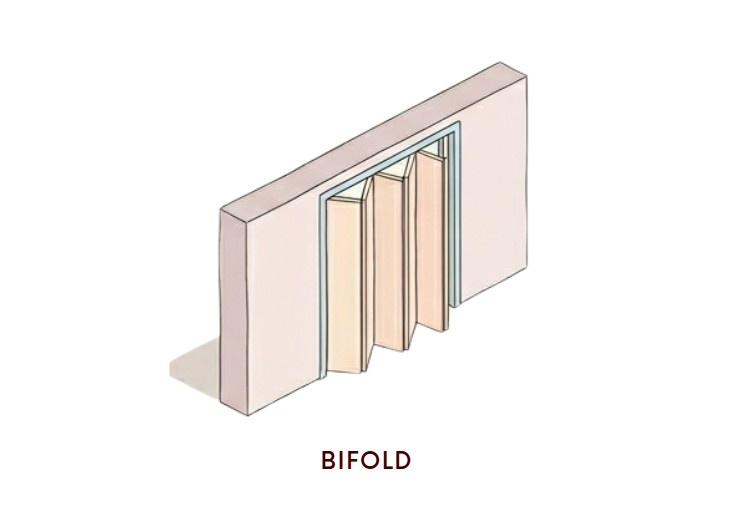
Bi-fold doors consist of multiple panels connected by hinges that fold and stack to one or both sides of the opening. The mechanism runs along a track, allowing the panels to collapse in a concertina-like motion. Architecturally, this system is highly effective for opening up large spans, creating seamless transitions between indoor and outdoor spaces. Unlike sliding doors, bi-fold systems can fully clear the opening, maximizing accessibility and visual connection. However, they require stacking space at the ends, which must be accounted for in design. In terms of performance, they provide moderate sealing but may have more joints and moving parts, requiring careful detailing and maintenance. Bi-fold doors are widely used in villas, patios, cafés, and commercial spaces, where flexibility and openness are key. Visually, they contribute to a dynamic façade or interior edge, often paired with glass panels for transparency.
Pocket Door
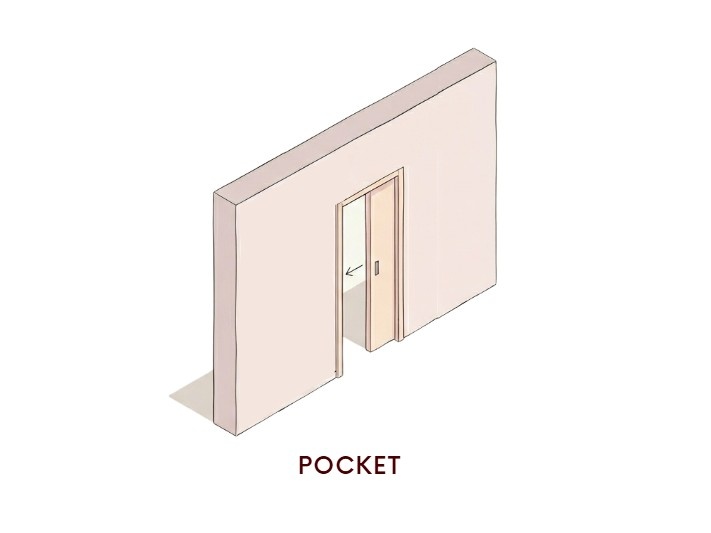
Pocket doors are a highly space-efficient solution where the door panel slides into a concealed cavity within the wall thickness. The mechanism involves a track system integrated the wall, allowing the door to completely disappear when open. Architecturally, this eliminates both swing clearance and visible stacking, making it ideal for compact layouts and minimal interiors. Pocket doors require careful planning during construction, as the wall must accommodate the cavity and structural adjustments. While they maximize usable space and create a clean, uncluttered look, they may offer slightly reduced acoustic insulation compared to solid hinged doors. These systems are commonly used in bathrooms, wardrobes, studio apartments, and partition walls, where spatial efficiency is critical. In terms of design, pocket doors align with minimalist and contemporary aesthetics, emphasizing seamless transitions and hidden elements.
Door opening mechanisms play a crucial role in shaping how spaces are experienced and used.
Conclusion
Each type—hinged, sliding, pivot, bi-fold, and pocket—offers a unique balance of space efficiency, functionality, and design expression. While hinged doors remain reliable and versatile, sliding and pocket systems optimize compact layouts, and pivot and bi-fold doors elevate spatial drama and flexibility. The right choice depends on context, available space, user needs, and design intent, making door mechanisms an essential consideration in both architectural and interior design decisions.
These were some insights on Types of Door Opening Mechanisms. Stay tuned for more information on other significant topics in the AEC industry and follow Kaarwan for such detailed guides!
FAQs
1. Which door mechanism is best for small spaces?
Pocket and sliding doors are ideal as they eliminate swing clearance and save space.
2. Are barn-style sliding doors good for privacy?
They provide limited privacy due to gaps and lack of tight sealing.
3. Why are pivot doors used in luxury projects?
They support large, heavy panels and create a strong visual statement.
4. Do bi-fold doors require more maintenance?
Yes, due to multiple panels and moving joints, they need regular maintenance.
5. Can pocket doors be added later in existing walls?
It is possible but requires significant wall modification and structural adjustments.