Bamboo is gaining recognition as a resilient, eco-friendly, and versatile construction material. Its high tensile strength, rapid renewability, and aesthetic warmth make it an ideal alternative to conventional steel and timber. However, working with bamboo requires specialised joinery techniques that respect its unique anatomical structure.
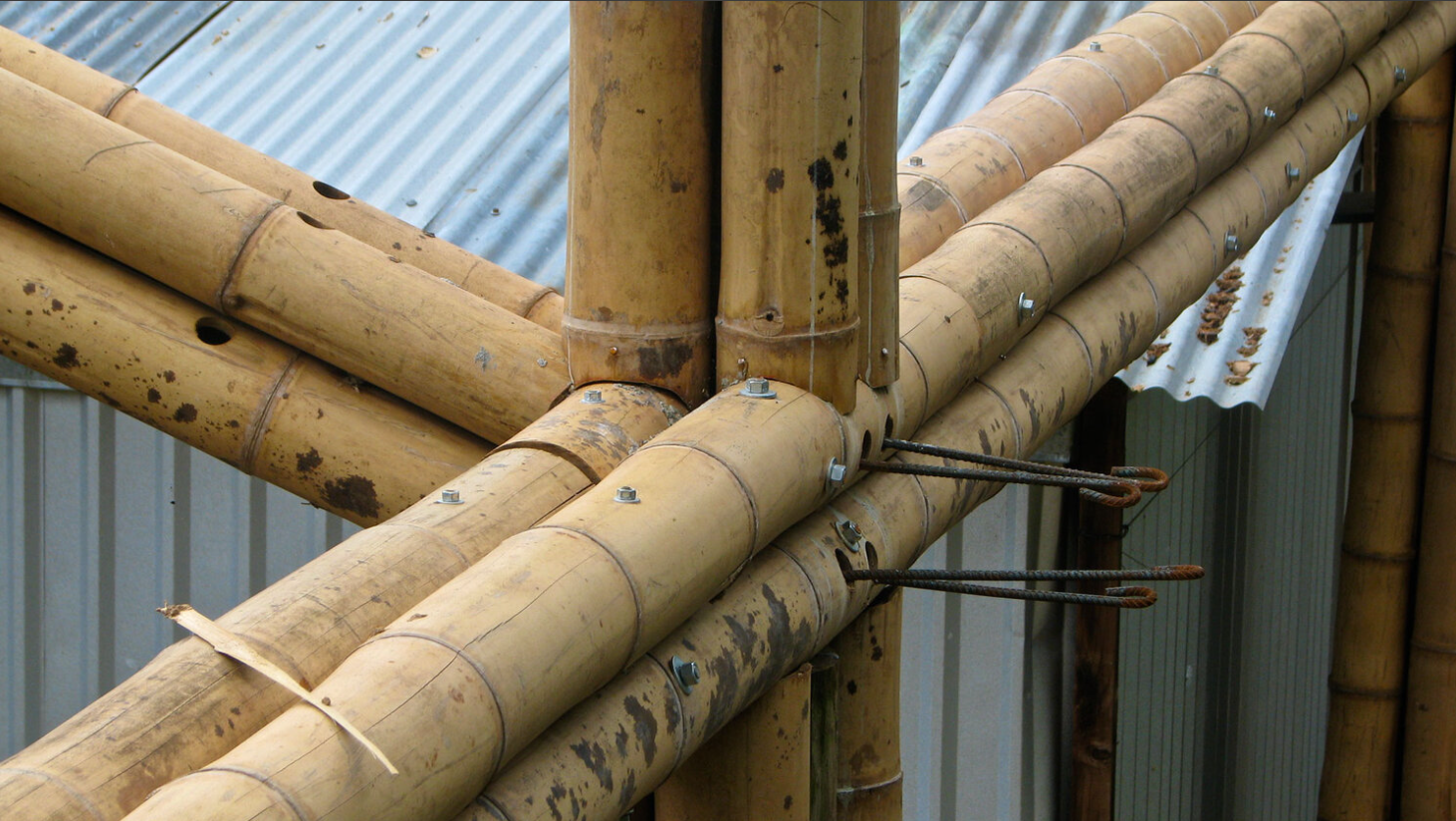
Image Credits: Guaduabamboo.com
Bamboo joinery relies on careful notching, doweling, binding, and strategic mechanical fastening. Let’s explore six essential types of bamboo joints that architects and builders use to craft stable and beautiful bamboo structures, from roofs to walls, columns to domes.
1. Splice Joint:
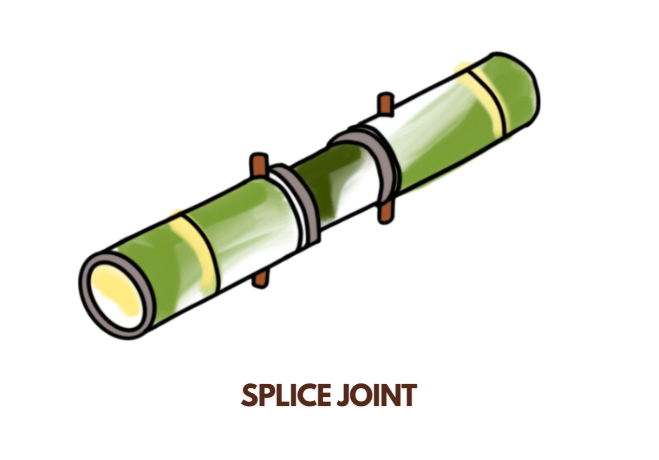
Image Credits: Shivani Chougula @Kaarwan
The splice joint is one of the most commonly used techniques to extend the length of bamboo members, especially in columns, rafters, and beams. In this method, two bamboo segments are aligned end-to-end and connected using wooden dowels or metal rods inserted transversely through the culms. This reinforces the joint longitudinally while maintaining visual continuity. Proper alignment is crucial to prevent uneven load transfer. The splice joint is typically reinforced with natural fibre binding or resin adhesives for added durability. Though simple, this joint is structurally sound for vertical loads and widely used in load-bearing columns or long rafter spans in pitched roofs.
2. Through Joint:

Image Credits: Shivani Chougula @Kaarwan
A through joint is a perpendicular cross joint used at junctions of beams and columns. It involves boring a hole through the vertical bamboo column, into which a horizontal member is passed. The two intersecting members are then bound together using natural fibre rope, vines, or rattan. This joint is excellent for lightweight roof structures and lattice frameworks. Its strength depends on the precision of the hole cut and the tightness of the binding. Through joints allow for efficient load transfer and create visually expressive intersections in open pavilions, verandahs, and skeletal bamboo shelters.
3. Angular Joint:
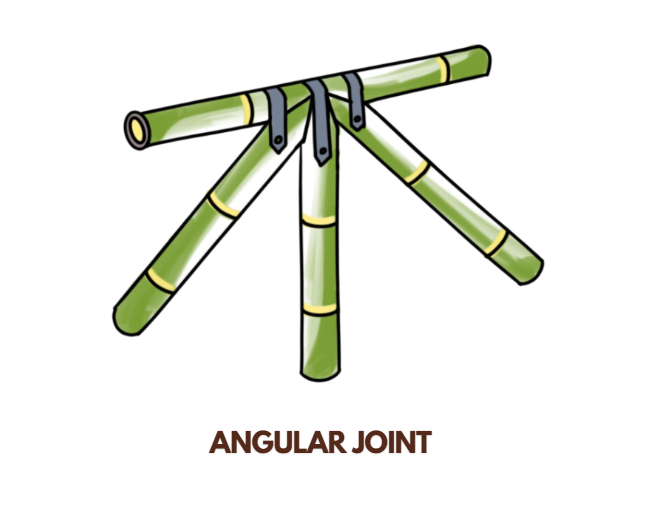
Image Credits: Shivani Chougula @Kaarwan
Angular joints are employed where multiple bamboo members converge at a non-orthogonal angle, making them ideal for roof trusses, rafters, and bracing systems. The connection typically uses metal strap bindings, which wrap around the meeting ends to hold them tightly in place. Sometimes, pre-fabricated plates or notched seatings are introduced for better grip and load distribution. Angular joints are structurally demanding, as they resist not just axial compression but lateral forces as well. They are often seen in A-frame roofs, lean-to structures, and dynamic pavilions with sloping elements. Their strength and adaptability make them fundamental in bamboo roof geometry.
4. Orthogonal Joint:

Image Credits: Shivani Chougula @Kaarwan
This joint connects bamboo members at right angles, most commonly for framing and non-load-bearing partitions. A horizontal member is typically notched or strapped onto a vertical one using metal bands or wire ties. Since it’s not designed to bear heavy loads, the orthogonal joint is mainly used in panel frameworks, wall partitions, or shelving systems within bamboo interiors. The simplicity of the joint allows for quick assembly and disassembly, making it ideal for temporary or modular bamboo installations. Careful alignment is key to ensuring a clean, flush appearance in exposed frameworks.
5. Bundle Joint:

Image Credits: Shivani Chougula @Kaarwan
The bundle joint comes into play when multiple bamboo poles need to be grouped into a single strong column. This is common in bamboo buildings that require thicker structural members without using oversized individual poles. The culms are arranged closely in a circular or triangular pattern and secured with tightly bound wedges and rope or metal bands to avoid deformation. The bundle increases the overall compressive strength and resistance to buckling, making it highly effective in load-bearing columns, especially in large halls, canopy structures, and multistory bamboo towers. It combines elegance with structural robustness.
6. Multiangular Joint:

Image Credits: Shivani Chougula @Kaarwan
The multiangular joint is used in complex frameworks like geodesic domes, star-shaped pavilions, or radial trusses, where multiple bamboo members need to meet at a central hub. It involves custom-fabricated metal plates with bolts, which hold several bamboo poles radiating outward in a precise geometry. This joint demands high craftsmanship and careful planning as it bears multidirectional stresses and requires exact angular calibration. Though more technical and labor-intensive, multiangular joints enable large-span architectural feats and are widely used in event spaces, gazebos, and experimental bamboo structures requiring spatial complexity and dynamism.
Conclusion:
Mastering bamboo joinery is essential for translating this sustainable material into structurally sound and aesthetically expressive architecture. Each type of joint—from the humble splice to the intricate multiangular—serves a unique function dictated by geometry, load paths, and design intent. Understanding these joint types not only enhances structural performance but also deepens appreciation for the craftsmanship and logic embedded in vernacular bamboo construction.
As bamboo continues to shape the future of eco-architecture, intelligent joinery will remain at its core. If you’re excited to apply this craftsmanship in your studio work, explore courses that help you document, detail, and present your ideas professionally, through:
Explore Kaarwan’s practical design courses:
- Advanced Rhino & Grasshopper Certification with Job Support Program or 1-Day Masterclass on Computational Design
- Advanced SketchUp Modelling with Lumion Visualisation
- Visualisation & Rendering Course or 2-Day Masterclass on V-Ray
- Professional Revit & BIM Certification Program or 1-Day Masterclass on BIM
- Professional BIM Certification Program for Civil Engineers
At Kaarwan, we aim to empower design professionals to enhance their skill set, honour material intelligence, and confidently build their space in the evolving world of architecture.