Every thesis-topic list out there does the same thing: gives you a typology, housing, heritage, health infrastructure, and leaves you to figure out where. Which sounds fine until you're three weeks into "informal settlement upgrading" with no actual settlement you can visit, measure, or talk to anyone about.
This list works backward from that problem. Instead of starting with a typology and hoping a site turns up, it starts with eight real Indian cities and the specific, visitable conditions inside them worth building a thesis around.
Why Site Access Should Drive Your Thesis Topic, Not Just Interest
Here's the thing nobody says loudly enough during topic selection season: a brilliant concept with an imaginary or inaccessible site produces a weak viva, every time. You can't really defend design decisions for a place you've only seen on Google Earth. Jurors notice. They ask the follow-up question about foot traffic patterns or seasonal flooding or how residents actually use that courtyard, and if you can't answer from something you observed firsthand, the whole presentation feels thinner than it should.
This isn't a new idea, it's baked into how good thesis guidance already works. Can it be contextualised? Can you anchor it to a specific site, city, or community? That question matters more than almost anything else on a topic shortlist. Site access isn't a box to check after you've picked something exciting, it's one of the first filters, right alongside genuine personal interest and whether a mentor with real expertise is available to guide you.
The cities below aren't random. Each one carries a specific, well-documented urban condition, mill land, riverfront, heritage core, transit corridor, that gives you both a real place to stand in and a body of existing data (municipal records, heritage listings, transit authority reports) to actually build a literature review around.
Mumbai
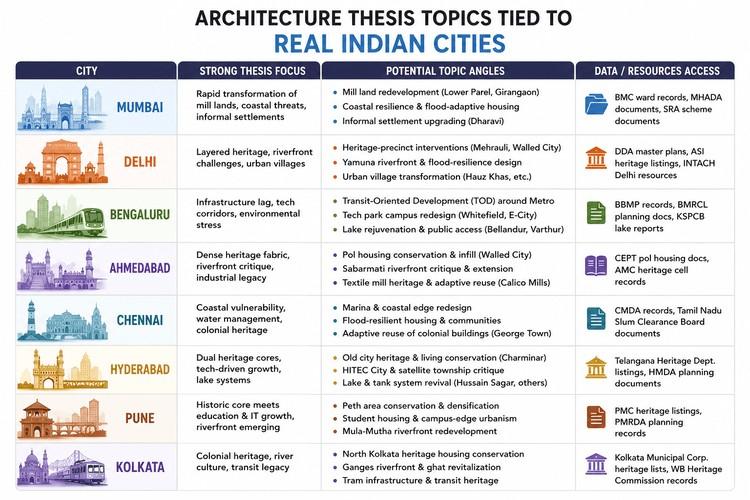
Mumbai's thesis material comes from land that used to be something else and is now fighting over what it becomes next.
Mill land redevelopment in Lower Parel and Girangaon is still, genuinely, one of the richest thesis territories in the city. Dozens of former textile mills sit mid-transition, some converted into malls and office towers, some derelict, some caught in litigation. A thesis here can dig into adaptive reuse, worker housing displacement, or how a single mill compound could be redesigned as genuinely public space instead of another glass tower.
Coastal resilience housing is increasingly urgent given Mumbai's flooding patterns, and there's real municipal flood-zone data available through BMC records to ground a design proposal in.
Informal settlement upgrading, Dharavi specifically, remains heavily studied but for good reason, the in-situ redevelopment debate is live, contested, and full of primary source material if you're willing to do the fieldwork rather than just cite older papers.
Site data access: BMC ward office records, MHADA documentation on mill land, and Slum Rehabilitation Authority (SRA) scheme documents are publicly available starting points.
Also Read: Architecture Portfolio Building Tips for Students
Delhi
Delhi's strength as a thesis city is the sheer density of layered history sitting inside a functioning, modern capital.
Heritage-precinct interventions around Mehrauli or the walled city (Shahjahanabad) let you work with ASI-protected structures alongside living, occupied neighborhoods, a genuinely tricky and rewarding design problem: how do you intervene respectfully in a place that's simultaneously a monument and someone's home?
Yamuna riverfront and flood-resilience design has become a hot, urgent topic given recent flood events, and there's a growing body of NGT and DDA documentation to work from.
Urban village transformation (like Hauz Khas Village or similar urban villages absorbed into the city) offers a distinct thesis angle, informal growth patterns colliding with formal city planning, and a lot of walkable, observable material.
Site data access: Delhi Development Authority (DDA) master plan documents, ASI heritage listings, and INTACH Delhi Chapter resources.
Bengaluru
Bengaluru's thesis material is almost entirely about a city that grew faster than its infrastructure could keep up.
Transit-Oriented Development (TOD) around Metro stations is a strong, well-precedented thesis direction here, Bengaluru's ongoing Metro expansion creates genuinely current, live case study opportunities rather than hypothetical ones.
Tech park campus redesign, rethinking the isolated, car-dependent IT campus model that dominates Whitefield and Electronic City, is underexplored territory with real relevance to how the city's biggest employment centers actually function.
Lake rejuvenation and public access is a rich, specific Bengaluru topic, the city's disappearing and encroached-upon lakes (Bellandur, Varthur) offer both an environmental thesis angle and genuine site access for observation and community interviews.
Site data access: BBMP records, BMRCL (Metro) planning documents, and Karnataka State Pollution Control Board lake status reports.
Ahmedabad
Ahmedabad rewards thesis students who want to work with genuinely dense heritage fabric rather than isolated monuments.
Pol housing conservation and infill inside the walled city is a mature, well-documented thesis territory, INTACH and CEPT have produced substantial groundwork here, giving you a real academic foundation to build on rather than starting from zero.
Sabarmati riverfront critique and extension, the existing riverfront development is well-known, but there's genuine thesis room in critically examining its social equity gaps, who actually benefits from that public space versus who got displaced to build it.
Textile mill heritage, similar to Mumbai but distinct in scale and context, Ahmedabad's mill heritage (particularly around the Calico Mills area) offers adaptive reuse potential with a different socioeconomic backdrop than Mumbai's.
Site data access: CEPT University's own extensive pol-housing documentation, AMC heritage cell records.
Still torn between a few thesis topics? Kaarwan's Thesis Bootcamp helps you evaluate, compare, and confidently choose the topic that best matches your interests, strengths, and career goals.
Chennai
Chennai's thesis strength comes from its relationship with water, both as threat and as underused civic asset.
Marina and coastal edge redesign, beyond the tourist-facing beach stretch, there's real thesis material in how Chennai's coastline serves (or fails) fishing communities and informal settlements along it.
Flood-resilient housing, post-2015 and subsequent flood events have generated real data and real urgency around this, making it one of the more rigorously groundable topics on this list.
Adaptive reuse of colonial-era commercial buildings in George Town offers a heritage angle distinct from Delhi or Ahmedabad's, colonial trading architecture repurposed for a contemporary, still-functioning commercial district.
Site data access: Chennai Metropolitan Development Authority (CMDA) records, Tamil Nadu Slum Clearance Board documentation.
Hyderabad
Hyderabad offers a genuinely distinct thesis angle: a city with two very different historic cores (the old city and the Deccan-era precincts) sitting alongside explosive tech-driven new development.
Old city heritage and living conservation around Charminar and the Golconda precincts, where conservation questions intersect directly with an active, dense, still-thriving commercial and residential population.
HITEC City and satellite township critique, examining how Hyderabad's rapid IT-driven growth has created new townships with their own infrastructure and social gaps worth a design-research response.
Lake and tank system revival, similar to Bengaluru, Hyderabad's historic tank irrigation system (Hussain Sagar and smaller tanks) offers strong environmental and public-space thesis material.
Site data access: Telangana Heritage Department listings, HMDA planning documents.
Ready to turn your site research into a portfolio-ready thesis? Kaarwan's Thesis Bootcamp walks you through synopsis writing, site analysis, and jury presentation, structured around real Indian sites, not generic templates.
Pune
Pune's thesis material sits at the intersection of a historic Peshwa-era core and one of India's fastest-growing IT and education corridors.
Peth area conservation and densification, the old city's peth neighborhoods offer a genuinely walkable, well-documented heritage fabric under real densification pressure, similar territory to Ahmedabad's pols but with distinct architectural language.
Student housing and campus-edge urbanism, given Pune's massive student population, the informal housing markets that spring up around colleges are an underexplored, genuinely current thesis direction.
Mula-Mutha riverfront, following Ahmedabad and Sabarmati's precedent but at a very different scale and stage, Pune's riverfront development is comparatively new territory for a critical thesis response.
Site data access: Pune Municipal Corporation (PMC) heritage listings, Pune Metropolitan Region Development Authority (PMRDA) planning records.
Kolkata
Kolkata's thesis strength is its extraordinary, still-largely-unprotected colonial and pre-colonial architectural heritage.
North Kolkata heritage housing conservation, the city's grand, decaying mansions and neighborhoods offer some of the richest and most urgent heritage-thesis material in the country, much of it genuinely at risk of demolition, which adds real stakes to the research.
Ganges riverfront and ghat revitalization, distinct from Ahmedabad or Pune's river projects, Kolkata's ghats carry deep cultural and ritual significance that any design intervention has to reckon with directly.
Tram infrastructure and transit heritage, Kolkata's tram system, one of Asia's oldest, offers a genuinely unusual thesis angle combining heritage transit infrastructure with contemporary urban mobility questions.
Site data access: Kolkata Municipal Corporation heritage building lists, West Bengal Heritage Commission records.
Also Explore: How to Write an Architecture Thesis Synopsis
How to Adapt These If You're Not in One of These Cities
If you're studying or living somewhere that didn't make this list, the good news is the underlying logic transfers completely, it's not really about these eight cities specifically, it's about the kind of urban condition they represent.
Every tier-2 or tier-3 city has its own version of these patterns: a historic core under conservation pressure, a river or water body with civic potential nobody's addressed properly, an informal settlement with a real, specific redevelopment debate happening, or a transit corridor being planned right now.
The exercise is the same: walk your own city with these lenses, mill land, riverfront, heritage core, transit node, informal settlement, and identify which pattern shows up locally. Tier-2 cultural centres and civic buildings are just as valid, and often less saturated academically, than a repeat of Dharavi or the Sabarmati riverfront.
The six-criterion filter still applies wherever you are: genuine interest, available literature, real site access, mentor expertise, realistic scope, and a contribution you can state in one sentence. City name is secondary to whether those five things line up.
Also Read: How to Pick the Right Thesis Topic: A Practical Guide
From Topic to Synopsis
Once you've landed on a city and a genuine site-grounded direction, the next real step is turning that into a synopsis a jury can actually engage with, not just an interesting idea on paper. That means narrowing scope, articulating your contribution in one clear sentence, and mapping out research versus design time realistically rather than letting research eat the whole year.
Also Explore: 50+ Trending Architecture Thesis Topics for 2026
Still deciding between two or three shortlisted topics? Kaarwan's Thesis Bootcamp includes guided topic-scoring sessions to help you commit with confidence instead of guessing.
Conclusion
Picking a thesis topic tied to a real, walkable, visitable city isn't just a practical shortcut, it's genuinely what separates a thesis that feels alive in the viva room from one that feels like it's describing a place nobody's actually been. Whichever of these eight cities you're closest to, or whichever tier-2 city you're adapting this framework to, start with the site, not the idea.
FAQs
Can I choose a thesis topic for a city I don't live in?
Yes, but plan for real travel and repeat site visits, most guides recommend at least 5–7 visits during research and design. A city you can only visit once for a weekend rarely produces the depth of site understanding a strong thesis needs.
Do juries prefer site-specific or conceptual thesis topics?
Site-specific topics generally defend better, juries consistently probe site-level questions, foot traffic, climate, stakeholder behavior, and a real, visited site gives you concrete answers instead of assumptions. Purely conceptual topics can work but need exceptional theoretical grounding to hold up under questioning.
How do I get site data and access for my thesis city?
Start with municipal corporation records, heritage listings from INTACH or state heritage departments, and transit or development authority planning documents, most are publicly available or accessible through a formal request. For stakeholder access (residents, shopkeepers, local officials), starting early and being upfront about your academic purpose goes a long way.