.jpeg)
Introduction: India's BIM Revolution Has Already Begun
Over 76% of AEC firms in India are expected to actively use BIM by 2026, up from just 13% in 2011. Yet most architects, civil engineers, and MEP professionals are still working with outdated CAD workflows, losing out on higher-paying roles, international project opportunities, and the efficiency gains that BIM delivers. If you are reading this guide, you are already one step ahead.
Building Information Modelling (BIM) is a digital process that creates intelligent, data-rich 3D models of buildings and infrastructure, enabling design, construction, and facility management teams to collaborate on a single, coordinated platform. Unlike traditional CAD drawings, BIM models carry real-world information like materials, costs, schedules, energy performance, and clash data all in one place.
This guide is for you if you are:
- An architect who wants to future-proof their career and access global firms hiring BIM professionals
- A civil or structural engineer looking to move into BIM coordination and management roles
- An MEP engineer ready to specialise in one of the highest-paying BIM niches in India
- A fresh graduate wanting to enter the AEC industry with a job-ready, in-demand skill set
- A working professional who wants to upskill without leaving their current job
By the end of this guide, you will know exactly what BIM is, why it matters for your career, what to look for in a BIM course, how Kaarwan's programs compare, and how to take the next step.
Kaarwan provides three specialisation-based and live online BIM certification programs: Revit BIM for Architects, BIM Civil for Civil Engineers, and BIM MEP for MEP Engineers. All three programs are Autodesk-certified and promise global recognition once the certification is done. All three programs come with 6 months of job support.
What is BIM? A Simple, Clear Explanation
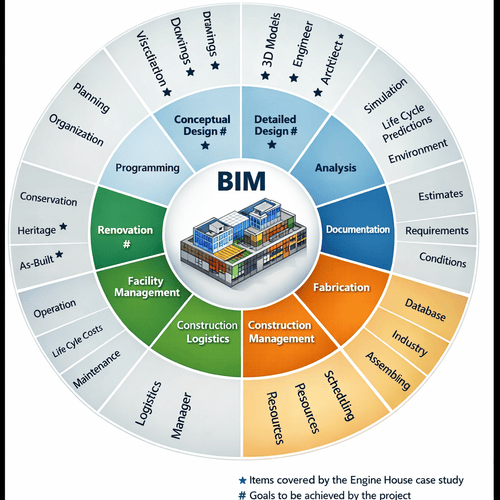
BIM stands for Building Information Modelling. At its core, BIM is a digital representation of the physical and functional characteristics of a building or infrastructure project. But it is much more than a 3D drawing; it is a shared knowledge resource and a collaborative process.
Think of BIM as a smart, living model. Every wall, beam, pipe, and duct in a BIM model carries information: its material, cost, supplier, installation date, energy performance, and maintenance schedule. This data-rich approach allows architects, engineers, contractors, and facility managers to make faster, better decisions with fewer errors.
How BIM Differs from CAD
| Feature | Traditional CAD | BIM |
| Output | 2D drawings / 3D geometry | Intelligent data-rich 3D model |
| Collaboration | Files exchanged manually | Centralised Common Data Environment (CDE) |
| Information | Lines and shapes only | Materials, cost, schedule, energy data |
| Clash Detection | Manual, time-consuming | Automated with tools like Navisworks |
| Updates | Each drawing is updated separately | Model updates propagate everywhere |
| Use in India | Still common in smaller firms | Mandatory for large and international projects |
Key BIM Software Used in India
- Autodesk Revit — the industry standard for architectural, structural, and MEP BIM modelling
- Navisworks — for clash detection, 4D scheduling, and model coordination
- Autodesk Civil 3D — for infrastructure and site modelling
- Dynamo — visual programming for BIM automation and parametric workflows
- Autodesk BIM 360 / Construction Cloud — for cloud-based collaboration and project management
- Trimble Tekla — for advanced steel detailing and fabrication
- Autodesk ReCap Pro — for Scan to BIM and point cloud modelling
BIM Levels Explained Simply
- Level 0 — Unmanaged 2D CAD; no collaboration; still used in very small firms
- Level 1 — Mixture of 2D and 3D CAD with some shared data; basic file management
- Level 2 — Federated BIM models shared via a CDE; the current standard for major Indian and global projects
- Level 3 (iBIM) — Fully integrated, cloud-based, single shared model; the future of construction
India's government infrastructure projects and large private AEC firms are rapidly moving to Level 2 BIM and beyond, with ISO 19650 compliance becoming a requirement for international work. Professionals trained at Level 2 and above are the ones commanding the highest salaries.
Build practical Revit and BIM skills used in real architecture and construction projects. Learn from Kaarwan's industry experts, work on real models, and take the next step toward a successful BIM career.
Why Learn BIM in 2026? Career, Salary & Industry Demand
The case for learning BIM in 2026 is not just about staying current; it is about unlocking a career trajectory that most AEC professionals in India are not yet on. The numbers make this clear.
Industry Adoption — The Numbers You Need to Know
- 76% of AEC firms globally now use BIM in 2026, up from just 13% in 2011.
- BIM engineer job listings in India have grown 25% in the past year alone.
- 89% of architecture firms in India are actively using BIM as of 2026 — it is now an industry standard.
- 72% of MEP engineering firms already require BIM skills by 2025, with demand rising further in 2026.
- India's Smart City Mission and PMAY projects now mandate BIM-compliant deliverables.
- Global firms like AECOM, Jacobs, and Mott MacDonald require ISO 19650-compliant BIM workflows from all Indian project teams.
BIM Salary Data in India: By Role & Experience (2026)
| Role | Experience | Avg. Monthly Salary (India) |
| BIM Modeller | 0–2 years | Rs. 25,000 – 33,000/month |
| BIM Architect / Designer | 2–4 years | Rs. 40,000 – 50,000/month |
| BIM Engineer | 4–6 years | Rs. 55,000 – 85,000/month |
| BIM Coordinator | 4–6 years | Rs. 50,000 – 70,000/month |
| BIM Manager | 7+ years | Rs. 1,00,000+/month |
| BIM Consultant | 10+ years | Project-based / Consulting fees |
Sources: AmbitionBox, Payscale, SalaryExpert/ERI — Updated March 2026
BIM-skilled professionals earn up to 60% more than their non-BIM peers at the same career stage. For MEP engineers specifically, the salary advantage is even stronger — with BIM MEP professionals commanding significantly higher packages compared to non-BIM MEP peers, driven by the acute shortage of MEP BIM talent in India.
Career Transition Paths
- Architect → BIM Architect → BIM Coordinator → BIM Manager
- Civil Engineer → BIM Modeller → BIM Engineer → BIM Project Lead
- MEP Engineer → MEP BIM Modeller → MEP BIM Lead → BIM VDC Manager
- Fresh Graduate → BIM Technician → BIM Coordinator (within 2–3 years)
Government Push & Industry Mandate
India's Smart City Mission and PMAY projects now mandate BIM-compliant deliverables, pushing even mid-sized firms to adopt BIM workflows urgently. The Indian government's push towards digital infrastructure is accelerating BIM adoption across public sector projects, from metro rail and national highways to affordable housing and smart urban development. Simultaneously, global AEC firms operating in India require ISO 19650-compliant BIM workflows from all project teams, making BIM certification not just a career advantage but a professional necessity for anyone working on large-scale or international projects.
Global Opportunities for India-Trained BIM Professionals
India has emerged as a global talent hub for BIM professionals. Countries actively hiring BIM-trained engineers and architects from India include the UAE, Qatar, the UK, Canada, Singapore, and Australia. Firms like AECOM, Jacobs, Buro Happold, Mott MacDonald, and Colliers run BIM operations out of Indian offices and regularly recruit from certified training programmes.
Who Should Take a BIM Course?
BIM is not a single-track skill — it serves different professionals in different ways. Here is how to know if a BIM course is right for you and which track to choose.
Architects & Architecture Students (B.Arch / M.Arch)
If you are an architect still working exclusively in AutoCAD or SketchUp, you are at risk of being passed over for roles at large firms and MNCs that now require Revit proficiency as a baseline. BIM for architects goes beyond 3D modelling — it encompasses documentation, energy analysis, multi-disciplinary coordination, and parametric design. The right BIM course will teach you Revit, Navisworks, Twinmotion, and Dynamo — transforming you from a drafter into a BIM Architect.
Civil & Structural Engineers (B.Tech / B.E. Civil)
Civil engineers who learn BIM gain the ability to create accurate structural models, automate BOQs and quantity take-offs, detect clashes before construction begins, and manage projects using 4D and 5D BIM. This moves them from site execution roles into high-value BIM Coordinator and BIM Manager positions. The Civil BIM track should include Revit, Civil 3D, Tekla, Navisworks, and Dynamo.
MEP Engineers (Mechanical, Electrical & Plumbing)
MEP BIM is the fastest-growing and highest-paying BIM specialisation in India. MEP engineers who can model HVAC, electrical, fire protection, and plumbing systems in Revit MEP — and coordinate those systems with architectural and structural models in Navisworks — are extraordinarily sought after. The salary premium for MEP BIM professionals can reach 60% over non-BIM MEP engineers.
Fresh Graduates & Career Switchers
For fresh graduates, a BIM certification is not just a skill, it is a career accelerator that allows you to skip entry-level CAD roles and join firms directly as a BIM Technician or Junior BIM Engineer. Career switchers from related fields such as quantity surveying, construction management, and facility management also benefit significantly from BIM certification.
Build practical Revit and BIM skills used in real architecture and construction projects. Learn from Kaarwan's industry experts, work on real models, and take the next step toward a successful BIM career.
What to Look for in a BIM Course in India: 7 Evaluation Criteria
With dozens of BIM courses available online and offline across India, choosing the right one is itself a skill. Here is an objective framework you can use to evaluate any BIM programme.
1. Curriculum Depth- Fundamentals to Advanced
A good BIM course should begin with BIM fundamentals (LOD levels, standards, ISO 19650 basics) and progressively advance to topics like 4D/5D BIM simulation, clash detection, Scan to BIM, and visual programming with Dynamo. Beware of courses that stay at the surface level — Revit basics alone are not enough for today's job market.
2. Software Coverage- Beyond Revit
Revit is the entry point. A job-ready BIM professional also needs Navisworks for clash detection and 4D simulation, Dynamo for automation, BIM 360 or Autodesk Construction Cloud for collaboration, and at least one specialisation tool — Civil 3D for civil engineers, Tekla for structural work, or Revit MEP with Insight for MEP engineers.
3. Faculty Credentials- Industry Experience Matters
There is a significant difference between a trainer who has taught BIM and a professional who has used BIM on live projects at firms like AECOM, Jacobs, Dar Al-Handasah, or Buro Happold. Look for instructors with verifiable real-world project experience — not just certifications. Ask for their LinkedIn profiles.
4. Project-Based Learning- Real Briefs, Not Dummy Exercises
The most reliable indicator of a good BIM course is the quality of student portfolios produced. Look for courses where students complete 5+ portfolio projects that reflect real-world project types — residential, commercial, infrastructure, and MEP coordination. These projects become your primary job application asset.
5. Certification- Autodesk-Recognised and Industry-Accepted
A course completion certificate carries weight, but an Autodesk Certified Professional credential carries global weight. The best courses bundle both — a course completion certificate AND official Autodesk certification. Always verify whether the provider is an Autodesk Authorised Training Centre.
6. Placement Support- Verified Hiring Partners, Not Just Promises
Many courses claim placement support. What matters is the specifics: Do they have named hiring partner firms? Do they share salary hike data from real past cohorts? Do they offer 1-on-1 resume and LinkedIn coaching, mock interviews, and ATS-optimised CV guidance?
7. Mode & Schedule Flexibility
For working professionals, live online classes with recorded backups are the most practical format. Verify: Are classes held on weekends or evenings? How are doubts resolved between sessions? Is there a dedicated community? Can you access materials for life, or is access time-limited?
Kaarwan's BIM Courses- What Makes Them Different?
Kaarwan is an IIT Roorkee-founded EdTech platform, trusted by more than 2.5 lakh learners in the AEC industry with a 4.9 rating out of 5. Its BIM programmes are taught by working professionals from top firms like AECOM, Jacobs, and Gensler, making every course practical, industry-relevant, and career-focused.
Kaarwan currently offers three specialised BIM certification programmes, each tailored to a specific engineering discipline.
Professional Revit & BIM Certification Program (For Architects)
| Detail | Information |
| Duration | 4 Months (14+2 weeks) / 150 Hours |
| Fee | Rs. 89,999 / EMI up to 12 months |
| Batch Size | 25 seats |
| Certifications | Autodesk Revit + Navisworks + Kaarwan + Google for Education |
| Projects | 6+ portfolio projects |
| Job Support | 6 months |
| Tools Covered | Revit, Navisworks, Twinmotion, BIM 360, Dynamo, ReCap Pro, Forma, FormIt, pyRevit, DiRoots (12+) |
Designed for B.Arch and M.Arch graduates, practising architects, and design students who want to master industry-standard BIM workflows. Over 9 structured modules, students progress from Revit fundamentals through advanced custom modelling, energy analysis, point cloud processing, visual programming with Dynamo, and BIM project management — completing 6+ real-world portfolio projects along the way.
Key Faculty: Kartik Sood (AECOM, Dar Al-Handasah, Jacobs — 8+ years experience), Juhi Goyal (Navisworks & Clash Detection Specialist — Jacobs), Yashvi Morarka (Course Director, 7+ years experience, 750+ students trained).
Build practical Revit and BIM skills used in real architecture and construction projects. Learn from Kaarwan's industry experts, work on real models, and take the next step toward a successful BIM career.
Professional BIM Certification for MEP Engineers
| Detail | Information |
| Duration | 5 Months (16+2 weeks) / 150 Hours / 25 Assessments |
| Fee | Rs. 1,04,999 / EMI up to 12 months |
| Batch Size | 25 seats |
| Certifications | Autodesk Revit + Navisworks + 4+ Skill Certificates + Kaarwan (5+ total) |
| Projects | 3+ projects including Capstone MEP coordination project |
| Job Support | 6 months |
| Tools Covered | Revit MEP, Navisworks, Dynamo, Autodesk Insight, ReCap Pro, BIM 360, Bluebeam, pyRevit, DiRoots (7+) |
India's most comprehensive BIM course for Mechanical, Electrical, and Plumbing engineers. Across 12 modules and 16 weeks, students master HVAC modelling, electrical and plumbing layouts, fire protection systems, clash detection, energy analysis, Dynamo automation, and CDE-based project management. The capstone project involves coordinating a complete multi-disciplinary MEP model for a residential building using Revit, Navisworks, and BIM 360.
BIM MEP professionals can earn 60% more than non-BIM MEP engineers. 72% of MEP engineering firms in India already required BIM skills by 2025, and that number has grown further as we move through 2026.
Upgrade your MEP design skills with BIM workflows used in modern building projects. Learn coordination, modelling, and project collaboration with Kaarwan while preparing yourself for better opportunities in the growing MEP industry.
Professional BIM Certification Program for Civil Engineers
| Detail | Information |
| Duration | 6 Months (20+ weeks) / 150 Hours / 35 Assessments |
| Fee | Rs. 1,24,999 / Rs. 10,000/month no-cost EMI up to 12 months |
| Batch Size | 25 seats |
| Certifications | Autodesk Revit + Navisworks + ReCap Pro + Kaarwan (4+ certs) + 5+ Skill Certificates |
| Projects | 5+ projects including infrastructure and structural models |
| Job Support | 6 months |
| Tools Covered | Revit, Navisworks, Civil 3D, Tekla, ReCap Pro, Dynamo, BIM 360, BIM Track, Bluebeam, Primavera P6, pyRevit, DiRoots (12+) |
India's most job-aligned BIM certification for civil engineers — 12 modules over 6 months covering RCC structural modelling, rebar and steel fabrication, architectural and MEP systems, infrastructure with Civil 3D, advanced steel with Tekla, Scan to BIM, Dynamo automation, and ISO 19650-compliant project management. Past alumni have secured roles as BIM Engineers at Cube Consultancy, Kent Data Centers, SABS, Tesla Outsourcing, and Morphogenesis.
Career salary benchmarks: BIM Modeller Rs. 4–6 lakh/year, BIM Engineer Rs. 8–12 lakh/year, BIM Coordinator/Manager Rs. 10–20 lakh/year.
Learn how BIM is used in large infrastructure and civil engineering projects. Gain hands-on skills in modelling, coordination, and project workflows with Kaarwan that help civil engineers work more efficiently.
What All Kaarwan BIM Programs Include
- Weekly live sessions with dedicated doubt-solving between classes
- Personal course dashboard with progress tracking and module-wise quizzes
- Portfolio building with real projects featured on Behance
- 6 months of job assistance: 1-on-1 guidance, ATS-optimised resume, mock interviews, LinkedIn optimisation
- Guest lectures from industry experts at AECOM, Jacobs, Buro Happold, Mott MacDonald, and Colliers
- Lifetime access to course materials and recordings
- Active community with 2.5 lakh+ learners and direct instructor access
Industry-Wide Fee Range
| Course Type | Typical Fee Range | What's Usually Included |
| Short online course (recorded) | Rs. 5,000 – 20,000 | Video content, basic cert |
| Instructor-led online course | Rs. 20,000 – 60,000 | Live sessions, cert, limited support |
| Professional certification programme | Rs. 60,000 – 1,50,000 | Live sessions, Autodesk cert, placement, projects |
| Masters / PG programmes | Rs. 10 – 15 lakh | Full degree, broader curriculum, higher time commitment |
Kaarwan BIM Course Fees at a Glance
- BIM Revit (Architects): Rs. 89,999 | 4 months | 12+ tools | Autodesk certified
- BIM MEP (MEP Engineers): Rs. 1,04,999 | 5 months | 7+ tools | Autodesk certified
- BIM Civil (Civil Engineers): Rs. 1,24,999 | 6 months | 12+ tools | Autodesk + ReCap Pro certified
- All programmes: EMI available up to 12 months | Book a seat at Rs. 10,000
The ROI Case for a BIM Certification
Consider this: a BIM Coordinator in India earns Rs. 50,000–60,000 per month, approximately Rs. 6–7.2 lakh per year. A BIM Engineer earns Rs. 6–10 lakh per year. Compare either salary against a one-time investment of Rs. 89,999–1,24,999 for a 4–6 month certification, and the return on investment becomes obvious. Most Kaarwan alumni recoup their course fee within 2–3 months of landing their first BIM role.
Top BIM Courses in India — Honest Comparison (2026)
Top BIM Courses in India — Honest Comparison (2026)
| Provider | Mode | Duration | Certification | Placement | Fee Range | Best For |
|---|---|---|---|---|---|---|
| Kaarwan | Online Live | 4–6 months | Autodesk + Industry | Yes (6 months, 1:1) | Rs. 89K–1.25L | Architects, MEP & Civil Engineers |
| Novatr | Online Live | 7 months | Autodesk + NSDC + Novatr | Yes | Rs. 1.95L | AEC professionals targeting global firms |
| TechnoStruct Academy | Online Live | 6–10 months | Autodesk + ACCE | Yes (Lifetime) | Rs. 1.25L–1.9L | Experienced professionals + International roles |
| CADD International | Offline/Online | ~3–6 months | Autodesk Authorized Partner | Yes (Lifelong) | ~Rs. 30K–60K | beginners |
| NIBT | Online/Offline | 20–60 days | Autodesk | Limited | ~Rs. 15K–35K | ME/CE/EE engineers, quick skill add-on |
BIM Career Paths After the Course — Roles, Salaries & Top Employers
The BIM Career Ladder
| Stage | Role | Experience | Avg. Salary (India) | Key Responsibilities |
| Entry | BIM Technician / BIM Modeller | 0–2 years | Rs. 3–6 lakh/year | Modelling, documentation, and basic coordination |
| Mid | BIM Engineer / BIM Designer | 2–4 years | Rs. 6–10 lakh/year | Model development, clash checks, family creation |
| Senior | BIM Coordinator | 4–6 years | Rs. 10–15 lakh/year | Multi-disciplinary coordination, LOD management |
| Lead | BIM Manager | 7+ years | Rs. 15–20 lakh/year | BIM strategy, ISO 19650 compliance, team management |
| Expert | BIM Consultant / VDC Lead | 10+ years | Project-based | Advisory, BEP drafting, enterprise BIM implementation |
Specialised BIM Roles in High Demand
- MEP BIM Lead — coordinating HVAC, electrical, plumbing, and fire systems on large commercial projects
- BIM VDC Manager — Virtual Design & Construction specialist overseeing entire digital project delivery
- BIM Automation Developer — using Dynamo, Python, and API scripting to automate repetitive BIM tasks
- Scan to BIM Specialist — converting point cloud data from laser scans and drones into accurate BIM models.
- BIM Content Creator — building and managing parametric Revit families and shared parameter libraries
Top Hiring Companies for BIM Professionals in India
- AECOM, Jacobs, Dar Al-Handasah, Mott MacDonald, Buro Happold, Gensler — global firms with India operations
- Tata Consulting Engineers, L&T Construction, Godrej Properties, Adani — major Indian conglomerates
- Colliers, JLL, CBRE — real estate and facility management firms
- Total Environment, Studio Intersect, Morphogenesis — design-focused architecture firms
- BIMedge, BIMGrafx, Tesla Outsourcing, DSM Soft — BIM services and outsourcing companies
- Kent Data Centres, SABS, Cube Consultancy, Virtual Building Studio — mid-sized firms actively hiring freshers
International Opportunities
BIM professionals trained in India are in demand globally. The UAE, Qatar, and Saudi Arabia are experiencing large-scale infrastructure booms requiring thousands of BIM-trained engineers. The UK mandates BIM Level 2 on all government-funded projects. Canada, Singapore, and Australia have active immigration pathways for AEC professionals with BIM credentials. A Kaarwan Autodesk certification is globally recognised and accepted by employers in all these markets.
Ready to Become a BIM Professional? Here's Your Next Step.
The shift to BIM in India is not coming; it is already here. The firms hiring today are looking for professionals who can hit the ground running with tools like Revit, Navisworks, Civil 3D, and Dynamo. The question is not whether you should learn BIM. The question is which track is right for you and how soon you can start.
Explore Kaarwan's three specialised BIM tracks designed for your background — the Professional Revit & BIM Certification Program for architects, the Professional BIM Certification for MEP Engineers for those in mechanical, electrical, and plumbing roles, and the Professional BIM Certification Program for Civil Engineers for those in infrastructure and structural fields. Each programme is Autodesk-certified, project-driven, and built to make you job-ready in 4–6 months with real industry support.
Frequently Asked Questions
Is BIM a good career in India?
Yes, unequivocally. BIM is one of the fastest-growing professional specialisations within India's AEC sector. BIM engineer job listings have grown 25% year-on-year. BIM-skilled professionals earn 30–60% more than their non-BIM peers. With India's infrastructure boom — Smart Cities, PMAY, national highways, and metro rail — and the increasing presence of global firms requiring ISO 19650-compliant teams, BIM professionals are among the most sought-after in the engineering and architecture workforce.
What is the eligibility to take a BIM course?
Most BIM certification programmes require a background in B.Arch, B.Tech or B.E. in Civil, Mechanical, or Electrical Engineering, or a Diploma in a related discipline. Fresh graduates are welcome, as are working professionals with 1–10+ years of experience. You do not need prior BIM knowledge — good courses start from the fundamentals.
Can I learn BIM without prior CAD experience?
Yes. While prior CAD experience is helpful, it is not required for a well-structured BIM course. Kaarwan's programmes begin with BIM and Revit fundamentals and build progressively. Many of Kaarwan's successful alumni had no prior software experience when they enrolled.
Which software is used in BIM?
The core software stack for BIM in India includes Autodesk Revit, Navisworks, Autodesk Civil 3D, Dynamo, Autodesk BIM 360 / Construction Cloud, Trimble Tekla, and Autodesk ReCap Pro. Add-ins like DiRoots, pyRevit, and BIM Track are also widely used in professional practice.
What is the BIM course fee in India?
BIM course fees in India range from Rs. 5,000 for basic recorded courses to Rs. 1,50,000 for comprehensive live certification programmes. Kaarwan's programmes are priced at Rs. 89,999 (Revit/Architects), Rs. 1,04,999 (MEP), and Rs. 1,24,999 (Civil), with no-cost EMI options available. All fees include Autodesk certification, live sessions, placement support, and lifetime material access.
Is BIM certification worth it?
The data says yes. BIM-certified professionals earn up to 30% more than non-certified peers at the same experience level. An Autodesk Certified Professional credential is recognised by employers across India, the UAE, the UK, Canada, and Singapore. Many large firms and government project contractors now require BIM certification as a minimum qualification for BIM-specific roles.
How long does it take to learn BIM?
A professional-level BIM certification takes 3–6 months with structured, live instruction. Shorter courses can teach Revit basics, but are unlikely to make you job-ready for coordination or management roles. Kaarwan's programmes range from 4 months (Revit/Architects) to 6 months (Civil Engineers), with 150 hours of structured learning plus project work.
What is the difference between BIM and CAD?
CAD produces 2D drawings or basic 3D geometry. BIM creates intelligent, data-rich 3D models where every element carries information — material specs, cost data, energy performance, installation schedules, and more. BIM enables real-time collaboration across disciplines from a single federated model, whereas CAD workflows rely on manually exchanged drawing files.