Why Choosing the Right BIM Course Matters in 2026
There are more BIM courses available in India right now than at any point in the industry's history. A quick search returns dozens of options, short courses, long programmes, free YouTube tutorials, offline institutes, and online certifications, and if you are trying to decide which one is worth your time and money, the sheer volume of choices can be genuinely overwhelming.
But here is what makes this decision more important than most people realise: not all BIM courses are built the same, and the wrong choice does not just waste your money, it can leave you with surface-level skills that are not enough to get hired at the firms that actually pay well.
The BIM job market in India has grown dramatically, with over 14,500 active BIM listings as of early 2026 and fresher openings up by 78% from 2024. Companies like AECOM, WSP, Mott MacDonald, and Jacobs are actively recruiting from structured BIM training programmes, but they are looking for candidates with real project experience, Autodesk certifications, and coordination skills. A basic Revit tutorial course simply does not meet that bar.
This guide is going to help you figure out which BIM engineer course is actually worth your investment in 2026, and which track is right for your specific discipline and career goals.
What to Look for in a BIM Engineer Course
Before you compare courses, you need to know what actually matters. Here is a practical checklist of the features that separate a genuinely career-building BIM course from one that just looks good on paper:
Software coverage that goes beyond Revit basics
Revit is the foundation, but the job market has moved well past basic modelling skills. A course worth taking should cover Navisworks for clash detection and coordination, Dynamo for automation; BIM 360 or Autodesk Construction Cloud for CDE management, and at least one discipline-specific tool , Civil 3D for civil engineers, Tekla for structural work, or Revit MEP for MEP engineers. If a course only teaches Revit, it is not going to make you competitive for coordinator-level roles.
Real project work, not just tutorials
The single biggest differentiator between candidates in BIM interviews is the quality of their portfolio. Recruiters at global AEC firms want to see coordinated models, clash detection reports, and BIM Execution Plan documents, not just screenshots of completed exercises. A good BIM course should include five or more real-world project simulations that you can directly add to your portfolio and present in interviews.
Autodesk certification
An Autodesk Certified Professional credential carries genuine weight with employers in India, the UAE, the UK, and Singapore. Always check whether the course provider is an Autodesk Authorised Training Centre and whether the Autodesk certification is included in the programme fee or comes at an additional cost.
Placement and career support
Many courses advertise placement support, but the details vary enormously. What you need to look for specifically is one-on-one career guidance, ATS-optimised resume building, mock interviews, and LinkedIn profile optimisation, and a support system that stays with you until you actually land a role, not just until the course ends.
Live instruction from working BIM professionals
There is a meaningful difference between learning from someone who teaches BIM and learning from someone who actively uses BIM on live projects at firms like AECOM, Jacobs, or Dar Al-Handasah. Real-world experience translates into practical project insights that recorded tutorials simply cannot replicate.
Mode and schedule flexibility
For working professionals, live online classes with weekend or evening schedules and recorded backup sessions are the most practical option. Always check whether you have lifetime access to materials, how doubt-solving sessions are structured, and whether there is an active peer community.
Types of BIM Courses Available
It helps to understand the landscape before making a decision. BIM courses in India broadly fall into a few categories:
Short online courses and recorded programmes (Rs. 5,000 to Rs. 20,000)
These cover Revit basics and are suitable for absolute beginners who want to get a feel for the software. They typically do not include live instruction, real project work, Autodesk certification, or placement support. They are a useful starting point but rarely sufficient to get you hired at a top firm.
Instructor-led online programmes (Rs. 20,000 to Rs. 60,000)
These offer live sessions and some structured content, but depth and support vary significantly. Many do not include Autodesk certification or the multi-software coverage needed for coordinator-level roles.
Professional BIM certification programmes (Rs. 60,000 to Rs. 1,50,000)
These are the most comprehensive option and the ones most likely to make you genuinely job-ready. They include live instruction from working professionals, multiple software tools, five or more real portfolio projects, Autodesk certification, and structured placement support. This is the category that Kaarwan's programmes sit in.
Postgraduate and MBA programmes (Rs. 10 lakh to Rs. 15 lakh)
Full degree programmes that combine BIM with broader construction management or business education. Best suited for professionals aiming for leadership roles, but a longer time and financial commitment than most students and working professionals need.
Offline institute programmes
Available in major cities through providers like CADD International. Good for those who prefer in-person learning, but schedules are less flexible and software depth can be more limited than the best online programmes.
Ready to get started? Explore Kaarwan's Professional Revit and BIM Certification Program, build real skills, earn your Autodesk certification, and land a role at your dream BIM company — all in just four months.
BIM Course for Civil Engineers vs Architects vs MEP Engineers
The right BIM course depends heavily on your educational background and the discipline you want to work in. Here is a clear breakdown of which track makes the most sense for each profile:
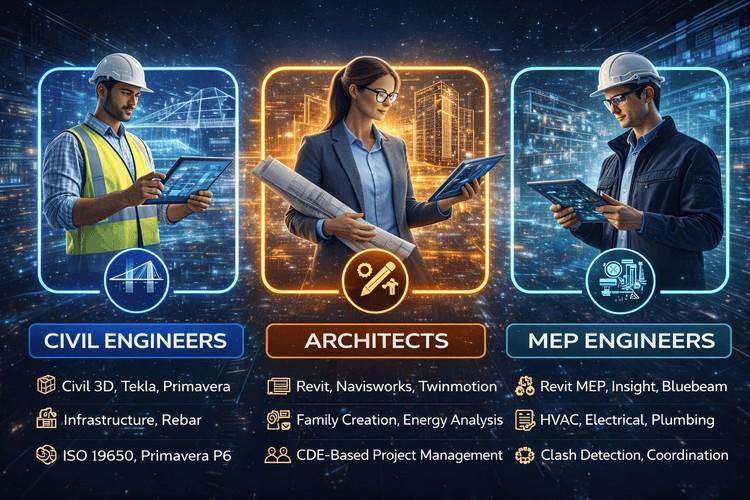
For Architects (B.Arch / M.Arch)
Architects entering BIM need to master Revit Architecture for building modelling, documentation, and parametric design. The course should also cover Navisworks for coordination, Dynamo for automation, and visualisation tools like Twinmotion. The goal is to move from being a CAD drafter to a BIM Architect who can lead multi-disciplinary coordination on real projects. Look for a programme with six or more portfolio projects covering residential, commercial, and mixed-use building types.
Typical entry roles after course: BIM Architect, BIM Modeller, BIM Coordinator. Starting salary: ₹3 LPA to ₹6 LPA, moving to ₹8 LPA to ₹14 LPA at senior level.
For Civil Engineers (B.Tech / B.E. Civil)
Civil engineers have one of the broadest sets of BIM opportunities available to them, spanning structural modelling, infrastructure, and construction coordination. A good civil BIM course should cover Revit Structure, Navisworks, Civil 3D for infrastructure modelling, Tekla for steel detailing, Dynamo for automation, and ISO 19650-compliant project workflows. The six-month timeline reflects the depth of content required to become genuinely competitive.
Typical entry roles after course: Civil BIM Engineer, BIM Modeller, BIM Coordinator. Starting salary: ₹3 LPA to ₹6 LPA, moving to ₹10 LPA to ₹21 LPA at senior level.
For MEP Engineers (Mechanical, Electrical, Plumbing)
MEP BIM is the fastest-growing and highest-paying BIM discipline in India right now, with MEP engineers consistently earning 20 to 40% more than Architectural BIM professionals at the same experience level. A strong MEP BIM course should cover Revit MEP for HVAC, electrical, plumbing, and fire protection system modelling, Navisworks for clash detection, Dynamo for automation, and BIM 360 for collaborative project delivery. The capstone project should involve a complete multi-disciplinary MEP coordination workflow.
Typical entry roles after course: MEP BIM Engineer, MEP BIM Modeller, MEP BIM Coordinator. Starting salary: ₹3 LPA to ₹5 LPA, moving to ₹10 LPA to ₹18 LPA at senior level.
Kaarwan BIM Professional Course
Kaarwan is an IIT Roorkee-founded EdTech platform trusted by more than 44,000 learners in the AEC industry. Its BIM programmes are taught by working professionals with experience at firms like AECOM, Jacobs, Dar Al-Handasah, and Mott MacDonald, meaning every session is grounded in how BIM actually works on real projects, not just how it works in theory.
Kaarwan offers three specialised BIM certification programmes, each tailored to a specific discipline:
Professional Revit and BIM Certification Program, For Architects
Duration: 4 months (14 plus 2 weeks) , 150 hours of structured learning Software covered: Revit, Navisworks, Twinmotion, BIM 360, Dynamo, ReCap Pro, FormIt, pyRevit, DiRoots , 12 or more tools in total Projects: 6 or more real-world portfolio projects Certifications: Autodesk Revit, Autodesk Navisworks, Kaarwan Certificate, Google for Education Job support: 6 months of structured 1:1 career support
This programme is built for B.Arch and M.Arch graduates and practising architects who want to move into BIM roles at global firms. The curriculum covers everything from Revit fundamentals through advanced custom family creation, energy analysis, point cloud processing, Dynamo automation, and CDE-based project management. Key faculty include Kartik Sood, who has worked at AECOM, Dar Al-Handasah, and Jacobs with 8 or more years of experience, and Juhi Goyal, a Navisworks and clash detection specialist.
BIM Certification for MEP Engineers
Duration: 5 months (16 plus 2 weeks) , 150 or more hours, 25 assessments Software covered: Revit MEP, Navisworks, Dynamo, Autodesk Insight, ReCap Pro, BIM 360, Bluebeam, pyRevit, DiRoots , 7 or more tools Projects: 3 or more projects including a capstone MEP coordination project Certifications: Autodesk Revit, Autodesk Navisworks, 4 or more skill certificates, Kaarwan Certificate , 5 or more in total Job support: 6 months of structured 1:1 career support
This is India's most comprehensive BIM course specifically designed for Mechanical, Electrical, and Plumbing engineers. Across 12 modules, students master HVAC modelling, electrical and plumbing system layouts, fire protection design, clash detection, energy analysis, Dynamo automation, and CDE-based project management. The capstone project involves coordinating a complete multi-disciplinary MEP model for a residential building using Revit, Navisworks, and BIM 360. Key faculty include Navid Deshmukh, a BIM Manager and Mechanical Engineer with extensive MEP BIM experience across international projects in the Middle East and India.
BIM Certification Program for Civil Engineers, V2.0 (Aligned to 2026 Jobs)
Duration: 6 months (20 or more weeks) , 150 or more hours, 35 assessments Software covered: Revit, Navisworks, Civil 3D, Tekla, ReCap Pro, Dynamo, BIM 360, BIM Track, Bluebeam, Primavera P6, pyRevit, DiRoots , 12 or more tools Projects: 5 or more projects including infrastructure and structural models Certifications: Autodesk Revit, Autodesk Navisworks, Autodesk ReCap Pro, Kaarwan Certificate , 4 or more, plus 5 or more skill certificates Job support: 6 months of structured 1:1 career support
This Civil BIM Certification program by Kaarwan is the most comprehensive programme, 12 modules covering RCC structural modelling, rebar and steel fabrication, architectural and MEP system coordination, infrastructure with Civil 3D, advanced steel with Tekla, Scan to BIM workflows, Dynamo automation, and ISO 19650-compliant project management. Past alumni from this programme have secured roles at Cube Consultancy, Kent Data Centres, SABS, Tesla Outsourcing Services, and Morphogenesis.
What all three Kaarwan programmes include:
Every programme comes with weekly live sessions and dedicated doubt-solving, a personal course dashboard with progress tracking and module-wise assessments, portfolio building with real projects featured on Behance, 6 months of 1:1 job support including ATS-optimised resume building, mock interviews, and LinkedIn optimisation, guest lectures from industry experts at AECOM, Jacobs, Buro Happold, Mott MacDonald, and Colliers, and lifetime access to all course materials and recordings.
Kaarwan is trusted by learners from companies and institutions including AECOM, Jacobs, Dar Al-Handasah, Godrej, Adani, Flipkart, Livspace, and ISB.
What You Get After Completing a BIM Course
If you complete the right BIM programme, the outcomes are concrete and well-documented. Here is what you can realistically expect:
A globally recognised certification
An Autodesk Certified Professional credential is recognised by employers across India, the UAE, the UK, Canada, and Singapore. It validates your proficiency in industry-standard BIM tools and is increasingly listed as a requirement in job postings from global AEC firms. Kaarwan's programmes also come with a Kaarwan course certificate and discipline-specific skill certificates.
A job-ready portfolio
Five or more real project simulations give you coordinated models, clash reports, and BIM Execution Plan documents to show in every interview. This portfolio is often more persuasive to recruiters than the certification itself , it shows that you can actually do the work, not just that you attended a course.
A meaningful salary jump
BIM-certified professionals in India earn 15 to 30% more than non-certified peers at the same experience level. For MEP engineers specifically, the premium can reach 60% over non-BIM peers. Most Kaarwan alumni recoup their course investment within two to three months of landing their first BIM role.
Access to roles at top firms
Companies like AECOM, WSP, Mott MacDonald, Jacobs, Arcadis, and Tata Consulting Engineers actively recruit from structured BIM certification programmes. Kaarwan's placement network includes firms across Bengaluru, Hyderabad, Mumbai, Delhi NCR, and Pune, as well as international opportunities in the UAE, UK, Singapore, and Canada.
Long-term career trajectory
A BIM certification is not just about your first job , it is about the career path it unlocks. Engineers who enter the field with the right skills can progress from BIM Modeller to BIM Coordinator to BIM Manager within five to eight years, with salaries moving from ₹3 LPA to ₹35 LPA and above at the senior end.
Start Your BIM Journey with Kaarwan
If you have read this far, you already know that the BIM opportunity in India is real, the demand for trained professionals is growing fast, and the right course can genuinely change the trajectory of your career. The question now is which track is right for you and when you want to start.
Kaarwan's three BIM certification programmes — for architects, MEP engineers, and civil engineers — are each designed to give you the specific tools, real project experience, industry certifications, and career support you need to go from enrolled to employed in four to six months.
Every programme is Autodesk-certified, taught by working industry professionals, and backed by six months of structured placement support that stays with you until you land the role. Kaarwan graduates like Rikta Parikh (Virtual Building Studio), G. Madhusmita (Tesla Outsourcing Services), and Charit Bisen (Virtual Building Studio) are proof that the right training and support system makes all the difference — from course completion to job offer. The next batch starts soon. Seats are limited to 25 per cohort.
Explore Kaarwan's BIM Courses and take the first step toward a career that pays what your skills are worth.
Ready to get started? Explore Kaarwan's Professional Revit and BIM Certification Program, build real skills, earn your Autodesk certification, and land a role at your dream BIM company — all in just four months.
Frequently Asked Questions
Which is the best BIM course for engineers in India in 2026?
The best BIM course depends on your discipline. For architects, the Professional Revit and BIM Certification Program covers the full architectural BIM workflow. For MEP engineers, the BIM Certification for MEP Engineers is the most comprehensive option available in India right now. For civil engineers, the BIM Certification Program for Civil Engineers V2.0 covers the widest software stack including Revit, Civil 3D, Tekla, Navisworks, and Dynamo. All three Kaarwan programmes are Autodesk-certified and come with six months of placement support.
Can I do a BIM course online in India?
Yes , and online is the most practical format for most working professionals and students in India. Kaarwan's programmes are fully live online, with sessions scheduled on weekends and evenings to work around existing commitments. You also get lifetime access to recordings and course materials, so you can revisit content as needed throughout your career.
How long does a BIM course take?
The timeline depends on the depth of the programme. Kaarwan's BIM Certification for Architects takes four months (150 hours), the MEP programme takes five months (150 or more hours), and the Civil programme takes six months (150 or more hours with 35 assessments). Shorter courses of four to eight weeks can teach Revit basics but are generally not sufficient to make you competitive for coordinator-level roles at global AEC firms.
Does a BIM course include placement support?
This varies significantly between providers. Kaarwan's programmes include six months of structured 1:1 placement support , dedicated career sessions, ATS-optimised resume building, mock interviews, and LinkedIn optimisation , that continues until you are placed. This is one of the most important things to verify before enrolling in any BIM programme.
What is the salary after completing a BIM course in India?
Entry-level BIM engineers with a recognised certification typically start at ₹3 LPA to ₹6 LPA. At global AEC delivery centres in Bengaluru and Hyderabad, freshers with strong portfolios and Autodesk certifications can start at ₹4.5 LPA to ₹6 LPA. At mid-level with three to six years of experience, salaries reach ₹7 LPA to ₹12 LPA. MEP BIM engineers consistently earn 20 to 40% more than Architectural BIM professionals at the same experience level.
Is a BIM certification recognised internationally?
Yes. An Autodesk Certified Professional credential is globally recognised by employers in India, the UAE, the UK, Canada, Singapore, and Australia. Kaarwan's Autodesk certification is included in all three BIM programmes, and alumni have used it to secure roles at firms operating across these markets. Many Indian BIM professionals with Kaarwan certification have gone on to work on international projects from delivery centres in Bengaluru, Hyderabad, Pune, and Gurugram.