If you have been hearing the term "BIM Engineer" a lot lately and are not quite sure what it means, what they actually do all day, or whether it is actually a good career to build in India right now — this guide is going to answer all of that for you.
We are going to walk you through everything from what a BIM Engineer actually is, what their day looks like, what skills you need, how much you can earn in India in 2026, and the steps you need to take to get into the field. We have kept it simple, straightforward, and practical — because that is what actually helps.
What is a BIM Engineer?
A BIM Engineer is a professional who uses Building Information Modelling technology to design, coordinate, and manage digital models of buildings and infrastructure projects. They work right at the intersection of engineering, construction, and digital technology, and their job is essentially to bring all the different technical disciplines on a project together into one single, well-coordinated 3D model.
Now, a lot of people confuse BIM Engineers with CAD engineers, but the two are quite different. A CAD engineer works mostly with 2D drawings or basic 3D shapes, think of it as a very advanced digital drawing board. A BIM Engineer, on the other hand, works with intelligent, data-rich models where every single element — every wall, beam, duct, and cable tray, carries detailed information about its material, cost, installation schedule, and maintenance requirements. That layer of information is what makes BIM so much more powerful than traditional CAD.
So if you want a simple way to think about it: a CAD engineer draws a building, while a BIM Engineer builds a complete digital version of it — one that carries all the information needed to design it, construct it, and manage it across its entire lifetime.
BIM Engineer Roles and Responsibilities
The day-to-day work of a BIM Engineer is a healthy mix of technical modelling, cross-discipline coordination, and team collaboration. No two days are exactly the same, especially on large projects, but here is a clear picture of what the role typically involves:
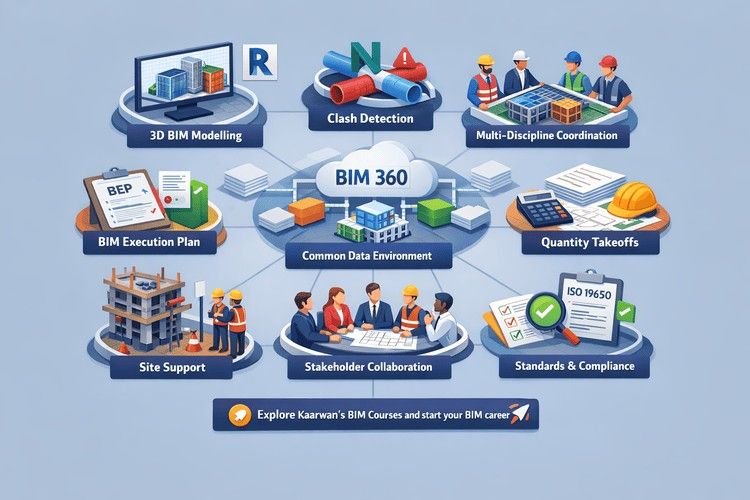
1. 3D BIM Modelling and Model Management
Creating and managing detailed 3D BIM models using software like Autodesk Revit, while ensuring every model meets the project’s LOD (Level of Development) standards and quality requirements.
2. Clash Detection and Issue Resolution
Running clash detection using Navisworks to identify and flag conflicts between architectural, structural, and MEP systems — resolving issues digitally before they become costly on-site problems.
3. Multi-Discipline Coordination
Coordinating across teams by combining models from architects, structural engineers, and MEP engineers into a single federated model for seamless collaboration.
4. BIM Execution Plan (BEP) Management
Maintaining the BIM Execution Plan (BEP) and ensuring the entire team follows standard workflows, naming conventions, and data protocols throughout the project.
5. Common Data Environment (CDE) Management
Managing project data in platforms like Autodesk BIM 360 or Construction Cloud, ensuring everyone works on the latest and most accurate model versions.
6. Quantity Takeoffs and Documentation
Generating quantity takeoffs and construction documentation directly from the model, saving time and reducing errors compared to manual 2D processes.
7. Construction and Site Support
Supporting on-site teams by providing accurate and updated BIM data to help with better decision-making during construction.
8. Stakeholder Collaboration
Working closely with architects, structural engineers, MEP engineers, contractors, and project managers across all project stages.
9. Standards and Compliance Management
Ensuring the project adheres to industry standards like ISO 19650, especially for government and international projects.
10. Reporting and Issue Tracking
Producing detailed clash detection reports and actively tracking the resolution of issues with relevant teams.
Skills Required to Become a BIM Engineer
To do this job well, you need a solid combination of technical software skills and the kind of professional skills that help you work effectively within a team. Here is a clear overview of both.
Technical Skills:
| Skill | Why It Matters |
| Autodesk Revit (Architecture / Structure / MEP) | Core modelling tool for almost every BIM role in India |
| Navisworks | Clash detection, coordination, and 4D scheduling |
| Dynamo | Automation and scripting within Revit — a major salary differentiator |
| BIM 360 / Autodesk Construction Cloud | Common Data Environment management |
| AutoCAD Civil 3D | Essential for civil and infrastructure BIM roles |
| ISO 19650 knowledge | Required on international and government projects |
| LOD 100–400 understanding | Determines the accuracy and detail level of your models |
Soft Skills:
| Skill | Why It Matters |
| Communication | Explaining complex model data to architects, engineers, and non-technical clients |
| Analytical thinking | Identifying and resolving design conflicts before they escalate |
| Collaboration | BIM is a team process — coordination across disciplines is core to the role |
| Attention to detail | Model accuracy directly impacts construction quality and cost |
| Adaptability | BIM tools and standards evolve rapidly — continuous learning is essential |
BIM Engineer Career Path
One of the things that makes BIM such an attractive career is that the progression is actually quite clear and structured. You start with modelling and technical work, build your coordination skills over the mid years, and gradually move into leadership and strategy roles as you gain experience.
What is interesting, though, is that the timeline is not the same for everyone. Two engineers with the same number of years in the industry can be at very different salary levels and responsibility levels, especially when you compare how they have progressed in BIM engineer jobs, depending on when they adopted BIM and how seriously they invested in building the right skills.
Here is how the typical career progression looks:
| Role | Experience | What You Do |
| BIM Modeller / Technician | 0 to 2 years | Create 3D models, produce drawings, learn software under supervision |
| BIM Engineer / Designer | 2 to 4 years | Coordinate models, support clash detection, assist with BEP documentation |
| BIM Coordinator | 4 to 7 years | Manage multi-discipline coordination, run clash detection, oversee CDE workflows |
| Senior BIM Engineer / Lead | 6 to 9 years | Own model management, lead coordination meetings, drive BEP compliance |
| BIM Manager | 10 or more years | Oversee BIM strategy, manage teams, ensure ISO 19650 compliance, client liaison |
| BIM Consultant / Director | 12 or more years | Advise organisations on BIM implementation, lead digital transformation |
The move from BIM Engineer to BIM Coordinator is genuinely where things start to accelerate. At the coordinator level, you are no longer just building models — you are managing how different disciplines come together, running coordination meetings, and making sure the project delivers on its BIM commitments. That increase in responsibility shows up clearly in the salary numbers too.
BIM Engineer Salary in India 2026
BIM professionals in India are consistently earning more than their non-BIM counterparts, and that gap has been widening as demand for trained talent continues to outpace supply. When you look closely at the BIM Engineer Salary in India 2026, the trend becomes even more evident. There are a few things worth understanding upfront before you look at the numbers.
MEP BIM Engineers consistently earn 20 to 40% more than Architectural BIM professionals at the same experience level, simply because MEP coordination is more complex and there are fewer people who specialise in it. Adding Navisworks and Dynamo to your core Revit skills can push your BIM salary from the ₹3 to ₹6 LPA range all the way up to ₹8 to ₹15 LPA and beyond. And professionals with a recognised BIM certification earn anywhere from 15 to 30% more than non-certified peers at the same level of experience.
Here is a quick salary snapshot for 2026:
| Role | Experience | Salary Range (Annual CTC) |
| BIM Modeller / Drafter | 0 to 2 years | ₹2.5 L to ₹5 LPA |
| Junior BIM Engineer | 1 to 3 years | ₹4.5 L to ₹7.5 LPA |
| BIM Coordinator | 3 to 6 years | ₹7 L to ₹12 LPA |
| Senior BIM Engineer / Lead | 6 to 9 years | ₹10 L to ₹18 LPA |
| BIM Manager | 6 to 12 years | ₹12 L to ₹22 LPA |
| BIM Lead | 10 to 15 years | ₹20 L to ₹35 LPA |
Sources: AmbitionBox, Glassdoor, Naukri.com, LinkedIn Salary Insights, March 2026
The best cities for BIM salaries right now are Bengaluru, Hyderabad, and Pune, where global AEC delivery centres consistently pay more than domestic firms for the same role.
BIM Engineer Tools and Software
The tools you know directly determine the roles you can apply for and the salary you can command. Here is a breakdown of the core software every BIM Engineer in India should be building proficiency in:
Autodesk Revit — The industry-standard BIM authoring tool used across architectural, structural, and MEP disciplines. It is the foundation of almost every BIM role in India, and if you are starting out, this is the first tool you need to master.
Navisworks — The go-to tool for clash detection, model coordination, and 4D construction sequencing. It is essential at the coordinator level and above, and one of the most current in-demand skills in BIM job listings.
AutoCAD Civil 3D — The primary tool for civil and infrastructure BIM work, covering road design, drainage systems, highway modelling, and site coordination. Especially important for civil engineering professionals.
Autodesk InfraWorks — Used for large-scale infrastructure planning and conceptual design, including roads, bridges, and urban development projects. Highly relevant for government and smart city projects.
Dynamo — A visual programming tool within Revit that enables automation of repetitive tasks, standard enforcement, and large-scale data processing. One of the highest-value BIM engineers' skills in today’s job market.
BIM Engineer vs BIM Manager
These two roles are closely related but differ significantly in day-to-day work, responsibilities, and level of impact.
Key Differences
| Aspect | BIM Engineer | BIM Manager |
|---|---|---|
| Primary Focus | Technical execution | Strategy and leadership |
| Core Work | Modelling, clash detection, coordination | BIM planning, team management, implementation |
| Daily Tasks | Create and manage models, run clash detection, coordinate disciplines | Define BIM workflows, manage teams, oversee project delivery |
| Level of Responsibility | Project-level execution | Organization/project-level strategy |
| BIM Execution Plan (BEP) | Follows and supports BEP | Creates and owns BEP |
| Standards (ISO 19650) | Ensures compliance in models | Defines and enforces compliance across projects |
| Team Involvement | Works within a team | Leads and manages BIM teams |
| Client Interaction | Limited | High (client coordination and reporting) |
| Experience Level | 0–6+ years | 8–10+ years |
How to Become a BIM Engineer
Getting into BIM engineering is very achievable if you follow a clear and structured path. Here is a five-step overview of how most successful BIM Engineers in India have made it happen:
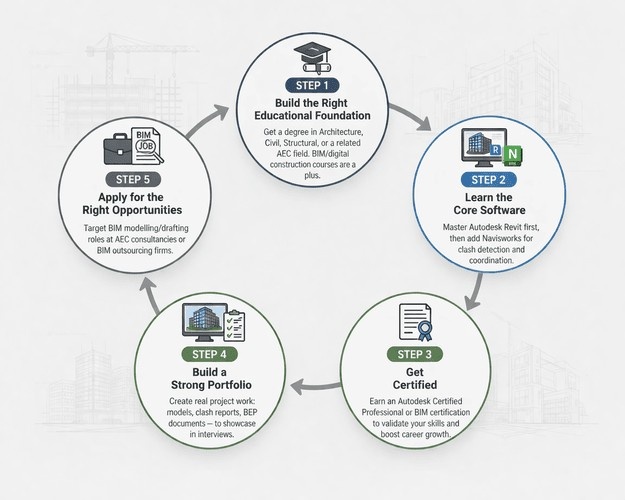
Step 1: Build the Right Educational Foundation A degree in architecture, civil engineering, structural engineering, or any related AEC field gives you the technical grounding needed to understand construction processes, design principles, and engineering standards. Some universities also offer specialised BIM or digital construction programmes, which can give you a strong head start.
Step 2: Learn the Core Software Start with Autodesk Revit for your discipline (Architecture, Structure, or MEP). Once you are confident, add Navisworks for clash detection and coordination. These two tools are the most commonly required skills in entry-level and mid-level BIM roles.
Step 3: Get Certified A recognised certification — such as Autodesk Certified Professional or a structured BIM programme — validates your skills to industry standards. Certified professionals in India typically earn 15–30% more and often progress faster in hiring processes.
Step 4: Build a Strong Portfolio A certificate alone is not enough. Employers look for real project work such as coordinated models, clash detection reports, and BIM Execution Plan (BEP) documents. Build your portfolio alongside your training so you always have practical work to showcase.
Step 5: Apply for the Right Opportunities. Start by targeting BIM modelling and drafting roles at AEC consultancies or BIM outsourcing firms. These are among the most accessible entry points for freshers and early-career professionals in India.
BIM Engineer Course at Kaarwan
What Kaarwan Offers Kaarwan provides industry-focused BIM certification programmes designed to make you job-ready in 4–6 months, with hands-on training, real projects, and placement support. I
deal for architecture, civil, and MEP students or professionals who want to transition into BIM roles or grow their career in the AEC industry.
Learn tools like Revit, Navisworks, and Dynamo, build a strong portfolio with real projects, understand ISO 19650 workflows, and get continuous placement support until you are hired.
Explore Kaarwan’s BIM Courses and start your BIM career in 2026