Ask anyone who's actually sat through a chaotic BIM coordination meeting, and they'll tell you the same thing: most clashes on a project aren't really about geometry. They're about nobody agreeing on the rules beforehand. That's the whole reason a BIM Execution Plan exists.
A BIM Execution Plan, or BEP, is the document that lays out how BIM will actually run on a project, who's modelling what, to what level of detail, using which software, and how everyone's meant to exchange information without stepping on each other's files. Think of it less as paperwork and more as the thing that keeps a dozen different firms rowing in the same direction.
If you're eyeing a BIM career, understanding the BEP isn't optional homework. It's often the exact thing that separates someone who can push buttons in Revit from someone who gets handed a coordinator title.
Also Read: BIM Engineer Interview Questions and Answers
What a BEP Actually Covers
A good BEP isn't vague. It's specific enough that nobody on the team has to guess.
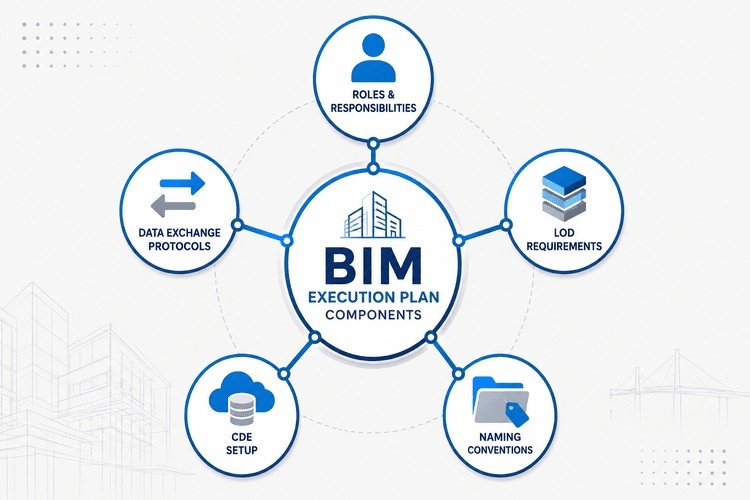
Roles and responsibilities come first, usually laid out as a matrix showing who authors which model, who reviews it, and who signs off. This is where the BIM Manager, Information Manager, and discipline leads all get named, not just described.
Level of Detail (or Level of Information Need) requirements come next, defined per element, per project stage. A wall might only need to exist as a rough volume at concept stage but needs to carry full material and performance data by construction documentation. Getting this wrong is one of the fastest ways to derail a coordination meeting, and it deserves its own deep dive, which is exactly what how BEP defines LOD requirements covers if you want the full breakdown.
Naming conventions sound boring until you're the third person that week who's opened a file called "Final_v2_ACTUAL_final." Consistent naming keeps a federated model from turning into a scavenger hunt.
The CDE configuration will identify the locations for the files, permissions for access, and methods for version control so no one is using an outdated model without realizing it.
Data exchange protocols will then provide information about the file types (IFC, native Revit, or whatever else the project requires), frequency of data exchanges, and when the clash detection process will occur.
Also Explore: BIM Jobs in India 2026: Top Companies Hiring
Pre-Contract vs Post-Contract BEP
Here's something a lot of students miss early on: a BEP isn't one document. It's two, written at very different moments, for very different reasons.
The pre-contract BEP shows up during the bidding stage, before anyone's won the job. It's essentially a pitch, here's how our team plans to meet your BIM requirements, here's our software capability, here's a rough outline of roles. It's intentionally high-level. Nobody expects a fully locked LOD matrix at this point, because the team hasn't even been confirmed yet.
The post-contract BEP is what happens once the ink's dry. This version is detailed, specific, and built with input from every discipline lead, not just whoever wrote the tender response. It includes the full information delivery schedule, finalized naming conventions, the actual coordination cadence, and a responsibility matrix that names real people, not just roles.
A rough way to remember the difference: the pre-contract BEP promises an approach. The post-contract BEP proves it, in enough detail that everyone can actually work from it day to day.
Getting comfortable with both versions matters more than it sounds, because interviewers love asking candidates to explain this exact distinction. It's a quick way to tell who's actually worked with BIM governance and who's only touched the modelling side.
How ISO 19650 Requires a BEP
If you've spent any time around BIM standards, you've probably heard ISO 19650 mentioned in the same breath as the BEP, and there's a reason for that. ISO 19650 is the international framework a lot of Indian and global projects now reference, and under it, the BEP isn't optional paperwork, it's a formal requirement. The project team is expected to produce a BEP as their direct response to the client's Employer's Information Requirements (EIR), essentially proving they understand what's being asked and how they intend to deliver it.
That's really as far as this page needs to go on the standard itself. If you want the full picture, how ISO 19650 structures information requirements covers the framework in proper depth, and how the Common Data Environment stages work walks through the CDE side of things separately. No point retyping all that here when it's already covered well.
Also Read: BIM Standards Every Engineer Should Know
Who Writes the BEP
This is usually where students get a little confused, so let's clear it up. The BEP isn't written by whoever's fastest on Revit. It's owned by the BIM Manager, sometimes alongside an Information Manager on larger projects, with input pulled in from every discipline lead involved.
That ownership matters for your career path more than it might seem right now. Early on, as a modeller or coordinator, you'll be working within the BEP, following its LOD requirements, sticking to its naming rules, showing up to the coordination meetings it schedules. But the jump from coordinator to manager is basically the jump from following the BEP to authoring and enforcing it.
If you're serious about that climb, start paying attention to BEPs on any project you touch, even as a junior. Read them properly instead of skimming past the boring-looking sections. That habit alone puts you ahead of a lot of your peers.
Also Explore: Understanding LOD in BIM Projects
BEP Template — What to Include
Whether you're drafting one for a college project, prepping for an interview, or just trying to understand what a "real" BEP looks like, here's the checklist that covers the essentials:
- Project information: name, client, scope, key milestones, version history
- BIM goals and uses: clash detection, 4D scheduling, quantity extraction, FM handover, whichever apply
- Roles and responsibilities matrix: BIM Manager, Information Manager, discipline leads, named individuals where possible
- LOD/LOIN matrix: detail level required per element, per project stage
- Software and file formats: Revit versions, IFC export requirements, any DWG standards in play
- CDE platform and setup: naming conventions, folder structure, approval workflow
- Coordination and clash detection protocol: frequency, priority categories, who tracks resolution
- Information delivery schedule: what gets delivered, by whom, at what stage
- Quality control process: who reviews models before they're issued, what gets checked
You don't need all nine sections exhaustively detailed for a smaller academic project, but knowing what belongs on this list, and why, is exactly the kind of thing that comes up in interviews.
Also Read: BIM Engineer Career Path and Salary Guide
Thinking about where BEP knowledge actually takes your career? Kaarwan's BIM Certification programs build exactly this kind of practical, coordination-level understanding, not just software skills.
Common BEP Mistakes Early-Career BIM Engineers Make
A few patterns show up again and again with juniors just getting into BIM coordination:
Treating LOD requirements as vague suggestions. "Model should be detailed enough" isn't a specification. If you're writing or reading a BEP, LOD needs to be explicit per element, per stage, not left to interpretation.
Forgetting the BEP is a living document. A lot of people file it away after kickoff and never open it again. It should get revisited at major milestones, especially when scope or team composition changes.
Ignoring the CDE section. It sounds like the boring administrative part, until you're working from a model that's three versions out of date because nobody defined a clear approval workflow.
Confusing the BEP with just being "the BIM plan" in a loose sense. It's a formal, structured, agreed-upon document, not a set of Slack messages about how the project's going to work.
Skipping the pre- vs post-contract distinction entirely. This one comes up constantly in interviews, and not knowing it signals you've only seen BEPs from a distance.
Getting familiar with what a BIM Execution Plan (BEP) documents actually looks like in practice is genuinely one of the fastest ways to sound credible in a BIM interview, more than knowing another Revit shortcut ever will.
Also Read: BIM Engineer's Salary in India
Curious how this fits into real BIM career prep? Kaarwan's job-focused BIM training covers this alongside the coordination and Revit skills firms actually hire for.
Conclusion
A BEP isn't the exciting part of BIM, nobody's showing off their BEP on Instagram, but it's genuinely the document that decides whether a project runs smoothly or turns into a coordination nightmare. Understanding it, both the pre- and post-contract versions, is one of the clearest signals that you're ready for more than a modelling seat.
Ready to build the skills that get you there? Explore Kaarwan's BIM Certification programs and start moving toward coordinator and manager-level roles.
FAQs
Is a BEP the same as a BIM Manual?
Not quite. A BIM Manual is usually a firm's internal, general guidance on how they approach BIM across projects. A BEP is project-specific, agreed with the client and the full project team for one particular job.
Who owns the BEP on a project?
The BIM Manager, typically with support from an Information Manager on larger projects, owns and maintains it, with input from discipline leads across architecture, structure, and MEP.
Is a BEP required on every project?
Not legally on every single job, but any serious multi-discipline BIM project should have one, and it's increasingly a contractual requirement on projects following ISO 19650 or working with government and large private clients.
What's the difference between LOD and LOIN in a BEP?
LOD (Level of Development) is the more traditional term for how detailed a model element is at a given stage. LOIN (Level of Information Need) is the ISO 19650 equivalent, covering both geometric and non-geometric data requirements.