.jpeg)
The problem with most computational design resumes isn't the experience , it's how the experience gets communicated. An architect who's spent two years building Grasshopper definitions, running Ladybug simulations, and rationalizing complex geometry submits a resume that looks almost identical to someone who touched Rhino once in a software elective. "Rhino, Grasshopper" buried in a skills list. A few project names with vague descriptions. And then silence from recruiters.
This isn't a hypothetical. It's what happens when a genuinely solid computational skill set gets packaged in a generic architecture resume template.
Firms hiring for computational and parametric design roles , whether that's a computation-focused studio, a design technology team at a larger firm, or an AEC consultancy building out its digital practice , are screening for a very specific set of signals. Tool stack, yes. But more than that: evidence of parametric thinking, proof of what those tools produced, and some indication of how deep the Grasshopper knowledge actually goes. Listing plugins without context tells them nothing. A bullet that says "used Grasshopper for environmental analysis" tells them almost nothing. A bullet that says "built a Ladybug-driven solar analysis definition that optimized shading device geometry across 12 facade iterations, reducing projected cooling load by 18%" , that's a different conversation entirely.
This guide builds a computational design resume from the ground up: format, skills section structure, summary formulas, and ready-to-adapt bullet points for Rhino/Grasshopper, parametric design, and scripting-adjacent work. If you're still figuring out your direction, start with the growing demand for computational design roles , this guide is for when you're ready to apply.
Why a Generic Architecture Resume Doesn't Work for Computational Design Roles
Most architecture resumes are built around the same structure: a project list, a software column, an education section. That structure works for a conventional architectural design role. For computational design and parametric design roles, it quietly signals the wrong thing.
Hiring managers at computational-design-focused practices or digital design teams aren't reading resumes the same way a general architecture recruiter does. They're looking for specific signals, often within the first 10–15 seconds:
What's the actual tool stack? Not "3D software , Rhino, Revit, AutoCAD." They want to know whether you've used Rhino 7 or 8, which Grasshopper plugins you've actually built definitions in, whether you've written Python scripts for automation or just connected nodes. The difference between "familiar with Grasshopper" and "built custom parametric components from scratch" is enormous , and the resume needs to communicate which one.
What did the tools produce? This is where generic resumes fail hardest. "Used Grasshopper for facade design" means nothing. "Developed a Grasshopper definition that rationalized a freeform NURBS facade into 340 flat-packable panels with unique cutting files exported to CNC" means a lot.
Is there scripting exposure? Not every computational design role requires Python or C# fluency, but many roles expect at least basic scripting , and candidates who have it are immediately differentiated from those who don't.
The bottom line: a generic architecture resume with Rhino and Grasshopper listed as software skills won't get you shortlisted for a computational or parametric design role. This guide fixes that.
Also Read: Computational Design for Architects , What It Actually Means , Kaarwan
Resume Format and Structure for Computational Designers
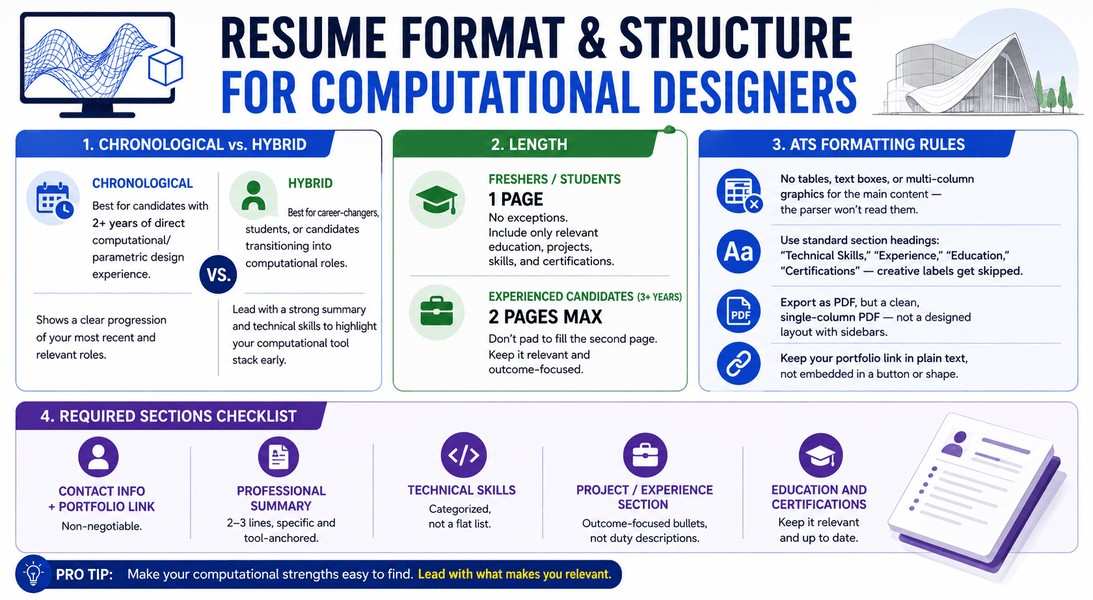
Chronological vs. Hybrid
For candidates with two or more years of direct computational/parametric design experience, a standard reverse-chronological format works well. Your most recent role is probably the most relevant, and the progression tells a clear story.
For career-changers , architects or designers pivoting into computational roles, or students finishing a Rhino/Grasshopper course and applying for their first computational role , a hybrid format works better. Lead with a strong summary and a prominent technical skills section, then move into project experience. This way, your computational tool stack gets seen before a reviewer reaches the parts of your experience that weren't computational-focused.
Length
One page for freshers and students. No exceptions , there's no reason a recent graduate's computational design resume needs two pages unless they've done significant project work worth documenting in detail.
Two pages maximum for experienced candidates with 3+ years. Don't pad to fill the second page. If you can't fill it with genuinely relevant content, keep it to one.
ATS Formatting Rules
Most firms at any reasonable scale run resumes through applicant tracking systems before a human sees them. For an ATS resume as a computational designer, the formatting rules are strict:
- No tables, text boxes, or multi-column graphics for the main content , the parser won't read them
- Standard section headings: "Technical Skills," "Experience," "Education," "Certifications" , creative labels get skipped
- Export as PDF, but a clean, single-column PDF , not a designed layout with sidebars
- Keep your portfolio link in plain text, not embedded in a button or shape
Required Sections Checklist
Every computational design resume needs:
- Contact info + portfolio link (non-negotiable , covered separately below)
- Professional summary (2–3 lines, specific and tool-anchored)
- Technical skills (categorized, not a flat list)
- Project/experience section (outcome-focused bullets, not duty descriptions)
- Education and certifications
Ready to build a computational design resume backed by real Grasshopper project work and a recognized certification? Kaarwan's Rhino & Grasshopper course gets you there. Apply today.
What to Include in a Computational Design Resume Summary
The summary is where most computational design resumes start going wrong. "Passionate architect with strong design skills seeking to apply creativity in a dynamic firm" , that's not a summary, it's a placeholder. It tells a computational design hiring manager nothing actionable.
A summary that works for computational/parametric roles follows a simple formula:
[Experience level] + [core tool stack] + [one quantifiable outcome or distinguishing capability]
Here are two examples , one for a fresher, one for someone with experience:
Fresher/Student: "Architecture graduate with Rhino 7 and Grasshopper 3D proficiency developed through project-based training, including parametric facade studies and Ladybug-driven environmental simulations. Portfolio includes five Grasshopper definition-led projects covering form optimization, structural morphology, and digital fabrication output. Seeking a computational design or design technology role in an AEC or parametric-focused practice."
2+ Years Experience: "Computational designer with 3 years of experience in parametric form-finding, environmental simulation, and Grasshopper-to-fabrication workflows across residential and commercial projects. Proficient in Rhino 8, Grasshopper 3D, Python scripting, and Rhino.Inside.Revit. Reduced documentation time by 30% through automated drawing extraction definitions; rationalized three freeform facade projects for CNC fabrication within parametric model environments."
Notice what both summaries do: they name specific tools, they name a project type or workflow, and the experienced one has a number attached to an outcome. That's the formula.
Also Read: Rhino 8 and Grasshopper Tutorial for Beginners
Skills Section , What to List and How to Prioritize
The technical skills section of a computational design resume is not a flat list. Group it into categories. Not because it looks better, but because ATS systems and human reviewers can both parse a grouped structure faster , and because it immediately signals that you understand the distinction between your core parametric tools and your adjacent capabilities.
Here's a practical grouping structure:
Core Parametric & Computational Tools: Rhinoceros 3D (v7/v8), Grasshopper 3D, Rhino.Inside.Revit
Grasshopper Plugins (list only those you've genuinely used in a project context): Kangaroo 2 (physics simulation), Ladybug Tools (environmental analysis), Honeybee (energy modeling), Karamba3D (structural analysis), Weaverbird (mesh subdivision), Lunchbox, Human UI
Scripting & Programming: Python (GH Python), C# (RhinoCommon), Rhinoscript; JavaScript or other languages if relevant
Adjacent BIM & Documentation Tools: Autodesk Revit, Dynamo, Navisworks; AutoCAD
Visualization & Fabrication: Enscape / V-Ray / Lumion, Adobe Creative Suite; CNC workflow output (G-code), 3D printing output; Speckle
One important note: when you're applying for a specific role, check the job description before submitting. If the posting mentions Karamba3D, make sure Karamba3D appears in your skills section , ATS keyword matching is literal. If they wrote "Grasshopper" and you wrote "GH3D," they don't match.
For a deeper look at which Grasshopper skills employers actually look for, that's worth reading alongside building this section.
Also Explore: Parametric Design Career Roadmap , Kaarwan
Parametric Designer Resume
A parametric designer resume has a specific emphasis that separates it from a broader computational design resume. Parametric design work is about iteration, optimization, and the relationship between parameters and outcomes. The resume needs to reflect that mindset , not just the tools.
What recruiters reading a parametric designer resume want to see:
Iteration counts and metrics. How many design options did you generate? How did the parametric model respond to input changes? A bullet that says "explored 40+ form variations through parametric manipulation of slenderness ratio, taper, and twist parameters" communicates parametric thinking. A bullet that says "designed multiple building options" does not.
Optimization language. Parametric design is often used to optimize something , shading performance, structural efficiency, material use, construction complexity. If your parametric work had an optimization objective, name it and quantify the outcome.
Form-finding and geometry rationalization. These are the two most common parametric workflows in practice, and they should appear by name if they're part of your experience.
Here are four sample parametric design resume bullet points, ready to adapt:
- "Developed a parametric massing model in Grasshopper 3D exploring 35+ form variations across height, setback, and courtyard geometry parameters for a mixed-use competition brief, shortlisting three optimal configurations for client presentation."
- "Conducted facade optimization studies using a Grasshopper definition linked to Ladybug solar analysis, varying shading fin depth and angle across 20 iterations to reduce direct solar radiation on south-facing glazing by 22% while maintaining target daylighting levels."
- "Rationalized a freeform NURBS roof surface into approximately 280 flat-packable steel panels using custom Grasshopper logic, generating panel schedules and CNC cutting files directly from the parametric model."
- "Designed a structurally informed canopy using Karamba3D integrated within a Grasshopper definition, optimizing member cross-sections for minimum material use under live load conditions, reducing estimated steel tonnage by 14% vs. initial concept."
The most common mistake on parametric designer resumes: listing "parametric modeling" as a skill with no project evidence attached. That single line, unsupported by a bullet showing what it produced, doesn't differentiate you from anyone else who's opened Grasshopper.
Rhino Grasshopper Resume
The Rhino Grasshopper resume has a very specific audience: design technology teams, digital fabrication studios, computation-first practices, and design technology roles within larger firms where the Grasshopper-to-fabrication or Grasshopper-to-BIM pipeline is a daily workflow. This is the most specialized version of a computational design resume, and the specificity of what you list here matters more than anywhere else.
How to List Rhino/Grasshopper Proficiency Honestly
Don't say "proficient in Grasshopper" if you've modified templates but haven't built definitions from scratch. And don't undersell yourself either. A useful honest framework:
- Working knowledge: Can build and modify parametric definitions; understands data trees and basic node logic; has used at least 2–3 plugins for real project applications
- Intermediate: Builds complex definitions from scratch; manages multi-branch data structures; has written GH Python scripts for automation tasks
- Advanced/Scripting: Builds custom components in C# (RhinoCommon); has created reusable parametric families or tools used by team members; comfortable with API-level manipulation
Apply whichever level applies honestly , hiring managers who use Grasshopper daily will probe this in an interview.
Sample Bullets for Grasshopper-Driven Work
These are ready-to-adapt Rhino Grasshopper resume bullets organized by what they demonstrate:
Plugin usage (environmental): "Built a Grasshopper definition integrating Ladybug for solar radiation mapping and Honeybee for EnergyPlus simulation setup, comparing three facade configurations for a passive-certified residential project; results informed final orientation and glazing ratio decision."
Custom component / scripting: "Developed a custom GH Python component to automate room schedule extraction from Rhino geometry attributes, reducing manual documentation time by approximately 4 hours per project iteration."
Physics / structural: "Used Kangaroo 2 physics engine in Grasshopper to simulate cable-net and tensile surface behavior for a public pavilion, iterating anchor point positions until achieving target deflection-to-span ratio under wind load."
Fabrication output: "Created a Grasshopper definition that processed complex NURBS geometry into 3D-printable mesh components, applying Weaverbird subdivision for smoothness and outputting STL files directly, eliminating manual post-processing steps."
Rhino.Inside.Revit workflow: "Established a live Rhino.Inside.Revit link enabling direct transfer of parametrically generated facade paneling geometry into Revit as native curtain wall components, maintaining associativity for design iteration across both environments."
One thing worth mentioning here: if you've completed a formal Grasshopper certification or course with project deliverables, it belongs in the certifications section , and it matters more than most people think for roles where hiring managers are uncertain about a candidate's practical depth. Kaarwan's Rhino & Grasshopper Certification builds exactly the kind of project portfolio that makes these bullets credible , definitions you built, not tutorials you watched.
Also Read: Rhino Grasshopper Course in India (2026)
Sample Computational Design Resume Bullet Points (By Experience Level)
This section is where the resume guide either earns its value or doesn't. Generic bullet advice ("use action verbs, quantify your impact") tells you nothing specific. Here's what that actually looks like for computational design, at each experience level.
Fresher / Student (Portfolio Project-Based)
You don't have professional project history , that's fine. You have coursework, training projects, and portfolio work. Frame it the same way professional experience gets framed: what tool, what project, what it produced.
- "Developed a parametric facade definition in Grasshopper for an architecture thesis project, generating 25 facade panel configurations from a single Grasshopper definition by adjusting density, rotation, and depth parameters."
- "Built a Ladybug solar analysis workflow to evaluate daylighting performance across three courtyard geometries for a competition entry; findings directly informed final courtyard proportion."
- "Created digital fabrication files from a Grasshopper definition, outputting laser-cutting paths for a 1:50 physical model of a pavilion structure with 64 unique panel geometries."
1–3 Years (Early Career, Single-Firm)
Now you have real project context. Name the project type, the tool, the outcome. One or two numbers per bullet.
- "Designed and deployed a Grasshopper-based room layout generator for a residential developer client, automating unit arrangement across 8 typologies from parametric input variables; reduced schematic layout time from 3 days to approximately 6 hours per building type."
- "Integrated Rhino.Inside.Revit into the studio's standard workflow for a mixed-use retail project, enabling complex curved geometry modeled in Rhino to be embedded into Revit documentation as native elements; reduced geometry rebuild time by an estimated 30%."
- "Conducted structural form-finding studies using Karamba3D within Grasshopper for a long-span roof canopy, iterating 12 structural configurations and presenting deflection and reaction force comparisons to structural engineer."
3+ Years (Senior, Cross-Project Impact with Metrics)
Leadership, mentoring, firm-level contribution, and cross-project metrics are now relevant alongside individual project work.
- "Led computational design effort across five residential and commercial projects, establishing reusable Grasshopper definition library for facade panelization, environmental analysis, and area schedule extraction; estimated 40% reduction in setup time for new project workflows."
- "Mentored two junior designers in Grasshopper fundamentals and GH Python scripting; developed internal reference documentation used as standard onboarding resource."
- "Directed development of a parametric structural system for a prefabricated housing prototype, coordinating Grasshopper definition output with structural engineer and CNC fabricator; system produced 12 panel types covering 8 unit configurations from a single parametric model."
Also Read: What These Roles Pay at Each Experience Level , Kaarwan
Common Mistakes That Get Computational Design Resumes Rejected
These come up consistently. Simple to fix once you know them.
Listing tools without project context. This is the biggest one. "Grasshopper, Kangaroo, Ladybug, Python" in a skills list tells a hiring manager you've installed the tools. A bullet showing what those tools produced in a real or training project tells them you can use them. If you have space for only one fix, it's this one.
No portfolio link. A computational design resume without a portfolio link is a significant red flag in this field. Computational and parametric design work is inherently visual and process-oriented , hiring managers want to see the definitions, the iterations, the fabrication outputs. A portfolio link in the header is mandatory. If your portfolio isn't ready, that's a separate problem worth solving before submitting applications.
Generic architect resume template applied without tool or script specificity. Taking a standard architecture resume template and inserting "Rhino" and "Grasshopper" into the software section doesn't create a computational design resume. It creates an architecture resume that mentions Rhino and Grasshopper. The entire framing , summary, bullet language, skills structure , needs to shift toward parametric and computational specificity.
Overclaiming scripting depth. Don't list "Python (advanced)" if you've written a handful of GH Python scripts. Technical interviews in computational design roles often involve live problem-solving or code review. Overclaiming is worse than underselling because it leads directly to a specific, uncomfortable moment in the interview.
Missing portfolio and project evidence together. Some candidates have the portfolio but write bullets that don't reference the specific work in it. Others write strong bullets but don't link a portfolio. Both together is what gets you called.
Build the Skills to Back This Resume Up
Kaarwan's Rhino & Grasshopper Certification builds the exact project portfolio , definitions, simulations, fabrication outputs , that makes every bullet in this guide credible. Enroll now.
Closing Thoughts
A computational design resume that gets shortlisted is built on three things: format that doesn't get filtered by ATS, a skills section that shows tool depth not just tool awareness, and bullet points that prove the tools actually produced something.
The format part is mechanical , follow the rules in this guide and it's handled. The skills section takes honesty and categorization. The bullets are where the real work happens, and they're entirely dependent on having real project evidence to draw from.
That's the connection point to the course and the portfolio , not as a sales pitch, but as the actual mechanism. If the project evidence isn't there yet, Kaarwan's Rhino & Grasshopper Certification builds it. Real definitions, real simulation outputs, real fabrication workflows , the exact kind of work that becomes resume bullets and portfolio pages.
The resume is the argument. The portfolio is the proof. Build both together.
If you're still mapping your parametric design career path or want to understand what these roles pay at each experience level, those are the natural next reads alongside this guide.
FAQ
Do I need a portfolio if I have a strong computational design resume?
Yes , without exception. A computational design resume without a portfolio link is incomplete in this field. Parametric and computational work is process-driven and visually complex; hiring managers want to see the actual Grasshopper definitions, the iterations, and the outputs, not just read bullet descriptions of them. Think of the resume as the argument and the portfolio as the evidence. Both are required. If your portfolio isn't ready, building it should happen in parallel with building the resume, not after.
Should freshers list coding/scripting skills they're still learning?
Yes, but honestly. List it with appropriate framing , "GH Python (basic)" or "Python scripting (coursework projects)" is honest and still adds signal value. Don't list "Python (intermediate)" if you've written five scripts for training exercises. Computational design hiring managers often interview with live coding or scripting questions, and a mismatch between resume claims and actual capability is worse than being appropriately junior and honest about it.
Is a 1-page resume enough for computational design roles?
For freshers and students: yes, absolutely. One strong page with a targeted summary, a properly structured skills section, and three to four well-written project bullets is more competitive than two pages of padded content. For experienced candidates with 3+ years and multiple real projects to show: two pages is appropriate, but only if the second page is genuinely adding project evidence or certification detail, not restating the same work in different words.
How do I show Grasshopper scripting experience without formal work history?
Through training and personal projects, framed the same way professional experience gets framed. A Grasshopper definition built during a structured certification program , especially one with a real design brief, iteration process, and documented output , is legitimate portfolio and resume content. Label it clearly: "Course Project , Kaarwan Rhino & Grasshopper Certification" or "Personal Project" as appropriate. The key is showing the definition did something: generated X outputs, solved Y problem, produced Z fabrication files. The project context matters; the employment context doesn't, especially at entry level.