

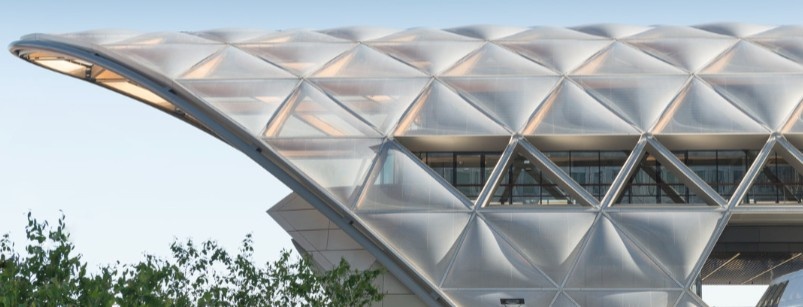
For over a century, glass has defined architectural transparency. It was the universal answer whenever light and visibility were required. But today, the very idea of “transparency” is being rewritten — not by thicker glass or stronger coatings, but by a featherweight polymer that behaves nothing like a traditional façade.
That material is ETFE (Ethylene Tetrafluoroethylene) — and it is quietly reshaping how architects think about daylight, enclosure, and energy.
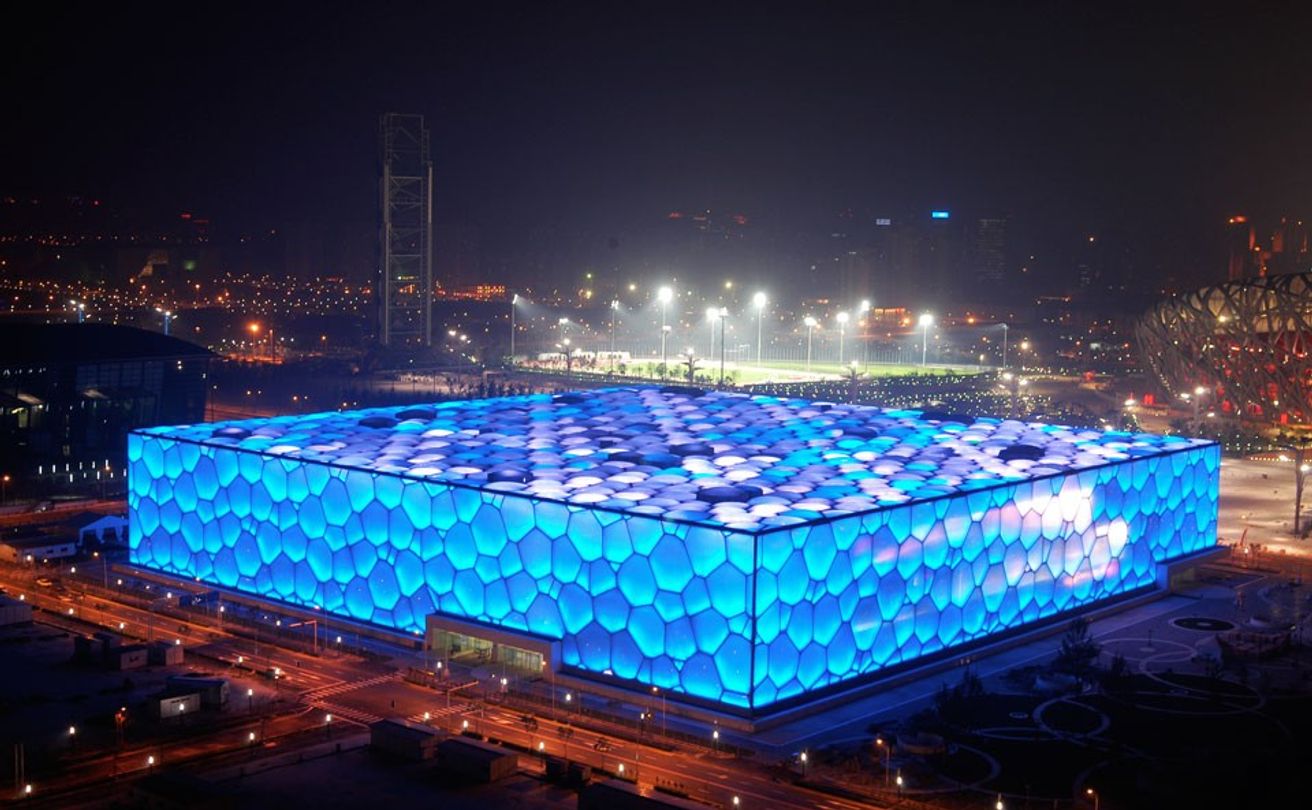
Image Source: RTF, ETFE Panels allow facades/structural form to be lit by multiple colors during night, while during the day, it allows natural day light in, with an option varying translucency.
From Material Substitute to Design Behaviour
To call ETFE a glass replacement is to miss its essence. ETFE is not simply another transparent panel — it is a dynamic, air-supported membrane system. While conventional façades such as curtain walls, ACP cladding, or polycarbonate sheets remain static, ETFE operates as a responsive skin.
Through controlled air pressure and layered film technology, it negotiates between climate, comfort, and light — actively. This shift marks the beginning of what could be called material intelligence in architecture.
Imagine façades that breathe, roofs that adapt to solar conditions, and skins that perform like climate-responsive membranes rather than heavy, rigid barriers.
ETFE enables:
- Parametric inflation control to tune form and stiffness.
- Daylight modulation through printed or fritted layers.
- Solar gain regulation via air cavity management.
- Dynamic translucency that shifts the atmosphere of a space throughout the day.
This new behaviour aligns perfectly with where architectural practice is heading — towards buildings that are lighter, faster, and smarter in energy use.
.jpeg)
Image Source: Hand Drawn, Pragya Laungani
How ETFE Works
An ETFE cushion typically consists of two or three thin polymer films, sealed along their perimeter and inflated with low-pressure air to form a pillow-like structure. A small mechanical unit maintains constant air pressure, keeping the membranes stable against wind loads and environmental stresses.
Despite being 10 times lighter than glass, these cushions can span large areas with minimal structural support. They also allow for complex freeform geometries, enabling architects to create organic, fluid structures that would otherwise be prohibitively expensive in glass or steel.
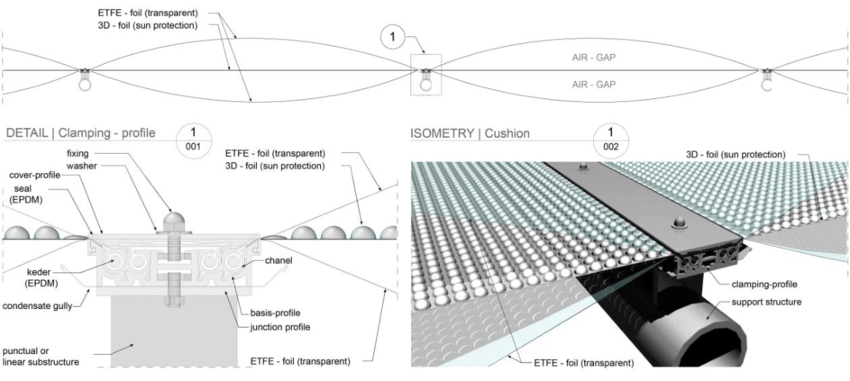
Image Source: Jan Cremers, Research Gate Doc
Where ETFE Works Best
ETFE’s lightweight nature and diffused light quality make it particularly powerful in large-scale public structures, where spatial experience and environmental comfort matter as much as structural performance.
| Application Type | Why ETFE Excels |
|---|---|
| Stadiums and Arenas | Achieves vast spans with minimal steel, provides soft daylight, and dramatically reduces total construction weight and cost. |
| Zoos, Botanical Gardens, Biodomes | Transmits UV light essential for plant growth and natural ecosystems — creating controlled yet living environments. |
| Airport Terminals and Transport Hubs | Offers glare-free daylight and thermal comfort, reducing reliance on artificial lighting. |
| Retail Malls and Atriums | Combines luminous ambience with efficient climate control, enhancing user experience while reducing energy load. |
These use cases demonstrate that ETFE is not an exotic experiment — it’s a practical response to the growing need for lightweight, low-maintenance, and sustainable envelope systems.
Advantages That Matter for Practice
Beyond its visual novelty, ETFE provides engineering and financial advantages that appeal to both architects and clients.
- Self-Cleansing Behaviour: Its static surface charge repels dust, allowing rain to wash it clean — removing the need for costly façade maintenance cycles.
- Exceptional Lightness: At roughly 1% the weight of glass, ETFE reduces the structural load, foundation size, and overall embodied carbon.
- UV Transparency: Unlike most plastics, ETFE allows UV light to pass through — crucial for biological and botanical applications.
- Ease of Repair: Individual cushions can be replaced without dismantling the whole façade, keeping lifecycle costs low.
- Superior Thermal Performance: The air cavity acts as insulation, creating a lightweight double-skin system that regulates temperature effectively.
All of these combine into one insight — ETFE is financially intelligent as much as it is technically innovative.
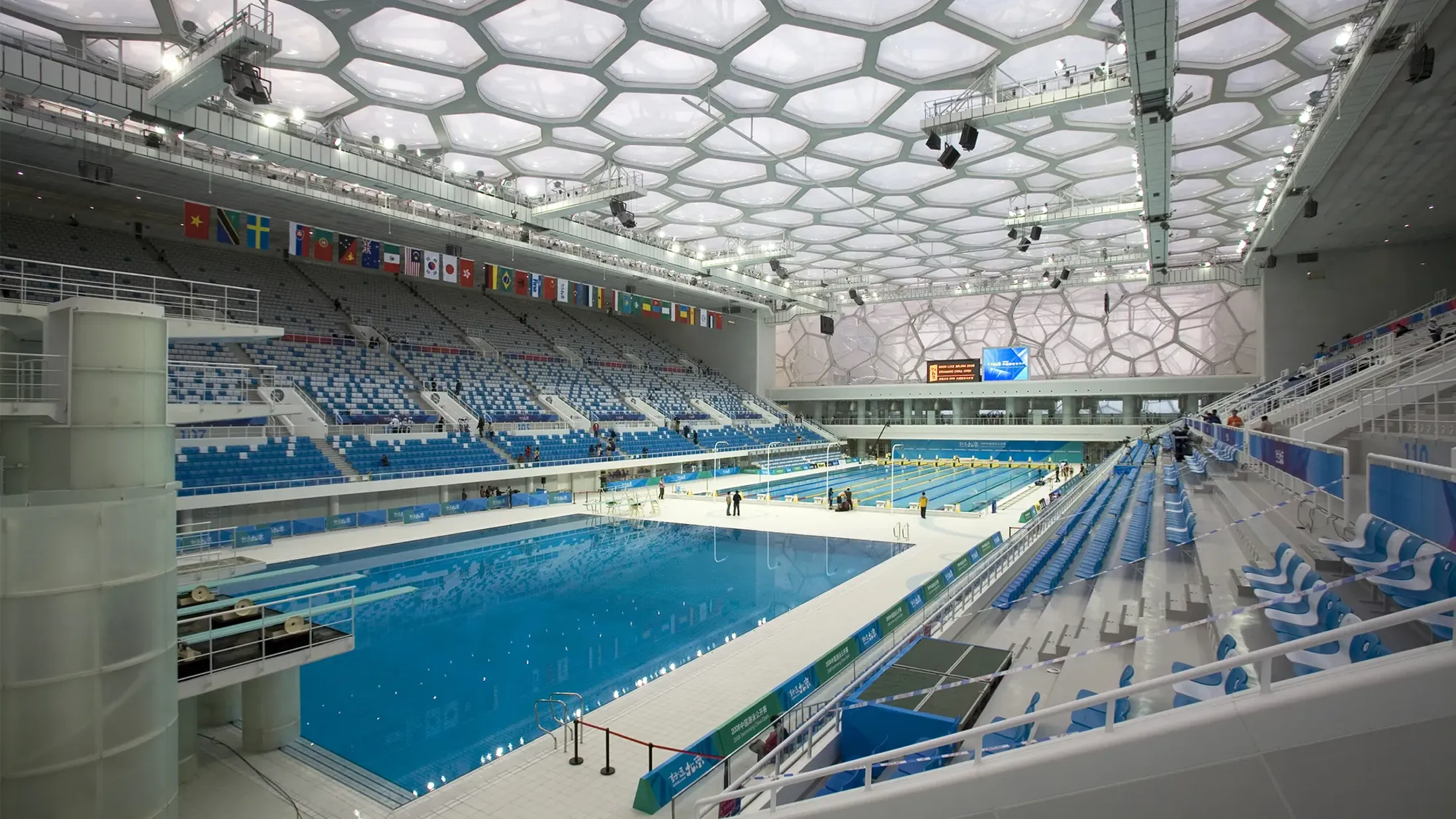
Image Source: Arup
Project Case Studies
1. Eden Project, UK – Nicholas Grimshaw
The Eden Project remains one of the most iconic examples of ETFE architecture. Here, ETFE made possible the creation of vast biodomes that simulate different global climates under one roof. The material’s light weight and high transparency allowed Grimshaw’s team to construct a massive ecosystem enclosure with minimal structural burden — a perfect fusion of ecological and architectural intelligence.
2. Allianz Arena, Munich – Herzog & de Meuron
This project demonstrated ETFE’s expressive potential. Each cushion on the façade is LED-lit, enabling the entire stadium to glow in different colours based on the event — a façade that communicates, rather than merely enclosing. The Allianz Arena proved that architectural skins could be both performative and emotional.
3. Beijing National Aquatic Centre (Water Cube), China – PTW Architects & ARUP
ETFE’s structural behaviour reached new heights here. The Water Cube’s parametric, bubble-like façade is inspired by natural minimal surface geometry, creating a thermally efficient and visually stunning envelope. This project cemented ETFE’s position in the computational design and membrane engineering conversation globally.
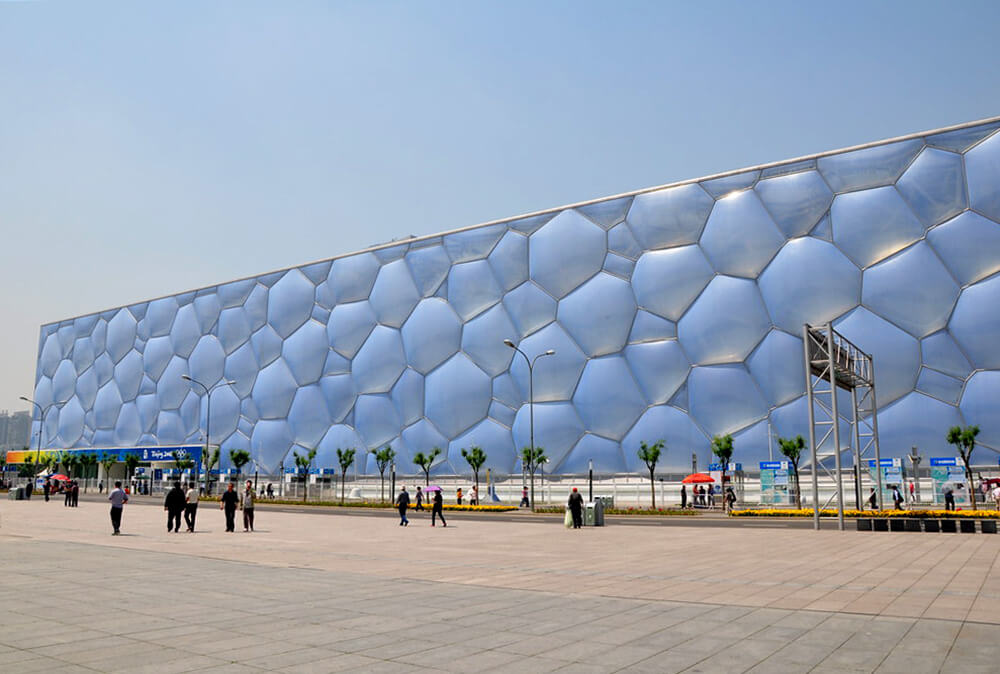
Image Source: Archit Travel - Yes it does look & feel in person too like a big bubble wrap :)
Where ETFE Should Not Be Used
As promising as ETFE is, it’s not universally applicable. Architects must approach it with precision, not hype.
Avoid ETFE in:
- Vandal-prone areas where puncture risks are high.
- Fire-sensitive industrial buildings with stringent material codes.
- Small residential projects where visual or tactile solidity is desired.
ETFE thrives when it’s part of a designed system, not an isolated material swap.
ETFE and the Digital Future
ETFE sits naturally within BIM-integrated workflows and parametric design systems. Since cushion geometry, air cavity logic, and shading performance can be digitally modelled, architects can coordinate real-time daylight analysis, inflation behaviour, and fabrication geometry within one simulation environment.
This level of integration means ETFE is not just a material — it’s a data-driven design element. In an age of simulation, AI-driven performance analysis, and net-zero building codes, materials like ETFE that can adapt and perform will outlast those that merely protect.
From Transparency to Intelligence
ETFE represents a philosophical shift in architectural material thinking — from mass to membrane, from thickness to performance, from protection to participation.
It doesn’t just let light in; it modulates it. It doesn’t just cover; it communicates. It doesn’t just replace glass; it redefines transparency.
As the profession leans toward lighter, climate-responsive construction, ETFE is set to become a defining material for architects who view building envelopes not as barriers, but as living, breathing systems of light and air.
FAQs
1. What is ETFE in architecture?
ETFE (Ethylene Tetrafluoroethylene) is a lightweight polymer used as an air-inflated cushion system for façades and roofs, offering transparency, thermal insulation, and structural efficiency.
2. How does an ETFE cushion work?
Multiple ETFE film layers are sealed and inflated with low-pressure air to create a stable, insulated pillow that resists wind loads and provides diffuse natural light.
3. Why is ETFE preferred over glass?
ETFE is 10 times lighter than glass, easier to maintain, allows UV transmission, and requires far less structural support — making it both cost-effective and sustainable.
4. Where is ETFE commonly used?
It’s ideal for stadiums, airports, botanical gardens, transport hubs, and atriums — spaces needing large spans, soft daylight, and low structural weight.
5. What are the limitations of ETFE?
It requires uninterrupted air pressure for stability, offers lower acoustic insulation, and is less suited to vandal-prone or high-fire-risk environments.
6. Can ETFE be used in Indian climates?
Yes — it performs well in tropical and semi-arid conditions, offering daylight diffusion, thermal comfort, and low maintenance, especially for public and institutional projects.




.png)