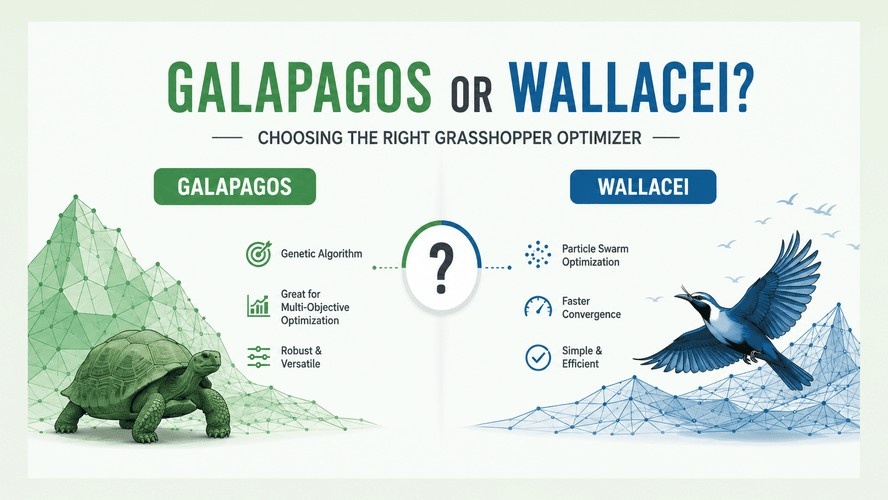
If you've spent any real time inside Grasshopper, you've probably hit that moment where you have a design that works, technically, but you know it could be better. Maybe the facade panels are eating too much daylight. Maybe the roof form is using more material than it needs to. That's the exact moment optimization tools earn their keep, and it's also the moment the Galapagos vs Wallacei question shows up, usually somewhere in a studio group chat or a very confused forum thread at 2 AM.
Here's the short version, so you're not left hanging: Galapagos is the fast, built-in solver you reach for when you've got one clear goal. Wallacei is the heavier, more analytical tool you bring in when you're juggling several goals that don't always agree with each other. Same evolutionary logic underneath, very different jobs on top. Let's get into why.
What Galapagos Actually Does
Galapagos ships with Grasshopper, which already tells you something — Rhino's own team built it to be the default entry point into evolutionary solving, and it shows. You set an input parameter (or a few), define a fitness goal, hit the green play button, and watch it iterate.
Under the hood, it's running a genetic algorithm. Think of it as breeding solutions: it generates a population of design options, keeps the ones that perform best against your fitness function, mixes their traits, mutates a few for variety, and repeats. Generation after generation, the population edges toward whatever you told it to optimize for — minimum surface area, maximum solar exposure, least structural deflection, whatever the single number is.
The catch, and it's not really a flaw so much as a design choice, is that Galapagos only understands one fitness goal at a time. You can't hand it "minimize cost AND maximize daylight AND keep the structure light" and expect a nuanced answer. It'll collapse everything into one number if you try, which usually means one goal quietly dominates the others without you realizing it. For early massing studies, quick facade panel tests, or narrowing down a parameter range before you commit to something heavier, though, it's genuinely hard to beat for speed and simplicity.
Want to actually run Galapagos and Wallacei yourself instead of just reading about them? Kaarwan's Advanced Rhino & Grasshopper Certification walks you through both, hands-on, using real project briefs.
What Wallacei Actually Does
Wallacei picks up more or less where Galapagos runs out of road. It's also evolutionary, also genetic-algorithm-based, but it was built specifically to handle multiple, competing objectives at once — which, if you've ever actually designed a building, is closer to how real projects behave anyway. Nobody optimizes for just one thing.
What sets it apart:
- Multi-objective optimization with Pareto front visualization — instead of spitting out one "best" answer, it shows you the whole set of trade-off solutions, so you can see exactly what you'd give up in daylight performance to gain in structural efficiency, for instance.
- Constraint handling — you can set hard and soft limits so the solver doesn't waste cycles chasing options that were never going to be buildable anyway.
- Statistical dashboards — box plots, correlation charts, convergence graphs. It's a lot more transparent about why certain solutions rose to the top, which matters when you have to explain a design decision to a client or a jury.
- Sensitivity analysis — it'll tell you which of your input parameters is actually moving the needle, which is oddly one of the most underrated features once you start using it.
None of this is free, though. Wallacei asks more of your machine and more of your patience — setup takes longer, and the extra analytical layer means each run tends to be slower than an equivalent Galapagos run. A 2025 comparative study out of Gebze Technical University, testing both solvers on a parametric high-rise design problem, found much the same pattern: Wallacei's added complexity pays off specifically once the problem has more than one meaningful objective, but it's overkill when it doesn't.
Also read: Harnessing Weaverbird & Kangaroo for Parametric Design
Galapagos vs Wallacei: Side by Side
| Aspect | Galapagos | Wallacei |
| Optimization type | Single-objective | Multi-objective |
| Setup | Very intuitive, minimal config | Needs more configuration and planning |
| Speed | Fast, low overhead | Slower, higher computational cost |
| Visualization | Basic fitness graph | Pareto fronts, statistical dashboards |
| Learning curve | Gentle | Steeper, some optimization theory helps |
| Best for | Quick concept tests, single clear goal | Complex, competing-objective projects |
| Native to Grasshopper | Yes, built in | Third-party plugin |
If you only remember one thing from this table, make it this: Galapagos optimizes toward an answer. Wallacei maps out a range of good answers and lets you pick the trade-off you're comfortable with. That distinction changes how you should be using each one.
When to Use Galapagos
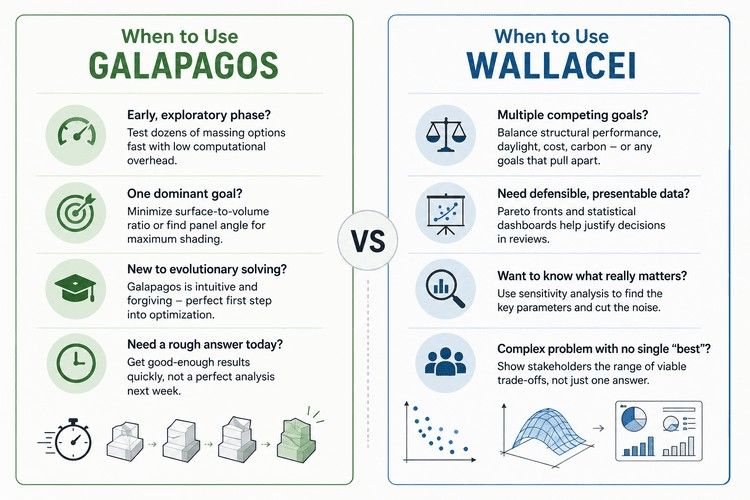
Reach for Galapagos when the brief is narrow and the clock is ticking. A few situations where it just fits:
- You're in the early, exploratory phase of a design and need to test dozens of massing options fast, without a huge computational overhead.
- There's genuinely one dominant goal — say, minimizing a facade's surface-to-volume ratio, or finding the panel angle that maximizes shading on a specific elevation.
- You're teaching yourself evolutionary solving for the first time. Honestly, most people's first real Grasshopper optimization experience is Galapagos, and that's not an accident — the interface doesn't punish you for not knowing genetic algorithm theory yet.
- You need a rough answer today, not a perfectly analyzed one next week.
When to Use Wallacei
Wallacei earns its setup time when the problem actually has layers to it:
- You're balancing structural performance against daylight, or cost against embodied carbon, or any pair (or trio) of goals that genuinely pull in different directions.
- You're further along in a project and need defensible, presentable data — the Pareto front visuals and statistical dashboards make it much easier to justify a design decision in a review.
- You want to understand which parameters actually matter before locking in a facade system, using the sensitivity analysis to cut out the noise.
- The project is complex enough that a single "best" answer would be misleading, and stakeholders need to see the range of viable trade-offs instead.
A few real projects make this trade-off concrete. The adaptive mashrabiya screens on Abu Dhabi's Al Bahar Towers weren't the product of a single-goal search — they had to respond to solar gain, structural feasibility, and fabrication limits all at once, which is exactly the kind of layered problem multi-objective solvers were built for.
The ICD/ITKE research pavilions out of Stuttgart lean on similar evolutionary, form-finding logic to balance material efficiency against structural behaviour. And Gehry's glass sails on the Fondation Louis Vuitton had to reconcile geometry, fabrication tolerances, and cost simultaneously — three competing pressures, not one. None of these were "find the single best shape" problems. They were "find the shape that survives five different demands at once" problems.
Also explore: Grasshopper for Structural Engineers: A Comprehensive Guide
Can You Use Both Together?
Yes, and honestly, a lot of practicing designers do exactly this rather than picking a side. A pretty common workflow looks like: run Galapagos first to narrow a huge parameter space down to a manageable range, quickly, without burning hours of compute time chasing options that were obviously never going to work. Then switch to Wallacei once you're closer to a final concept, when you actually need to weigh multiple performance criteria against each other and want the analytical depth to back up your decision.
It's not an either/or choice so much as a sequence. Galapagos for the rough cut, Wallacei for the fine one. If you're only ever using one of these tools, you might be leaving a genuinely useful workflow on the table.
Also read: Top 10 Must-Know Plugins for Rhino and Grasshopper
Common Beginner Mistakes with Either Tool
A few things trip people up, regardless of which solver they're using:
- Optimizing too early. Running dozens of generations before you've even sketched out what "good" looks like for your project just wastes time. Know your fitness criteria first.
- Vague fitness functions. "Make it better" isn't a fitness function. If your goal isn't numerically defined, neither solver can chase it properly.
- Ignoring computation time on heavy models. Both tools re-run your entire Grasshopper definition on every generation. If your model is already sluggish, a 50-generation Wallacei run can eat an entire afternoon. Simplify the geometry you're testing against before you hit go.
- Treating Wallacei's Pareto front as one "winner." The whole point of the Pareto front is that there isn't a single best answer — there's a set of trade-offs, and picking one is a design decision, not something the software does for you.
Also read: A Guide to Parametric Modeling with Rhino
Ready to Put This Into Practice?
Reading about optimization only gets you so far — the real learning happens once you're setting fitness goals and watching a solver iterate on your own model. Kaarwan's Advanced Rhino & Grasshopper Certification walks you through both Galapagos and Wallacei on real, project-based work, alongside the rest of the plugin ecosystem you'll actually use on the job.
If facade performance and computational workflows are where you want your career to go, this is the kind of hands-on, guided practice that turns "I've read about it" into "I've built it." The Advanced Rhino & Grasshopper Certification covers exactly this, from plugin fundamentals to full optimization workflows.
Choosing between Galapagos and Wallacei really comes down to how complicated your problem is, not which tool is "better." A quick daylight test on a single facade panel doesn't need Wallacei's full analytical suite, and a high-rise juggling structural, environmental, and cost constraints at once is going to outgrow Galapagos fast. Get comfortable reading your own project's demands, and the choice mostly makes itself.
Optimization tools make a lot more sense once you're setting up fitness goals yourself. Kaarwan's Advanced Rhino & Grasshopper Certification is built around exactly that kind of practical, project-based learning.
FAQs
Is Wallacei harder to learn than Galapagos?
A bit, yes. Galapagos is built for a gentle learning curve — you connect a fitness goal and go. Wallacei asks you to understand concepts like Pareto fronts and constraint handling before you get real value out of it, so expect a steeper climb, especially if you're new to optimization theory in general.
Do I need both if I already know one?
Not strictly, but they cover different ground. If you're only ever solving single-objective problems, Galapagos alone will take you far. The moment your projects start involving competing performance goals — which most real facade and structural briefs eventually do — Wallacei becomes worth the extra setup time.
Which is more relevant for sustainability-focused projects?
Wallacei tends to fit better here, mainly because sustainability rarely comes down to one metric. Balancing daylight, energy load, and material use simultaneously is a multi-objective problem by nature, and that's precisely the scenario Wallacei was built to handle.
Can beginners start directly with Wallacei?
You can, but it's not the easiest on-ramp. Most people find it smoother to get comfortable with Galapagos and basic genetic algorithm logic first, then move to Wallacei once single-objective optimization feels intuitive.