Architecture has always been about pushing boundaries, but for decades, the tools available made certain ideas nearly impossible to execute. That changed with the rise of Grasshopper for Rhino, a visual programming environment that lets designers create complex, logic-driven geometries without writing a single line of code. What was once reserved for experimental labs is now reshaping skylines worldwide.
For students and professionals in architecture, interior design, or urban planning, understanding computational design through Grasshopper is no longer optional; it's essential. The tool has fundamentally altered how facades are conceived, how forms are generated, and how design decisions are made.
What Makes Grasshopper a Game-Changer in Architecture
Grasshopper is a visual programming in architecture tool that runs as a plugin inside Rhinoceros 3D. Instead of manually modelling every element, designers build a network of connected nodes, called components, that process data and generate geometry in real time. Tweak one slider, and the entire design updates instantly.
This node-based logic allows designers to explore hundreds of iterations within minutes, something that would have taken days in traditional software. Unlike AutoCAD or Revit, Grasshopper treats design as a living system, not a static drawing. And the best part? No coding background required. Its visual interface bridges the gap between design thinking and computational logic, making it accessible, yet incredibly powerful.
How Grasshopper Powers Parametric Facade Design
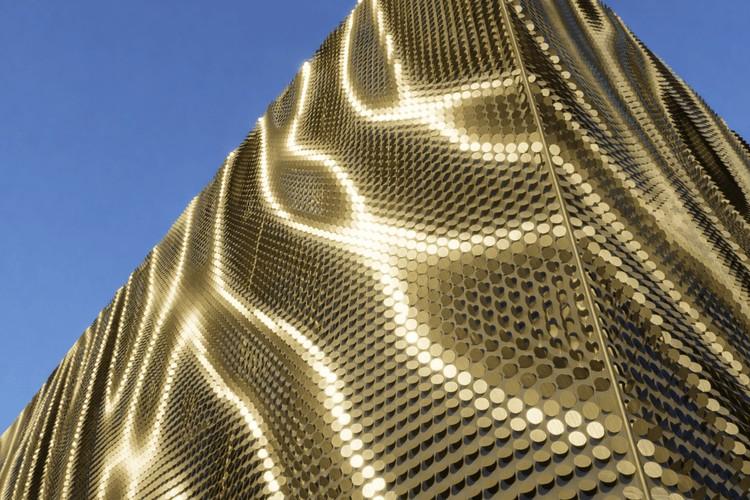
Image Source - Parametric Architecture
The most visible impact of Grasshopper today is on parametric facade design. Facades are no longer just protective skins; they are intelligent, performance-driven surfaces that respond to light, wind, climate, and user behaviour.
Using attractor algorithms, designers can define a facade panel's shape, size, rotation, and density as parameters tied to real-world inputs. The result? A surface that breathes, adapts, and performs.
"A requirement for the design, development, and realisation of complex morphology is a closed, digital information loop between the project's model, finite element simulations, and computer numeric machine control," University of Stuttgart
The Role of Plugins: LunchBox, Ladybug & Kangaroo
What truly elevates Grasshopper is its plugin ecosystem. These Grasshopper plugins extend its capabilities far beyond basic modelling, turning it into a full-scale design and analysis powerhouse:
- LunchBox — Specialises in panelling and generating complex geometric surface patterns. It's widely used for parametric facade design workflows, making it a favourite for architects working on intricate cladding and fabrication-ready surfaces.
- Ladybug & Honeybee — It connects live climate data directly to the model, enabling detailed sun path analysis, wind studies, and energy performance simulations, all within the same Grasshopper environment.
- Kangaroo — A physics-based plugin built for form-finding, allowing designers to simulate real structural behaviour and arrive at naturally optimised, force-driven shapes.
- Karamba3D — Takes it further by enabling full parametric structural analysis, ensuring that even the most expressive, complex forms remain buildable and structurally sound.
Together, these tools transform Grasshopper into a complete computational design environment, bridging creativity, performance, and engineering in one seamless workflow.
From Sketch to Skin: Grasshopper in Form-Finding
Traditionally, architects sketched a form and then figured out how to build it. Grasshopper flips that process entirely; the form emerges from logic, constraints, and data. This is the foundation of algorithmic architecture.
Want a tower that tapers based on wind loads? A roof shell shaped by structural optimisation? Grasshopper can generate, test, and refine these forms iteratively, all within the same model. This makes it invaluable during schematic design phases, where rapid iteration defines the quality of the outcome.
Case Study: Real-World Projects Powered by Grasshopper
Grasshopper has evolved beyond a conceptual tool to power some of the world’s most complex, performance-driven buildings. From climate-responsive facades in Europe to mega infrastructure in Asia, parametric workflows optimise form, structure, daylight, and fabrication in real time. Here are two built examples where Grasshopper moved from experimentation to full-scale execution.
Kaktus Towers, Copenhagen, Bjarke Ingels Group (BIG)
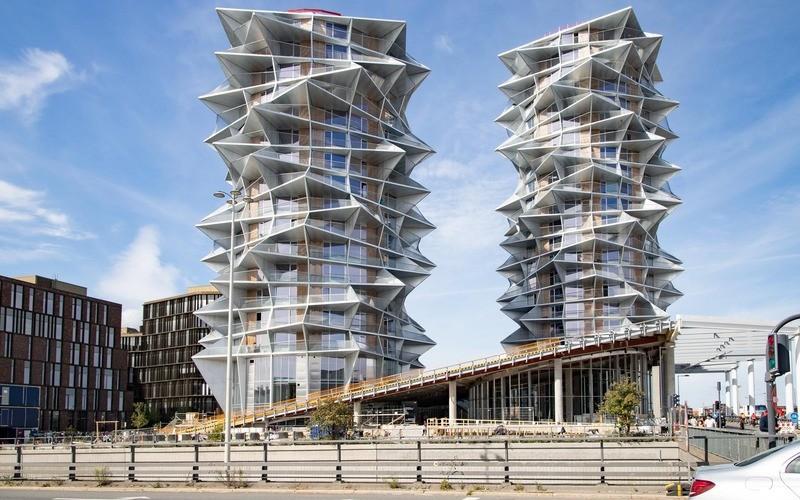
Image Source: HSHansen
BIG used Ladybug and Honeybee within Grasshopper to simulate environmental performance, ensuring every unit received maximum natural light during Copenhagen's dark winters. Digital fabrication of facade panels and balcony modules was directly linked to the parametric model.
Beijing Daxing International Airport, Zaha Hadid Architects
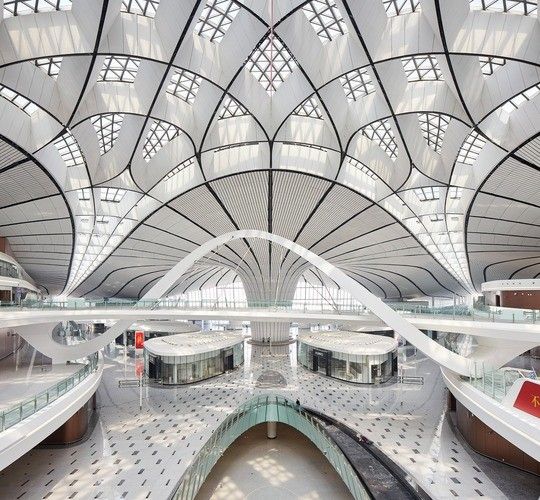
Image Source: Architonic
The airport's entire roof geometry, circulation flow, and radial symmetry were controlled through Grasshopper scripts, enabling precision coordination across structural, architectural, and MEP systems at an enormous scale.
Dynamic Solar Shading Project, Japan
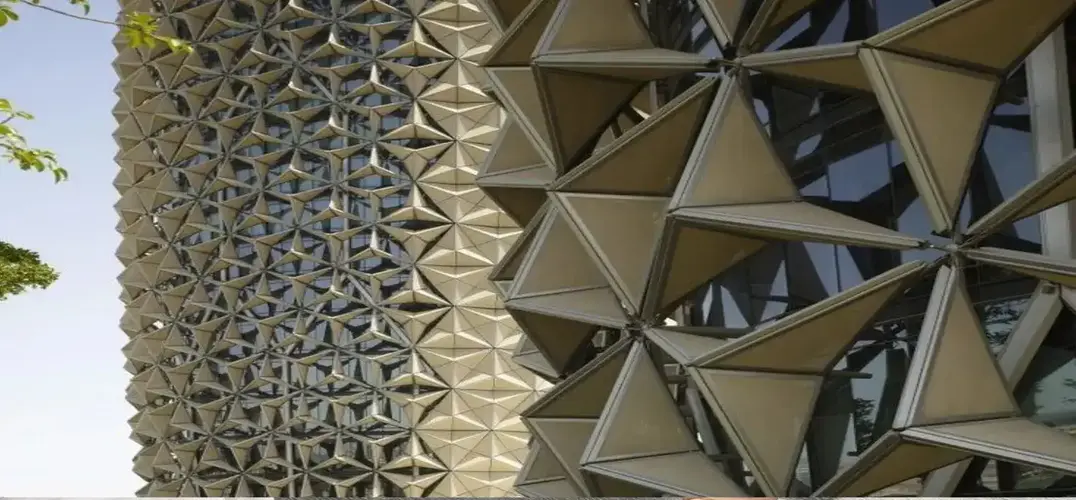
Image Source: WFM Media
A fully customizable adaptive facade system was developed using Grasshopper for Rhino. By analysing weather data, the team optimised louvre depth and spacing to control solar heat gain, a perfect example of computational design meeting sustainability.
These aren't experiments; they are landmark, built structures proving that parametric facade design belongs at the forefront of mainstream practice.
Grasshopper and Sustainable Design: A Natural Fit
Sustainability and Grasshopper go hand in hand. With Ladybug and Honeybee, designers can integrate solar radiation studies, daylight analysis, and thermal simulations directly into the parametric modelling workflow, meaning sustainable decisions shape the design from day one, not as an afterthought.
For students and young professionals, this is Grasshopper's biggest career differentiator. Firms pursuing green certifications and climate-responsive buildings actively seek designers who can balance aesthetics with performance, and digital fabrication-ready, data-driven design is exactly that skill.
Advance your skills with the Advanced Rhino & Grasshopper Certification with Job Support Program. Master real-world parametric workflows, build a strong portfolio, and gain expert mentorship with dedicated career support to confidently enter the industry.
Conclusion
Grasshopper has democratized complexity. Forms and facades that once required elite computational studios can now be explored by a motivated architecture student with the right training. From parametric facade design to form-finding, from environmental simulation to algorithmic architecture, Grasshopper sits at the intersection of creativity and computation.
Learning Grasshopper isn't just a skill upgrade; it's a shift in how you think about design itself. Whether you're just starting out or looking to evolve your practice, structured guidance can significantly accelerate that journey. Programs like Parametric Modelling in Rhino for Designers by Kaarwan are designed to bridge the gap between theory and real-world application, helping designers move from understanding tools to mastering workflows.
FAQs
1. What is Grasshopper used for in architecture?
Grasshopper is used for parametric modelling, facade design, form-finding, and environmental analysis in architecture, allowing designers to create complex, data-driven forms efficiently.
2. Is Grasshopper good for facade design?
Yes, Grasshopper is one of the best tools for parametric facade design, enabling adaptive panels, complex surface patterns, and real-time design iteration.
3. Do I need coding knowledge to learn Grasshopper?
No. Grasshopper uses a visual, node-based interface, so no prior programming or scripting experience is required to get started.
4. What is the difference between Rhino and Grasshopper?
Rhino is a 3D modeling software; Grasshopper is a visual programming plugin for Rhino that adds parametric and computational design capabilities.
5. Which Grasshopper plugins are best for facade design?
LunchBox, PanelingTools, Ladybug, Honeybee, and Kangaroo are among the most popular Grasshopper plugins used for facade and form design.
6. Can Grasshopper be used for sustainable architecture?
Absolutely. With plugins like Ladybug and Honeybee, Grasshopper supports solar analysis, daylighting studies, and energy optimisation, making it ideal for sustainable design.
7. What is parametric facade design?
Parametric facade design is a computational approach where facade elements like panels, openings, and patterns are generated and controlled through adjustable mathematical parameters.
8. Is Grasshopper used by top architecture firms?
Yes. Firms like Zaha Hadid Architects, BIG (Bjarke Ingels Group), and many others actively use Grasshopper and Rhino for their most complex projects.
9. How long does it take to learn Grasshopper for architecture?
With consistent practice and structured learning, beginners can grasp Grasshopper basics in a few weeks. Advanced workflows may take several months to master.
10. What is algorithmic architecture?
Algorithmic architecture is a design approach where building forms and systems are generated through defined rules, logic, and computational algorithms, tools like Grasshopper being central to this method.