

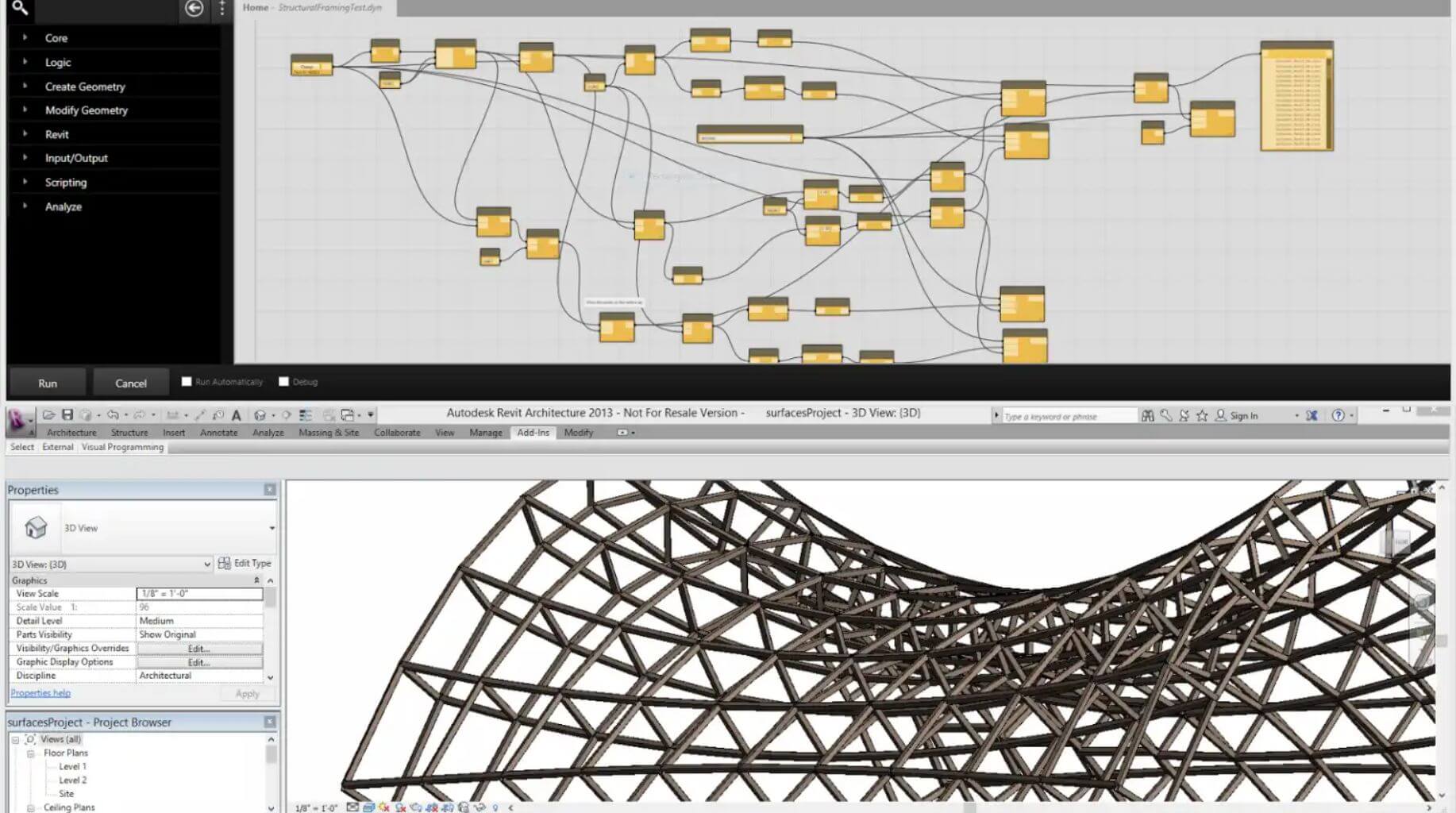
In the last decade, architecture has gone beyond simple CAD drawings. Designing buildings has taken a sharp turn, with projects now created through algorithms, data, and computational workflows. At the centre of this shift is Grasshopper, a tool that has been a trailblazer in an architect’s journey of approaching a design.
If you’ve recently searched terms like “what is Grasshopper Rhino” or looked more into “Grasshopper parametric design India 2026”, you’re not alone. Students, architects, and designers across India are adopting computational design because it has become a core industry skill, enabling faster results.
But what exactly is Grasshopper? How does it work with Rhino? And why are so many architecture studios asking for it?
This beginner’s guide is going to help you break it down step by step.
What Is Grasshopper in Architecture?
Grasshopper is a visual programming tool built within Rhino 3D that creates space for architects to build designs using parameters and rules instead of manually modelling each and every element.
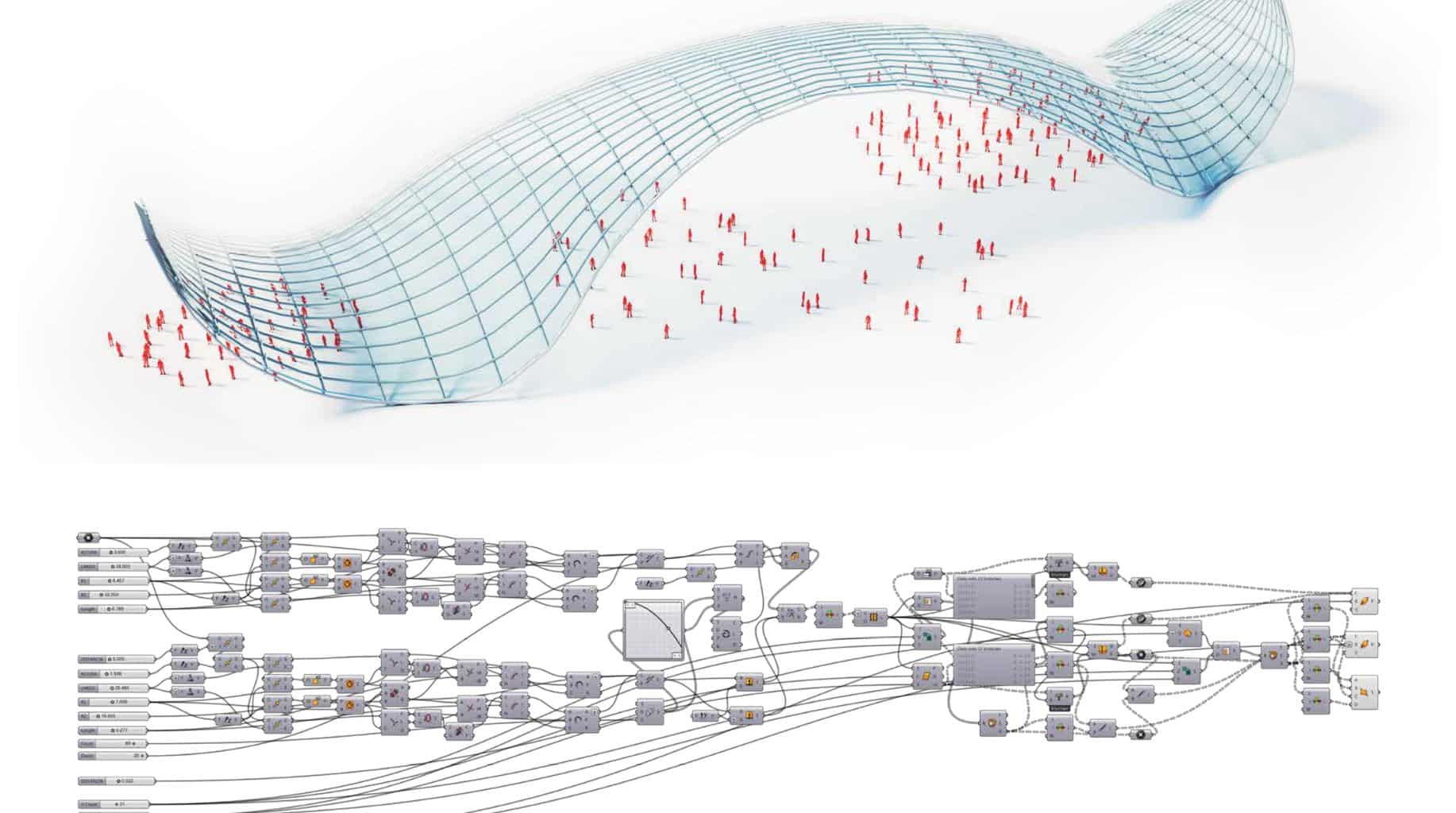
Instead of drawing a facade, wall, or structure directly, you define a set of instructions:
- Relationships between elements
- Dimensions
- Environmental parameters
- Geometric rules
Grasshopper then generates the design automatically.
In simpler terms, parametric design allows you to create the flow of the design or the system that generates the form, not just the form itself.
For instance:
- A roof structure that physically shifts as per the length of the span
- A building envelope that optimises ventilation and daylight
- A facade pattern that moves with sunlight exposure
Since the geometry is influenced by a couple of parameters, you can alter the entire design model by just adjusting a few values. This flexibility is why grasshopper parametric design in India in 2026 is becoming a core skill for architecture professionals and students.
Why Grasshopper Is Becoming Mainstream in 2026
For most of the years, parametric design was considered a niche skill used only by experimental architecture firms.
That has certainly changed.
Today, computational workflows are widely used across architecture, engineering, and construction. Tools like Rhino and Grasshopper allow designers to work through multiple form iterations, optimise performance, and generate multiple design options within minutes.
Several factors are leading this shift:
Increasing project complexity
Modern architecture includes facades, structural systems, and climate-responsive design. This is where parametric tools help architects handle this complexity efficiently.
Faster design iteration
Instead of manually reworking models, parametric systems automatically update geometry when these parameters alter, creating a brand new iteration.
Sustainability and performance design
Grasshopper enables designers to integrate environmental data, daylight analysis, and material optimisation into the design building process.
Growing adoption in India
Architecture firms in India are more and more using computational design for facades, urban studies and complex geometry projects.
As a result of this, the search for grasshopper parametric design in India in 2026 reflects a growing industry demand for many computational designers.
Understanding the Rhino + Grasshopper Workflow
To get an understanding of what Grasshopper Rhino is, it is important to see how the two tools work in sync.
Step 1: Modelling in Rhino
Rhino is a 3D modelling software that’s being widely used in the architecture and industrial design fields. Architects have been using Rhino to:
- Build base geometry
- Model surfaces and curves
- Import site information
- Prepare fabrication-ready models
Rhino provides precise geometric control, specifically for complex surfaces.
Step 2: Parametric logic in Grasshopper
Grasshopper sits within Rhino as a visual scripting interface. This means that instead of writing the entire code, designers create algorithms by incorporating all the components and nodes on the canvas.
Each component performs a very specific task, such as:
- Dividing geometry
- Generating patterns
- Creating points or curves
- Controlling parameters
These components are interconnected with wires, forming a parametric definition that creates geometry inside Rhino. Since everything is rule-based, adjusting one value can instantly update the whole design layout.
Step 3: Iteration and Optimisation
Once the parametric system is built, designers can explore variation real quick. For example:
- Testing different structural grids
- Optimising building orientation
- Adjusting facade panel density
This iterative process in the workflow is one of the main reasons grasshopper parametric design in India in 2026 is getting more attention among architecture students.
What Can You Build With Grasshopper?
Grasshopper is widely used across multiple design disciplines and is popular amongst designers/architects.
Here are some common architectural applications.
Parametric facades
Grasshopper is widely used to design adaptive facade systems. This allows architects to create and experiment with patterns that respond to:
- Sunlight exposure
- Ventilation requirements
- Structural constraints
These facades bring together aesthetics with performance optimisation to create something easy to build and beautiful to look at.
Complex building geometry
Many contemporary buildings bring in curved surfaces, twisted towers, and other organic forms. Parametric modelling makes it much easier to control and generate these geometric forms. Instead of modelling each element individually, designers highlight geometric rules and allow the system to generate the structure with ease.
Urban design simulations
Grasshopper is quite efficient in urban-scale analysis and can help designers simulate:
- Daylight access
- Building density
- Pedestrian movement
- Site optimisation
These computational studies help architects make more data-centric decisions early on in the design process.
Digital fabrication workflows
Grasshopper is closely related to fabrication technologies. Designers can also generate fabrication-ready data for:
- CNC cutting
- Robotic fabrication
- Parametric furniture
- Modular structures
This link between physical production and digital fabrication is one of the reasons why parametric design is revolutionising architectural workflows.
Career Opportunities for Grasshopper Designers
Learning computational design can significantly open multiple career options for architecture students.
Today, many studios are looking for designers with parametric modelling experience. Some common job roles include:
Computational Designer
This role specialises in algorithmic modelling and advanced geometry in design.
Parametric Architect
A parametric architect makes use of computational tools to create many complex building systems.
Facade Designer
This role majorly focuses on developing parametric workflows for manufacturing and construction.
With many architecture offices inclining towards advanced design tools, expertise in Grasshopper parametric design in India in 2026 is of high importance in the job market.
However, for students, learning Grasshopper early can provide a strong competitive edge in this cut-throat industry.
How Beginners Can Start Learning Grasshopper
If you’re someone who is fairly new to computational design, Grasshopper can feel like a lot at first. The interface might also look different from any traditional modelling software.
But once you understand the logic behind this, the learning curve also becomes manageable. Anyone who’s starting in this field, this is what a typical beginner path might look like:
- Learning the basics of Rhino
- Understanding parametric thinking
- Building simple Grasshopper scripts
- Exploring plugins and simulations
- Applying workflows to real design projects
While this is practical, the most effective way to learn is through guided projects that connect parametric concepts to architectural design problems.
Learn Grasshopper Parametric Design in 50 Hours
If you want to build practical computational design skills quickly, a structured learning framework will make all the difference. Kaarwan’s 50-hour Grasshopper Parametric Design Program is created for architecture students and professionals who are willing to learn and understand parametric workflows right from the ground up.
The course focuses on:
- Basics of Rhino & Grasshopper
- Parametric modelling technique
- Facade design workflows and methods
- Generative geometry systems
- Strategies used in digital fabrication
Instead of simply learning software prompts, the program will help participants develop parametric thinking, which is a pivotal skill behind the concept of computational design. So, for anybody who’s looking into “what is Grasshopper Rhino” or looking up “Grasshopper parametric design in India in 2026”, a focused training can take your learning process to another level.
Final Thoughts
Tools like Grasshopper have evolved from merely an experimental design tool into the epicentre of modern architectural design. This tool not only helps professionals create interactive designs but also enables them to expand their design thinking and create something extraordinary. This tool also allows architects to create designs with algorithms, parameters, and data. This enables more responsive, innovative, and efficient design solutions.
This also means that as computational workflows continue to grow across the industry, understanding Grasshopper and Rhino is not going to be optional for architects involved in advanced design methodologies.
For students and young professionals in India, learning about Grasshopper parametric design in India in 2026 is not only about mastering a simple software or tool, but it’s also more about learning an innovative way of thinking about architecture and design.
And, this is where you start: Here
FAQs
1. What is Grasshopper used for in architecture?
Grasshopper is used to create parametric models, generate complex geometry, design responsive facades, run environmental simulations, and automate repetitive design tasks within Rhino.
2. Is Grasshopper difficult for beginners to learn?
Grasshopper can feel unfamiliar at first because it uses visual programming instead of traditional modelling. However, once you understand parametric logic and basic components, the learning process becomes much easier.
3. Do I need to learn Rhino before learning Grasshopper?
Yes. Since Grasshopper works inside Rhino, having a basic understanding of Rhino modelling, curves, and surfaces helps you learn parametric workflows more effectively.
4. What is the difference between Rhino and Grasshopper?
Rhino is a 3D modelling software used to create geometry manually. Grasshopper is a visual programming tool within Rhino that generates geometry automatically using parameters and rules.
5. Why are architecture firms asking for Grasshopper skills?
Many architecture and design studios use parametric tools to manage complex geometry, optimise performance, and quickly test design variations. This makes Grasshopper a valuable skill in modern architectural practice.
6. Can Grasshopper be used for sustainable design?
Yes. Grasshopper can integrate environmental analysis tools that help architects study daylight, ventilation, solar exposure, and energy performance during the design process.
7. What careers use Grasshopper in architecture?
Common roles include computational designer, parametric architect, facade designer, and digital fabrication specialist.
8. Is Grasshopper popular among architecture students in India?
Yes. Many architecture schools and studios in India are increasingly adopting computational design tools, which is why Grasshopper parametric design in India is gaining strong interest among students in 2026.


.png)