.jpg)
Green Design for Data Centres: The Future of Digital Sustainability
There is a data center somewhere that facilitates every time you send an email, upload a file to the cloud, or watch a movie online. Massive energy usage and an ever-increasing carbon footprint are costs of maintaining the digital world's infrastructure.
Conventional data centres use an excessive amount of water and power. Better still, there is an alternative. The data center industry is witnessing a sea change as green design transforms these once inefficient buildings into green powerhouses. Sustainable development is considerably more than just causing less damage, says Jochen Zeitz. More positive deeds are the goal.Is there a way to get there? Let's dissect it.
Why Eco-Friendly Data Centers Are Essential
Impact on the Environment
Worldwide, data centres consume 1% to 2% of all electricity. Until you consider that one facility can use as much power as a small town, it might not seem like much.
Not to mention the millions of gallons of water needed annually for cooling these systems—it's not only electricity, either. Power and water consumption will continue to rise due to the rapid expansion of cloud computing. Solutions that are sustainable, water-wise, and energy-efficient are obviously required.
Rules and Current Market Conditions
Carbon emissions are being severely limited by governments across the globe. Businesses are under pressure from both customers and investors to become more environmentally conscious. Fail to adapt, and you risk falling behind. Sustainable information technology is now an absolute must for every company serious about doing business.
An Actual Case Study
Already, tech behemoths are at the forefront. One example is Google's carbon-neutral data centers, which use renewable energy, smart cooling, and AI-driven power management to achieve zero net carbon emissions. They have proven that environmentally friendly data centres are not only feasible, but also lucrative.
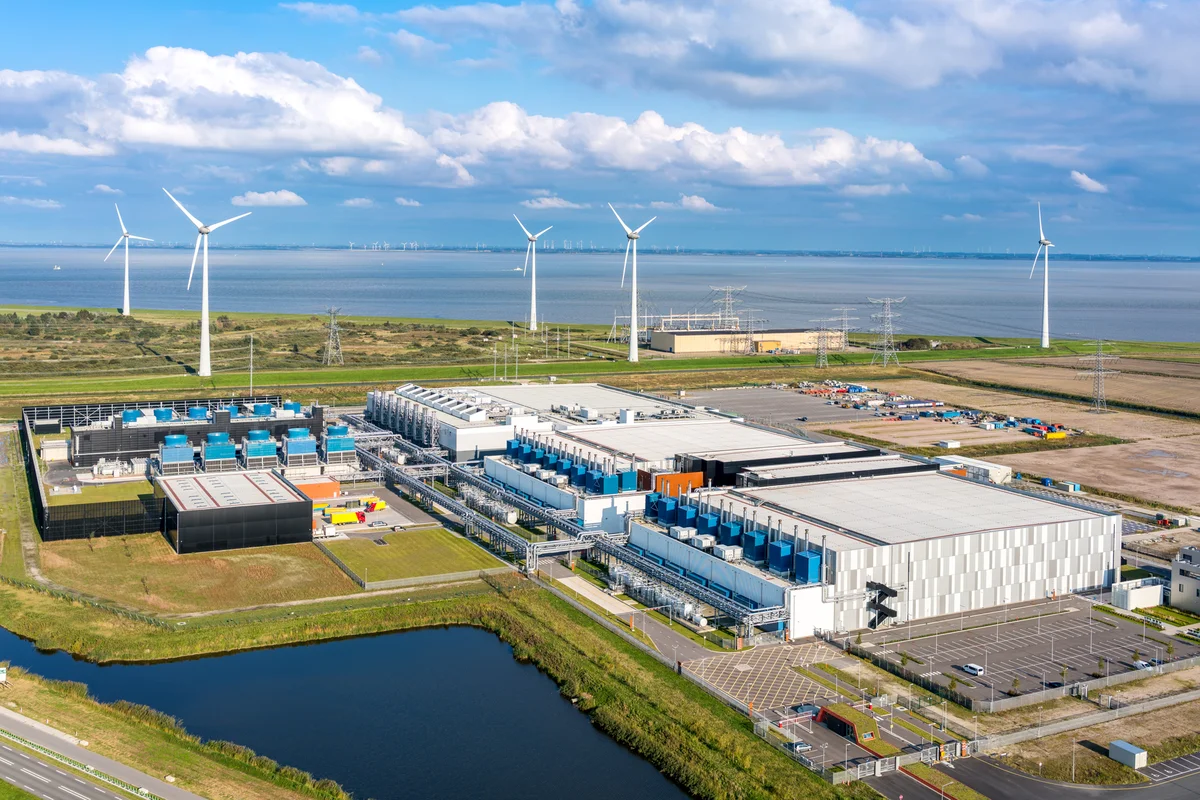
Google's carbon-neutral data centers (Img Src: Google)
A Guide to Eco-Friendly Architecture
Efficiency in Power Use
Reduced energy waste is possible with well-managed cooling and power. Revolutionizing the sector are solutions like free-air cooling, liquid cooling, and automation driven by artificial intelligence. The data center of Facebook in Luleå, Sweden, uses the cold Arctic air to chill servers instead of using conventional air conditioning—that is a clever idea.
Conserving Water
Cooling towers that use a lot of water are an ancient model. Eliminating the need for water for cooling is demonstrable by Microsoft's Project Natick, a data center that is underwater. Water usage can be drastically cut with the help of sustainable cooling technologies such as closed-loop systems and evaporative cooling.
Structured Modularity
Envision an efficient, scalable, and adaptable data center constructed like Lego blocks. With modular data centres, businesses can increase capacity without breaking the bank or destroying the environment with costly and time-consuming construction projects.
Intelligent Technology
Data centres are becoming smarter with the help of AI and the Internet of Things. Automated task balancing, real-time energy monitoring, and predictive maintenance all contribute to maximizing efficiency. AI does more than just ensure everything runs properly; it also seeks out methods to reduce power use.
Eco-Friendly Supplies
There is an ecological footprint associated with data center building as well. Sustainable building practices, such as using recycled materials, eco-friendly insulation, and low-energy design, can have a significant impact. These buildings are certified to fulfill high sustainability criteria by organizations like LEED (Leadership in Energy and Environmental Design).
Green Data Centers: Why They're Beneficial
Save Money Over Time
The initial investment in smart cooling systems and renewable energy sources is high, but the savings in the long run more than make up for it. It's a good financial move to invest in energy-efficient facilities because they reduce electricity and maintenance costs.
More Solid Company Identity and CSR
Businesses that really care about the environment attract both consumers and investment. In addition to being good for the environment, becoming green is also excellent for the company.
Adherence to Environmental Legislation
Companies who put money into sustainability today will be able to avoid fines and remain ahead of the curve when tougher energy rules are on the way.
For the Future
Technology advances at a dizzying rate. To keep their data centres competitive and economical for the long haul, businesses are turning to net-zero energy solutions and other state-of-the-art efficiency measures.
Possibilities and Obstacles
Sometimes it's tough to go green. Difficulty in integrating new technology, high upfront expenditures, and complicated retrofits for older buildings can all impede uptake. Governments are providing incentives, while developments in renewable energy and artificial intelligence are lowering the barriers to entry for sustainable IT.
Simultaneously, new technological developments are appearing. For instance, edge computing enables processing of data closer to its origin, therefore decreasing the demand for large, power-hungry central servers. It is also becoming easier to store and distribute renewable energy efficiently because of developments in battery storage.
The Future of Eco-Friendly Data Centers: Where Do We Go From Here?
Data centers should aim for total energy independence in the future. Powering their business using solar, wind, or hydrogen fuel cells is something many companies are exploring. Additionally, smart microgrids are on the rise, enabling data centers to efficiently produce and disperse their own power.
Reusing waste heat is another fascinating new development. Historically, server heat has been considered an undesirable byproduct and discarded. However, there are businesses who are taking steps to improve sustainability by redirecting this heat to heat neighboring buildings or even create more power.
A Guide for Businesses Just Starting Out
Anyone in charge of IT infrastructure or working in the tech business shouldn't be overwhelmed by the prospect of switching to green data centers. A couple of places to begin are:
- Find inefficiencies by doing an energy audit.
- Make the switch to sustainable energy sources whenever you can.
- Maximize efficiency in real-time with AI-powered energy management.
- Investigate modular architectures for environmentally friendly operation scaling.
- To decrease water usage, put money into other cooling methods.
- Modest adjustments, such as reducing server loads and switching to more energy-efficient gear, can build up to big results in the long run.
Conclusion
Future data centers will be environmentally friendly. We can reduce environmental damage without sacrificing performance by using energy-efficient cooling, renewable power, and smart technologies.
"The future will be green, or not at all," Jonathon Porritt rightly stated.
Google and Facebook are only two examples of tech companies that have proven the effectiveness of green data centers. Starting now, everyone from students studying sustainability to professionals shaping digital infrastructure can be a part of the movement toward more environmentally friendly data centers.
Businesses may improve their energy efficiency now and pave the way for a greener, more efficient digital future by implementing these improvements.The future of architecture is bright, but are your skills keeping pace? Kaarwan's architecture-specific courses provide you with the knowledge and tools to confidently navigate the AEC industry. Gain valuable insights, master in-demand software, and stand out with designs that impress!
FAQs
1. What is a green data centre?
A green data centre uses energy-efficient technologies, sustainable cooling systems, and renewable energy to reduce carbon footprint while maintaining high performance and operational efficiency.
2. How do green data centres save energy?
They use AI-driven energy management, liquid cooling, modular design, and renewable energy sources like solar and wind to minimize electricity consumption and improve sustainability.
3. Why is water conservation important in data centres?
Traditional cooling systems use millions of gallons of water annually. Sustainable solutions like free-air cooling and underwater data centres eliminate or drastically reduce water usage.
4. What role does AI play in green data centres?
AI optimizes power distribution, predicts maintenance needs, and enhances energy efficiency by automating cooling and workload management, reducing overall resource consumption.
5. Are green data centres more expensive to build?
Initially, yes, but long-term cost savings from lower energy consumption, reduced maintenance, and compliance with environmental regulations make them financially viable and future-proof investments.