Types of Tests on Burnt Clay Bricks
Burnt clay bricks remain one of the most widely used masonry units in Indian construction. Their performance depends on properties such as dimensional accuracy, degree of burning, water absorption, strength, surface hardness and resistance to damage. Before bricks are used in masonry, basic field checks can help identify visibly defective or poorly manufactured units, while laboratory tests establish compliance with Indian Standards.
In India, IS 1077:2025 — Common Burnt Clay Building Bricks — Specification (Sixth Revision) is the current product specification for common burnt clay building bricks. The standard specifies requirements including general quality, dimensions and tolerances, compressive strength, water absorption, efflorescence and warpage. The corresponding test methods are covered by the IS 3495 series, including water absorption under IS 3495 (Part 2):2019.
It is important to distinguish between formal standardized tests and traditional field-quality checks. Shape, colour, soundness, hardness and the simple drop check are commonly taught as site-level checks for burnt bricks, whereas properties such as compressive strength, water absorption, efflorescence and warpage have defined Indian Standard test procedures.
The following six tests are useful for understanding the basic quality checks commonly associated with burnt clay bricks.
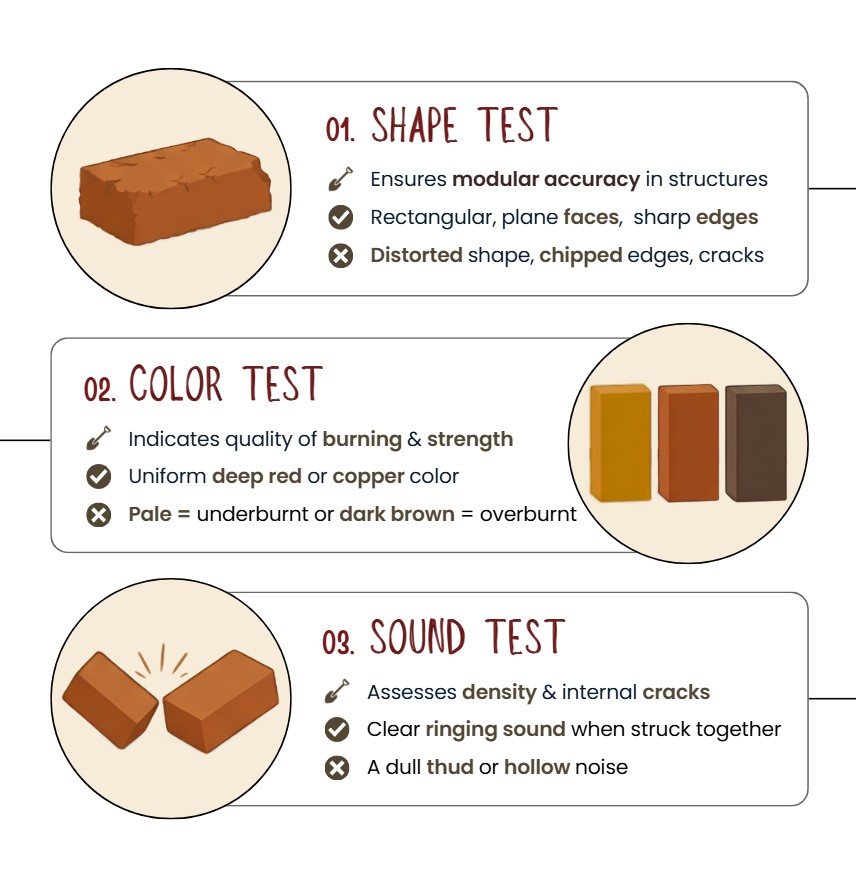
Shape Test
Burnt clay bricks should have a regular rectangular shape with straight edges, sharp corners and reasonably uniform faces. This helps maintain consistent joints and dimensions during masonry construction.
Bricks with distorted shapes, chipped edges or uneven surfaces can make it difficult to maintain uniform courses and mortar joints.
Under IS 1077:2025, common burnt clay building bricks are specified for dimensional and quality requirements. Warpage is separately addressed through IS 3495 (Part 4):2019.
Colour Test
Good-quality burnt clay bricks generally have a uniform colour throughout. Traditional field guidance commonly associates well-burnt bricks with deep red, cherry or copper-red shades.
A pale colour may indicate under-burning, while very dark or blackened surfaces can indicate over-burning. However, colour alone should not be treated as a definitive quality test because firing conditions and clay composition also affect brick colour.
Sound Test
When two good-quality bricks are struck together, they should produce a clear, ringing sound. This is a traditional field check used to assess whether the brick appears well-fired and sound.
A dull or muted sound may indicate cracks, internal defects or inadequate firing, although this check does not provide a numerical measure of compressive strength.
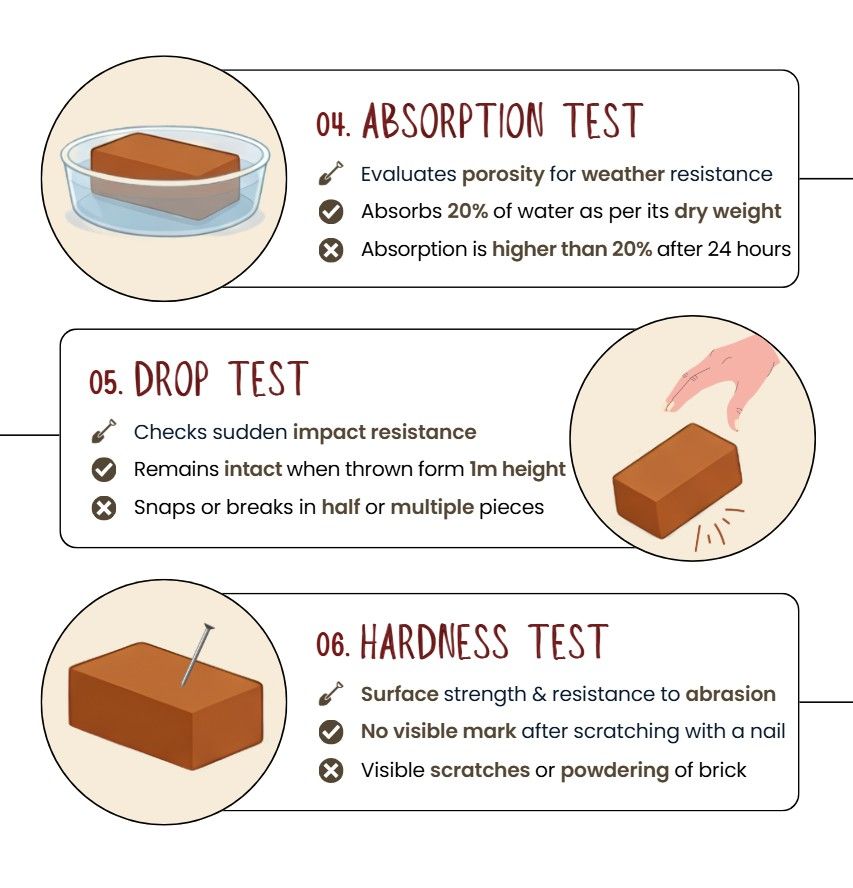
Water Absorption Test
Water absorption measures how much water a brick takes up after being immersed for a specified period. Excessive absorption can affect masonry performance and may increase the amount of water drawn from mortar.
Under IS 3495 (Part 2):2019, the brick is dried, weighed, immersed in water for 24 hours, surface-dried and weighed again. The percentage increase in mass represents water absorption.
IS 1077:2025 specifies a maximum water absorption of 20% by dry weight for bricks up to class 12.5 and 15% for higher classes.
Drop Test
A brick can be dropped flat onto a hard surface as a traditional site-level check of its general toughness and resistance to impact.
A sound brick should not readily break into pieces from a normal field drop. However, this is a practical field check rather than a standardized impact-resistance test under the IS 3495 series.
Hardness Test
Hardness can be checked by scratching the brick surface with a fingernail or another suitable hard object. A good brick should resist noticeable scratching or indentation.
This gives a quick indication of surface hardness and firing quality, but it should not be confused with a formal abrasion-resistance test.
Why Brick Testing Matters in Indian Construction
Brick quality can vary significantly depending on the clay source, moulding process, drying conditions and kiln firing. A visually attractive brick is not necessarily a structurally suitable brick, just as a brick that passes a simple field check cannot automatically be assumed to comply with every requirement of the relevant Indian Standard.
For projects where brick performance is specified, the class of brick, required properties, sampling procedure and applicable standards should be clearly established.
For common burnt clay building bricks, IS 1077:2025 provides the product specification, while the IS 3495 series provides standardized methods for several important tests. Sampling is covered by IS 5454:2024.
This distinction is especially important for load-bearing masonry, where compressive strength and other specified properties need to be verified rather than inferred from colour, sound or hardness alone.
Conclusion
Testing burnt clay bricks helps determine whether a batch is suitable for construction and whether it meets the required quality and performance criteria.
Simple field checks such as shape, colour, soundness, hardness and the drop test can quickly identify visibly defective or poorly fired bricks. The water absorption test, meanwhile, provides a measurable property that can be compared with the requirements of the applicable Indian Standard.
For formal quality control, these checks should be supplemented by standardized testing, particularly compressive strength, water absorption, efflorescence and warpage under the relevant BIS standards.
Ultimately, good brickwork begins with more than choosing bricks that look right. Consistent dimensions, adequate firing, controlled water absorption and verified strength all contribute to durable and reliable masonry.
These were some insights on Tests on Burnt Clay Bricks. Stay tuned for more information on other significant topics in the AEC industry and follow Kaarwan for such detailed guides!
FAQs
1. Which Indian Standard is used for common burnt clay building bricks?
IS 1077:2025 is the current BIS specification for common burnt clay building bricks. It specifies requirements including general quality, dimensions, tolerances, compressive strength, water absorption, efflorescence and warpage.
2. Which IS code covers testing of burnt clay bricks?
The IS 3495 series covers standardized methods of testing burnt clay building bricks. It includes compressive strength, water absorption, efflorescence and warpage, with later parts covering initial rate of absorption and modulus of rupture.
3. What colour should a good burnt clay brick be?
A good burnt clay brick should generally have a uniform colour. Traditional field guidance describes well-burnt bricks as commonly deep red, cherry or copper coloured. Colour alone, however, is not sufficient to establish compliance or strength.
4. What is the maximum water absorption of burnt clay bricks?
Under IS 1077:2025, water absorption after the specified 24-hour immersion is limited to 20% by dry weight for brick classes up to 12.5 and 15% for higher classes. The applicable limit should therefore be checked against the specified brick class.
5. Is the drop test an IS-standardized test for bricks?
No. The traditional test of dropping a brick from approximately 1 m onto a hard surface is a field-quality check, not a formal impact-resistance test under the IS 3495 series. Formal brick quality assessment uses standardized procedures such as compressive strength, water absorption, efflorescence and warpage.