

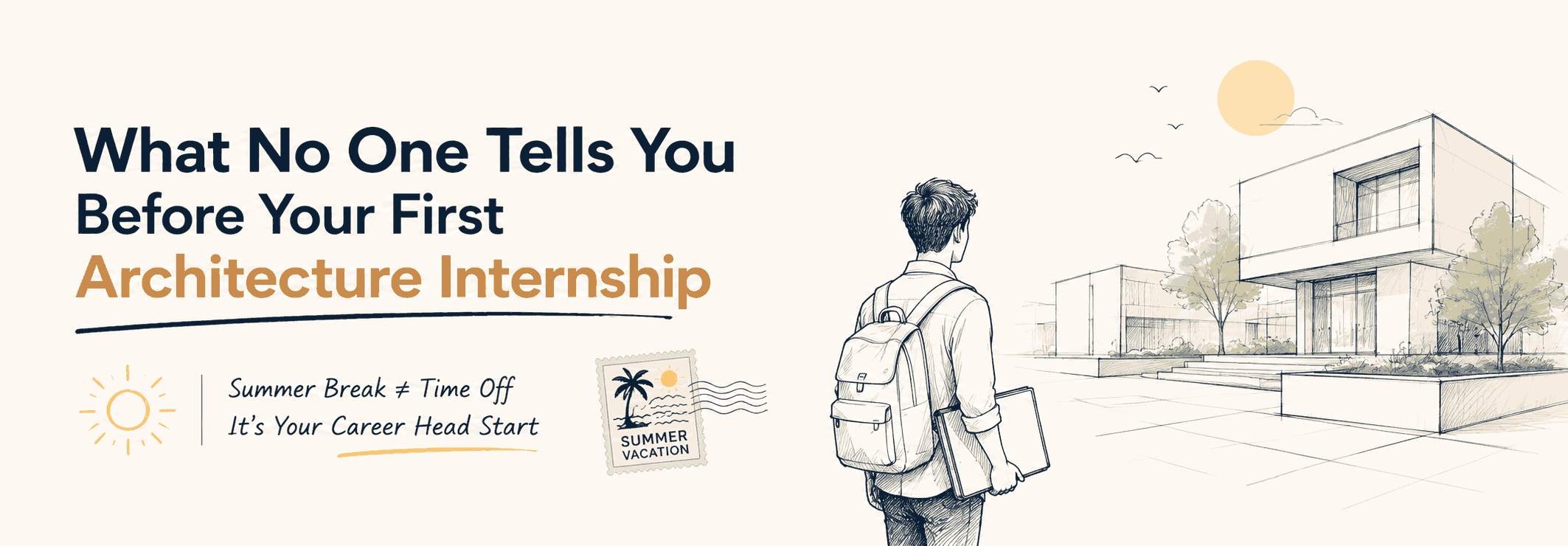
There's a specific kind of silence that happens on your first morning at a firm.
You've arrived on time — maybe even early. Your portfolio is on your laptop, freshly exported. You're wearing the right thing, or at least you think you are. And then someone points you to a desk, hands you a set of drawings, and walks away. No brief. No instructions. Just the hum of a studio that already knows what it's doing — and you, trying very hard to look like you do too.
Nobody tells you about that silence. And nobody tells you about most of what comes after it.
The first architecture internship is one of the most formative experiences you'll have — not because it's glamorous, but because it isn't. It's the first time the profession stops being theoretical and starts being real. And the gap between what architecture school prepares you for and what a firm actually needs from you on day one is wider than most students expect.
Here's what we've seen, across every batch of students who've made that transition — and what we wish someone had told them before they walked through that door.
The First Week Is Not About Your Skills. It's About Your Instincts.
Every firm has a culture. A rhythm. An unspoken set of rules about how work gets done, how feedback gets given, and how questions get asked. The students who settle in quickly are rarely the most technically prepared ones — they're the ones who read the room fastest.
Watch before you perform. Notice how the senior architects communicate with each other. Notice whether this is a studio where questions are encouraged or where figuring it out yourself is the expectation. Notice how drawings are named, how files are organised, and how a meeting is run.
This isn't passive — it's intelligent. The student who spends the first week observing will outperform the one who spends it trying to prove themselves, every single time.
Your Software Skills Will Be Tested in Ways College Never Did.
You know AutoCAD. You've submitted projects to it. But here's what nobody warns you about — professional drawings have a standard that college submissions simply don't enforce.
In a firm, a drawing with messy layers gets sent back. A Revit file with incorrect families causes problems that ripple across an entire project. A presentation exported at the wrong resolution wastes everyone's time. These aren't creative failures — they're technical ones, and they're the ones that shape how quickly a firm starts trusting you with real work.
The students who hit the ground running are the ones who didn't just learn the software — they learned the discipline around the software. Clean file management. Correct layer conventions. The ability to work inside someone else's drawing without disrupting it.
If there's one thing worth practising before your internship starts, it's this — not more features, more fluency.
Nobody Will Explain Everything. That's Not Negligence. That's Practice.
Architecture firms are busy. Deadlines are real, clients are impatient, and the senior architect reviewing your work has three other things open on their screen. Nobody is going to walk you through every decision step by step — and the expectation, often unspoken, is that you'll figure out the parts you don't know.
This can feel like being thrown in the deep end. It is. But it's also one of the fastest ways to learn that exists.
The instinct to ask for help isn't wrong — it's how you ask that matters. Don't ask what to do. Ask for enough context to make your own decision. "I want to approach this section drawing this way — does that align with how the firm usually handles it?" is a very different question from "what should I do here?" One shows initiative. The other signals that you're waiting to be managed.
Firms remember the students who solved problems. They forget the ones who waited for instructions.
Site Visits Will Teach You More Than Any Studio Crit Ever Did.
If you get the opportunity to visit a construction site during your internship, go. Go every time. Go even if it's inconvenient.
There is no textbook equivalent for standing on a slab and understanding why that beam is placed where it is, or watching a contractor explain why the detail on the drawing doesn't work in practice. Construction teaches you something that renders never can — that buildings are made by human hands, under real conditions, with real constraints, and the gap between drawing and building is where most of architecture actually lives.
The students who come back from site visits with questions are the ones who are learning. The ones who come back with photographs for Instagram are the ones who missed the point entirely.
Go with your eyes open. Come back with questions.
The Internship Isn't Just About What You Learn. It's About What You Discover.
This is the part that doesn't fit neatly into a listicle, but it might be the most important thing on this page.
Your first internship is data. It's telling you something about what kind of practice you thrive in, what kind of work energises you, and what kind of architect you might want to become. Pay attention to it.
Did you come alive when you were on site, or when you were in front of a screen? Did the residential project feel meaningful, or did you keep looking over at the urban design team? Did you enjoy the detail work, or were you more interested in the early concept conversations?
To Sum It Up
None of these questions has a right answer. But they all have your answer — and the sooner you start listening for it, the more deliberately you'll be able to shape what comes next.
Summer is a good time to find out. And there's no better place to start building the skills that will make your first internship count — than right now.
Explore Kaarwan's summer courses →
The firm won't wait for you to be ready. But you can decide how ready you are when you walk in.
FAQs:
1. When should architecture students apply for their first internship?
Ideally, after your second or third year, once you have basic design and software skills to contribute meaningfully.
2. What software should I know before an architecture internship?
AutoCAD, SketchUp, Photoshop, and basic Revit knowledge are the most useful starting points.
3. Is it okay to not know Revit before my first internship?
Yes, but learning the basics beforehand can make you a much stronger candidate.
4. How long are architecture internships typically?
Most summer internships last between 4 and 12 weeks, depending on the firm and project cycle.
5. What should I carry on my first day at an architecture firm?
A notebook, your laptop (if required), and a willingness to learn.
6. Will I be doing real work or just making chai?
A good internship gives you real responsibilities—from drawings and models to research and presentations.
7. How do I find architecture internships in India?
Use LinkedIn, alumni networks, faculty referrals, firm websites, and architecture communities.
8. What's the difference between a good internship and a bad one?
A good internship teaches you how practice works. A bad one keeps you busy without helping you grow.
9. Should I intern at a big firm or a small studio?
Big firms offer structure and scale; small studios offer broader exposure and hands-on learning.
10. How do I convert an internship into a job offer?
Be reliable, proactive, and easy to work with. Skills get you noticed; professionalism gets you hired.




.png)