


In a profession where tradition and innovation often walk hand in hand, few voices resonate with as much authority as Norman Foster’s. As one of the most influential architects of our time, Foster has consistently embraced technological progress—not as a replacement for creativity, but as an enabler of it. His reflections on Building Information Modelling (BIM) offer a glimpse into the digital future of architecture, one where efficiency, sustainability, and imagination converge.
For AEC professionals navigating today’s software-driven workflows, Foster’s perspective feels both visionary and practical.
Why BIM Matters Now
Building Information Modelling is often misunderstood as merely a 3D modelling tool. In reality, BIM represents an entirely new way of working: it connects every aspect of design, construction, and operation into a single, intelligent digital model. For Foster, BIM is less about software and more about collaboration and foresight.
By embedding data into models, BIM allows architects, engineers, and contractors to anticipate conflicts, optimise material use, and predict building performance long before the first brick is laid. It embodies the ethos of “designing for life-cycle,” something Foster’s practice has championed for decades.
Norman Foster’s Digital Ethos
From the HSBC Headquarters in Hong Kong to Apple’s ring-shaped campus in California, Foster + Partners has consistently used technology as a catalyst for innovation. Foster often remarks that digital tools enable architects to “see the unseen”—whether it is wind behaviour across a facade or the carbon footprint of a material choice.
In his view, BIM is part of a broader cultural shift in architecture:
- From drawing to modelling: The profession is moving away from static representations to dynamic, data-rich models.
- From silos to synergy: BIM demands that disciplines collaborate from day one, rather than handing drawings from one team to another.
- From short-term to long-term thinking: With BIM, buildings are conceived not only as projects to be built, but as systems to be maintained, adapted, and lived in.
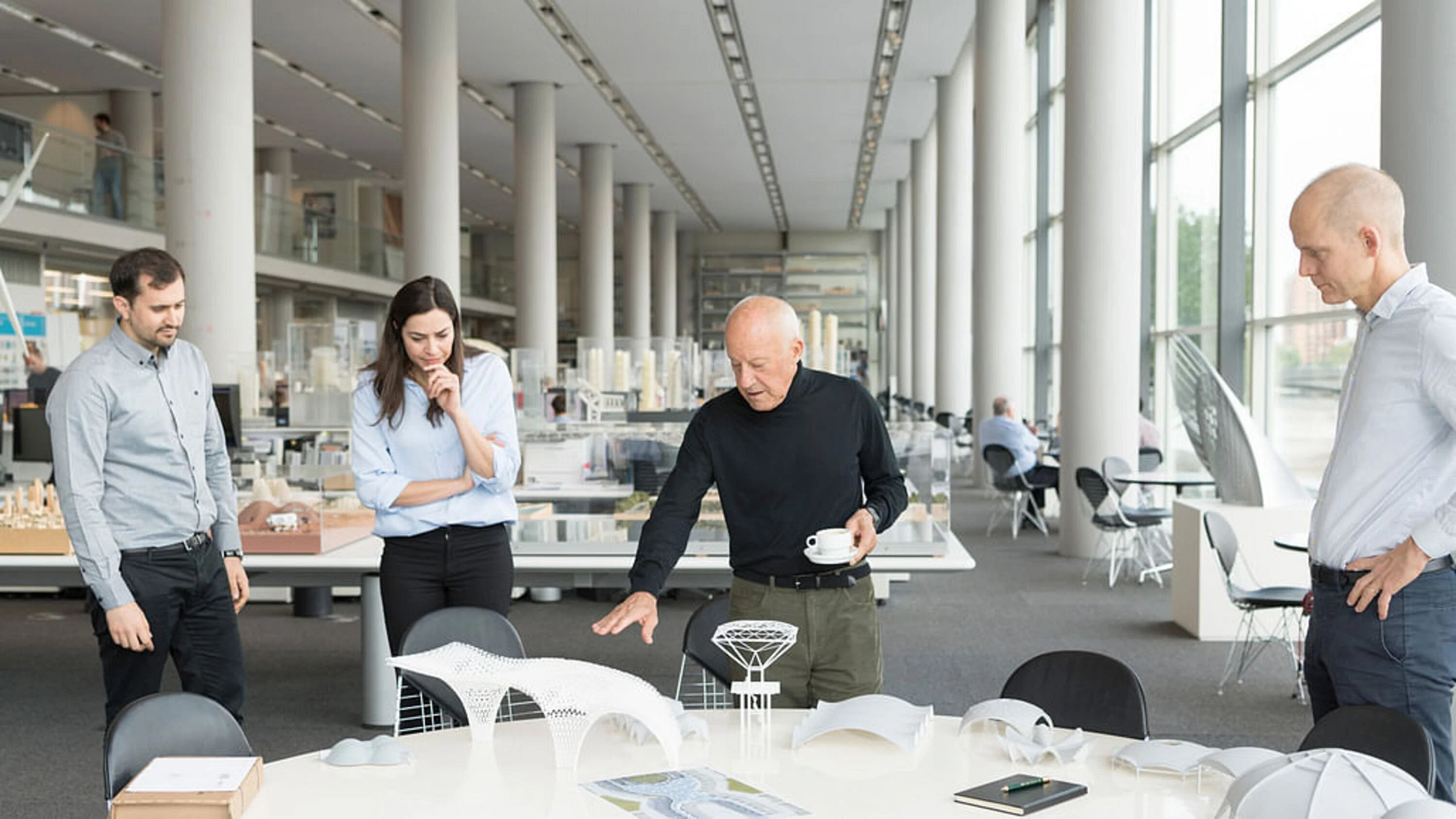
The Digital Future of Architecture
Norman Foster envisions a future where architects are empowered, not constrained, by digital tools. Here are a few key threads of this vision:
- Sustainability through Simulation BIM allows designers to simulate daylight, energy use, and carbon impact in real time. For Foster, this is a natural evolution of architecture’s responsibility: to design buildings that are both beautiful and regenerative.
- Integration with Computational Design Foster + Partners has already integrated parametric workflows, where Grasshopper and BIM models converge. Complex facades or structural grids can be generated algorithmically, then embedded with real-world data for construction.
- Human-Centred Design Despite the talk of algorithms and automation, Foster insists technology must always serve human needs. BIM, when used effectively, improves not only efficiency but also the quality of space, ensuring environments respond to comfort, well-being, and experience.
- Global Collaboration In Foster’s world, projects stretch across continents and cultures. BIM facilitates seamless collaboration across time zones, ensuring a shared digital language where architects in London, engineers in Mumbai, and contractors in Dubai can all work from the same live model.
Case in Point: Apple Park
Perhaps the most iconic example of Foster’s digital-first philosophy is Apple Park in Cupertino. The vast circular building, dubbed the “spaceship campus,” demanded unprecedented levels of coordination. The facade alone—consisting of the world’s largest curved glass panels—was made possible by digital workflows that combined parametric design with BIM-enabled fabrication.
The project exemplifies how BIM doesn’t dampen creativity—it empowers it. Without such digital precision, a vision of that scale and complexity would have been unthinkable.
_1758104400662.png)
What AEC Professionals Can Learn
For architects and engineers across India and beyond, Foster’s stance offers a clear takeaway: digital tools are not optional add-ons; they are central to future practice. Whether working on a residential block in Hyderabad or an office complex in Bangalore, the principles remain the same:
- Start with data-rich models, not just drawings.
- Collaborate early and openly across disciplines.
- Use simulation and analysis to design sustainably.
- Keep human experience at the core.
In short, BIM is not about “keeping up with the times”—it is about leading with foresight.
Conclusion
Norman Foster’s reflections on BIM highlight a fundamental truth: the future of architecture will be shaped not only by bold ideas but by the tools we use to bring them to life. For AEC professionals, mastering BIM is more than learning software—it is embracing a mindset where collaboration, efficiency, and creativity intersect.
At Kaarwan, the call is simple: the digital future is already here. The question is—will you be ready to build it?
FAQs
1. What is Norman Foster’s view on BIM?
He sees BIM as a cultural shift towards collaboration, foresight, and long-term thinking in architecture—not just a modelling tool.
2. How does BIM improve sustainability?
By simulating performance factors such as daylight and energy use, BIM allows architects to make informed design choices that reduce carbon and energy costs.
3. Has Foster + Partners used BIM in major projects?
Yes, projects like Apple Park relied heavily on BIM to coordinate complex geometry and fabrication workflows.
4. Why is BIM important for AEC professionals in India?
It helps streamline workflows, reduce errors, and design more sustainable buildings—critical in fast-growing urban contexts.
5. Is BIM replacing creativity in architecture?
No. As Foster argues, BIM empowers creativity by reducing technical inefficiencies, allowing architects to focus on design innovation.




.png)