

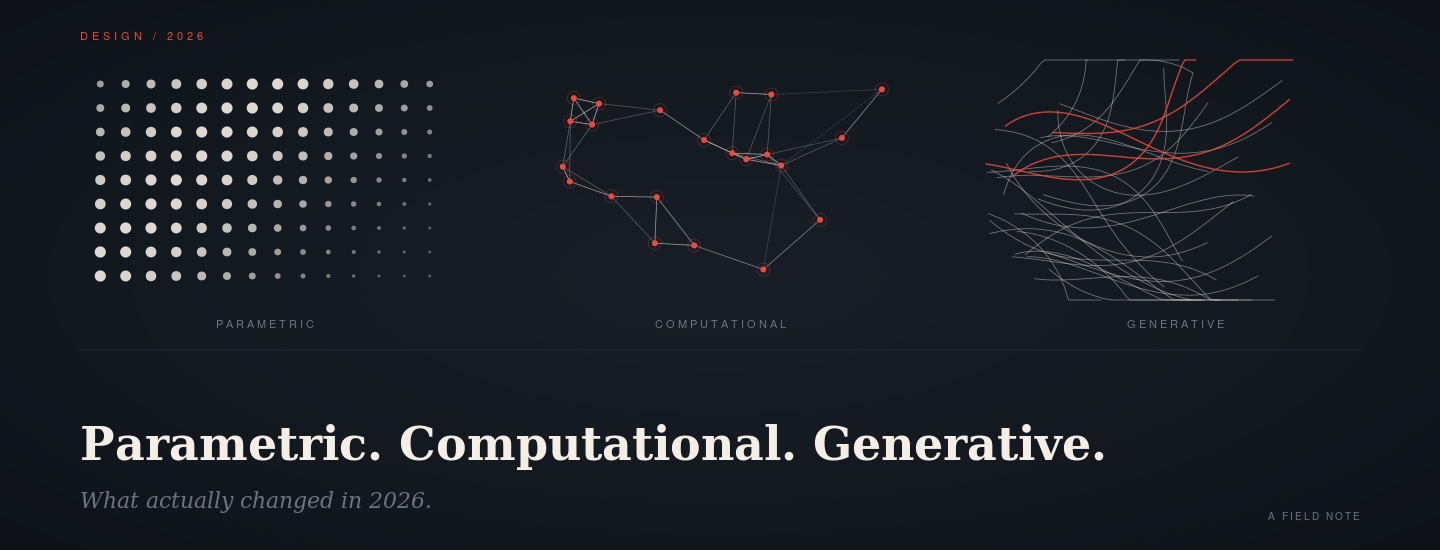
History is proof that people have mostly mixed up parametric and computational design. And no matter where we encounter students, we keep getting the same question. At architecture meetups or design conferences, someone leans in over a flat white and goes, "Wait, are these all the same thing?"
No. They're not. But the lines are blurring fast, and 2026 is the year a lot of folks finally noticed.
If you've been working in AEC, product design, or even fashion tech, you've probably seen the terms parametric, computational, and generative tossed around like they're interchangeable. Not only are they different, but each one represents a different way of thinking about how computers help us design things. And this year, the way they overlap (and the way they don't) is shifting in ways worth paying attention to.
So let's deep dive into it.
A Quick Recap about Computational Design
Before we get into 2026, a tiny bit of context. Parametric design isn't new. Antoni Gaudí used hanging chain models to "parametrically" calculate Sagrada Família's catenary curves in the 1880s. He just did it with weights and string instead of code. The digital version showed up in the 1960s with people like Ivan Sutherland and his Sketchpad system. By the early 2000s, Grasshopper for Rhino landed and parametric design went mainstream in architecture.
Computational design followed a different track. It grew out of academia in the 1990s and 2000s, where people like Lars Spuybroek and Greg Lynn started using algorithms not just to define shapes but to solve specific problems. Wind loads. Structural efficiency. Daylight access. The math was doing real work, not just making pretty curves.
Generative design is the youngest of the three. It really took off after 2015 when Autodesk pushed it into Fusion 360, and the bracket Airbus designed using it ended up on Wired covers. Then ChatGPT happened. Then Stable Diffusion. And by 2024, generative design started meaning something completely different from what it meant five years before.
Parametric Design: The Rule Maker
The simplest way to put it is: Parametric design is when you build a system of rules and relationships, and the design responds when you tweak the inputs. Change the building height, and the column spacing adjusts. Slide a parameter for solar angle, and the facade panels rotate.
You're still the designer. The computer just keeps everything in sync.
Think of it as a really elaborate spreadsheet for shapes. You define the cells, you define the formulas, and the geometry updates when you fiddle with the values. The intent stays yours. The execution gets faster.
Tools that dominate this space haven't changed wildly. Grasshopper is still king for most architects, especially after Rhino 9 dropped earlier this year with native AI scripting nodes baked in. Revit's Dynamo holds steady in the BIM world. ArchiCAD's Param-O has been picking up users in Europe.
A good 2026 example? The new Heatherwick Studio project for the Tirana waterfront uses parametric facade systems that respond to local wind patterns. The team set up the rules. The wind data feeds in. The facade adapts. Nothing is "designed" in the conventional sense. The system just runs.
But there's a catch with parametric work. It's deterministic. Same inputs, same outputs. Always. There's no creativity from the computer. It's a calculator with curves.
Computational Design: The Problem Solver
This is where it gets confusing. Computational design is the umbrella term, and parametric design technically lives underneath it. Anything where you're using code or algorithms to inform the design process counts.
Topology optimisation for structural members. Path planning for HVAC routing. Acoustic simulation feeding back into the wall geometry. Daylight analysis driving window placement. Even the genetic algorithms that Galapagos popularised in Grasshopper a decade ago.
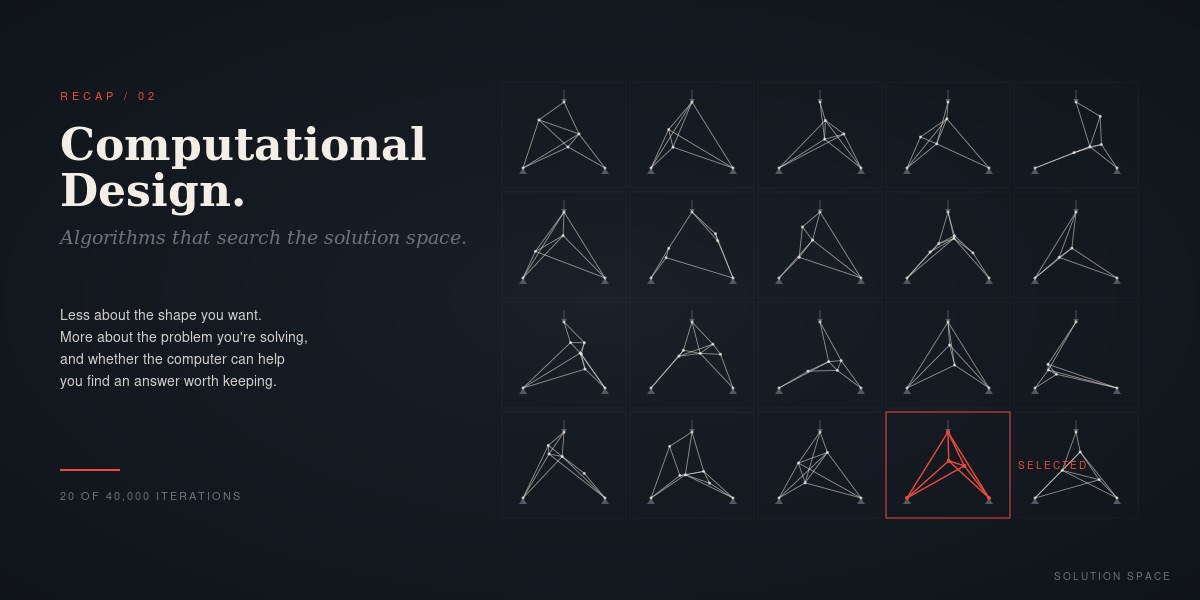
Computational design is less about "what shape do I want" and more about "what problem am I solving, and can the computer help me search the solution space?"
The shift in 2026 is that computational design has gotten cheaper and more accessible. Cloud compute prices keep falling. Real-time rendering and simulation in tools like Unreal Engine 5.5 and Twinmotion 2026 mean you can iterate on physics-based decisions in seconds instead of overnight. A small studio can now do what only Buro Happold or Arup could pull off five years ago.
Computational design is the point where engineering and architecture have started to actually merge, not just collaborate. The walls between disciplines are coming down because the math is shared.
Generative Design: The One That Got Weird
This is where 2026 really matters. Generative design used to mean something specific. You'd give the software a problem (hold this load, fit in this space, use this material), set your goals and constraints, and the system would generate dozens or hundreds of valid solutions. Often these looked organic, almost bone-like, because the algorithms were essentially mimicking how nature distributes material.
That version still exists. Autodesk Fusion's generative design module hasn't gone anywhere. It's matured, gotten faster, and integrated better with manufacturing. Companies like General Motors still use it for lightweight brackets. SpaceX has a whole library of generatively designed parts in their Starship program.
But the term "generative design" got hijacked. By 2024, it meant something else entirely to most people, especially those outside engineering. It meant AI-generated stuff. Midjourney concept renders. ChatGPT is writing your design brief. Stable Diffusion mood boards. NeRF and Gaussian splatting captures of physical environments are turned into editable 3D.
| Dimension | Parametric | Computational | Generative |
| What it actually is | A system of rules where the design adapts when you change the inputs. | Algorithms that search a defined solution space to find good answers to a stated problem. | The system proposes options based on goals, constraints, or natural-language intent. |
| Who's driving | The designer. The author of the rules. | The designer frames the problem. The algorithm does the searching. | The system proposes. The designer curates. |
| What goes in | Parameters, data feeds, geometric constraints. | Objective functions, performance simulations, constraints. | Prompts, references, goals, fitness criteria. |
| What comes out | One design that flexes with its inputs. | Many evaluated variants, ranked by performance. | Many novel options, often more visual than buildable. |
| Same input, same answer? | Yes, every time. | Mostly. Stochastic methods are the exception. | No. Especially with AI in the loop. |
| When to reach for it | Facade systems, modular layouts, anything that has to flex with site or program data. | Structural optimisation, energy modelling, daylight, acoustics, routing. | Early ideation, breaking out of a creative rut, exploring formal language. |
| Tools worth knowing in 2026 | Grasshopper, Rhino 9, Revit Dynamo, ArchiCAD Param-O. | Karamba, Ladybug, Galapagos, custom Python in Rhino, Autodesk Forma's solver layer. | Autodesk Forma's natural-language module, Fusion 360 generative design, Vizcom 4, Veras AI, Midjourney, Stable Diffusion, and Autograph for Grasshopper. |
| Seen in the wild this year | Heatherwick Studio's Tirana waterfront facade responds to live wind data. | KPF's Manila tower runs through 40,000+ structural variations. | Sou Fujimoto's Venice Biennale exhibit; Adidas 4DFWD Pulse, grown from 200,000 runners' pressure data. |
| What it asks of you | Logical thinking. Comfort with visual scripting. | Math literacy, simulation fluency, and sharp problem framing. | Taste. Prompt craft. The ability to judge what's worth keeping. |
| Where it goes wrong | Designers mistake parametric flexibility for actual design intent. The rules can be elegant, and the building still bad. | Garbage objectives produce garbage optima. The output is only as honest as the question. | Outputs can be stunning and structurally nonsensical. Always run them through computational and parametric tools before you trust them. |
| Where does it live in your project | Mid- to late-phase, after the design intent is set. | Mid phase, when problems need solving, and trade-offs need to be evaluated. | Early phase for ideation. Creeping into all phases as the tooling matures. |
In 2026, both meanings coexist, and they're starting to merge.
The big shift this year is that the optimisation-driven generative design (the old kind) is getting better at understanding intent through natural language. Autodesk Forma's new release lets you type "minimise cooling load, maximise daylight, keep floor plate efficient" and the system understands the trade-offs. You don't need to manually weight your goals anymore. The LLM layer translates your wishes into something the optimiser can chew on.
Meanwhile, the AI image generation side has gotten much better at producing things you can actually build. Last year, anything coming out of Midjourney was visually stunning and structurally insane. The columns floated. The geometry didn't close. The materials were vibes. This year, with Vizcom 4 and the Rhino plugin for Veras AI, you can generate concepts that are at least dimensionally honest. Several firms I've talked to use these as ideation tools, then port the results into Grasshopper for refinement.
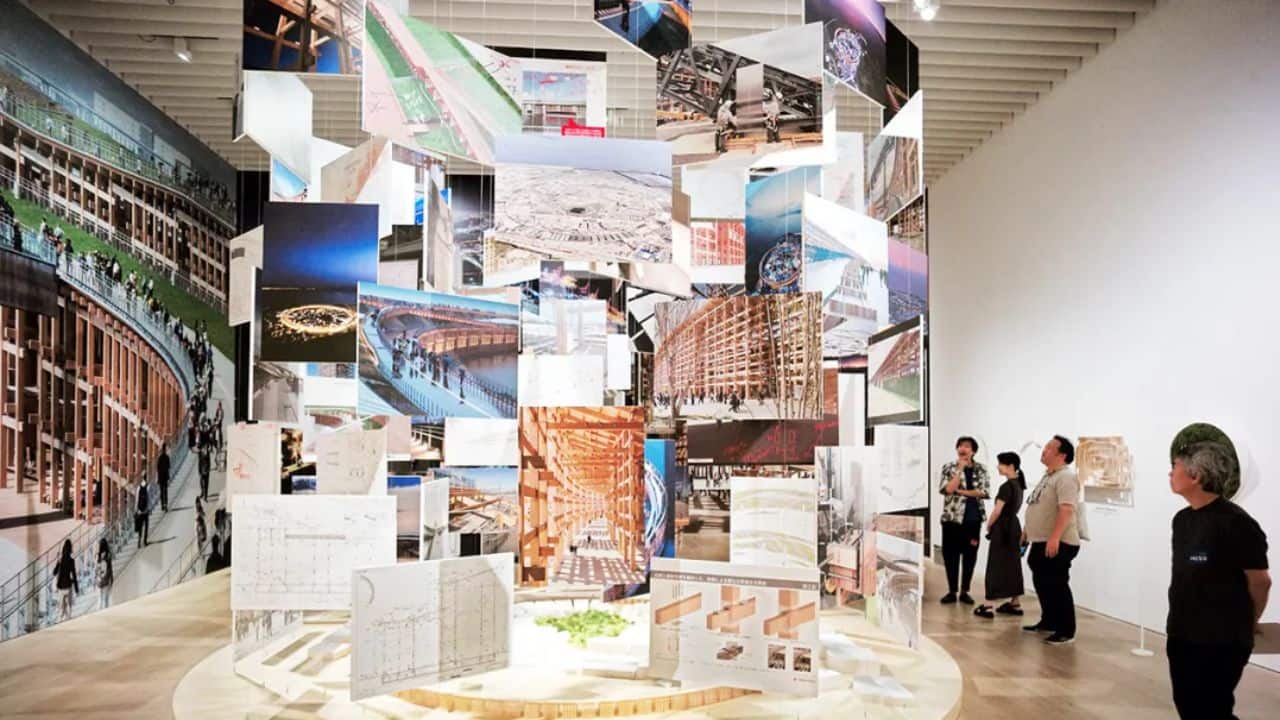
The Sou Fujimoto exhibit at the Venice Biennale this spring was largely produced through this hybrid pipeline. He's been pretty open about it. The forms came from an AI process. The structural feasibility came from computational tools. The construction documents came from parametric models. All three things, working together, in one project.
Outside architecture, it's the same story with different vocabulary. Adidas dropped a midsole this March, the 4DFWD Pulse, that was generated through a lattice optimiser running on shoe-pressure data from over 200,000 runners. The shape isn't designed in any traditional sense. It's grown from data. Compare that to a furniture brand like Vitra, which still uses parametric tools to adapt classic forms for new manufacturing methods, and you can see how the three approaches play different roles depending on what the project actually needs.
That's where 2026 is.
So What's Actually Different This Year?
A few things, mainly.
AI-native interfaces. The boundary between "type what you want" and "build the rules yourself" has dissolved. Most major tools now have a chat interface or a natural language layer. You can describe an outcome and let the software propose the rule system, then edit it.
Real-time multi-objective optimisation is mostly around running optimisations overnight on a server. Now you can iterate live, in your viewport, on a laptop. This changes the design conversation. You can sit with a client and explore trade-offs in front of them.
Embedded carbon and lifecycle thinking have also become a part of reinventing designs. Tools like One Click LCA and EC3 are now plugged directly into design workflows. When you generate a structural option, you immediately see the embodied carbon next to it. The 2026 RIBA sustainability mandate basically requires this in the UK now.
The manufacturing loop is closing. Generative design is used to produce shapes that are beautiful but expensive to fabricate. Now the optimisers are aware of the manufacturing method from the start. If you're CNC milling, the geometry respects tool access. If you're 3D printing, it accounts for support structures. If you're using robotic timber framing, it stays within the kinematic envelope of the robot.
And the most controversial bit. AI agents are starting to do the boring parts. There's a startup called Autograph (out of Cambridge, UK) that launched a Grasshopper agent this spring. You describe what you want the script to do, and it builds the definition. It's not perfect, but it's the kind of tool that would have seemed impossible two years ago.
A Practical Way to Think About It
If you're trying to decide which approach fits your project, here's how I'd frame it.
Use parametric design when you know roughly what you want and you want to control how it adapts. The shape of the building is decided. Now you need the panels to flex with the climate data. That's parametric.
Use computational design when you have a problem to solve and you need to search through possibilities. Structural optimization, energy modeling, anything with a clear objective function. Computational tools are your friend.
Use generative design (in the AI sense) when you're early in the process and need to explode the possibility space. You don't know what you want yet. You need stimulation. You need 200 ideas you didn't have before breakfast.
Most real projects in 2026 use all three. The early phase is generative. The mid-phase is computational. The late phase is parametric. They feed into each other.
What This Means for Designers
The old fear was that AI would replace designers. That fear is already feeling dated.
What's actually happening is that the role is changing. The designer becomes more of a curator, a director, a critic. You're not pushing pixels around. You're asking better questions, evaluating more options, and making clearer judgment calls.
The skills that matter now are taste, problem framing, and the ability to communicate intent precisely. The ability to draft is becoming less valuable. The ability to know what's worth drafting is becoming more valuable.
Some of the people I respect most in the field have made the same observation. Patrik Schumacher said something at the Architecture Foundation event in March that stuck with me. He said the bottleneck used to be production. Now it's discrimination. Knowing what's good. Knowing what to keep.
If you're a student or early-career designer in 2026, that's the skill to develop. Not the software. The judgment.
Conclusion
There's a lot of hype right now. A lot of people are selling courses that promise you can become an AI-augmented designer in six weekends. Most of it is nonsense. The tools are real, but the skill of using them well is still the same kind of slow craft it always was.
Parametric, computational, and generative design are not magic. They're leveraging. They make a good designer faster and more ambitious. They make a bad designer faster at producing bad work.
The most useful thing you can do in 2026 is probably not learn another plugin. It's go look at buildings. Make models with your hands. Read books. Develop the eye that the AI is going to lean on for direction.
Because here's the kicker. The computer can generate a thousand options. It still can't tell you which one is beautiful.
That part is still us.
But, if this has intrigued you enough, you can learn more here…
FAQs
Q1: What's the simplest way to tell parametric, computational, and generative design apart?
Parametric is rules-driven, computational is problem-driven, generative is idea-driven.
Q2: Is parametric design the same as computational design?
No. Parametric design sits inside computational design. All parametric work is computational, but not the other way around.
Q3: Which one should I learn first in 2026?
Start with parametric. Grasshopper is still the gateway, and everything else gets easier once you can build rule systems.
Q4: Will AI replace architects and designers?
No, but the job is shifting from production to judgment. The work is now about curation, framing, and knowing what to keep.
Q5: Can I use all three approaches in one project?
Yes, and most serious 2026 projects do. Generative for early ideation, computational for problem-solving, parametric for refinement.
Q6: Is Grasshopper still worth learning?
Yes. Even with AI scripting tools like Autograph, reading and editing a Grasshopper definition is still the most useful skill in computational architecture.
Q7: What's the difference between Autodesk's generative design and Midjourney-style generative AI?
Autodesk-style optimises for engineering goals and gives you buildable output. Midjourney-style optimises for visual plausibility, which often isn't buildable.
Q8: Is computational design only for big firms like Arup or Buro Happold?
Not anymore. Cloud compute is cheap enough that small studios can now run analysis that used to need a six-figure software stack.
Q9: Do I need to know how to code to use any of this?
Less than before. Most tools have natural-language layers now, but basic Python helps when the AI gets it wrong.
Q10: What skills matter most for designers in 2026?
Taste, problem framing, and the ability to communicate intent. Drafting is losing value. Judgment is gaining it.



.png)