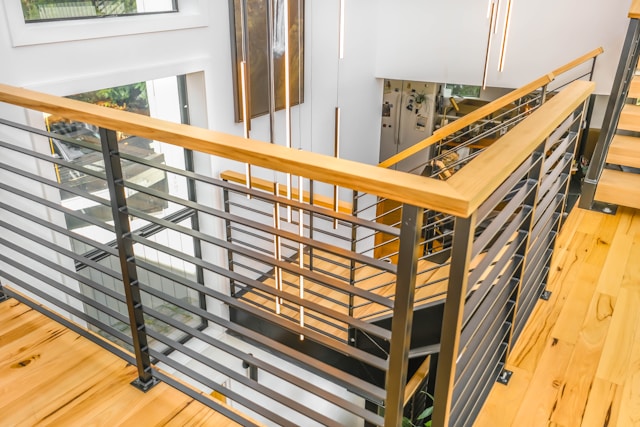
Railing Installation Process:
In architectural practice, stainless steel railings are widely used due to their durability, clean appearance, and adaptability across residential and commercial projects. When installed on an RCC staircase, the process must be carefully coordinated with structural work, finishing layers, and final aesthetics.
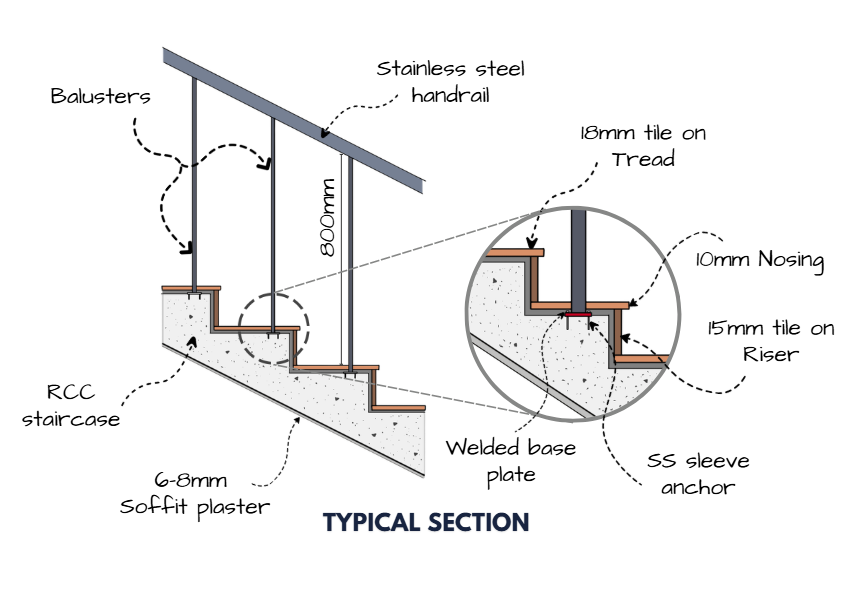
The installation typically begins after the RCC staircase slab and steps are cast and cured. At this stage, the structural integrity of the staircase is established, but finishes such as tiling or stone cladding are yet to be applied. Railing posts (balusters) are usually fixed either top-mounted on the tread or side-mounted to the waist slab, depending on design intent and space constraints. For top-mounted railings, anchor bolts or threaded rods are drilled into the concrete, ensuring sufficient embedment depth for load transfer and safety. In side-mounted installations, base plates are fixed into the concrete edge, allowing the walking width of the staircase to remain unobstructed.
Once the railing posts are aligned and temporarily secured, levels, plumb, and handrail height are carefully checked as per local building codes. Only after this verification are the posts permanently tightened and welded or mechanically fixed. At this stage, coordination with flooring is crucial. Stair treads are then finished with tile, stone, or wood, with precise cut-outs around railing posts. These junctions are concealed using rosettes, collars, or flush cover plates, ensuring that no bolts or rough edges remain visible. This step is essential for achieving a clean architectural finish.
The handrail is installed last, typically as a continuous stainless steel tube or profile. Joints are either factory-polished welds or concealed mechanical connections, giving the impression of a seamless element. Final finishing includes polishing, brushing, or matte treatment depending on the design language, followed by cleaning and protection until handover. When executed correctly, the railing appears as an integrated architectural component rather than an added-on safety feature.
Railing design and fixing methods vary based on material, usage intensity, and safety requirements. Read further to explore various types -
Types of Railings in Architecture
1. Stainless Steel Railings
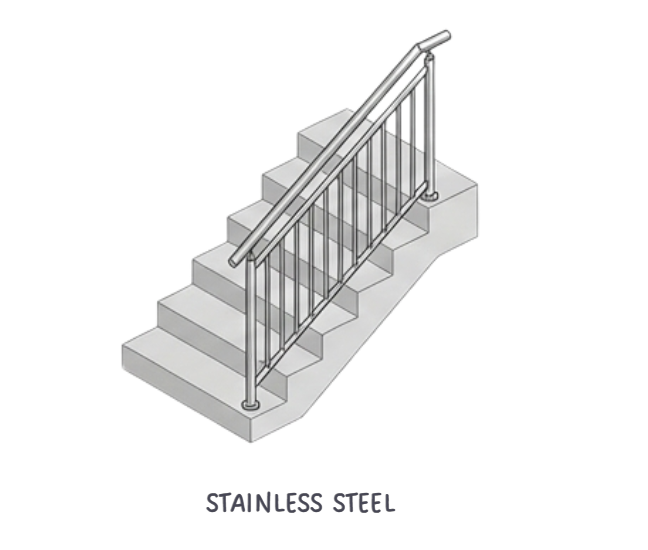
Stainless steel railings are among the most versatile options in contemporary architecture. Their clean lines and neutral appearance make them suitable for both residential and commercial applications, including staircases, balconies, hospitals, and public buildings. Architecturally, they support minimal and modern design languages, often paired with glass or cable infill for visual lightness. Stainless steel performs well in high-traffic areas due to its resistance to corrosion, impact, and wear, especially when grades like SS 304 or SS 316 are used. Maintenance is relatively low, requiring periodic cleaning to retain surface finish. However, fingerprints and scratches may be more visible in polished finishes, making brushed or matte textures preferable in heavy-use spaces.
2. Wooden Railings
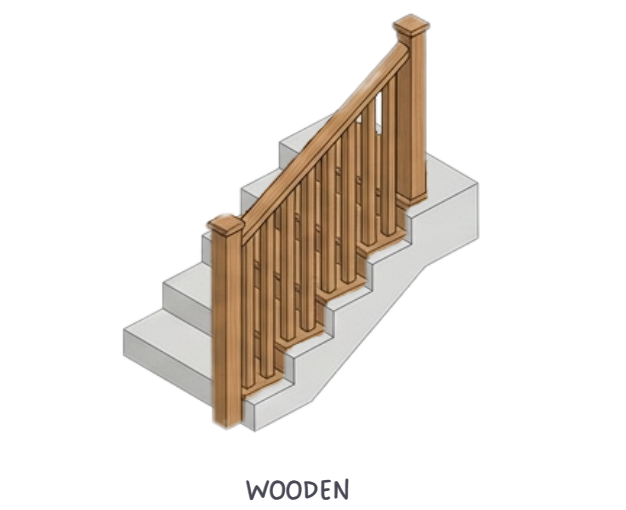
Wooden railings introduce warmth, tactility, and a human scale to interiors, making them particularly popular in residential staircases, heritage projects, and boutique hospitality spaces. From an architectural standpoint, wood works well in inward-looking homes, traditional layouts, and spaces where material richness is prioritized over minimalism. Structurally, wooden railings are often combined with metal subframes to improve strength and longevity. While visually appealing, wood requires regular maintenance such as polishing or sealing to protect it from moisture, termites, and wear. As a result, wooden railings are better suited for low to moderate traffic areas and controlled indoor environments rather than exposed or commercial settings.
3. Glass Railings
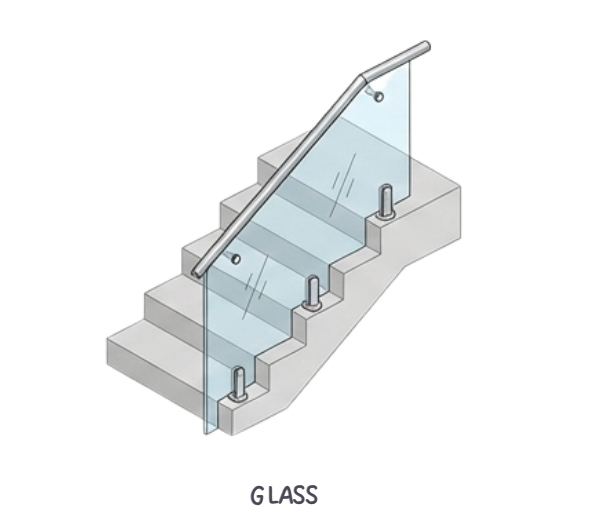
Glass railings are frequently used when visual continuity, openness, and light transmission are key design goals. Commonly seen in luxury residences, malls, offices, and terraces, they allow staircases and balconies to feel lighter and less intrusive. Architecturally, glass railings help maintain uninterrupted sightlines, making them ideal for compact spaces or areas overlooking landscapes. Toughened or laminated safety glass is used to meet structural and safety requirements, often supported by stainless steel or aluminum channels. While glass railings are durable, they demand regular cleaning to manage dust, smudges, and water marks. Their performance depends heavily on correct detailing, especially at base channels and edge supports.
4. Cable Wire Railings
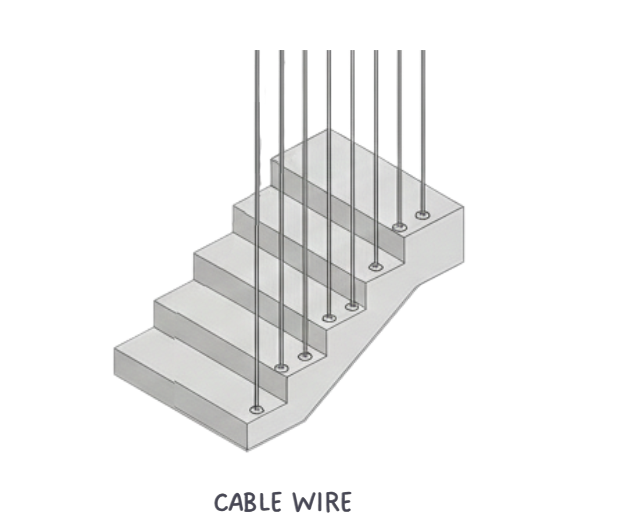
Cable wire railings are a contemporary option that emphasizes horizontality and visual permeability. They are often used in modern residences, staircases with long spans, terraces, and outdoor decks. Architecturally, cable railings suit minimalist and industrial aesthetics, allowing views to pass through while still maintaining safety. Stainless steel cables are tensioned between posts, requiring precise installation to avoid sagging over time. While they are durable and weather-resistant, cable railings may not be ideal in households with small children due to climbability concerns. Maintenance involves periodic tension checks and cleaning, but overall upkeep remains moderate.
Each railing type addresses a specific combination of safety, use, and aesthetics.
Conclusion:
Railings play a far more significant role in architecture than merely acting as safety barriers. Their installation detailing determines longevity, safety, and visual clarity, while the choice of railing type influences how a space feels and functions over time. Whether it is the precision of a stainless steel railing on an RCC staircase, the warmth of wood, the transparency of glass, or the lightness of cable systems, each option carries distinct architectural implications. Thoughtful selection and execution ensure that railings seamlessly integrate into the design narrative, enhancing both user experience and spatial quality.
FAQs:
1. What is the safest way to fix railings to an RCC staircase?
Core cutting or embedded base plates provide strong and concealed anchorage.
2. How are railing joints hidden in finished flooring?
Fixings are concealed within tiles or stone with neatly finished sleeves and grout.
3. Which railing type is best for heavy public use?
Stainless steel railings are preferred for their strength and low maintenance.
4. Are glass railings structurally safe?
Yes, when toughened or laminated glass is used with proper fixing systems.
5. When are cable wire railings recommended?
They suit areas needing openness, visibility, and light visual impact.